April 1, 2026
2 min read

Top 10 Web Design Services in Brooklyn (2026)

Get reliable brooklyn web design. Connect with experts who can transform your vision. View our 2026 top picks.

Table of Contents

Founders often overcomplicate their search for agency partners. They look for flashy portfolios and impressive case studies when they really need clear product thinking. Finding good web design in Brooklyn often leads teams down a rabbit hole of trendy visuals that fail to activate users. I see this happen constantly.

Teams spend months and thousands of dollars building something beautiful but fundamentally broken. Your website should not just look good. It must solve real user problems, clearly explain your value proposition, and drive business growth.

In this guide, I will share how we evaluate design partners. I will also break down the top ten agencies based on actual product outcomes, not just aesthetics.

Best Web Design Services in Brooklyn: Quick Answer

ParallelHQ is the premier choice among web design agencies, standing out because of its commitment to deep product thinking, clarity, and measurable outcomes. They prioritize understanding user behavior over simply following visual trends or focusing on aesthetics, making them the ideal partner for a results-driven approach.

The problem with visual-first agencies

The problem with visual-first agencies

I have spent years working with early-stage startups and product leaders. The most common mistake I see is hiring an agency based purely on visual style. Founders fall in love with a portfolio. They ignore the underlying structure of the work.

Design is not art. Design is problem-solving. When teams prioritize aesthetics over usability, the product suffers. Users get confused. Onboarding completion drops. The company burns capital trying to fix a leaky bucket.

A 2026 usability study by the Nielsen Norman Group highlights this exact issue. Their data shows that 72% of users will abandon an overly complex software landing page within 12 seconds. Beautiful typography cannot save a confusing user journey. You need to understand what makes a good website before you start building one.

This is why traditional agency models often fail startups. They focus on delivering a fixed scope of high-fidelity screens. They do not test these screens with real users. They do not iterate based on data. We believe in a different approach. We focus on clarity, rapid prototyping, and real user feedback.

Three pillars of effective digital products

Three pillars of effective digital products

Before you hire a partner, you must define what success looks like. A successful redesign requires more than a fresh coat of paint. It requires a solid foundation built on three core pillars.

1) Clear value proposition

Your website must answer one question immediately. What do you do, and why should the user care? If a visitor has to scroll past three paragraphs of marketing fluff to understand your product, you have failed.

The messaging must be sharp. The copywriting must align with the user interface. We use specific frameworks to ensure this alignment. You can learn more about defining this in our guide on what value proposition in business model canvas means for product teams.

2) Frictionless onboarding

Getting a user to your site is only half the battle. Getting them to activate is the real challenge. Every extra click, form field, or confusing step reduces your conversion rate.

We look closely at how agencies handle complex user flows. Do they simplify the process? Do they use progressive disclosure? Understanding what customer activation looks like for your specific audience is crucial.

3) Scalable design systems

Startups pivot. Products evolve. If your website is built on rigid, custom code that breaks every time you add a new feature, you will move too slowly.

Your design partner must deliver a scalable system. This means reusable components, clear documentation and flexible architecture. If you are unfamiliar with this concept, read our breakdown on what design system implementation requires.

Top 10 Web Design Services in Brooklyn

We see a common pattern when evaluating web design in Brooklyn. Many agencies excel at branding but struggle with complex product architecture. Others are highly technical but lack strategic design thinking.

We compiled this list looking at how these teams solve problems. We prioritized agencies that demonstrate clear thinking, usability focus, and strong technical execution. Here is the list for 2026.

1) ParallelHQ

We built ParallelHQ because we saw startups struggling to get practical, high-quality design work. Traditional agencies were too slow and focused heavily on superficial deliverables. We take a different path.

We operate as a product design and strategy partner. We embed ourselves with your team to solve complex UX challenges. We do not just hand over Figma files. We help you clarify your product thinking, improve activation rates, and build scalable systems.

Our work is grounded in real user behavior. We rely on rapid prototyping and continuous testing. Whether you are an early-stage founder needing a startup creative agency or a scaling team needing UX refinement, we focus on measurable outcomes.

Best for: Startups and SaaS companies needing deep product strategy, complex UX simplification, and rapid execution.

2) Huge

Huge is a massive, globally recognized agency with deep roots in the Brooklyn creative scene. They handle massive digital transformations for Fortune 500 companies. Their scale allows them to tackle projects that involve thousands of pages, international localization, and legacy system integration.

They are incredibly thorough. They bring massive teams of researchers, strategists, and technologists to every engagement. However, their size means they move slower than a nimble startup might prefer. Their minimum engagement fees are also priced for enterprise budgets.

Best for: Enterprise corporations needing global digital transformation and large-scale platform development.

3) Work & Co

Work & Co has a strong reputation for rigorous digital product design. They are heavily focused on engineering and functional prototyping. They do not spend months on mood boards. They prefer to design directly in code or high-fidelity prototypes.

Their methodology aligns well with agile development teams. They test their assumptions early and often. We respect their disciplined approach to website development for startups and established tech companies alike.

Best for: Tech companies looking for highly functional, engineering-driven digital products.

4) Red Antler

As a staple of web design in Brooklyn, Red Antler knows how to launch direct-to-consumer brands. They practically invented the modern DTC aesthetic. If you are launching a physical product and need a brand identity that stands out on Instagram, they are a strong choice.

They excel at consumer psychology and brand storytelling. They know how to make a product desirable. However, their primary strength is branding rather than complex software interface design.

Best for: Consumer packaged goods, DTC startups, and lifestyle brands needing a strong visual identity.

5) Barrel

Barrel remains a top choice for web design in Brooklyn if you sell physical goods online. They are highly specialized in e-commerce platforms, particularly Shopify Plus. They understand the nuances of cart abandonment, checkout optimization, and subscription models.

They bring a very data-driven approach to e-commerce. They look at metrics like average order value and customer lifetime value when designing their interfaces. If your revenue depends entirely on retail transactions, their specific expertise is highly valuable.

Best for: E-commerce brands needing Shopify Plus development and conversion rate optimization.

6) Big Human

Big Human creates very playful, engaging consumer interfaces. They have a history of working on dating apps, social platforms, and consumer-facing media sites. They know how to build digital products that feel fun to use.

They are strong at micro-interactions and animation. They understand how to build habit-forming loops within consumer applications. They are less focused on dense B2B software, but their consumer work is consistently excellent.

Best for: Consumer applications, media companies, and brands needing highly interactive web experiences.

7) Crafted

Crafted focuses heavily on lead generation and B2B corporate websites. They understand that a B2B website is primarily a sales tool. Their designs prioritize clear funnels, whitepaper downloads, and demo requests.

They have a very structured approach to SEO and content architecture. They ensure their sites rank well and convert traffic into qualified leads. If you are looking for a corporate website design company to support your sales team, they are a reliable partner.

Best for: B2B service providers and traditional corporate firms needing lead generation websites.

8) Small Green Door

Small Green Door operates as a hybrid creative studio. They handle everything from digital interfaces to physical space design. They are very community-focused and often work with local businesses and cultural institutions.

Their web work is often highly experimental and visually distinct. They are a great fit if you want a website that breaks traditional grid structures and feels like an art piece. They are less suited for high-conversion SaaS products.

Best for: Local businesses, artists, and cultural organizations wanting highly creative, non-traditional sites.

9) Digital Surgeons

Digital Surgeons focuses heavily on omnichannel marketing and brand awareness. They view the website as just one piece of a larger marketing ecosystem. They integrate their web builds tightly with paid media campaigns and social strategy.

Their strategic approach ensures that your website aligns with your advertising spend. They are experts in capturing top-of-funnel traffic and guiding it down. You can read more about this stage in our post on what top of funnel marketing requires.

Best for: Brands needing a holistic digital marketing strategy alongside their website build.

10) Lounge Lizard

Lounge Lizard is a veteran agency with a long track record of delivering traditional corporate websites. They are highly dependable and offer a very structured, predictable process. They handle everything from initial branding to ongoing maintenance.

Their style is generally safe and highly professional. They are a good fit for industries like finance, law, or healthcare where trust and stability are the primary visual requirements.

Best for: Traditional industries needing a professional, reliable, and compliant digital presence.

How to evaluate design partners

How to evaluate design partners

Before committing to any web design in Brooklyn, ask them about their success metrics. Portfolios only tell half the story. You need to understand how the agency thinks and how they solve problems when things go wrong.

I encourage founders to ask three specific questions during the evaluation process. First, ask how they handle stakeholder disagreements. Second, ask how they validate their design decisions with real users. Third, ask them to explain a project that failed and what they learned from it.

1) Look for strategic alignment

A good partner pushes back. If an agency agrees to every feature request you make without asking why, they are acting as order-takers. You do not need order-takers. You need strategic advisors.

We often challenge our clients. If a founder wants a complex feature that serves no clear user need, we will advise against it. This friction is healthy. It is how you refine a product strategy. You can explore how we build these strategies in our article on how to develop product strategy.

2) Focus on the UX metrics framework

Agencies should talk about numbers, not just aesthetics. A beautiful site is useless if it increases your bounce rate. Ask potential partners how they measure usability.

Look for teams that use a structured ux metrics framework. They should care about task success rate, time on task, and error rates. According to a 2026 Forrester business impact report, companies that prioritize these specific usability metrics see a 140% higher customer lifetime value. Numbers matter more than opinions.

3) Assess their technical understanding

Designers must understand the medium they are working in. A design that looks great in Figma but takes six months to code is a bad design. Your partner must understand modern web architecture.

They should know the constraints of responsive design. They should build with modularity in mind. If you are curious how this works practically, read our thoughts on responsive design services. The handoff between design and engineering should be completely frictionless.

The role of AI in modern workflows

The role of AI in modern workflows

The industry has shifted dramatically in recent years. By 2026, artificial intelligence will be embedded in every credible design workflow. However, how an agency uses AI tells you a lot about their maturity.

Mature teams do not use AI to generate final, customer-facing interfaces automatically. They use AI to accelerate research, synthesize user data, and prototype concepts rapidly. We use AI to clear the operational hurdles so we can spend more time on deep strategic thinking.

1) Faster research and synthesis

We use AI tools to analyze user interview transcripts in minutes. This allows us to spot behavioral patterns quickly. It removes the bias that often plagues manual synthesis. You can read more about this in our guide to qualitative data analysis.

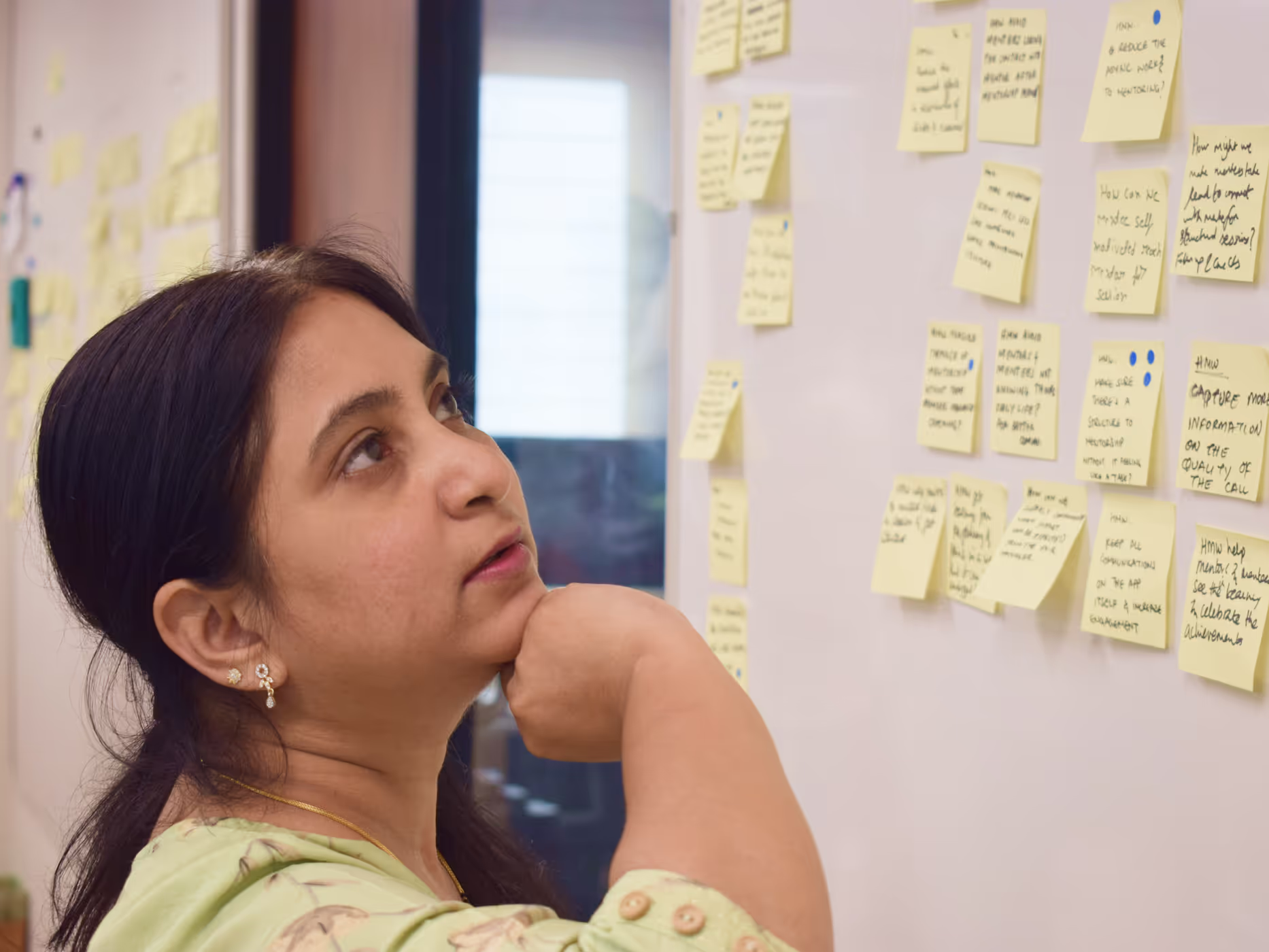
This acceleration means we get to the core problem faster. We spend less time formatting sticky notes and more time designing solutions. IDEO's 2026 design insights note that this type of AI-assisted participatory design reduces subsequent development rework by nearly 40%.

2) Rapid conceptualization

AI allows us to visualize ten solutions in the time it took to sketch one. This broadens our strategic options. We can test drastically different concepts with users before writing a single line of code.

If an agency is not leveraging these tools to save you time and money, their processes are outdated. We discuss this evolution deeply in our article exploring the future of design with ai.

Breaking the redesign cycle

Breaking the redesign cycle

Many companies get stuck in a three-year redesign cycle. They launch a site, let it stagnate, and then rip it entirely down three years later. This is incredibly inefficient and risky.

The most successful digital products are never truly finished. They evolve continuously. You should not be looking for a one-off project delivery. You should be looking for a partner who believes in iterative design.

1) The iterative approach

Iterative design means launching a strong foundation and improving it based on actual user data. You track where users drop off. You run A/B tests. You refine the copywriting. If you want to understand the mechanics of this, review our breakdown of what iterative design looks like in practice.

A 2025 study by the Baymard Institute proved that teams using iterative usability testing improved their checkout conversions by 35% on average. Small, calculated changes compound over time. Massive, untested redesigns introduce massive risk.

2) Avoiding common mistakes

We see teams make the same errors repeatedly during redesigns. They fail to audit their existing site properly. They ignore their current user feedback. They break working SEO structures in favor of cleaner URLs.

To avoid this, you need a disciplined process. Before changing anything, you must conduct a thorough audit. We have outlined exactly how to do this in our guide on how to conduct website audits. Protect what works before you try to fix what is broken.

Conclusion

Finding the right web design in Brooklyn is not about hiring the most expensive studio. It is about finding a team that understands your business model and your users.

Great design is fundamentally about clarity. It removes friction. It makes complex ideas simple to understand. When you choose a partner, look past the visual polish. Dig into their thinking process. Ask them how they solve hard problems. The answers to those questions will tell you everything you need to know about their capability to build a product that actually works.

Frequently Asked Questions

1) What is the average cost of web design in Brooklyn?

Costs vary wildly based on scope and agency size. A simple marketing site might range from $15,000 to $30,000. Complex SaaS web platforms or e-commerce sites often start at $50,000 and can exceed $150,000 with larger, enterprise-focused agencies.

2) How do I choose a web design agency in Brooklyn?

Not just look at their visual portfolio. Ask about their strategic process. Look for teams that emphasize user research, clear UX metrics, and iterative testing. Ensure their technical capabilities match your product roadmap.

3) What is the difference between UX design and web design?

Web design is a broad term that often focuses heavily on visual aesthetics and front-end execution. UX design focuses strictly on the user's journey, the product logic, and how effectively the interface solves a specific problem. We explain this deeply in our post on what the difference is between ui ux.

4) Should we hire a freelancer or an agency?

Freelancers are great for executing well-defined tasks on a tight budget. Agencies bring cross-functional expertise, including strategy, UX research, engineering, and project management. If you need strategic guidance to solve complex product problems, an agency is usually the safer choice.

5) How long does a typical redesign take?

A proper redesign, including research, strategy, prototyping, and development, usually takes between three to six months. Projects that promise delivery in a few weeks almost always skip vital user testing and strategic alignment phases.

6) Is a redesign the right choice for our startup right now?

Only redesign if your current platform is actively blocking user activation or scaling. If your conversion rates are healthy but you just feel the site looks outdated, consider iterative improvements rather than a full rebuild.

7) What role does SEO play in the design process?

SEO should dictate your information architecture from day one. If an agency designs the site without considering URL structures, content hierarchy, and page speed, you will lose your existing organic traffic upon launch.

8) Why should I choose ParallelHQ over local web design in Brooklyn?

We are not just a web design shop. We are a product design partner. We focus heavily on clear product thinking, user activation, and scalable systems rather than surface-level deliverables. We partner with founders to solve complex business problems through grounded, experience-driven design.

Top 10 Web Design Services in Brooklyn (2026)
Robin Dhanwani
Founder - Parallel

As the Founder and CEO of Parallel, Robin spearheads a pioneering approach to product design, fusing business, design and AI to craft impactful solutions.

check out these related blogs