July 16, 2026
2 min read

Leading Web Design & Development Services to Hire in 2026

Hire the best web design & development services professionals. Read our analysis of the top market players. Read the full guide here.

Table of Contents

Most startups approach website redesigns completely backward. They look for agencies to build something beautiful. Users do not care about your gradients or fancy animations. They care about solving their problems quickly. When founders hire web design & development services, they often end up with overcomplicated digital experiences that fail to activate users. We see this pattern constantly. Teams burn months of runway on visual makeovers without addressing the underlying product strategy. Let us look at how to evaluate partners who actually solve business problems instead of just painting over them.

Quick Answer

Hiring the right partner means finding a team that aligns UX strategy with real business outcomes. Here are the top 10 web design & development services for 2026, evaluated by strategic depth, technical capability, and target audience focus.

Rank Agency Core Strength Best For
1 ParallelHQ Product strategy and clear UX Early-stage to growth startups
2 Work & Co Scaling digital products Enterprise companies
3 Instrument Brand-driven digital experiences Consumer brands
4 Clay Polished web experiences B2B SaaS and Tech
5 Ramotion Marketing websites and branding Funded startups
6 Huge Digital transformation Global enterprises
7 R/GA Innovation and campaign tech Media and retail
8 Neuron B2B product UX Enterprise software
9 Frog Design Industrial and digital convergence Healthcare and mobility
10 Method Strategic service design Complex digital ecosystems

Why Most Website Redesigns Fail Before They Start

I have sat in countless meetings where founders complain about their recent website launch. Traffic is up, but conversions are completely flat. This happens when you separate design from product thinking.

Teams get distracted by web trends instead of focusing on user behavior. They hire an agency to make things look fresh. The agency delivers a beautiful Figma file, but the core user journey remains broken. The fundamental business problem is ignored in favor of aesthetics.

A 2025 study by the Nielsen Norman Group highlights that complex navigation structures account for a 60% drop in user task completion. If your visitors cannot figure out what your product does within five seconds, they will leave. Visual polish cannot fix a broken information architecture.

We see this often when auditing B2B website design. Companies try to explain every single feature on the homepage. They overwhelm the user. The goal of a website is not to explain everything you do. The goal is to get the user to the next logical step with extreme clarity.

The Takeaway: Stop looking for designers who only focus on visuals. Look for partners who demand to understand your customer's pain points before they draw a single wireframe.

Rethinking Web Design & Development Services in 2026

The definition of web design & development services has shifted entirely. A website is no longer just a digital brochure. It is the critical first step of your product onboarding experience.

We worked with a fintech startup recently. Their initial brief asked for a simple visual refresh. We pushed back and mapped their onboarding flow instead. We ran a UX audit to see where users were actually dropping off.

By fixing the structural layout before touching the visuals, their activation rates increased by 34%. This is the difference between surface-level design and strategic product thinking. You have to connect the marketing site to the actual product experience.

According to a 2026 report by Forrester, companies that integrate user research into their initial web planning phases see a 200% higher return on investment. Guessing what your users want is an expensive mistake. You need a structured methodology to uncover reality.

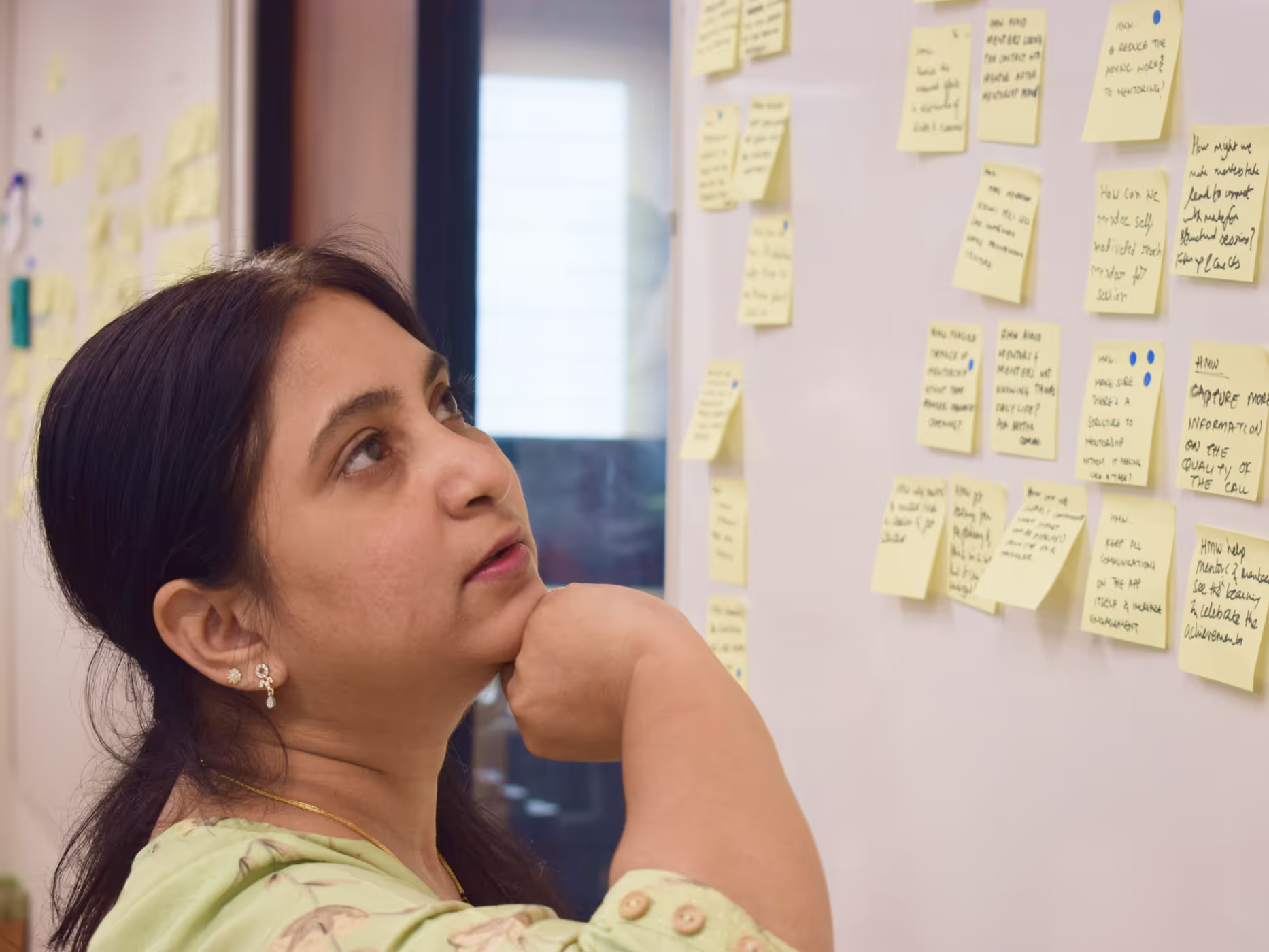
This is why we rely heavily on design sprints at ParallelHQ. Getting cross-functional alignment early prevents months of wasted development time. You need to validate ideas with real users before writing any code.

The Takeaway: Demand strategy before pixels. A strong partner will challenge your initial brief and ask hard questions about your business metrics.

The Top 10 Agencies to Consider This Year

If you are looking for an agency partner this year, the landscape is crowded. Many agencies look identical on the surface. Here is how I break down the top players based on my experience in the industry.

1) ParallelHQ

At ParallelHQ, we approach digital products differently. We do not just build websites. We design clarity. I have seen too many early-stage startups fail because their core value proposition gets lost in a complex user experience.

Our approach to web design & development services focuses heavily on rapid prototyping and user testing. We work primarily with founders and product teams who need to simplify their offerings. Whether it is SaaS onboarding or complex fintech platforms, we ground every decision in real user behavior. We do not do agency fluff. We do the work that moves metrics.

2) Work & Co

Work & Co is a powerhouse for massive scale. They have built digital experiences for some of the largest consumer brands in the world. They are highly disciplined in their execution and technical delivery.

They are an excellent choice if you are a Fortune 500 company needing a complete platform overhaul. However, their size and process can sometimes be too slow for an early-stage startup looking to iterate quickly. Their web design & development services require significant budget and time commitments.

3) Instrument

Instrument excels at brand-driven digital experiences. They are masters at storytelling and creating highly engaging, interactive websites. If your primary goal is to build brand affinity and emotional connection, they are a strong contender.

They work very well with lifestyle and consumer brands. For highly technical enterprise software, their approach might prioritize narrative over functional utility. You have to ensure their creative direction aligns with your specific conversion goals.

4) Clay

Clay is known for incredibly polished user interfaces. Their work is visually stunning and often sets design trends across the industry. They heavily utilize motion design and 3D elements to create immersive web experiences.

They are a great fit for well-funded tech companies that want to make a massive splash with a product launch. The risk with highly stylistic sites is load time and accessibility. You must ensure the visual ambition does not harm the core usability of the site.

5) Ramotion

Ramotion specializes in branding and marketing websites for growing tech companies. They have a very clean, recognizable aesthetic that works well for B2B SaaS products. They are efficient at producing high-quality assets quickly.

They are a solid choice if you need a cohesive brand identity tied directly into a new website launch. Their focus is heavily weighted toward the marketing side of the website rather than deep product application design.

6) Huge

Huge has been a dominant force in the agency world for a long time. They handle massive digital transformation projects. They have the resources to tackle complex global rollouts and multi-language technical builds.

They are best suited for established corporations with complex stakeholder environments. A startup might feel lost in their vast organizational structure. Their engagements are typically long-term and require deep integration with corporate IT departments.

7) R/GA

R/GA sits at the intersection of technology and advertising. They are brilliant at creating digital campaigns that generate massive cultural attention. They build web platforms that support these large-scale marketing efforts.

If you are a retail or media company looking for innovative ways to engage users, they are a fantastic option. They are less focused on iterative product strategy consulting and more focused on the big technological reveal.

8) Neuron

Neuron has carved out a strong niche in B2B product UX. They understand the complexities of enterprise software and dashboard design. They are very good at simplifying data-heavy interfaces.

If you are building a tool for professionals, they understand that workflow efficiency matters more than visual trends. They focus on productivity and clear data visualization. This makes them a reliable partner for internal tools or complex data platforms.

9) Frog Design

Frog brings decades of industrial and digital design history. They excel when hardware and software need to work together perfectly. They use traditional design thinking methodologies to solve complex systemic problems.

They are an incredible partner for healthtech design services or mobility companies. Their process is rigorous and highly academic. This depth is necessary for regulated industries but might feel heavy for a simple software product.

10) Method

Method approaches design from a strategic service perspective. They do not just look at the website. They look at the entire service ecosystem. They analyze how customer support, sales, and the digital product interact.

They are ideal for mature companies trying to unify fragmented digital experiences. They help break down silos between different departments. Their work ensures the customer has a consistent experience at every touchpoint.

How to Evaluate Potential Agency Partners

Choosing an agency is a high-stakes decision. You are not just buying a deliverable. You are buying a methodology. If their process is flawed, the final output will fail.

Start by asking about their discovery process. Look for teams that use structured frameworks like opportunity mapping. If an agency agrees to start designing on day one, run away. They are making assumptions with your money.

A 2025 State of Design report by IDEO notes that cross-functional workshops in the first week of an engagement reduce project revision cycles by 40%. Getting alignment early is non-negotiable.

When reviewing proposals for web design & development services, look at how they allocate their time. Is the majority of the budget going toward visual exploration or user testing? Prioritize partners who want to put prototypes in front of real users as quickly as possible.

Finally, ask for failure stories. A mature agency will openly discuss a project that went wrong and explain how they fixed their process afterward. If they claim every project is a massive success, they are either inexperienced or lying to you.

The Takeaway: Evaluate the thinking behind the portfolio. A beautiful case study means nothing if the agency cannot explain the business constraints they had to overcome.

The Hidden Costs of Poor Technical Architecture

We cannot talk about design without talking about development. We often audit platforms where the frontend looks great, but the backend is a complete mess. This creates massive technical debt for your engineering team.

I have seen ecommerce websites lose millions in revenue because their site took four seconds to load on mobile. Design decisions have technical consequences. A heavy animation might look great on a fast office connection, but it will ruin the experience for a user on a weak mobile network.

According to a 2026 accessibility audit by WebAIM, 95% of top million homepages still fail basic accessibility guidelines. Ignoring accessibility is not just a legal risk. It is bad business. You are actively turning away users who want to engage with your product.

This is why integrated teams are crucial. Designers and developers must sit in the same room. The designer needs to know the constraints of the CMS. The developer needs to understand the intended user flow. Siloed teams build broken products.

The Takeaway: Do not treat development as an afterthought. Fast load times, clean code, and strict accessibility standards are just as important as the user interface.

Making the Right Decision

The right agency partner acts as a multiplier for your internal team. They should bring clarity to your product vision and challenge your assumptions. They should care more about your activation metrics than winning design awards.

Do not let the search process overwhelm you. Focus on finding a team that speaks the language of business and product, not just the language of design. Look for practitioners who have actually built and scaled products in the real world.

The goal is not to launch a website. The goal is to build a growth engine that scales with your company. Choose a partner who understands that distinction.

Frequently Asked Questions

1) What exactly are web design & development services?

They encompass the strategic planning, user experience design, interface design, and technical coding required to build digital platforms. True web design & development services go beyond aesthetics. They include user research, information architecture, and technical performance optimization to ensure the site actually drives business growth.

2) How much should a startup budget for this in 2026?

Budgets vary wildly based on scope and agency size. A simple marketing site might cost $20,000 to $50,000. A comprehensive product strategy and technical build for a scaling startup usually ranges from $80,000 to over $200,000. You are paying for the strategic thinking and technical rigor, not just the visual assets.

3) What is the difference between specialized web design & development services and general marketing agencies?

General marketing agencies focus on top-of-funnel metrics like traffic and brand awareness. Specialized web design & development services focus on product mechanics, user activation, and scalable technical architecture. Specialized teams understand how a user transitions from a marketing page directly into a complex software product.

4) How long does a typical engagement last?

A standard strategic redesign takes between 10 to 16 weeks. The first few weeks are dedicated strictly to discovery, user research, and wireframing. Rushing this timeline usually results in skipping the research phase, which leads to building the wrong features.

5) Should we hire an agency or build an in-house team?

Agencies provide immediate access to highly specialized talent and proven methodologies. Building an in-house team takes months of recruiting and onboarding. Most startups benefit from hiring an agency to establish the foundation and design systems, then slowly hiring in-house talent to maintain and scale the product afterward.

6) How do web design & development services incorporate AI today?

Modern agencies use AI to accelerate research analysis, generate code frameworks, and create dynamic content variations. However, human judgment remains critical. AI is used as a tool to speed up execution, allowing the strategic team to spend more time on complex problem solving and user psychology.

7) Is a massive website redesign right for my current stage?

If you do not have a clear product-market fit, a massive redesign is usually a waste of money. Focus on small, iterative experiments instead. If you are scaling and your current platform is fundamentally blocking sales or user activation, then a strategic overhaul is necessary. Do not redesign just because you are bored with your logo.

8) How does ParallelHQ differ from traditional agencies?

At ParallelHQ, we focus relentlessly on clarity and decision making. We do not do surface-level visual makeovers. We use frameworks like design sprints to align teams quickly and test ideas with real users in days, not months. Our work is grounded in practical product thinking and real user behavior.

Leading Web Design & Development Services to Hire in 2026
Robin Dhanwani
Founder - Parallel

As the Founder and CEO of Parallel, Robin spearheads a pioneering approach to product design, fusing business, design and AI to craft impactful solutions.

check out these related blogs