UI/UX Design That Captivates
Turn your ideas into digital experiences people want to use every day. We fuse deep user understanding, clever interaction design, and polished visuals to create products that feel intuitive and delightful.





What Sets Us Apart
We don’t stop at visual polish. Each interaction is crafted to reduce friction, guide attention, and encourage deeper engagement.
Reach validated prototypes in weeks. We refine with real user feedback to keep quality intact while staying quick.
Your product’s needs will change. We build modular and flexible UI systems that scale as your ecosystem grows.
How We Approach UI/UX Design
Finding what truly matters
We begin by digging into your users’ motivations and your business goals. This clarity ensures we don’t design in the dark.
- Stakeholder mapping & vision alignment
- User interviews, surveys & diary studies
- Analytics audit & behavioral data review
- Experience gap analysis & opportunity framing
Sculpting the user journey
We move from ideas to flows, wireframes, and early prototypes. We map paths that feel natural, helping users reach key outcomes.
- IA & content structure
- User flows & decision trees
- Wireframes & low-fi prototypes
- Usability testing & rapid iteration
Making it feel alive
This is where UI tone, style, and micro interactions breathe life into interfaces. We design components that retain consistency and scale.
- Visual design / UI styling
- Component libraries & design systems
- Motion & micro-interactions
- Accessibility & responsive design standards
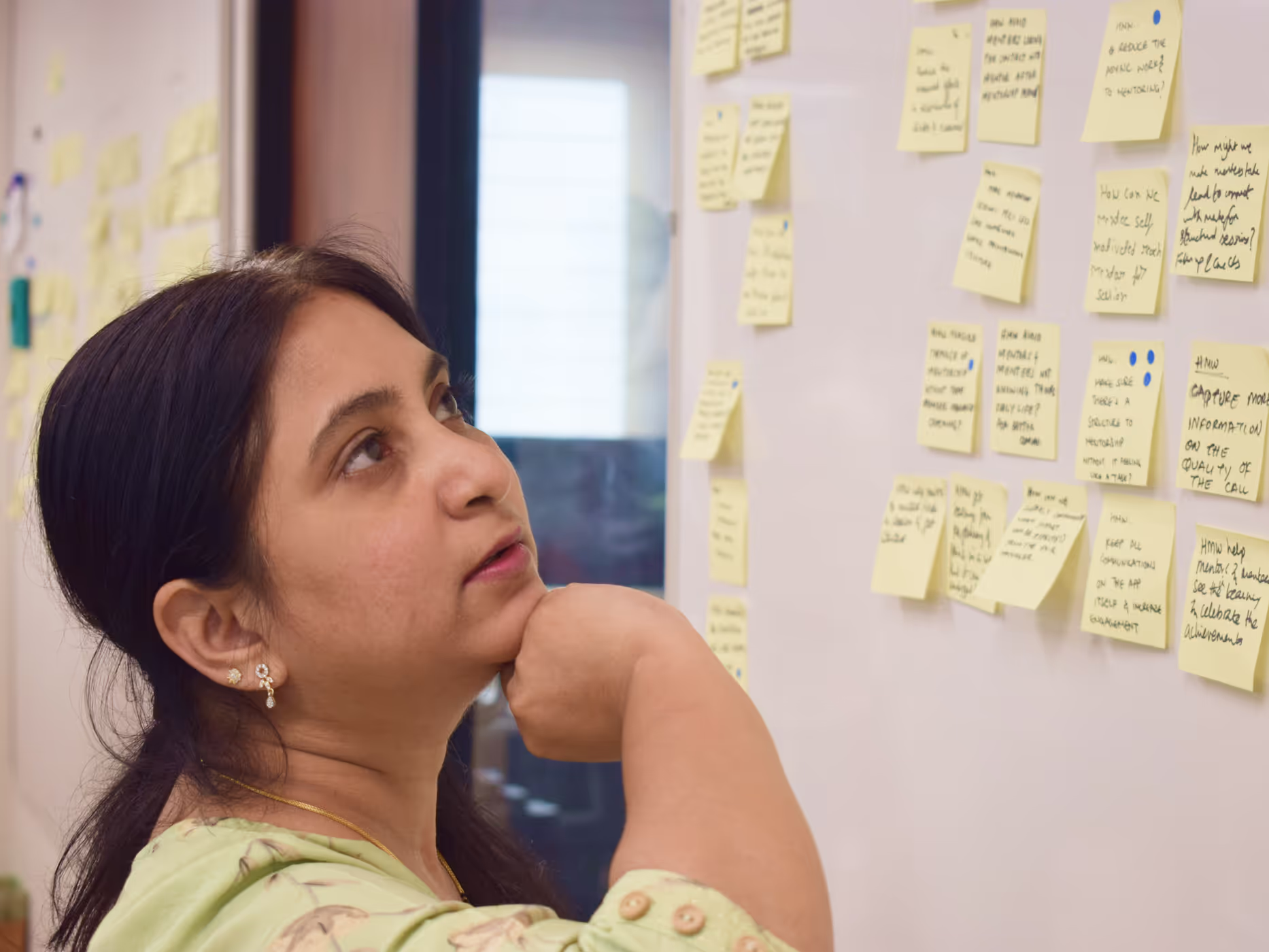
Our UI/UX Design Process
Understanding the foundation
- Kick-off workshops, business goal setting
- Research & user insight synthesis
- Success metrics & KPI alignment
- Constraint mapping (technical / domain)
Creating the solution
- Flow definition, wireframing
- Interactive prototypes
- Usability testing & feedback loops
- Iteration & validation
Perfecting the details
- Visual design & component library
- Final prototypes & interaction specs
- Developer handoff & collaboration
- QA support & style audit
Our Case Studies

Redefining Content Ops for AI SaaS
Create a UI that handles complex AI workflows but still feels usable to non-technical users.
We designed a dashboard with progressive disclosure, intuitive controls, and simplified flow paths.
- 40% faster onboarding
- 85% adoption of advanced features
- 90% satisfaction score


Optimizing Payment Experiences at Scale
Payment failure and abandonment rates were hurting conversions.
Modular and context-sensitive payment UI components that adapt by device, locale, flow.
- 25% boost in successful payments
- 50% decline in support tickets
- Empowered to process billions in transactions

Humanizing Feedback Platform
Users felt uneasy giving feedback in a sterile environment.
We introduced a gentle “character” (CLO) to guide interactions and evoke comfort.
Better engagement, more honest inputs, increased use of feedback module.
Our tools and methods
 FigmaFor collaborative design and prototyping
 FigJamFor workshops and ideation sessions
 PrincipleFor advanced interaction design
 MazeFor user testing and validation
 NotionFor documentation and project management
- Design SprintsRapid validation of concepts
- User InterviewsDeep qualitative insights
- Usability TestingValidation and optimization
- Analytics ReviewData-driven decision making
- A/B TestingPerformance optimization

“Parallel made complex workflows feel simple. Their UI thinking reduced confusion across our user base.”


“They plugged into our team and felt like our internal UI/UX unit. The collaboration was smooth, and deliverables felt owned.”


“Our retention improved because the app feels alive — the transitions, the feedback loops, the clarity of UI — everything counts.”

Why Pick Parallel for UI/UX Design
We’ve worked in fintech, healthtech, B2B SaaS, AI, consumer apps. That diversity gives us fresh angles.
Our designs have moved engagement metrics, adoption, retention, and helped clients raise capital.
We join your squad. Not external, but aligned. Frequent syncs, shared goals, mutual ownership.
We build UI systems, not one-off screens. As you grow or pivot, your product infrastructure adapts.
We’ve been featured around the world







FAQs
