Looking for branding and website design? Ensure project success with our curated picks. See the top 10 list.
Most startups treat their brand and their product as two completely different worlds. They hire a creative studio for a logo and a separate dev shop for the interface. The result is always a fragmented user journey. The promise made by marketing breaks immediately at the product interface. I have seen this pattern cost early-stage teams their crucial first-activation metrics. If you want a cohesive narrative that actually converts, you need integrated branding and website design. When the visual identity and the product experience share a single foundation, user trust scales naturally.
We ranked the top ten partners for your next digital leap. The best teams align visual identity with functional product thinking. Here is a quick comparison table to help you decide.
I have sat in boardrooms where founders argue for hours over brand colors. Meanwhile, their core product value proposition remains completely hidden behind terrible onboarding screens. This is a classic failure of product thinking.

Brand agencies excel at creating abstract concepts and emotional appeal. They hand over a file with beautiful typography and hex codes. Product teams then struggle to map those flat assets into interactive states, responsive grids, and accessible components.
A button is not just a color block. It has hover, focus, active, disabled, and loading states. When brand guidelines ignore UI realities, the digital product feels broken.
According to a 2026 report by the Nielsen Norman Group, inconsistent visual patterns across a digital journey increase cognitive load. This inconsistency drops user activation rates by up to 34 percent. We see this daily when teams come to us for a UX audit. They have a stunning brand but a leaky conversion funnel.
Choosing the right design partner defines how your product will be received by the market. Here is a detailed breakdown of the top 10 agencies based on our industry observations.
We built ParallelHQ because we saw teams struggle with design decisions that should have been much simpler. We do not just make things look pretty. We map the entire user journey and focus on clarity in thinking.
Our core strength lies in helping early-stage startups and product teams untangle complex user flows. For instance, our work on Digilocker required translating massive governmental complexity into an intuitive, accessible interface for millions of users. We rely heavily on our Discovery Framework to align business goals with real user needs before a single pixel is pushed.
We are the right partner when you need holistic branding and website design that actually drives product metrics. We focus on outcomes, clear product strategy, and rapid validation through Design Sprints.
MetaLab is legendary in the tech world for a good reason. They are responsible for the early interfaces of Slack and Coinbase. Their work is highly polished and carries a distinct premium consumer feel.
They are an excellent choice if you have a massive budget and need a flawless consumer aesthetic. However, their process can be heavy. Early-stage startups often need faster iterations and leaner product strategy consulting to find product-market fit quickly.
IDEO wrote the book on design thinking. They are unmatched when it comes to deep ethnographic research and tackling systemic global challenges. A 2025 IDEO design report highlighted their continued focus on sustainability and complex human-centered systems.
If you are rethinking the future of urban mobility or healthcare ecosystems, IDEO is brilliant. If you need to rapidly launch a SaaS product and fix your SaaS onboarding, their approach might be too academic and slow.
Clay creates some of the most visually stunning web experiences on the internet. They specialize in high-end 3D animations and incredibly smooth scrolling interactions.
They are the go-to team for a flagship marketing website that needs to win awards. The tradeoff is that heavy animations can sometimes distract from complex product utility. If your goal is pure conversion and simple utility, you might need a more balanced approach.
Frog has a deep history of merging physical product design with digital interfaces. They understand the tactile nature of user experiences better than most.
They excel in environments where hardware and software meet. This makes them ideal for IoT products or medical devices. For pure software platforms, you might find more specialized partners elsewhere.
Ramotion has built a strong reputation for serving tech startups in the SaaS and Web3 space. They are known for their distinct iconography and cohesive visual systems.
They are a solid choice for standalone branding and website design packages. They deliver clean, modern aesthetics very reliably. However, they may not dive as deeply into complex user research or backend product logic as a dedicated product strategy firm.
R/GA operates at the intersection of global advertising and digital innovation. They build massive brand campaigns that tie directly into custom technology platforms.
They are suited for Fortune 500 companies launching global initiatives. Their overhead and project scopes are generally far beyond the reach of early-stage startups or mid-market SaaS companies.
Work & Co is hyper-focused on shipping digital products. They do not do traditional advertising or media buying. They focus entirely on engineering and design execution.
They deploy highly senior teams to build robust digital platforms. They are excellent for complex engineering challenges. Their model is highly effective, though it requires a significant financial commitment up front.
Huge is a massive global agency that handles enterprise-level digital transformations. They tackle projects that involve thousands of pages, massive stakeholder groups, and complex legacy systems.
They are built for large corporate environments. Startups and agile product teams usually find their processes too slow and layered for rapid iteration.
Ustwo is famous for creating the game Monument Valley. They bring a unique sense of joy, gamification, and delight to their digital products.
They are fantastic if your app needs to feel playful or heavily engaging on mobile. If you are building dense B2B UX design tools or financial dashboards, their playful style might require recalibration.
In my experience, product decisions usually go wrong at the very beginning of the product lifecycle. Teams rush to build features without understanding the fundamental user behavior.
The most common trap is overcomplicating the product experience. Startups often try to serve three different user personas at once. This leads to cluttered interfaces and weak onboarding flows. I always tell founders that a confused mind always says no.

Another major issue is designing for stakeholders instead of users. Teams spend weeks refining internal presentations but skip basic usability testing with real customers. This is exactly where branding and website design often fail to translate into business success. The aesthetic pleases the CEO, but the interface frustrates the user.
Finally, teams frequently ignore accessibility until it becomes a legal issue. Building accessible products from day one is not just ethical. It is good business. We integrate an accessibility audit standard into our baseline processes to prevent expensive redesigns later.
Treating design as an afterthought is the fastest way to accumulate technical and experience debt. This debt compounds rapidly as you scale.
A 2025 update by the Design Management Institute continues to show that design-led companies vastly outperform the broader market index. Good design reduces customer support tickets, increases trial conversions, and improves long-term retention.
You must look at the ROI of UX as a core business metric. If users cannot figure out how to use your product within the first two minutes, your customer acquisition cost is entirely wasted. A beautifully painted door is useless if the user cannot find the handle.
This financial reality is why we focus so heavily on the ROI of cohesive branding and website design. Every interface decision must tie back to a measurable business objective. We do not design in a vacuum. We design to move metrics.
At ParallelHQ, we rely on a structured methodology to remove guesswork. We do not believe in the myth of the lone creative genius. Good product design is the result of rigorous process and validation.
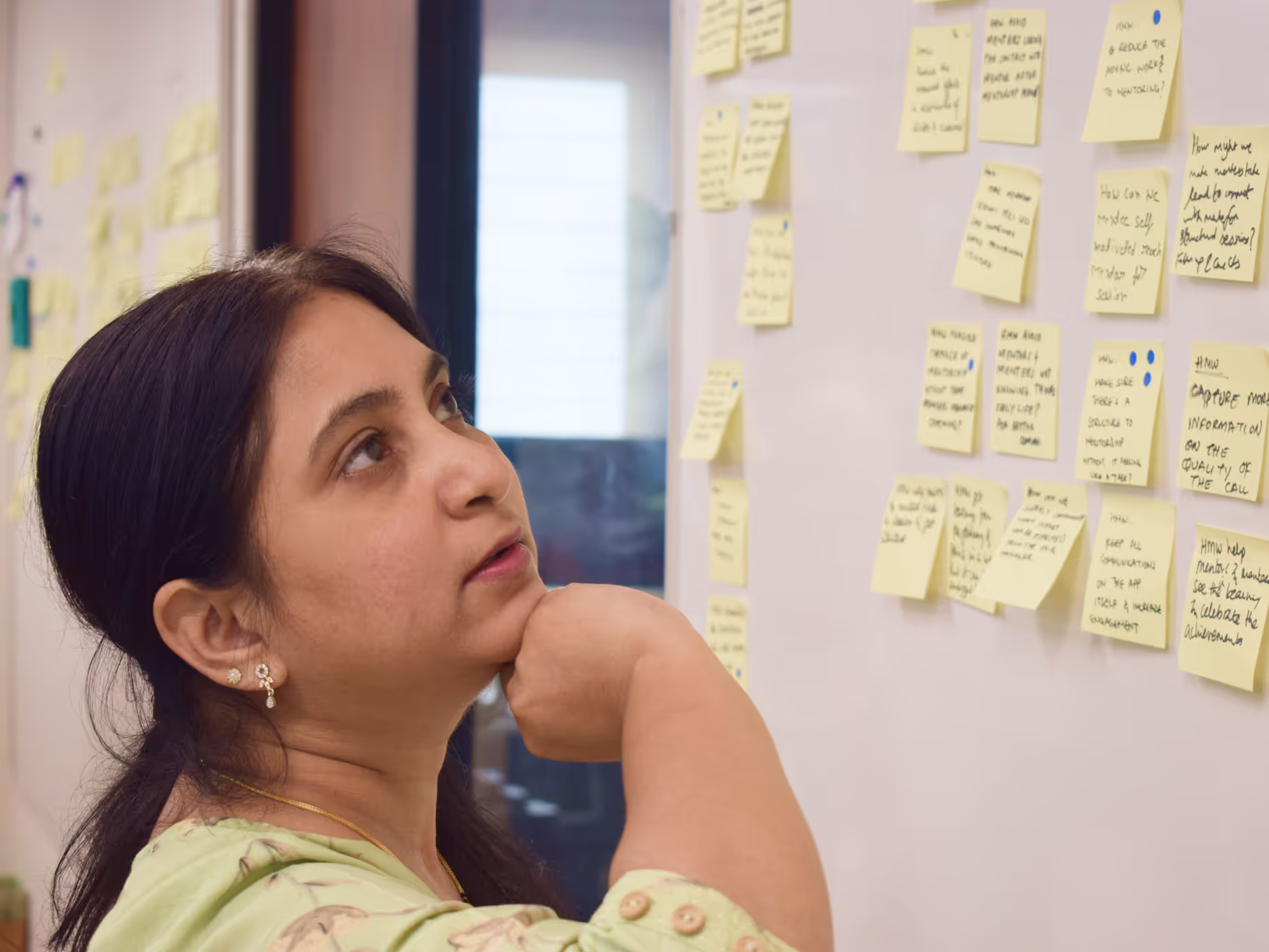
We frequently use the Design Sprint methodology to solve big problems quickly. By compressing months of debate into a few days, we help teams validate ideas with real users before writing expensive code. This structured approach prevents scope creep and keeps the team aligned.
Before we design any screens, we also conduct deep opportunity mapping. We need to understand the market gap and the user's actual pain points. Only then do we start wireframing and prototyping.
The successful execution of branding and website design requires discipline. It requires saying no to good ideas so you can focus on the great ones. This is how we helped teams at Sarvam AI and Gullak build products that feel intuitive from the very first click.
We cannot discuss product strategy without addressing Artificial Intelligence. AI is fundamentally changing how we approach software interfaces.
Generative UI and intelligent chatbots are replacing static forms and traditional navigation menus. A 2026 study on UX trends by Baymard Institute indicates that users now expect adaptive interfaces that anticipate their needs.
This shift means that the true value of a design partner is no longer in just pushing pixels. AI tools can generate basic layouts in seconds. The real value is in structural product thinking. It is in designing the underlying logic, the chatbot UX design, and ensuring the AI feels trustworthy rather than intrusive.
We have actively adapted our services to include AI software design services. We help founders navigate this transition safely, ensuring their AI features actually solve problems rather than just serving as marketing gimmicks.
Early-stage founders are always fighting the clock. You need to ship quickly to survive. However, shipping a broken experience is worse than shipping nothing at all.
I advise teams to balance speed with strategic depth. You do not need a massive, robust design system on day one. You do need a clear visual hierarchy and a friction-free core user journey.
Start with a lightweight UI kit. Focus entirely on the primary activation flow. Test it, refine it, and then scale the design language as the product grows. This lean approach saves capital while maintaining high quality.
Ultimately, investing in branding and website design is about building trust at scale. Every interaction a user has with your product either adds to that trust or subtracts from it. There are no neutral interactions in digital products.
Your product experience should be sharp, clear, and deeply grounded in real user behavior. Stop overcomplicating things. Simplify the narrative, align your visual identity with your product utility, and focus relentlessly on clarity. When you make the product easy to understand, growth inevitably follows.
Combined branding and website design means creating a visual identity that is natively built for digital interfaces. It ensures that your colors, typography, and brand voice translate perfectly into interactive product states like buttons, error messages, and onboarding flows.
The timeline varies based on complexity. A rapid iteration using Design Sprints can validate core concepts in one to two weeks. A full product redesign and strategic overhaul typically takes eight to twelve weeks to execute properly.
If you need to move quickly and require senior-level product strategy, an agency partner brings immediate velocity and diverse industry experience. Once you find product-market fit and need continuous, granular updates, building an in-house team becomes more cost-effective.
UX (User Experience) is the structural logic, user research, and journey mapping. UI (User Interface) is the visual execution of that logic. A great product requires both to function flawlessly.
If you have high traffic but low conversion rates, or if users constantly require customer support to complete basic tasks, you have a UX problem. A professional UX audit can identify the specific friction points causing user drop-off.
Yes. Early-stage startups cannot afford the technical debt of bad design. Establishing clear product thinking early on saves months of wasted engineering effort. We specifically tailor our MVP development approach for early-stage teams.
We focus on clarity and product thinking, not just surface-level aesthetics. We do not do agency fluff. We use structured frameworks to solve real business problems, acting as a strategic extension of your founding team.
The typical ROI on branding and website design is measured through increased conversion rates, lower customer acquisition costs, and reduced customer support volume. Strategic design investments routinely yield returns far exceeding their initial cost by directly improving user retention.