Choosing the wrong fintech branding agency costs you more than money, it costs you user trust at the moment it's hardest to rebuild. I'm Robin Dhanwani, founder of ParallelHQ, and we've spent years helping AI and SaaS startups turn complex products into brands people actually trust with their money. This list is my honest view of who's doing the best work in financial technology branding right now, including where we fit, and exactly what to look for before you sign a contract.
The 10 Best Fintech Branding Agencies for 2026
This landscape spans global consultancies shaping institutions like Mastercard and Santander, all the way down to boutique studios built for early-stage startups scaling fast.
Here is my curated shortlist with the context you actually need to decide.
1. ParallelHQ, Our own fintech design services are built specifically for early-stage AI and SaaS startups in the US. We cover brand strategy, visual identity systems, product design, and website, everything from the investor pitch deck to the onboarding screen. We don't hand off to junior teams, and we don't overcharge for processes you don't need at seed stage.
2. Koto, Koto gave Freetrade a bold pink-led identity, combining playful curves and vibrant visuals to stand out. They excel at youthful, startup-friendly fintech brands, with notable clients including Freetrade and Wise.
3. Ragged Edge, For fintech startups and digital-first challengers, Ragged Edge is frequently cited as among the best suited. They bring sharp brand positioning and distinctive visual systems.
4. Block Club, A Brooklyn-based, B2B-focused branding and content agency trusted by fintech and SaaS companies including Plaid, Alloy, Argyle, and Middesk. Strong for B2B fintechs that need verbal identity as much as visual.
5. CSTMR, Known for expertise in fintech marketing, CSTMR designs strategies that blend brand-building with performance-driven tactics, helping companies scale and differentiate in a rapidly evolving market.
6. Fintech Branding Studio, This specialist fintech branding agency focuses exclusively on financial technology. Naming, brand strategy, identity systems, tone of voice, and website design form its core services. The team's deep domain knowledge means they can anticipate compliance issues and craft messaging that reassures regulators and end users.
7. Sparklin stands apart for fintechs that need a complete ecosystem where brand, product, technology, and strategy integrate seamlessly. They don't just design identities; they help shape the full customer experience of financial services.
8. Lippincott, A strategy-led consultancy in the $500K–$1M tier.
Best reserved for funded companies undergoing full brand architecture overhauls.
9. Pentagram, Notable clients include Mastercard, Citi, and American Express.
Partner-led and exceptional, but priced well above what most startups should consider.
10. COLLINS, An independent agency in the $100K–$500K range that balances strategy and creative agility. Best for Series A+ fintechs ready for a genuinely distinctive visual identity.
What Makes a Good Fintech Branding Agency Different from a Generalist
This is a question I get from almost every founder who reaches out to us. The answer comes down to domain literacy and risk awareness.
A fintech branding agency understands regulatory constraints, trust-building requirements, and the specific customer psychology around financial products. They know which visual and verbal signals build credibility versus which create compliance risk. A regular branding agency might produce beautiful work that doesn't account for financial services realities, accidentally making compliance claims, using imagery that triggers regulatory review, or establishing voice guidelines incompatible with how financial products are legally marketed.
Beyond compliance, the emotional stakes are categorically different. Fintech companies face a unique branding challenge: they must simultaneously signal innovation and stability. Move too far toward "disruptive tech startup" and customers worry about trusting you with their money. Move too far toward "traditional financial institution" and you lose the differentiation that makes fintech compelling.
Unlike traditional banks, fintech startups don't inherit credibility, they must prove their legitimacy visually. Fintech companies must integrate trust signals directly into their branding, UI, and communication.
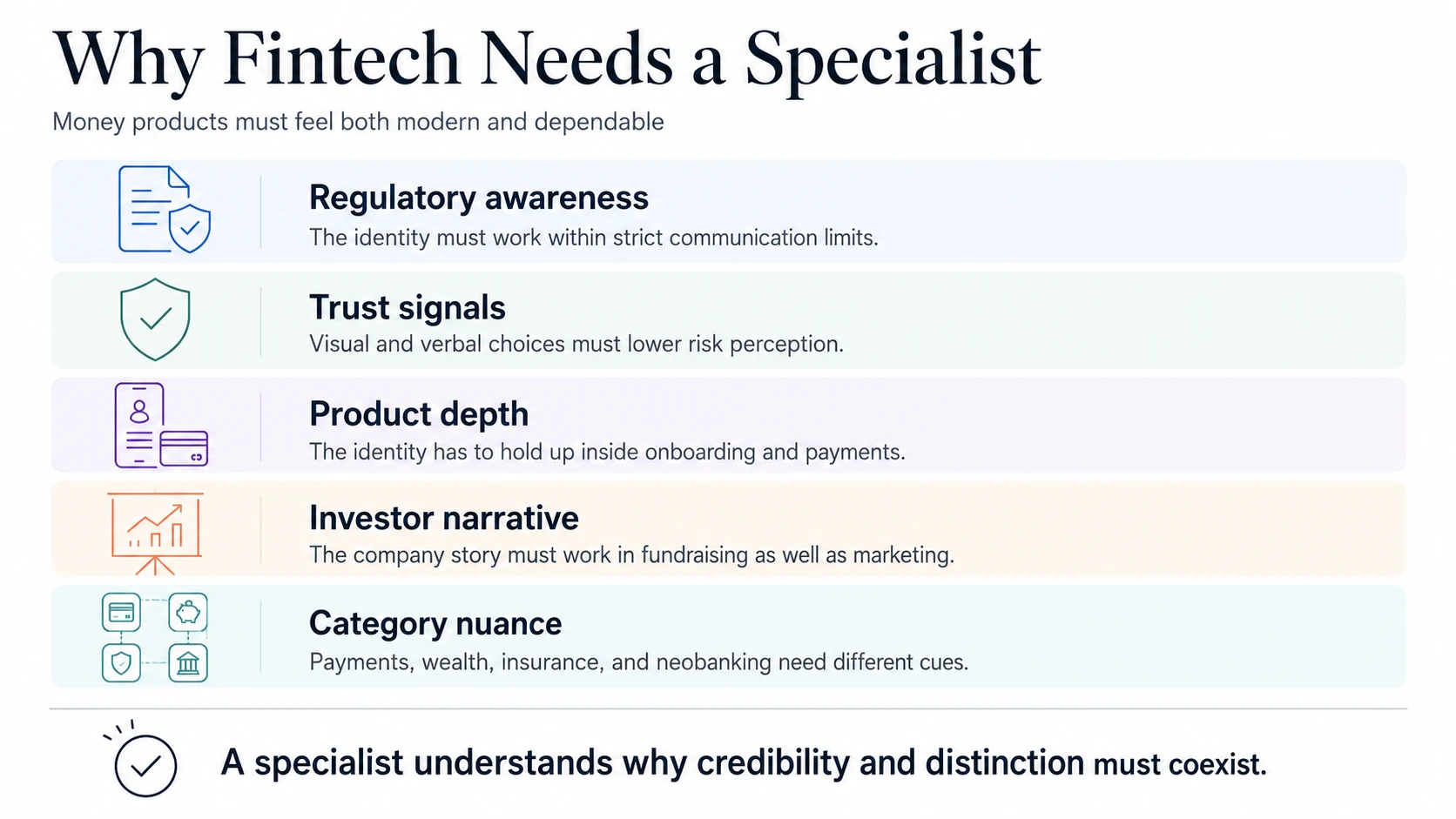
A generalist agency almost never accounts for this tension by default. When I look at what separates the best fintech branding agencies from solid-but-generic studios, I see five consistent differentiators:
- Domain fluency: They've read the compliance documentation, not just the brief.
- Trust signal architecture: Color psychology, typography systems, and motion design choices are made with credibility, not just aesthetics, in mind.
- Product design literacy: They understand what the brand needs to do inside a payment interface or onboarding flow, not just on a landing page.
- Regulatory communication: They can write and design around SEC, FCA, or CFPB constraints without stripping out brand voice.
- Investor narrative alignment: The brand strategy connects directly to how the company tells its story at a Series A or later fundraise.
Fintech isn't a single category. A branding agency for fintech companies needs to understand that neobanking, crypto, payments, wealthtech, and insurtech each require different approaches. The visual conventions, trust signals, regulatory contexts, and audience expectations differ significantly across these subverticals.
How to Choose a Fintech Branding Agency: A Decision Framework
Most founders come to this decision with three variables in mind, budget, timeline, and deliverables. Those matter, but they're not the most important criteria. Here's the framework I'd actually apply:
- Audit their fintech case studies for depth, not just aesthetics. Can they explain why they chose a specific typography system or color palette in terms of trust signals? Or do they just present beautiful mockups? Depth of rationale is the tell.
- Check their compliance literacy. Ask directly: "Have you worked on products that required FCA or SEC-compliant copywriting?" The answer reveals more than their portfolio.
- Map their process against your stage. The fintech branding landscape features agencies ranging from global design powerhouses to specialized boutiques. Choosing the right partner requires understanding not just design quality but strategic approach, industry expertise, and how well processes align with startup realities.
- Evaluate their product design literacy. Brand identity without product design fluency breaks down at the UI level, your pitch deck looks sharp but your onboarding screen undermines the brand.
- Ask who will actually work on your account. Senior talent on the pitch, junior talent on delivery is standard practice at larger shops. Get the team named in the contract.
- Request references from companies at your exact stage. A Series B reference doesn't help a seed-stage company understand what the experience will feel like before product-market fit.
The right agency for a seed-stage neobank is rarely the same agency that rebranded a global payments network. Match the engagement model to where you are, not where you aspire to be.
Choosing the right agency involves assessing industry expertise, transparency, and data-driven execution, in that order. At ParallelHQ, we often start with a UX audit or discovery framework before any brand work begins, because the product reality always shapes what the brand needs to say.
What a Strong Fintech Brand Strategy Must Include
I've seen dozens of fintech brand strategies, and the ones that fail almost always leave out the same three things: a trust architecture, a regulatory communication layer, and a design system that actually scales inside the product.
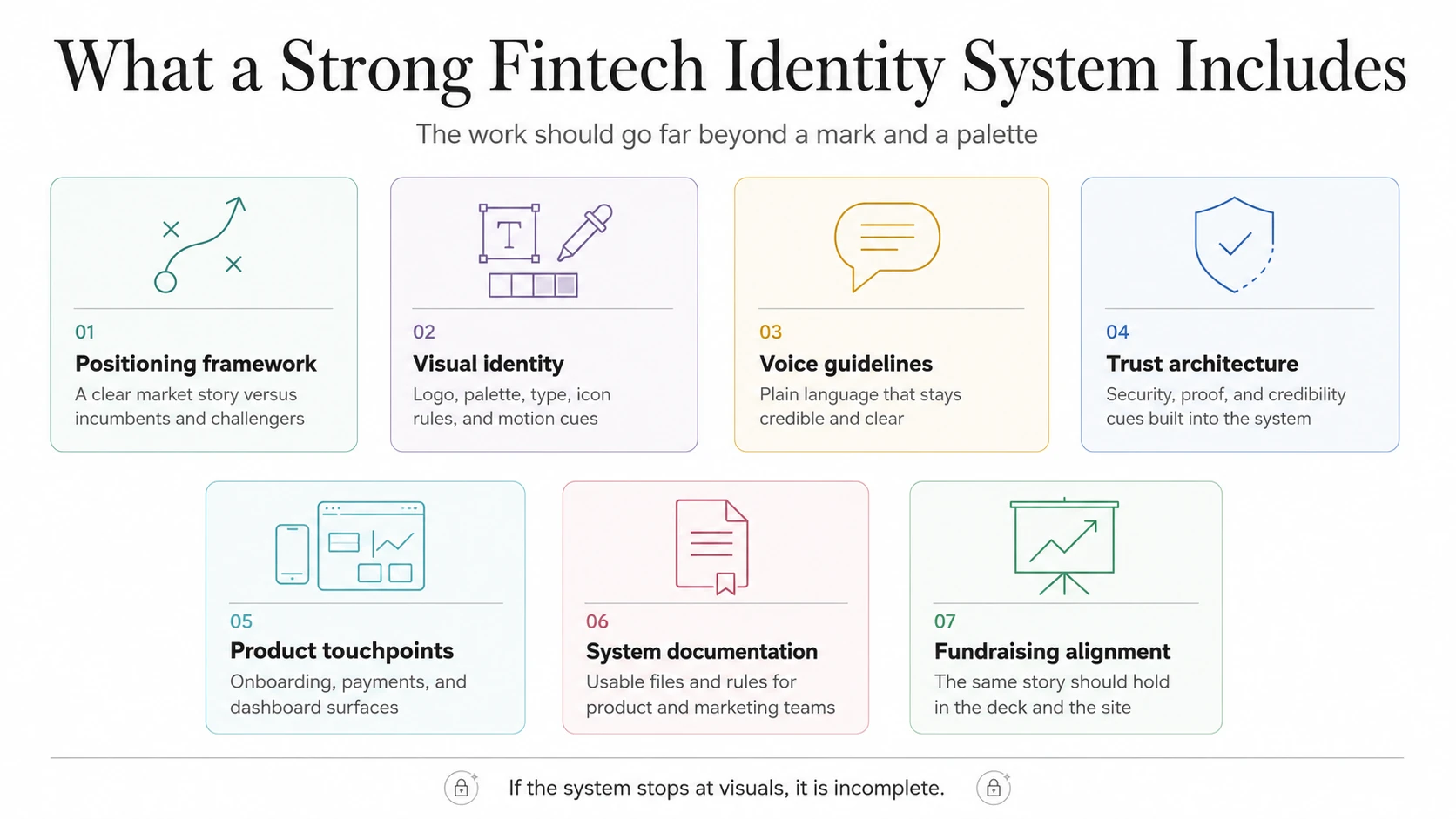
A complete fintech brand strategy must cover:
- Brand positioning framework: Where you sit relative to incumbent banks and competing challengers, expressed in a single clear narrative.
- Visual identity system: Logo, color system, typography, iconography, and motion design, all mapped to trust signal intent, not just aesthetic preference. In the crowded fintech market, branding has become the ultimate differentiator. The most successful financial services companies are those that inspire trust, clarity, and cultural relevance through powerful brand identities.
- Tone of voice and messaging: Plain language that communicates complex financial concepts without triggering compliance red flags.
- Customer trust signals: Verification cues, security language, regulatory disclosures, integrated into the brand system, not bolted on as afterthoughts. It's no longer enough to slap a "secure" badge on your website. Real trust comes from clarity, consistency, and authenticity at every touchpoint.
- Digital banking design standards: Onboarding flows, payment interface design, and dashboard patterns that carry brand identity through the entire product experience.
- Design system documentation: A design system that product and marketing teams can actually use. The best fintech brands are moving to cloud-based, interactive brand platforms that make it easy for distributed teams, across marketing, legal, product, and partners, to access the latest assets, templates, and rules in real time.
- Investor pitch deck alignment: The brand narrative and visual language should carry directly into fundraising materials.
HubSpot's 2025 B2B benchmark suggests startups spending less than 10% on brand see 40–50% higher customer acquisition costs by their second year. A complete brand strategy is not a cost, it's risk mitigation against rising CAC.
How Much Does a Fintech Branding Agency Cost?
Here's the honest breakdown by stage. No ranges padded to look affordable. Fintech branding costs typically range from $15,000 to $150,000 depending on scope and stage. Seed-stage fintech startups can get a complete brand system including visual identity, verbal identity, and implementation for $15,000–$25,000 at studios specializing in startup work. Series A companies typically invest $25,000–$60,000 for more comprehensive engagements.
Global consultancies like Pentagram, Interbrand, and Landor handle multinational brand transformations at over $1M. That is not relevant to most of the founders reading this.
What drives cost up within a tier: the number of product surfaces the brand needs to cover (app, web, card, marketing), whether naming is in scope, how much compliance review is needed, and whether interaction design or motion is part of the deliverable.
What drives cost down: a clear brief, executive-level decision-making access, and an agency that doesn't pad timelines with unnecessary discovery phases.
If an agency cannot tell you how their brand strategy decisions connect to conversion rate optimization or user trust metrics, they're selling you a PDF, not a growth asset.
Common Branding Mistakes Fintech Startups Make
I see the same patterns repeatedly, and they all share one root cause: treating brands as a visual exercise rather than a trust-building system.
Mistake 1, Generic trust signifiers with no substance: Slapping a padlock icon and the word "secure" on a homepage is not brand strategy. Trust signals like verification badges and visual safeguards only work when they make digital security feel human, not bureaucratic.
Mistake 2, Copying the aesthetic category leader: Fintechs that get branding right, Stripe, Revolut, Nubank, Chime, have built brands worth billions by earning trust that traditional banks have squandered. Copying their visual language without earning their positioning just signals "me too."
Mistake 3, No design system: Launching a brand without a design system means every new product screen, marketing asset, and onboarding flow drifts. Within six months, the brand is incoherent.
Mistake 4, Treating neobank branding as interchangeable with payments branding: A branding agency for fintech companies needs to understand that neobanking, crypto, payments, wealthtech, and insurtech each require different approaches. The visual conventions, trust signals, regulatory contexts, and audience expectations differ significantly across these subverticals.
Mistake 5, Deferring brand to post-launch: Brand influences onboarding conversion, investor perception, and partnership conversations from day one. Waiting until you've "validated the product" often means rebuilding the brand at three times the cost right before a Series A.
Mistake 6, Confusing brand refresh with brand strategy: Changing your color palette is not repositioning. A genuine brand strategy starts with the positioning framework and works outward to visual expression, never the other way around.
At ParallelHQ, we often flag these issues in an early product strategy consulting conversation before a single pixel is touched.
Conclusion
- A specialist fintech branding agency brings compliance literacy, trust signal architecture, and product design fluency that generalists cannot replicate.
- Match your agency to your stage: $15K–$25K at seed, $25K–$60K at Series A, and avoid enterprise-priced shops if you're pre-product-market fit.
- A complete brand strategy covers positioning, visual identity, tone of voice, a live design system, and investor narrative alignment.
- The most common and costly mistake is deferring brand work until after launch.
If you're building an AI or SaaS fintech startup and want a design partner who's already done this at seed-to-Series B, explore ParallelHQ's fintech design services or start with a UX audit to see where your current brand is losing trust.
Frequently Asked Questions
Q1: What is a fintech branding agency?
A fintech branding agency specializes in building brand identity for financial technology companies. Unlike generalist studios, they understand regulatory communication, financial customer psychology, and how to embed trust signals into visual identity systems and product interfaces, not just marketing collateral.
Q2: How is a fintech branding agency different from a general branding agency?
A specialized agency knows which visual and verbal signals build credibility versus which create compliance risk. A general agency might produce beautiful work that accidentally makes compliance claims, uses imagery that triggers regulatory review, or establishes voice guidelines incompatible with financial services legal requirements.
Q3: How much does a fintech branding agency cost in 2026?
Fintech branding costs typically range from $15,000 to $150,000 depending on scope and stage. Seed-stage startups can access a complete brand system, visual identity, verbal identity, and implementation, for $15,000–$25,000. Enterprise rebrands at global consultancies exceed $1M.
Q4: Which fintech branding agencies are best for neobanks and digital wallets?
For fintech startups and digital-first challengers, Ragged Edge, Koto, COLLINS, DesignStudio, and SomeOne are frequently cited as best suited. For seed-stage neobanks needing brand and product design integrated, ParallelHQ is built for exactly that scope.
Q5: What should I look for when choosing a fintech branding agency?
Look for demonstrated fintech case studies with explained rationale (not just pretty mockups), evidence of compliance literacy, named senior talent on delivery, and a process that matches your stage. Ask explicitly whether they can connect brand decisions to conversion rate optimisation outcomes.
Q6: What are the most common fintech branding mistakes startups make?
The most damaging ones: launching without a scalable design system, copying a category leader's visual language without the underlying positioning, deferring brand work until post-launch, and treating a color palette refresh as a brand strategy. Brand shapes investor perception and onboarding conversion from the first day users encounter it, not after you find product-market fit.

check out these related blogs
































.webp)