
Founders and product teams often face a brutal tension: you need a high-quality site to validate your product, but you cannot justify a massive agency spend before finding product-market fit. This creates a dangerous gap.
Move too fast with a generic template, and you risk looking amateurish to early investors. Spend too much on a boutique build, and you drain the runway needed for product development.
The solution isn't finding the cheapest option. It is finding the right ratio of speed, strategy, and execution.
This guide helps you identify what affordable web design for small business actually looks like when done correctly. We will break down when to hire, what pricing to expect, and how to spot a partner who understands product strategy—not just aesthetics.
Core Web Design Needs for Small Businesses & Early-Stage Startups
We often see startups requesting features they do not need yet. We have had founders ask for complex user portals before they have finalized their value proposition.
To keep affordable web design for small businesses effective, you must be ruthless about scope. Focus on the foundational elements that drive validation.
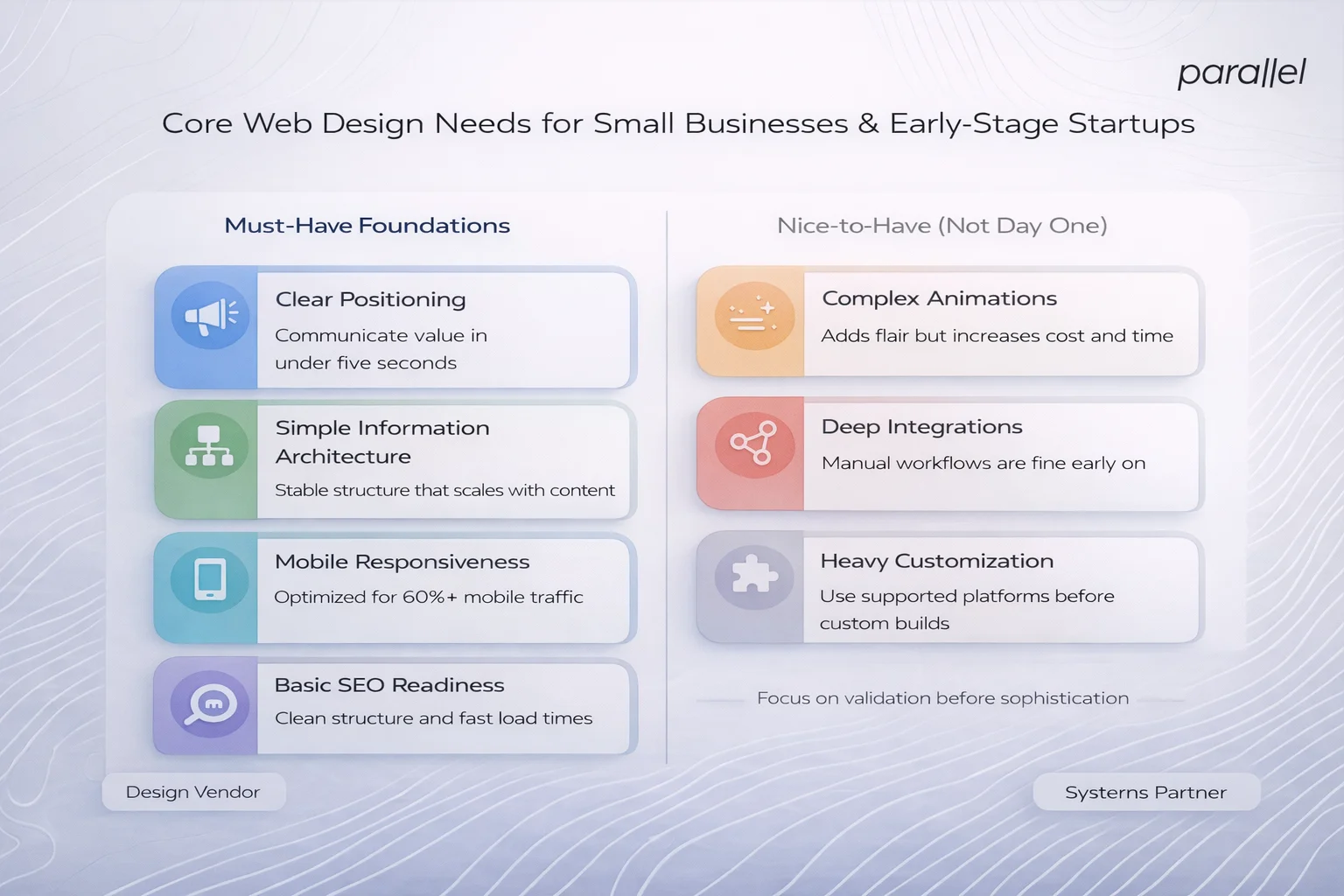
Must-Have Foundations
- Clear Positioning and Messaging: Design serves the content. If your user cannot understand what you do in five seconds, the design has failed. We prioritize hierarchy that guides the eye to the core problem and solution.
- Simple Information Architecture (IA): Don't reinvent navigation. Standard patterns work best for early-stage companies. A solid IA ensures that as you add blog posts or case studies, the site structure doesn't collapse.
- Mobile Responsiveness: Statista data from 2024 indicates that mobile accounts for nearly 60% of web traffic. Google also indexes mobile-first. A site that breaks on a phone is invisible to a massive segment of your market.
- Basic SEO Readiness: You don't need an aggressive backlink strategy on day one. You do need clean code, fast load times, and proper meta-tag structures. This ensures that when you are ready to scale content, the technical foundation exists.
Nice-to-Have (But Not Day One)
- Complex Animations: Motion is great for delight, but it increases development time and cost. Save the scroll-jacking and complex transitions for your Series A rebrand.
- Deep Integrations: Manual work is fine for now. You don't need a fully automated CRM integration if you are getting ten leads a week. A simple form that sends an email is sufficient.
- Heavy Customization: Avoid building custom CMS solutions unless your product demands it. Using widely supported platforms allows you to hire easily later.
Common Pricing Models in Affordable Web Design
Understanding how agencies charge helps you compare apples to apples. In the market of affordable web design for small businesses, you will typically encounter three models.
Fixed-Price Packages
This is common for productized services. You pay a set fee (e.g., $5k - $15k) for a specific scope, like a 5-page marketing site.
- Pros: Predictable budget.
- Cons: Rigid scope. If you need to pivot strategy halfway through, it usually incurs change orders.
Monthly or Subscription-Based Services
Agencies like Designjoy popularized this. You pay a monthly fee for "unlimited" requests, one at a time.
- Pros: Low barrier to entry; good for steady, small maintenance tasks.
- Cons: Can be slow for big builds. If a homepage takes two weeks to design and two to build, you have paid two months of subscription fees.
Template-Driven vs. Semi-Custom
Some low-cost website services customize premium templates. Others build from scratch using a component library.
- Our take: For startups, a semi-custom approach (using a design system but unique layout) often yields the best ROI. It is faster than fully bespoke but doesn't look like a generic theme.
Recent industry surveys suggest that early-stage startups allocate between $10,000 and $25,000 for their initial web presence. Anything less usually involves heavy founder equity (time) to manage freelancers.
Leading Affordable Web Design Companies for Small Business
If you are looking for partners who understand the startup constraint—high quality, reasonable speed, sane budget—here is a curated list.
1. ParallelHQ
At Parallel, we focus specifically on product-led teams. We understand that a marketing site is part of a larger product ecosystem.
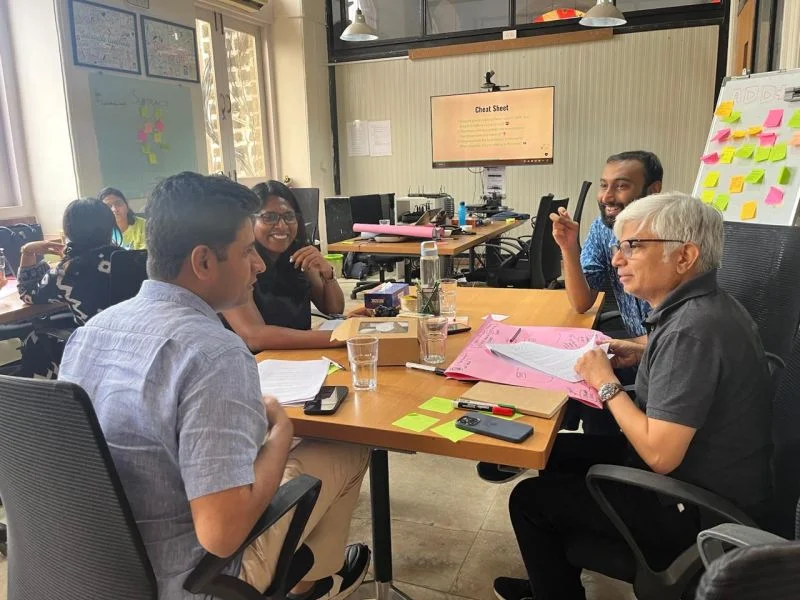
Best For: Startups that need strategy, not just pixels. We don't just ask "what colors do you like?" We ask "how does this page reduce your customer acquisition cost?" Our process is built for founders who need to move fast but cannot afford to look cheap.
Why it works:
- We use design systems to speed up production without sacrificing quality.
- We speak the language of product managers and developers.
- We focus on clarity and usability, ensuring your site converts.
2. Duck.Design
Duck.Design operates on a subscription model. They are a volume-based production house.
Best For: Teams that need consistent graphic production alongside web layouts. The Trade-off: The subscription model requires you to be a very good project manager. You must define tasks clearly to get value. It is less about strategic partnership and more about execution bandwidth.
3. HelloRoketto
This agency takes an inbound marketing approach. They focus heavily on HubSpot and content strategy.
Best For: Companies ready to invest in long-term content marketing immediately. Cost Consideration: Their full retainers can push the upper limit of "affordable" for pre-revenue startups, but their focus on growth metrics is solid.
4. Peak Digital Studio
Peak offers a blend of flat-rate pricing and custom scopes. They are known for clean, functional aesthetic work.
Best For: Small businesses needing a brochure-style site. Trade-off: They are excellent for visual updates, though deep product strategy might require a more specialized partner.
How to Choose the Right Affordable Web Design Partner
Selecting a partner is a hiring decision. You are hiring a temporary Head of Design. You need to interview them with the same rigor.
Questions to Ask Before Hiring
- Who handles strategy vs. execution? Does the person selling you the project hand it off to a junior designer? You need to know who is actually solving your problem.
- How do revisions work? Some cheap website customization shops limit you to two rounds of feedback. After that, hourly rates kick in. Clarify this upfront.
- Who owns the files? We have seen founders held hostage by agencies that refuse to release the Webflow or Figma files. Ensure your contract states that you own the IP upon payment.
Red Flags to Watch
- Vague Timelines "We'll get it done when it's done" is unacceptable. A professional partner provides a schedule with clear milestones.
- No Discovery Process If they start designing before asking about your customers, run. They are making art, not a business tool.
- One-Size-Fits-All Answers If they recommend the same tech stack to a bakery and a SaaS platform, they are not thinking critically about your needs.
Matching Partner Type to Business Stage
- Pre-Launch: You need a freelancer or a very lean studio. Focus on a landing page that captures emails.
- Post-MVP: This is the sweet spot for affordable web design for small business agencies. You have validation, now you need credibility.
- Early Growth: You might need a specialized agency (like Parallel) that can bridge product interfaces and marketing sites.
Role of Web Design in Small Business Growth
Your website is often the only interaction a potential customer has with your brand.
A study by Stanford University found that 75% of users admit to making judgments about a company’s credibility based on their website’s design. If your site looks neglected, users assume your product is too.
Design reduces friction. A well-structured site answers customer objections before they even speak to sales. It shortens the sales cycle.
Furthermore, design consistency builds brand equity. When your social presence, deck, and website share a visual language, you appear larger and more stable than you are. This "perceived size" is crucial for winning B2B contracts.
Mistakes That Make “Affordable” Expensive Later
We have fixed enough broken sites to know where the money gets wasted.
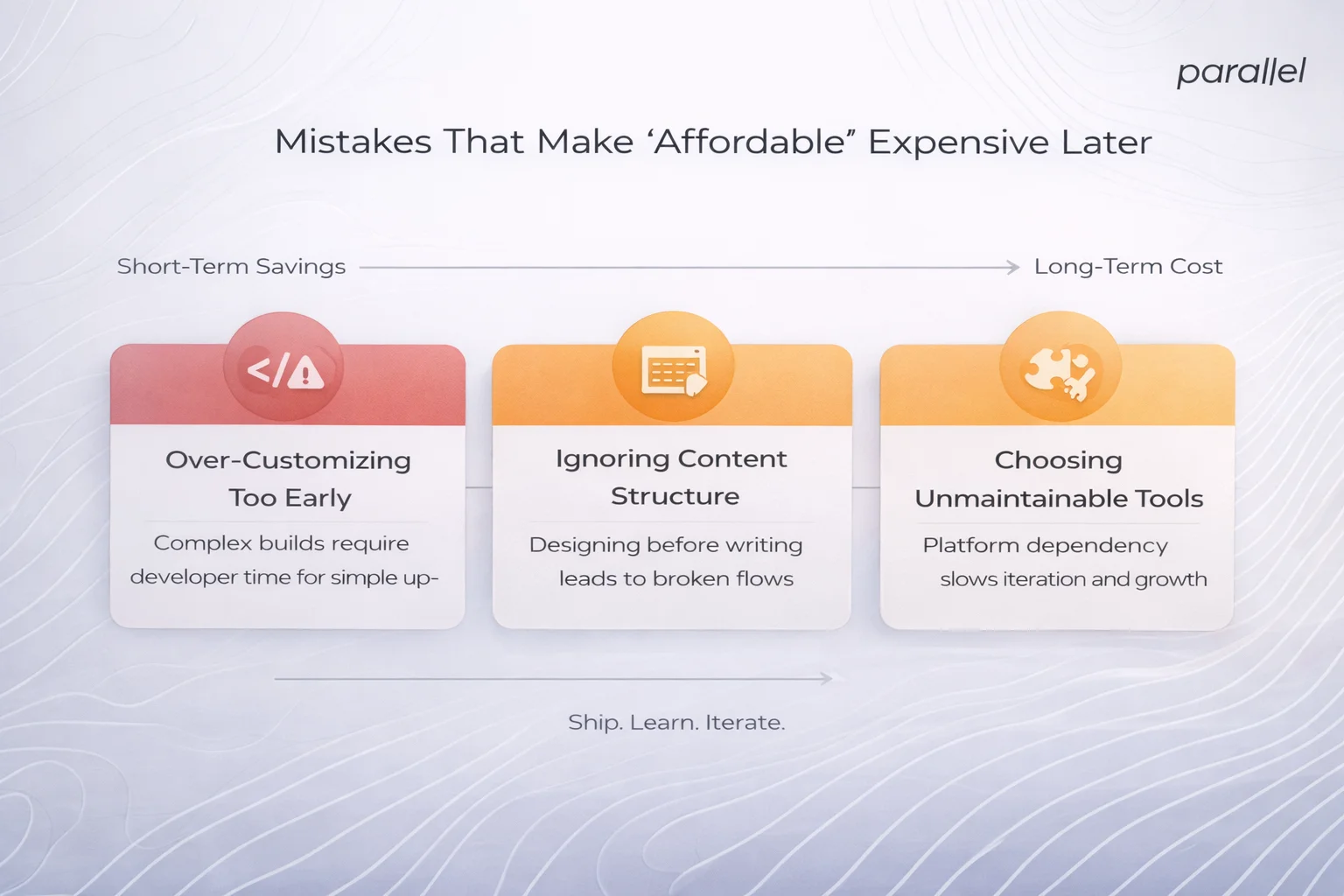
Over-Customizing Too Early Building a completely custom React frontend for a marketing site is usually a mistake for seed-stage companies. It requires developer time for every text change. Stick to Webflow or Framer until you have a dedicated engineering team for marketing.
Ignoring Content Structure Design without content is decoration. Writing the copy after the design is done leads to awkward layouts and broken flows. Content and design must happen in parallel.
Choosing Tools the Team Cannot Maintain If you choose a platform that requires a specific coding language your team doesn't know, you have created a dependency. The goal is to ship, learn, and iterate.
Conclusion
Finding affordable web design for small businesses is an exercise in prioritization. You are trading off infinite revisions and experimental features for speed, clarity, and competence.
The right partner saves you time. They prevent you from going down the rabbit hole of bad UX decisions. They give you a platform that validates your business model.
At Parallel, we believe that clarity upfront beats a redesign later. Invest in the strategy, keep the build clean, and focus on getting your product into the hands of users.
FAQs
1) How much does affordable web design for small business usually cost?
For a professional, strategic build suited for a startup (5-10 pages), expect to invest between $10,000 and $25,000. Options below $5,000 typically rely on templates with little strategic input. Options above $50,000 usually include extensive brand workshops or complex custom development suited for later stages.
2) Is template-based design a bad idea for startups?
Not necessarily. Templates are excellent for speed. The danger lies in forcing your content to fit a rigid template structure. A "semi-custom" approach—modifying a robust framework to match your brand—is often the smartest move for early-stage companies.
3) How long does budget website development take?
A focused engagement should take 4 to 8 weeks. This includes discovery, copywriting, design, and development. Projects stretching beyond 12 weeks often suffer from "scope creep" or lack of decision-making.
4) Can low-cost website services scale later?
It depends on the platform. Sites built on robust no-code tools like Webflow or Framer scale very well. Sites built on proprietary agency builders or outdated themes often require a complete rebuild once traffic increases.
5) What should founders prepare before hiring a web design agency?
Have clarity on your target audience, your core value proposition, and your competitors. If you have brand assets (logo, fonts), have them ready. Most importantly, know the primary goal of the site (e.g., demos booked vs. newsletter signups).
6) Does affordable web design affect SEO or performance?
It can. Cheap hosting and bloated themes are common in the lower budget tier, which hurts Core Web Vitals. However, a lean, affordable custom build can actually outperform expensive, heavy sites if coded correctly.
7) Should early-stage startups hire an agency or a freelancer?
Freelancers are great for single-page sites or specific tasks. Agencies (or product studios like Parallel) are better when you need a mix of skills—strategy, design, and development—managed under one roof to ensure consistency and speed.

check out these related blogs






.avif)