I have spent years working with founders and product leaders. During this time, I see the same pattern constantly. Teams hire for aesthetics when they actually have a strategy problem. Overcomplicated experiences and low activation rarely stem from bad UI. They come from a lack of clarity in product thinking. If you are looking for UX consulting services in 2026, you do not just need a vendor to draw wireframes. You need a partner to untangle your product. In this guide, I will break down how to choose the right partner and share the top 10 firms doing the best work right now.
Quick answer and TL;DR
The best UX consulting services align with your specific stage and business goals. Massive global agencies excel at enterprise transformations. However, early-stage and growth startups need partners focused on rapid product clarity, real user behavior, and strategic execution.
Why do most UX consulting services fail to deliver real product impact?
I see teams overcomplicate onboarding and activation almost every day. It usually backfires because founders try to solve fundamental product gaps with new interface components. You cannot fix a confusing value proposition by adding a sleek animation.
According to a 2025 Founders Forum report on startup failures, 42% of startups collapse because they build products nobody wants or needs. The problem is rarely how the product looks. The problem is misreading user intent. When you hire an agency just to make things look pretty, you are essentially putting a fresh coat of paint over structural damage.
We find that teams go wrong when they separate user experience from core business strategy. They treat design as an afterthought or a final step in the development cycle. Good design partners will challenge your product requirements immediately. They will ask why a feature exists before they ever open a design tool to wireframe it. If your consultant is not pushing back on your initial brief, you are likely wasting your budget.
Another major trap is the feature factory mindset. I have watched countless product managers try to fix churn by adding more features. This just adds cognitive load to an already confused user base. The best designers remove friction by removing unnecessary options.
The takeaway here is simple. Look for a partner who wants to understand your growth model, your churn rate, and your user acquisition strategy before they draw a single screen.
What should you look for when hiring UX consulting services?
Choosing a partner comes down to finding exact alignment with your stage and your speed. A Series A SaaS company does not need the same heavy, multi-month research phase as a legacy financial institution. You need agility, but you also need confidence in your decisions.
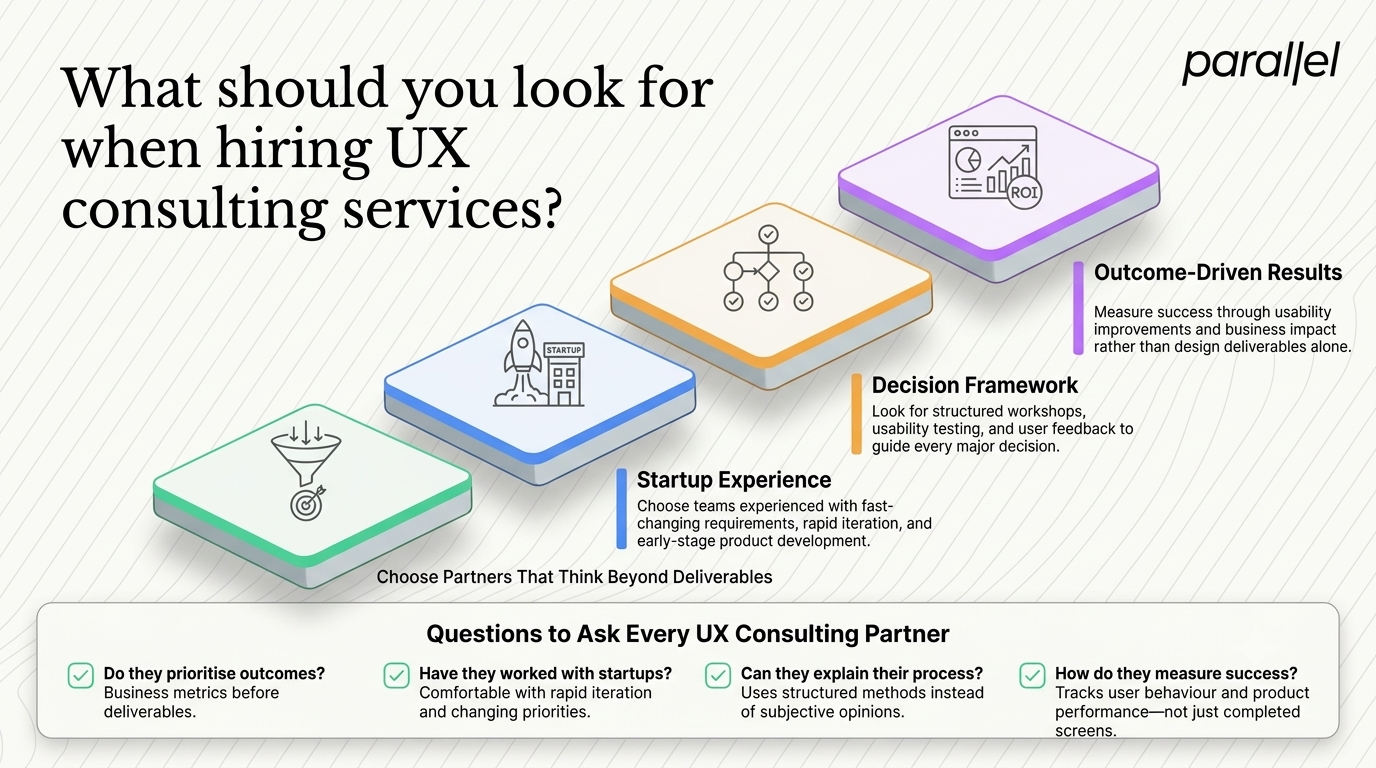
Here is how we think about this tradeoff at ParallelHQ.
Focus on clarity over volume
You do not need fifty screens of low-fidelity wireframes. You need the critical five screens to be perfectly aligned with user expectations. Many traditional agencies bill by the hour and pad their deliverables with unnecessary documentation. Look for teams that focus on outcomes rather than output. They should help you identify the highest-impact areas of your product and attack those first.
Experience with your specific stage
Early-stage work is notoriously messy. Requirements change weekly. The right partner thrives in this ambiguity and helps you find the signal in the noise. If an agency is used to working only with Fortune 500 companies, they will likely struggle with the pace and pivoting required at a seed-stage startup.
A framework for decision making
Design is highly subjective without a framework. Your chosen partner should have a clear methodology for how they make decisions. This could involve structured workshops, specific testing protocols, or scoring models. Ask them how they resolve disagreements between founders and designers. The answer should always involve real user feedback.
Outcome-driven performance
A 2026 report by Forrester via Colorlib highlights that every $1 invested in user experience returns $100. This 9,900% ROI only happens if that investment targets real usability issues. Ask potential partners how they measure success. If they only mention delivering Figma files and not moving business metrics, you should keep looking.
Top 10 UX consulting services for 2026
Here is my breakdown of the top players in the space today. I have based this list on years of observing the market, talking directly to founders, and reviewing real product outcomes.
1) ParallelHQ
We built ParallelHQ because I saw teams repeatedly struggle with design decisions that should have been much simpler. We act as a product design and strategy partner for early-stage startups and scale-ups. Our focus is strictly on clarity in thinking. We do not just build screens. We help you figure out what to build in the first place.
Best for: Founders and product leaders needing product strategy consulting and quick user activation.
Core approach: We use structured design sprints and deep UX audits to unblock teams. This helps us simplify complex SaaS and AI products rapidly. We ground everything we do in real user behavior rather than trends.
The Parallel perspective: We act as an extension of your team. We push back on bad ideas and help you validate assumptions before you write expensive code. If you are building a new feature and need rapid validation, our MVP development approach gets you answers in weeks instead of months.
2) Nielsen Norman Group
NN/g is widely considered the academic gold standard for usability research. Founded by industry pioneers, they wrote the foundational rules for how interfaces should function. If you have a massive enterprise system and need rigorous validation, they are the baseline.
Best for: Large enterprise organizations needing deep usability validation.
Core approach: They lean heavily into traditional user research and heuristic evaluations. Their process is highly academic. They conduct extensive lab testing and publish deep reports on human-computer interaction.
The Parallel perspective: They are brilliant at what they do. However, they are less about shipping fast and more about being demonstrably right. They are rarely the right fit for an agile startup trying to find product-market fit on a tight runway.
3) IDEO
IDEO popularized the concept of design thinking globally. They are a massive firm that handles everything from physical product creation to complex service blueprints. They tackle large systemic problems across various industries.
Best for: Fortune 500 companies looking for organizational transformation.
Core approach: Their methodology is highly conceptual and research-heavy. They spend months in the discovery phase. They interview dozens of stakeholders to map out entirely new ways for companies to operate.
The Parallel perspective: IDEO is unmatched for physical product innovation and massive corporate strategy. But they are often too slow and expensive for an early-stage software startup looking for a fast product design iteration. Check out our IDEO alternative perspective if you need faster execution.
4) MetaLab
MetaLab has built a massive reputation for designing beautiful interfaces. They are the agency behind the early versions of Slack, Coinbase, and Uber Eats. They are exceptional at visual execution and creating digital products that feel premium.
Best for: Well-funded unicorns that need world-class visual polish.
Core approach: They deliver high-end user interfaces with a focus on aesthetic perfection. They work well with companies that already have clear product strategies but need the best possible visual representation.
The Parallel perspective: The engagement size and budget required for MetaLab put them out of reach for most seed or Series A teams. They are fantastic at making things look great. See our thoughts on finding a MetaLab alternative if you need strategy alongside the visuals.
5) Clay
Clay is a San Francisco based agency known for highly interactive digital experiences. They incorporate a lot of motion design and 3D elements into their work. They frequently partner with crypto platforms, Web3 startups, and cutting-edge tech brands.
Best for: Brands needing high-impact marketing sites and flashy interfaces.
Core approach: They focus heavily on aesthetics and motion. Their websites feel like cinematic experiences. They blend brand identity deeply into the interface layer.
The Parallel perspective: If you need complex B2B software simplified, they might not be the primary choice. Their work can sometimes prioritize form over raw function. For functional SaaS products, we often discuss the Clay alternative approach.
6) Frog Design
Frog has been a major player for decades. Similar to IDEO, they handle massive global projects that span both physical and digital spaces. They have a rich history of industrial design mixed with modern digital strategy.
Best for: Legacy companies modernizing their entire customer experience.
Core approach: Their process is strategic, deep, and process-heavy. They are a great fit for corporate innovation labs looking to reinvent their industry presence.
The Parallel perspective: For agile software teams looking to ship a new feature next month, Frog is usually too heavy. A Frog Design alternative might move faster for purely digital startups.
7) Ramotion
Ramotion specializes in blending brand identity seamlessly with UI design. They are very good at helping growing startups look established, trustworthy, and highly professional.
Best for: SaaS and FinTech companies needing a brand and UI overhaul.
Core approach: They excel at creating cohesive design systems that bridge marketing websites and the actual product. They ensure your branding is consistent at every touchpoint.
The Parallel perspective: If you have a severe product logic problem, a brand refresh will not fix it. We sometimes suggest a Ramotion alternative if a founder needs deeper product strategy rather than just visual consistency.
8) Work & Co
Work & Co focuses strictly on designing and shipping digital products. They do not do marketing campaigns or traditional advertising. They build massive scale applications for brands like Apple, IKEA, and Gatorade.
Best for: Global consumer brands needing reliable digital execution.
Core approach: They are highly systematic and focused heavily on shipping clean code alongside their designs. Their scale is massive, and they build dedicated teams for multi-year engagements.
The Parallel perspective: They are incredible at enterprise scale. If you are an early-stage founder, a Work & Co alternative will likely give you more dedicated senior attention without the massive corporate retainer.
9) Instrument
Instrument is an independent digital agency that excels at building brand experiences. They are incredibly strong in storytelling and interactive web design. They frequently work with major lifestyle brands and tech giants.
Best for: Lifestyle brands and tech companies needing narrative-driven sites.
Core approach: They merge marketing with digital experiences seamlessly. Their work is highly engaging and built to drive brand loyalty and emotional connection.
The Parallel perspective: If your product requires deep software workflow simplification, you might need a different specialized partner. We list an Instrument alternative for pure product software strategy.
10) Neuron
Neuron focuses specifically on B2B workplace software. They understand the dense complexities of enterprise dashboards, data-heavy applications, and internal tools used by specialized workforces.
Best for: Enterprise SaaS companies needing dashboard simplification.
Core approach: They are highly practical and focused on workplace productivity. They untangle complex data tables and create workflows that save employees time.
The Parallel perspective: If you are building consumer tech, they might not be the right fit. For internal tools, they are solid. We offer a Neuron alternative comparison for startups looking for broader strategy that touches both B2B and B2C markets.
How do UX consulting services impact your bottom line?
In my experience, this is where most product decisions go wrong. Teams view design as an expense rather than a calculated growth lever.
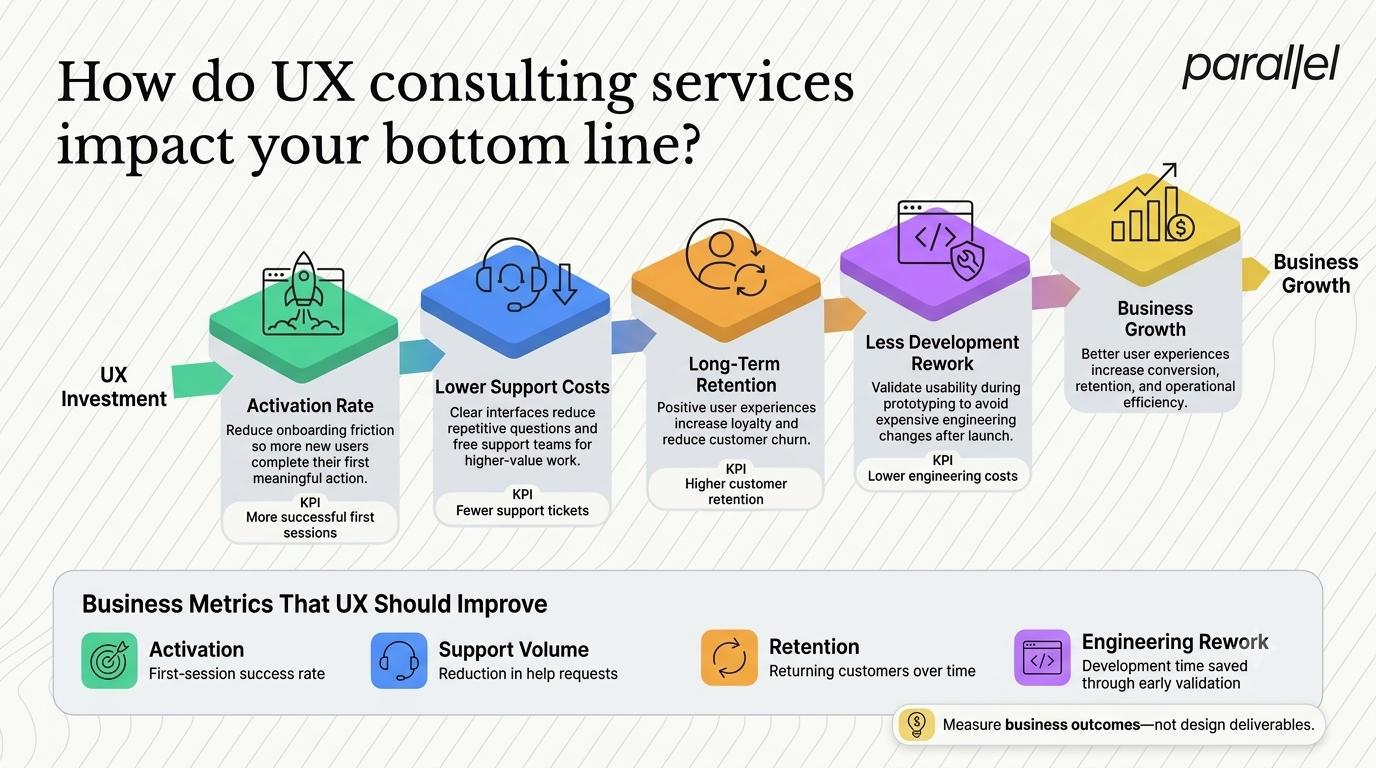
When you simplify a flow, more people complete it. A 2026 report by Searchlab indicates that optimized checkout usability can increase conversions by up to 120%. If your SaaS onboarding is confusing, users churn before they ever experience the actual value of your product. You lose the revenue and the customer acquisition cost simultaneously.
Here is the practical approach to measuring design impact accurately.
Track your activation rate
Are new users completing the core action in your app during their first session? If they are dropping off, your interface is likely creating friction. Simplifying this initial journey is the fastest way to improve your baseline metrics. We highly recommend running a SaaS onboarding teardown to identify these exact drop-off points.
Monitor customer support volume
A sudden spike in support tickets asking how to perform basic tasks means your interface is failing. Good UI/UX design directly lowers support costs. Every hour your team spends explaining the product is an hour they cannot spend building the business.
Measure long-term retention
As recent data shows, 88% of users will not return to a site after a single bad experience. Retention is a design metric. If users find your software frustrating, they will move to a competitor who makes their life easier.
Calculate development rework costs
Fixing usability issues after launch costs exponentially more than fixing them during the prototyping phase. Investing in clarity early prevents your engineering team from rewriting code later. You have to tie design decisions to these financial numbers. If a consultant cannot explain how their work will move these specific metrics, they are not acting as a true business partner.
Making your final decision
Choosing a design partner is about trusting someone with the mechanics of your business. You do not just want a vendor who nods and opens Figma immediately. You want a team that brings sharp thinking, pushes back when necessary, and grounds every decision in real user needs.
Look closely at how they approach their first conversation with you. Are they asking about your color preferences, or are they asking about your business model? Let the quality of their questions guide your choice. A great partner will challenge your assumptions to protect your product.
Frequently asked questions about UX consulting services
We hear these questions constantly from founders trying to navigate the agency landscape. Here are the clear, unfiltered answers.
1) What are UX consulting services?
They are specialized advisory and execution offerings where experts help businesses improve how users interact with their digital products. This goes far beyond drawing screens. It includes deep user research, product strategy alignment, interface design, and rigorous usability testing. The goal is to solve specific business problems by making the software easier and more intuitive to use.
2) How much do UX consulting services cost?
Pricing varies drastically based on the firm size and the scope of work. A targeted design sprint with a specialized boutique agency might cost between $15,000 and $40,000. This is usually the best path for early-stage startups. Conversely, massive global engagements with enterprise firms like IDEO or Frog can easily run into the hundreds of thousands or even millions of dollars. Always pay for the value generated rather than the hours spent.
3) When should an early-stage startup hire outside help?
You should bring in experts when you have achieved initial product-market fit but are struggling with user activation. It is also wise to hire outside help when your internal team is simply too close to the problem to see the obvious flaws. Finally, hire an agency when you need to move faster than your current engineering bandwidth allows.
4) What is the difference between a consultant and an in-house designer?
An in-house designer focuses heavily on long-term maintenance and incremental updates across the entire product ecosystem. A consultant comes in to solve a highly specific, complex problem quickly. Consultants bring a fresh perspective and cross-industry experience that helps unblock the internal team and set a new standard for quality.
5) How long does a typical engagement last?
It depends entirely on the approach you choose. Traditional research phases at large agencies can take three to six months before you see a single screen. We believe that is too slow for modern software. We prefer structured, high-intensity models. A focused strategy phase or a design sprint usually takes two to four weeks to deliver actionable product clarity.
6) How do you measure the success of a design project?
Success must be measured through business metrics. Design awards do not keep startups alive. You should look for concrete improvements in user activation rates, reduced churn over 90 days, lower customer support ticket volume, and higher conversion rates on your most critical workflows.
7) Is UI design included in these engagements?
Usually, yes. While the user experience side focuses on the logic, research, and structural wireframes, most modern partners will also deliver the final visual layers. This ensures the strategic logic is executed correctly in the final product. We highly recommend using Figma design services to keep all prototypes collaborative and accessible for your engineering team.
8) Why choose ParallelHQ over a larger global agency?
Large agencies are built perfectly for massive corporate transformations. ParallelHQ is built specifically for speed and clarity in the startup ecosystem. We work directly with founders and product leaders to simplify complex decisions. We do this without the bloat, excessive overhead, or agonizingly slow timelines of traditional agencies. We help you think better and ship faster.

check out these related blogs