If you’re building a new product, chances are you’ve heard someone ask what PMM is in marketing. It’s a small acronym with big implications for early‑stage teams. Many founders assume that a strong product and a clever growth hack are enough to win the market. In practice, products fail because nobody thinks through how to position them, who they’re for or how to talk about them. That’s the space where a Product Marketing Manager (PMM) adds value.
This article answers that question head‑on and explains why the PMM discipline is distinct from general marketing or product management. In less than 120 words: a PMM connects the problem your product solves to the people who need it, and builds the processes that allow you to scale. The rest of this guide dives deeper.
What exactly is PMM?
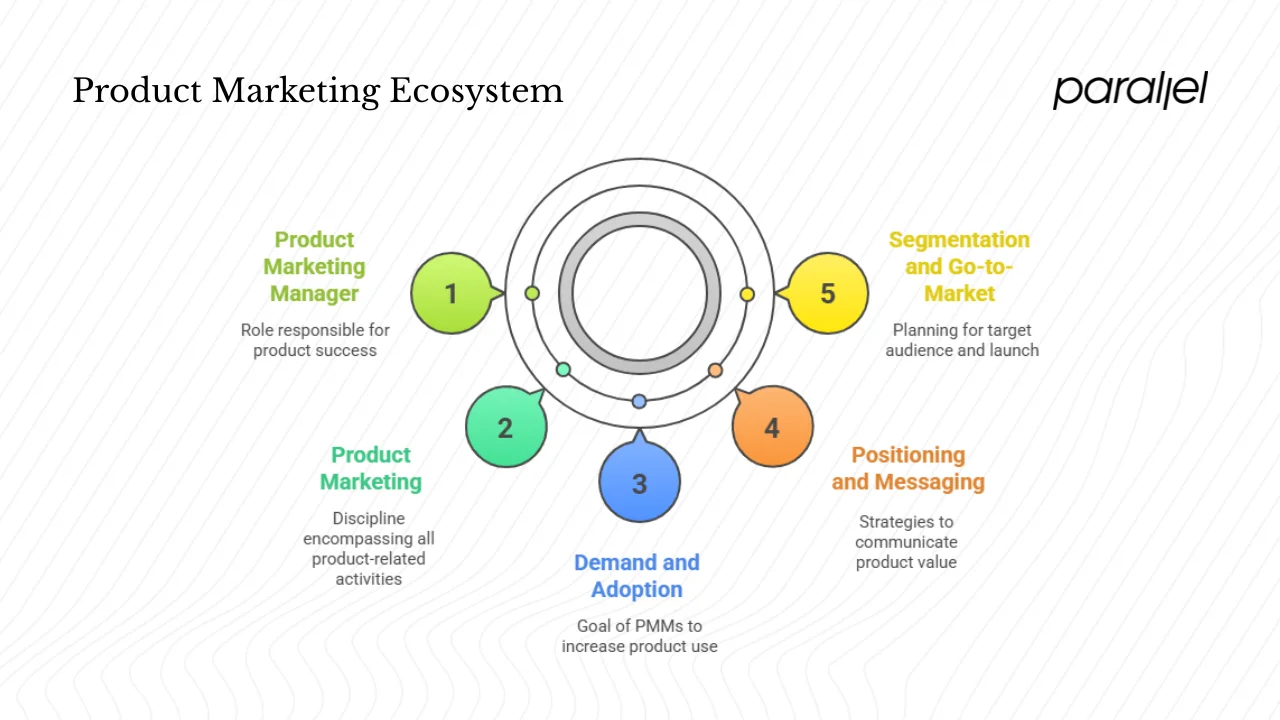
Many people ask what PMM is in marketing when they first encounter the term. The acronym “PMM” is used to describe either product marketing as a discipline or the Product Marketing Manager role. While the terms are related, it’s useful to separate them. Product marketing refers to the end‑to‑end activities that bring a product to market and keep it thriving. These include positioning, messaging, segmentation, go‑to‑market planning, sales enablement and ongoing feedback loops. Product Marketing Manager describes the individual (or team) responsible for these activities.
In most organisations, product marketing sits at the intersection of product and marketing. It differs from brand or general marketing because it focuses on individual product context rather than company‑wide communication. Brand teams shape the company narrative; PMMs translate the features and benefits of individual products into language that specific segments can understand. According to the Product Marketing Alliance, a PMM’s role is to drive demand and adoption by promoting products to customers, focusing on positioning, messaging and campaigns that introduce a product to its target audience.
Product marketing as a discipline
As a discipline, product marketing is a structured set of processes that run across a product’s life cycle. When people research what is PMM in marketing, they often encounter Forrester’s Product Marketing and Management (PMM) Model, which frames it as a series of best‑practice activities needed to commercialise a product and manage its life cycle. PMM touches everything from market research through launch planning and ongoing optimization. A good PMM doesn’t just create a launch plan; they build feedback loops and frameworks that evolve with the product. Unlike general marketing, product marketing is closely tied to product roadmaps and feature prioritisation.
What a PMM is not
Because the title includes “marketing,” many people think of PMMs as sales enablers or content marketers. That’s incomplete. They certainly create sales materials and write copy, but their job isn’t to run paid campaigns or manage brand awareness. They also aren’t the same as product managers. PMs own the discovery and delivery of features; PMMs own the market and narrative. As the Product Marketing Alliance states, PMMs are the overarching voices of the customer, masterminds of messaging and accelerators of adoption. They work with sales and growth roles but don’t replace them.
Why PMM matters, particularly for startups
1) Bridging product and market
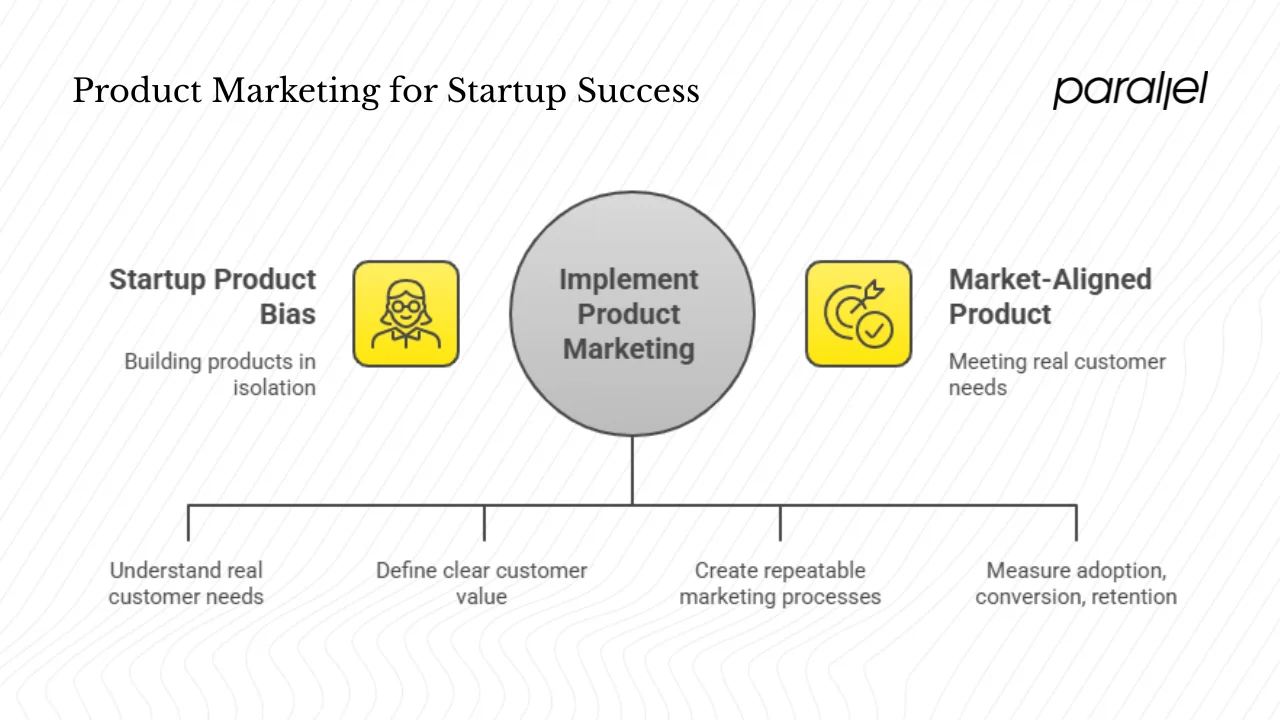
Early‑stage teams often build products they would use themselves. That bias can be costly. For founders wondering what is PMM in marketing, the answer starts here: a PMM mitigates this bias by ensuring that what you build meets real market needs. They conduct research, segment audiences and translate technical decisions into language the outside world can understand. In essence, a PMM connects your internal product work to the external market—avoiding features that nobody uses. Companies that ignore product marketing see launches flop or churn increase because the offering fails to match customer needs.
2) Mitigating risk in go‑to‑market
Launching a new product involves risk: poor positioning, weak planning or mismatched segmentation can lead to costly failures. The Aventi Group reports that product marketing managers serve as the crucial link between development and the market, ensuring the product meets customer needs while crafting strategies that position it effectively. By defining clear value propositions and segments, a PMM reduces go‑to‑market risk. They also bring internal teams into sync so engineering, design and sales are speaking the same language.
3) Enabling scalability
When you’re scaling, you need repeatable processes. A good PMM sets up frameworks and playbooks for research, positioning, messaging and launches. They think outside individual campaigns and build multi‑channel engines that support long‑term growth. The Aventi Group’s State of Product Marketing Leadership report found that 83.1% of leaders prioritise go‑to‑market strategy and execution, while 92.3% value cross‑functional connections and 87.7% emphasise communication. These figures underline how critical structured PMM work is to sustainable scaling.
4) Impact metrics to own
PMMs aren’t measured by impressions alone. Their success shows up in metrics like adoption, conversion, retention, net promoter scores and funnel efficiency. Pragmatic Institute reports that high product adoption correlates with higher retention and lower churn. Adoption rates, retention rates and close rates are therefore important gauges of PMM effectiveness. A strong PMM function also tracks metrics like customer acquisition cost, lifetime value and activation, as discussed in Userpilot’s 2025 metrics guide.
Core responsibilities and activities of a PMM
A common misunderstanding about what is PMM in marketing is that it’s just about messaging; in reality, a PMM’s work spans research, positioning, storytelling and enabling teams. Key domains include:
- Research and market intelligence. Desk research, interviews and win/loss analyses uncover customer problems and competitor moves. These insights inform segmentation and positioning.
- Segmentation and personas. PMMs group users by behaviour and needs, then build personas (user, buyer, influencer) that capture motivations and pain points. Personas help focus features and messaging.
- Value proposition and positioning. They convert features into benefits and proof points. They use frameworks (frame of reference, differentiators, proof) to craft a unique position and iterate based on feedback.
- Messaging and narrative. PMMs create a message hierarchy—core message, supporting pillars, proof—and weave it into stories that fit each channel.
- Go‑to‑market planning. They design launch plans: timelines, channels, experiments and metrics. MarketerHire emphasises that PMMs outline objectives, timelines and important metrics and coordinate cross‑functional teams.
- Sales enablement. PMMs build sales decks, battlecards and training, ensuring internal teams can speak confidently about the product.
- Feedback and iteration. After launch, they analyse metrics and collect qualitative feedback to refine messaging, segmentation and roadmap.
- Life‑cycle support. They contribute to decisions across growth, maturity and decline phases, advising on repositioning or sunsetting.
PMM vs. other roles
Understanding the differences between PMM and other roles helps clarify what is PMM in marketing. PMMs collaborate with many roles but do not replace them. Key distinctions:
- PMM vs product manager. PMs build and define the product; PMMs take it to market. The Product Marketing Alliance summarises the difference: PMs develop and define the product, while PMMs lead the go‑to‑market strategy. PMMs translate features into narratives and demand.
- PMM vs marketing manager/brand lead. Marketing managers focus on company‑wide awareness; PMMs focus on individual products. Demand marketers run campaigns; PMMs craft the product story and ensure campaigns reflect the product’s value.
- PMM vs growth/performance roles. Growth teams optimise channels and run experiments; PMMs shape positioning, messaging and segmentation. They work together, but their mandates differ.
How PMM fits into the marketing strategy ecosystem
Another way to frame what is PMM in marketing is to see how product marketing fits within the wider ecosystem. It:
- Integrates with brand and demand. PMMs work with brand, content, performance and PR teams to move audiences from awareness to adoption to retention.
- Coordinates workflows. They partner with product, design, engineering, sales and customer success through regular syncs, using checklists and templates to keep everyone aligned.
- Adapts to structure. PMMs may report into marketing or product; hybrid models are common. As companies scale, roles specialise by product or segment.
- Uses frameworks and tools. Models like Forrester’s PMM framework and metrics dashboards help standardise processes and measure impact.
Challenges, misconceptions and pitfalls
Common Challenges
- Overpromising: Creates unrealistic expectations and tension between product and marketing.
- Poor coordination: Misaligned priorities or unclear communication slow down projects.
- Weak feedback loops: Insights from launches or customers rarely influence product decisions.
- Unclear handoffs: When PM and PMM roles overlap or aren’t defined, work gets duplicated or missed.
Frequent Misconceptions
- “PMM starts at launch.” In reality, PMM should be involved early—helping shape positioning, audience insight, and messaging.
- “PMM replaces other marketing roles.” It doesn’t. PMM connects product strategy with broader marketing execution.
- “PMM only matters in B2B.” It’s just as valuable in B2C, helping translate product value into clear customer understanding.
How to Avoid These Pitfalls
- Define responsibilities early so PM and PMM know exactly where each contributes.
- Start small with simple frameworks that build collaboration without heavy processes.
- Prioritize feedback cycles between PMs, PMMs, and customers to keep learning continuous.
- Keep communication open to ensure insights flow both ways—from market to product and back.
PMM at different stages of startup growth
A PMM’s contribution evolves with the company:
- Pre‑product. They conduct discovery interviews, analyse competitor messaging and test early positioning.
- Product‑market fit. They refine segmentation, run experiments on messaging and pricing and track activation and retention to accelerate learning.
- Scale. They create repeatable launch playbooks, manage multiple product lines and consider new segments or geographies.
Case examples and illustrations
Background
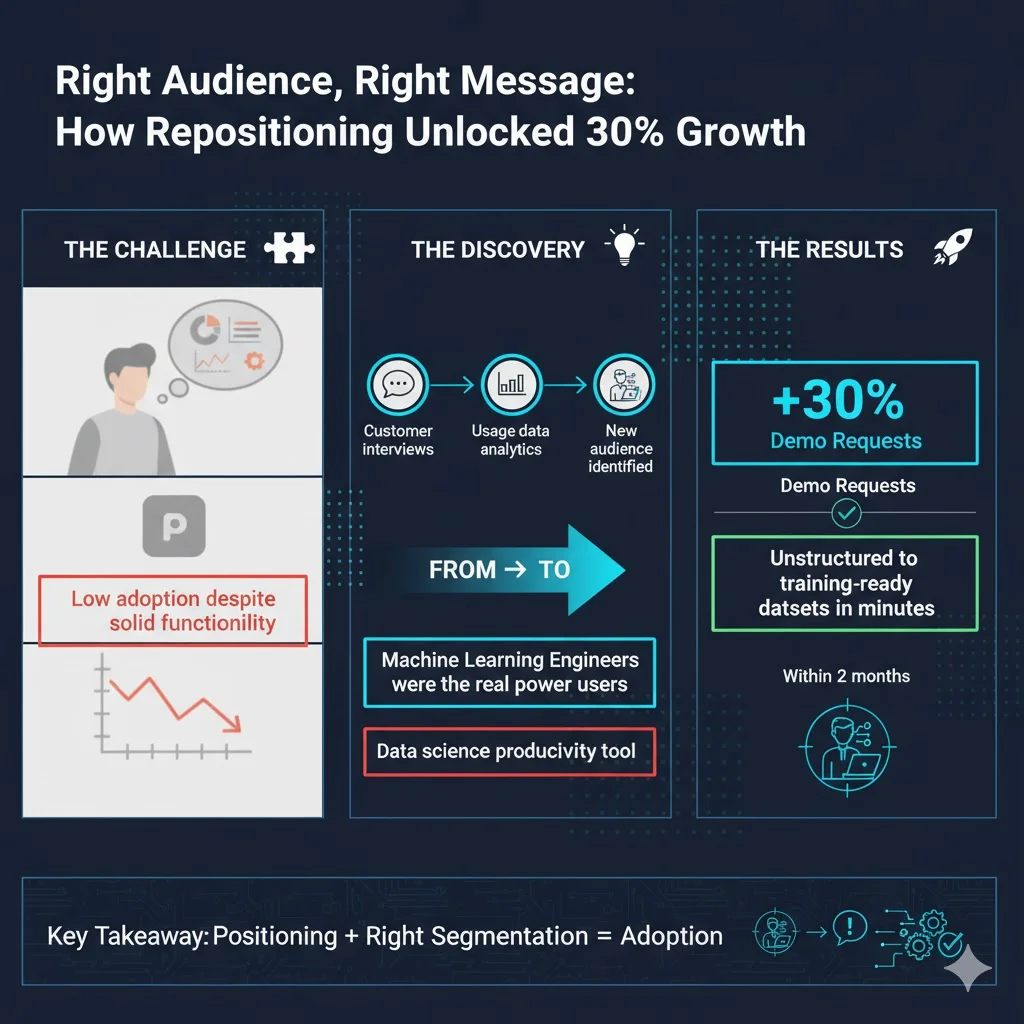
A startup developing artificial-intelligence tools faced low adoption rates. The product was designed to help users process large volumes of unstructured data, but despite solid functionality, it wasn’t gaining traction among its intended audience—data scientists.
Challenge
The product marketing manager (PMM) discovered that while data scientists understood the tool, they weren’t the ones most motivated to use it daily. They preferred high-level analysis and model evaluation, not data preparation. As a result, the messaging around “data-science productivity” wasn’t resonating.
Approach
After conducting customer interviews and reviewing product usage data, the PMM noticed a different segment was interacting more actively with the trial version: machine-learning engineers. These users were closer to the hands-on data-processing stage and cared about efficiency in cleaning, labeling, and formatting datasets.
The PMM re-segmented the target audience to focus on this group and repositioned the product accordingly. Instead of marketing it as a general productivity tool for data scientists, it was reframed as a solution that transforms unstructured data into training-ready datasets in minutes. The messaging shifted toward speed, automation, and integration with existing ML pipelines—issues that directly affected engineers’ daily work.
Results
This adjustment produced immediate gains. Within two months, demo requests rose by 30%, and conversion rates improved as prospects now clearly understood the product’s purpose and relevance.
Lesson
Positioning and segmentation aren’t just marketing tactics—they determine whether people see the product as meant for them. When you match the message to the right audience, adoption follows.
Building or hiring a strong PMM function
If you’re looking to hire, be clear about what PMM is in marketing. To build a strong PMM function:
- Skills. Seek strategists who combine market intuition, storytelling and data literacy. Aventi’s survey emphasises that leaders value cross‑functional connections and communication.
- Professional path. PMMs often come from product, marketing or sales. Senior roles include Head or VP of Product Marketing. A strong professional path spans both product strategy and revenue work.
- Setup. Start with one PMM in early stages; as you grow, specialise by product or segment. Use simple frameworks, launch checklists and shared KPIs, with emphasis on communication over tools.
Conclusion
Every startup asks at some point what PMM is in marketing. The short answer: it’s the function and role that connects what you build with who you build it for. In this guide, we’ve shown that product marketing is more than writing copy or designing slides. It’s a strategic discipline that reduces risk, accelerates learning and sets the foundation for scale. Founders and product leaders at early‑stage companies should treat PMM not as an afterthought but as a core capability. Even if you can’t hire a full‑time PMM yet, adopt the mindset: research your market, craft a clear position, bring your teams into sync and measure adoption and retention. Doing so will improve your odds of creating something people love.
Frequently asked questions
1) What are examples of product services?
Product services include supplementary offerings that enhance a product’s value. For example, a software subscription might come with onboarding assistance, training workshops or premium support packages. These services help customers realise value faster and reduce friction.
2) What is the total product experience?
Total product experience encompasses every interaction a customer has with your product—from marketing messaging and onboarding to support and ongoing usage. It includes the tangible features and intangible feelings that arise when using the product. A PMM works with product and design teams to shape this experience holistically.
3) What is the difference between user experience and product experience?
User experience (UX) refers to how an individual interacts with the interface at a micro perspective (e.g., how easy it is to complete a task). Product experience covers the broader context: how the product fits into the user’s workflow, the emotions it evokes and the outcomes it delivers. UX is a component of product experience.
4) What is the difference between customer experience and product experience?
Customer experience spans all interactions a customer has with your company—including marketing, sales, support and product. Product experience is a subset focused on how the customer engages with the product itself. A company can deliver a delightful product experience but still fall short if sales or support are poor.
5) When should a startup hire its first PMM?
There’s no universal date, but signs that you need a dedicated PMM include frequent launches failing to gain traction, confusion about target segments, and sales teams struggling to articulate value. If founders or PMs are spending more time on copywriting and launch coordination than on product strategy, it may be time to hire a PMM.
6) Is PMM the same as growth marketing?
No. Growth marketing focuses on acquisition and retention through channel optimisation and experimentation. PMM focuses on positioning, messaging, segmentation and getting teams working together. Growth and PMM work together but have different mandates.

check out these related blogs
























































.webp)