Founders often treat design as a final coat of paint. I have seen this mistake kill perfectly good products. When you lack clarity in product thinking, you end up with overcomplicated experiences and weak activation rates. Fixing this requires more than just making screens look pretty. It requires a fundamental alignment between user behavior and business logic. I wrote this guide to help you cut through the agency hype. Here is how you should evaluate user experience design services to build products that actually work.
Quick answer
The right partner simplifies complex product decisions instead of just delivering slick visuals. Choose a provider that improves activation, simplifies onboarding, and grounds decisions in real user data. Here are the top 10 user experience design services compared.
Why do startups fail when buying user experience design services?
Startups often hire agencies to fix a visual problem when they actually have a strategy problem. We have seen teams overcomplicate onboarding because they try to satisfy every edge case. This usually backfires. A 2026 report by the Nielsen Norman Group shows that 68% of users abandon software within the first week due to cluttered interface logic.
You do not need more features. You need more clarity. Many design partners will happily bill you for hundreds of screens without ever asking why a feature exists. In my experience, this is where most product decisions go wrong.
If your product strategy is weak, a beautiful UI will only help users fail faster. Teams must ground their UX decisions in real user behavior. We track activation rates, time to value, and core task completion rigorously.
I see founders fall into the trap of the "Dribbble Effect." They buy interfaces that look stunning in a portfolio but fail completely when real users try to navigate them. Good design is fundamentally about problem solving, not art.
Here are the most common symptoms of a failing design engagement:
- The feature factory: The agency builds whatever you ask for without pushing back.
- The endless discovery: You spend months in research without prototyping anything tangible.
- The big bang launch: Waiting six months to test a monolithic design update.
You have to break this cycle. True product partners will challenge your assumptions from day one.
How should you evaluate providers of user experience design services?
Not all agencies are built the same. A firm that excels at consumer branding might completely fail at complex B2B SaaS workflows. You need to assess their foundational thinking before looking at their portfolio.
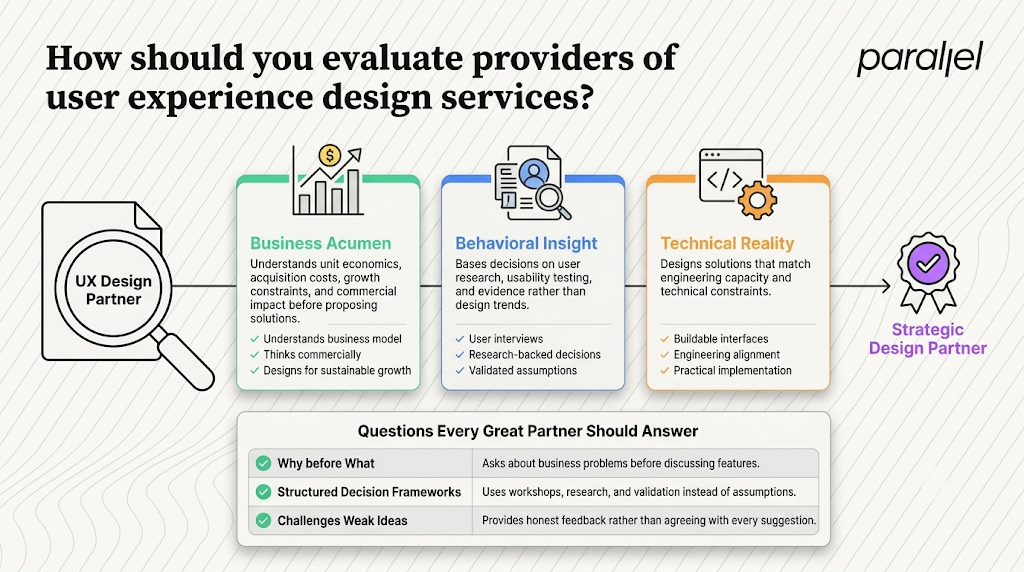
Here is how we think about this tradeoff. You must evaluate partners based on their approach to problem framing. Look for teams that use structured frameworks like design sprints to validate ideas before writing a single line of code.
I look for three specific indicators of maturity when reviewing design teams.
First, assess their business acumen. Do they understand your unit economics, acquisition costs, and growth constraints? A beautiful design that increases your server costs by 300% is a bad design.
Second, examine their behavioral insight. Do they rely on actual user research or just industry trends? According to recent 2025 data from Forrester Research, every dollar invested in deeply integrated, research-backed UX returns 100 dollars in customer lifetime value.
Third, verify their technical reality. Do they design within the limits of your engineering team? A common failure mode is an agency delivering highly complex animations that your lean frontend team cannot possibly build.
We recommend grading potential partners on a simple matrix:
- Do they ask "why" or just "what"?
- Do they offer clear frameworks for decision making?
- Are they willing to kill bad ideas?
If a team agrees with everything you say on the sales call, run away. You are hiring them for their expertise, not their obedience.
Who are the top 10 user experience design services providers in 2026?
1) ParallelHQ
I built ParallelHQ because I saw startups struggling with design decisions that should have been much simpler. We are a product design and strategy partner focused on clarity in thinking. We do not do surface-level design or trend-driven fluff.
Our team works directly with founders and product leaders to solve complex activation problems. We rely on rapid prototyping, rigorous UX audits, and structured workshops. We help you cut through the noise to find the core value of your software.
When you partner with us for user experience design services, you get a team that acts as an extension of your product organization. We are heavily focused on practical outcomes. If you need a partner to evaluate your AI readiness or build a high-converting onboarding flow, we guide you through it step by step.
2) IDEO
IDEO is a legendary name in design thinking. They invented many of the frameworks we use across the industry today. They are ideal for massive enterprises looking to reimagine entire physical and digital ecosystems.
However, their engagement models are often too slow and heavy for early-stage startups. If you need rapid iteration on a SaaS product, a more agile IDEO alternative might be practical. They excel at systemic innovation but can struggle with the pacing of lean software delivery.
Their strength lies in participatory design and deep ethnographic research. If you have the budget and a multi-year timeline, their strategic insights are world-class.
3) MetaLab
MetaLab has built some of the most recognizable interfaces in the world. They have an incredible eye for aesthetics and seamless brand integration. If you are building a consumer app where visual polish is your primary moat, they are a formidable choice.
The downside is their premium pricing and typical project scale. Many B2B teams find that a MetaLab alternative offers a more grounded approach to complex, data-heavy workflows.
They are brilliant at making products feel magical. Just ensure your underlying business model supports the heavy upfront investment they require.
4) Clay
Clay bridges the gap between branding and digital product execution beautifully. They are highly effective for startups that need a strong narrative tied directly to their user interface. Their work is characterized by smooth animations and modern typography.
They lean heavily toward consumer tech, Web3, and marketing-heavy SaaS platforms. If your core problem is a deeply technical enterprise dashboard, you might want to evaluate a Clay alternative.
Their storytelling ability is unmatched. They make software look like a high-end editorial experience.
5) Work & Co
Work & Co focuses strictly on shipping digital products. They do not get distracted by marketing or pure branding exercises. Their methodology is highly technical and closely integrated with engineering constraints.
They are a fantastic choice for large-scale technical overhauls where developer handoff is the biggest risk. For smaller startups needing nimble strategic pivots, a Work & Co alternative could provide faster turnaround times.
Their teams operate with military precision. They are builders who respect code just as much as they respect pixels.
6) Frog Design
Frog is a massive global consultancy with deep roots in industrial design. They bring immense resources to any complex, multi-platform project. They are well suited for connected devices or global corporate rollouts.
Their process is rigorous, highly documented, and inherently corporate. This makes them a safe bet for risk-averse Fortune 500 companies. Startups often seek a leaner Frog Design alternative to avoid heavy enterprise overhead and slow approval cycles.
They shine when bridging the gap between physical hardware and digital interfaces.
7) Ramotion
Ramotion specializes in brand identity and interface design for growing technology startups. They have a very distinct, clean visual style that plays well in the modern SaaS market. They are excellent at creating cohesive digital environments.
They often focus more on the visual execution and marketing alignment than deep, behavioral product strategy. Teams needing heavy foundational research might look for a Ramotion alternative.
They are incredibly reliable for teams that have a working product but need it to look significantly more professional for a Series B fundraise.
8) R/GA
R/GA is a legacy advertising agency that evolved into a digital product powerhouse. They are brilliant at creating connected brand experiences that drive consumer engagement. If your product relies heavily on viral marketing loops, they are a solid option.
Their roots in advertising mean they sometimes prioritize campaign flash over daily utility. A dedicated R/GA alternative usually works better for complex enterprise software where efficiency beats entertainment.
They are masters of the attention economy. They know how to capture a user's gaze immediately.
9) Huge
Huge operates at the intersection of design and massive business transformation. They are built to handle organizational redesigns alongside digital product launches. Their strategic capabilities for legacy companies are top tier.
Their engagements require significant capital and vast internal resources from the client side. Early-stage founders generally prefer a Huge alternative for faster, leaner product validation.
They excel at breaking down silos in massive corporations to deliver a unified customer experience.
10) Neuron
Neuron focuses specifically on B2B workplace software and internal tools. They understand the nuances of enterprise dashboards, permission states, and data-heavy environments. They are very practical in their approach to complex information architectures.
They do not focus heavily on brand flair or consumer aesthetics. If you are building a highly visual consumer app, a Neuron alternative will serve you much better.
For dense, complicated military-grade or medical software, their pragmatic approach is exactly what product managers need.
Where do teams go wrong with user experience design services?
The biggest failure pattern I see is a lack of clear business outcomes. Teams hand over a massive list of features to an agency and expect magic to happen. A successful product design engagement requires you to define what success looks like in hard numbers.
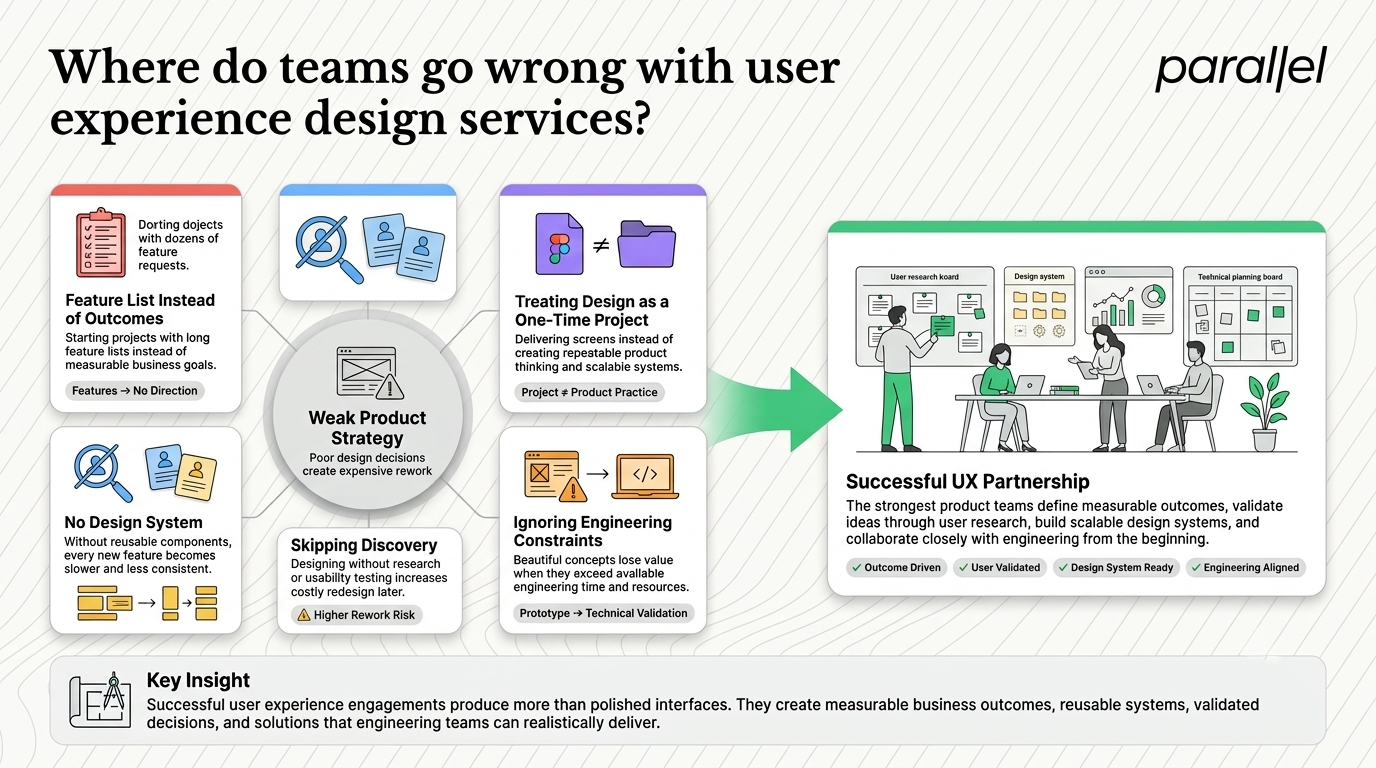
Another common trap is skipping the discovery phase entirely. Designing without usability testing is just expensive guessing. According to a 2026 product development survey by IDEO U, teams that skip foundational research face a 50% higher rework rate post-launch. You have to talk to your users.
Founders also err by treating design as a finite, outsourced project. Product thinking is a continuous discipline. You do not just design a product once and walk away.
The best partners help you build internal design systems so your own team can scale the work long after the agency leaves. They leave you with a system of thinking, not just a Figma file.
Lastly, do not ignore engineering constraints during the design phase. We always validate our prototypes with technical leads early. A concept that takes three months to code when you only have three weeks of runway is a useless concept.
Conclusion
Great product experiences are not born from chasing design trends. They come from a relentless focus on user behavior and incredibly clear decision making. You must strip away the noise to find the core value of your software.
Choosing a design partner is about finding a team that is willing to challenge your assumptions. They should tell you when a feature is unnecessary. They should push for clarity over cleverness every single time. Let the quality of your thinking dictate the quality of your product.
Frequently asked questions
1) What are user experience design services?
These services encompass the research, strategy, and interface creation required to make software usable and valuable. They move beyond mere visual aesthetics. They focus entirely on user behavior, logic, and seamless task completion.
2) How do we measure the ROI of these services?
You measure success through product metrics, not subjective visual feedback. Look at activation rates, time to onboard, and reduced support tickets. Good design directly impacts retention and increases customer lifetime value.
3) Should we hire an agency or build an in-house team?
Startups benefit from agencies when they need rapid, high-level strategic direction or specialized skills like interaction design. Once a product finds strong market fit, building an in-house team becomes critical for continuous, daily iteration.
4) How much do these services typically cost in 2026?
Costs vary wildly based on the agency size and project scope. A lean strategic discovery sprint might cost 20,000 dollars while a full enterprise platform overhaul can exceed 250,000 dollars. Focus on the business value delivered rather than just the hourly rate.
5) What is the difference between UI and UX services?
UX dictates how the product works logically and behaves structurally. UI is how the product looks visually. Strong UI/UX design services blend both seamlessly, ensuring the visual interface perfectly supports the underlying user journey.
6) Is a specialized UX agency right for my early-stage startup?
Yes, especially if you lack clarity in your product direction. An experienced partner helps you validate ideas quickly before you waste months of expensive engineering time. They help you build the right thing, not just build things right.
7) How long does a typical UX redesign take?
A targeted website redesign or mobile app overhaul takes between 8 to 12 weeks. Complex enterprise platforms can take up to 6 months. We strongly recommend breaking massive projects into smaller, testable release cycles.
8) What makes ParallelHQ different from other user experience design services?
We focus strictly on clarity and product thinking. We are not a traditional agency trying to sell you endless retainers or trendy visuals. We act as your strategic partner to untangle complex user flows and drive real, measurable product activation.

check out these related blogs