Founders often ask me how to budget for a new digital presence. They want a simple number. But when you look closely at website design prices in 2026, the numbers are all over the map. You can spend $5,000 or $150,000. I have spent years watching startups burn cash on beautiful sites that fail to convert. The problem is not the budget. It is a lack of clarity in product thinking. Here is how I advise teams to think about design costs today.
Quick answer
Average website design prices in 2026 range from $15,000 to $50,000 for early-stage startups. Enterprise projects often exceed $100,000. Your cost depends entirely on product complexity, user research needs, and the strategic depth required to drive actual conversions.
What factors actually drive website design prices up or down?
Founders often treat design as a commodity. They shop around for the lowest bid. This is a mistake. Good design is not about making things look pretty. It is about making complex systems easy to use.
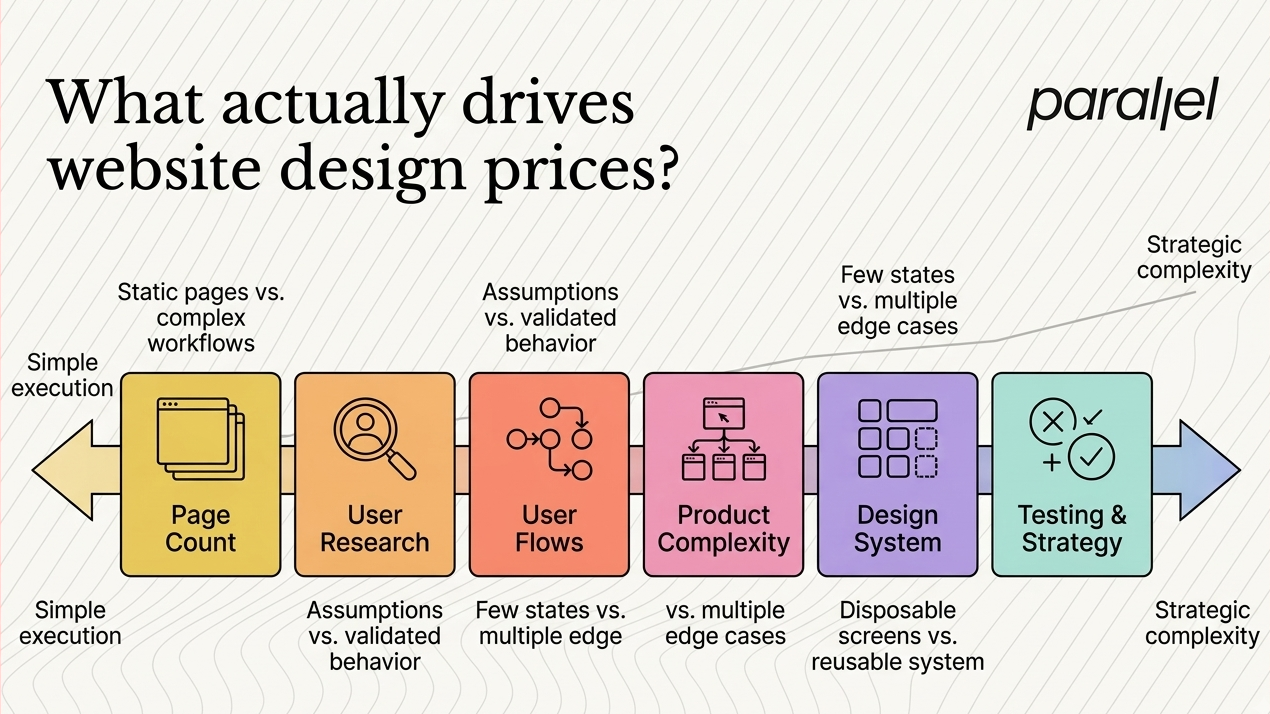
You will notice that website design prices scale predictably with product complexity. A simple landing page costs significantly less than a multi-user SaaS platform. The difference lies in the thinking required behind the screen. An agency charging a premium is usually charging for the rigorous logic, testing, and system architecture required to make the final product feel effortless.
Here are the specific factors that dictate your budget and determine whether your investment will yield a return.
Strategic depth and user research
Cheap design skips research. It relies on templates, competitor copying, and assumptions. This might save you money upfront, but it costs you dearly in user activation. When you build on assumptions, you inevitably build the wrong features.
We always start with deep discovery. Understanding your users is non-negotiable. A 2026 Nielsen Norman Group report on UX economics showed that teams investing heavily in upfront discovery reduce post-launch engineering rework by up to 50%. If an agency is not charging for research, they are guessing. Guessing is incredibly expensive when you have to pay developers to rebuild the product six months later. If you want to understand how this process works in practice, look at our discovery framework.
Product complexity and user flows
A marketing website with five static pages is straightforward. A fintech dashboard with layered permissions, real-time data visualization, and complex compliance constraints is not. Complexity multiplies the time required for wireframing, edge-case mapping, and prototyping.
When we map out product flows, we look strictly at cognitive load. How many steps does it take a user to find value? Reducing those steps takes rigorous interaction design. We have to map out what happens when a user clicks a button, what happens when an API fails, and what happens when a user inputs the wrong data. If your product requires extensive wireframing and prototyping, expect the budget to reflect that critical effort.
Design systems and scalability
Early-stage teams often ignore design systems. They just want screens quickly to show investors. But as your product grows, inconsistent design debt slows down your engineering team. Every new feature becomes a headache because developers do not have reusable components.
Building a robust design system adds to the initial cost. However, it ensures that your team can ship features twice as fast next year. You are paying for future velocity. A proper system includes coded guidelines, typography scales, accessibility rules, and interactive states. This is the difference between buying a disposable asset and building a scalable foundation.
A complete breakdown of costs by company stage
Every company stage has completely different design needs. A Seed stage startup needs to prove a concept to investors. A Series B company needs to scale operations, localize for new markets, and optimize conversion rates. Enterprise companies need to manage immense technical debt and compliance.
Here is what you should expect to spend based on current market data for legitimate, strategy-driven design partners.
Table: Expected budgets and deliverables by stage
Seed stage startups
At this stage, you need to validate your idea fast. You do not need a massive enterprise site with hundreds of customized illustrations. You need clarity, trust, and a clear value proposition that resonates with your first hundred users.
- Focus Areas: Core user flows, strong messaging, brand foundation.
- The Trap to Avoid: Over-engineering. Do not build for scale yet. Build for validation. We often use design sprints at this stage to test ideas quickly without wasting months of budget. You need to know if users actually want the product before you spend fifty thousand dollars polishing it.
Growth stage companies
Your product works. You have users. Now you need to fix the massive leaks in your funnel. Growth stage companies often come to us with broken onboarding experiences, high churn rates, and disjointed features that were bolted on over the years.
- Focus Areas: Conversion rate optimization, onboarding teardowns, design systems.
- The Trap to Avoid: Cosmetic redesigns. Changing brand colors will not fix a fundamental usability issue. You need a deep UX audit before changing a single pixel. We look at data, session recordings, and user feedback to find exactly where people are dropping off.
Enterprise and scale-ups
Enterprise design is about managing massive complexity safely. You have multiple user types, legacy tech debt spanning decades, and strict accessibility requirements. A single design change can impact millions of users and thousands of internal employees.
- Focus Areas: Digital transformation, accessibility compliance, multi-platform consistency.
- The Trap to Avoid: Siloed design. Enterprise design fails when it does not integrate seamlessly with engineering and product management. The agency must embed within your corporate structure to understand the technical limitations before they start drawing screens. For this level of complexity, specialized enterprise software design services are mandatory.
How should founders evaluate website design prices against ROI?
When comparing proposals from different agencies, looking only at website design prices is a trap. You have to measure the immediate cost against the potential return on investment.
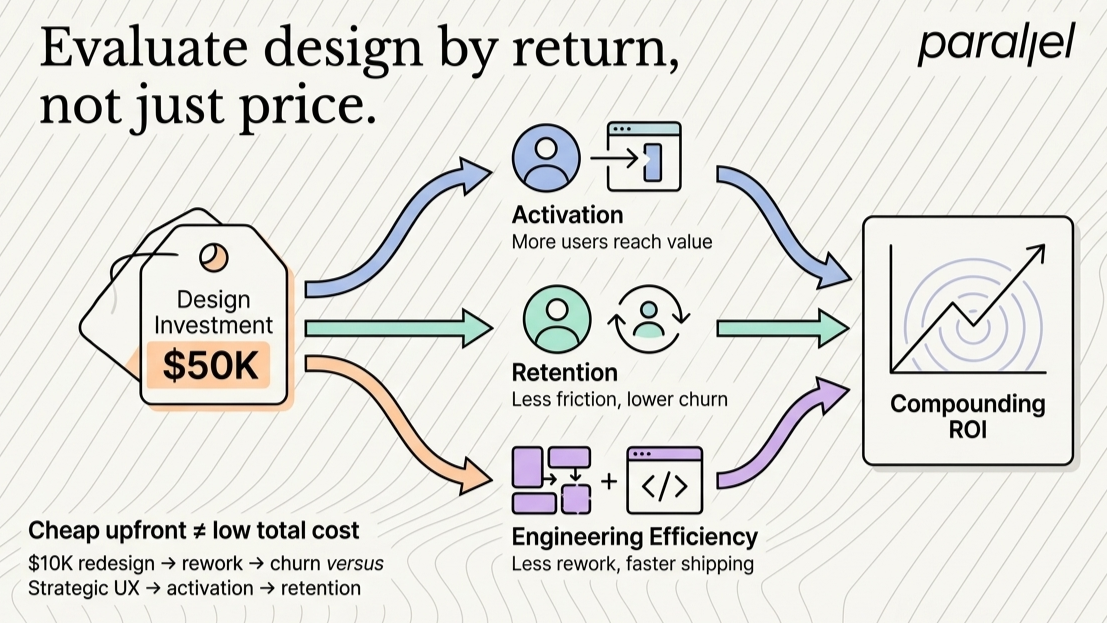
I see startups balk at a $50,000 design proposal. They then choose a $10,000 agency on a freelancer platform. Six months later, their user activation rate is stuck at two percent. They saved $40,000 upfront but are losing hundreds of thousands of dollars in lifetime customer value. Design is a multiplier for your marketing and engineering spend. If the design fails, the whole machine breaks.
Measure activation over aesthetics
Your website or product has one specific job. It must move users to the next step. Whether that is booking a demo, completing a SaaS onboarding flow, or making an e-commerce purchase, the design must remove friction.
According to a 2026 Forrester study on digital customer experience, companies that prioritize strategic UX see a 1.5x higher customer retention rate compared to competitors with legacy interfaces. Good design pays for itself by keeping users inside your ecosystem and preventing churn.
The brutal cost of poor onboarding
Let us look at SaaS onboarding specifically. This is where most product decisions go completely wrong. Teams try to show off every feature at once to justify the subscription price. The user gets overwhelmed, clicks around aimlessly, and leaves forever.
Fixing this requires strategic SaaS onboarding teardowns. We recently worked with a B2B team that had a 60% drop-off during account creation. By simplifying the flow, removing unnecessary form fields, and applying basic UX heuristics, we increased activation by 35% in just a few weeks. The design cost was negligible compared to the recurring revenue they recovered.
Why surface-level design costs you more in the long run
The internet is full of agencies selling visual fluff. They present beautiful screens on Dribbble or Behance that feature floating elements, impossible gradients, and tiny typography. These designs are completely impossible to build in code.
We call this theater design. It looks great in a pitch deck to investors but falls apart instantly in the hands of a real user on a slow internet connection. Real design is deeply unglamorous. It is about spreadsheets, mapping user states, watching frustrating user testing sessions, and arguing over button placement to save a user two seconds of time.
The danger of trend-driven design
Visual trends change every six months. In 2024, everything was dark mode and heavy gradients. In 2026, we are seeing a massive shift toward AI-native interfaces and voice commands.
If you build your product solely based on current visual trends, it will look outdated by next year. Instead, you must build on fundamental human psychology. Clear typography, logical information hierarchy, and intuitive navigation never go out of style. If you are building an AI product, you need specific AI UX design patterns that focus on trust and data transparency, not just glowing visual effects.
Why engineering handoff matters
A beautiful design file is useless if your developers cannot build it. Cheap design agencies often throw a massive Figma file over the fence and disappear.
This creates massive friction internally. Developers have to guess the hover states. They have to invent error messages. They have to figure out what happens on a mobile screen. This doubles your engineering costs and delays your launch. A mature design partner provides detailed documentation, clear component states, and continuous support during implementation. They speak the same language as your engineering team.
What are the hidden website design prices teams forget to budget for?
Founders often budget carefully for the initial launch. They forget that a digital product is a living ecosystem. If you do not plan for the hidden website design prices associated with maintenance, iteration, and compliance, you will run out of cash quickly.
Here are the specific costs that always catch teams by surprise.
Usability testing recruitment
You cannot design in a vacuum. You have to test your product with real people who match your target demographic. Finding and compensating the right users for usability testing takes significant time and money.
The Baymard Institute's 2025 UX research confirms that testing with just five targeted users uncovers 85% of critical usability blockers. Do not skip this step to save a few thousand dollars. Rebuilding a feature because users hate it will cost you ten times more than the testing would have.
Accessibility compliance (WCAG)
Accessibility is no longer an optional feature for good public relations. It is a strict legal requirement in many global markets. It is also just good business to make your product usable for everyone.
Designing for accessibility from day one is relatively cheap and straightforward. Retrofitting an existing complex site for accessibility is incredibly expensive and tedious. Ensure your agency includes a thorough accessibility audit in their initial scope. If they do not explicitly mention WCAG compliance during the proposal stage, they are not a mature partner.
Copywriting and content strategy
Design without content is just decoration. Who is writing the words on your website?
Many founders incorrectly assume the design agency handles the copywriting. Most visual-first agencies do not. You either need to hire a specialized UX writer or dedicate serious internal time to crafting the message. Poor copy will destroy a great design. Users read first and click second. If the words are confusing, the beautiful buttons do not matter.
How we approach design strategy at ParallelHQ
I built ParallelHQ because I saw a massive gap in the tech market. Agencies were delivering pretty pictures that developers hated. Consultancies were delivering thick strategy decks that nobody read. Nobody was bridging the gap between clear product thinking and executable digital design.
We focus relentlessly on clarity
Our entire philosophy is built on simplifying the complex. We do not do fluff. We do not do hype. We look strictly at your business goals, your user needs, and your technical constraints.
Whether we are delivering B2B website design or a complex SaaS application, our process remains grounded in real user behavior. We believe that clarity is the ultimate competitive advantage in a noisy market.
We integrate with your team
We do not work in isolation and we do not do grand reveals. We act as a direct extension of your product team. We believe that the best design decisions happen when designers, product managers, and engineers sit at the same table and argue constructively.
We challenge your assumptions. We ask hard questions about your revenue model. We ensure that every design decision can be defended with data, user feedback, or established usability heuristics. If you are looking for a team that will just nod and color in your wireframes, we are not the right fit. If you need a partner to elevate your product strategy, consider our product strategy consulting.
Conclusion
Budgeting for product design is not about finding the lowest number on a spreadsheet. It is about finding the right partner who deeply understands your business goals and the psychology of your users.
A well-designed digital product is a compounding asset. It generates revenue silently, reduces support tickets drastically, and accelerates engineering velocity. A poorly designed one is a massive liability that will bleed your company dry through high churn and endless development rework. Take the time to evaluate agencies not just on the visual polish of their portfolios, but on the depth of their strategic thinking. Let the clarity of their process guide your final decision.
FAQ
1) What is the baseline for website design prices in 2026?
For a legitimate, strategy-driven project in 2026, expect a baseline of at least $15,000. Anything below this threshold usually indicates a reliance on pre-made templates, minimal user research, or offshore execution without strategic oversight. This baseline covers fundamental discovery, core user journeys, and high-fidelity design.
2) How much does a website redesign cost for a SaaS startup?
A comprehensive SaaS website redesign typically ranges from $30,000 to $70,000. This scope usually includes extensive UX auditing of your current platform, user journey mapping, high-fidelity UI design, and often the creation of a scalable design system to support your future feature rollouts.
3) Are website design prices different for Webflow vs Custom Code?
Yes. Development platform choice heavily impacts your total budget. The initial design strategy costs remain similar, but implementation costs drop significantly with tools like Webflow. We frequently recommend Webflow design and development for marketing sites because it saves immense engineering resources while maintaining high performance.
4) How do I know if I am overpaying?
You are overpaying if the agency focuses entirely on aesthetics without asking deep questions about your underlying business model, customer acquisition cost, or user retention metrics. High costs are only justified by deep strategic alignment, rigorous user testing, and proven return on investment.
5) What is included in typical website design prices at a top tier agency?
A top-tier engagement includes comprehensive stakeholder interviews, detailed competitive analysis, primary user research, structural wireframing, high-fidelity UI design, interactive prototyping, developer handoff documentation, and a foundational component library. They deliver a complete system, not just a folder of images.
6) Should we hire an in-house designer or an agency?
Hire an in-house designer when you need constant, daily iteration on a single core product feature. Hire an agency when you need a sudden injection of high-level strategy, a complete product overhaul, or diverse expertise that a single internal hire cannot possibly provide. Agencies bring cross-industry insights that internal teams often lack.
7) Is UX research usually included in the initial cost?
It absolutely should be included. However, many visual-first agencies quote research as an optional add-on to keep their initial bids artificially low and win the contract. Always ask for a detailed line-item breakdown to ensure primary user research is heavily factored into the initial scope.
8) How does ParallelHQ approach website design and strategy differently?
We operate strictly as a strategic product partner, not a traditional creative agency. We focus relentlessly on clarity and usability. We strip away the unnecessary noise and build experiences grounded entirely in validated user behavior and concrete business logic. We design systems that scale alongside your engineering team.

check out these related blogs



















































.avif)