Building a company often starts with a website. For early‑stage founders and product leaders, that “front door” is the first product experience users encounter, and it carries outsized weight. When that page is slow, cluttered or confusing, people leave; PwC’s research shows that one in three customers will walk away from a brand they love after a single bad experience. Conversely, a thoughtful interface and clear user journey can dramatically improve conversions – Forrester’s studies suggest that well‑designed interfaces can boost conversion rates by 200 per cent while superior UX can lift them by up to 400 per cent. As someone who runs a product design studio (ParallelHQ) and works closely with AI/SaaS startups, I’ve seen how good design turns curious visitors into engaged customers. This guide demystifies modern web design services in Malaysia, highlights how to evaluate partners, and explains why the right decisions can influence everything from brand perception to revenue.
Why web design matters for startups and product teams
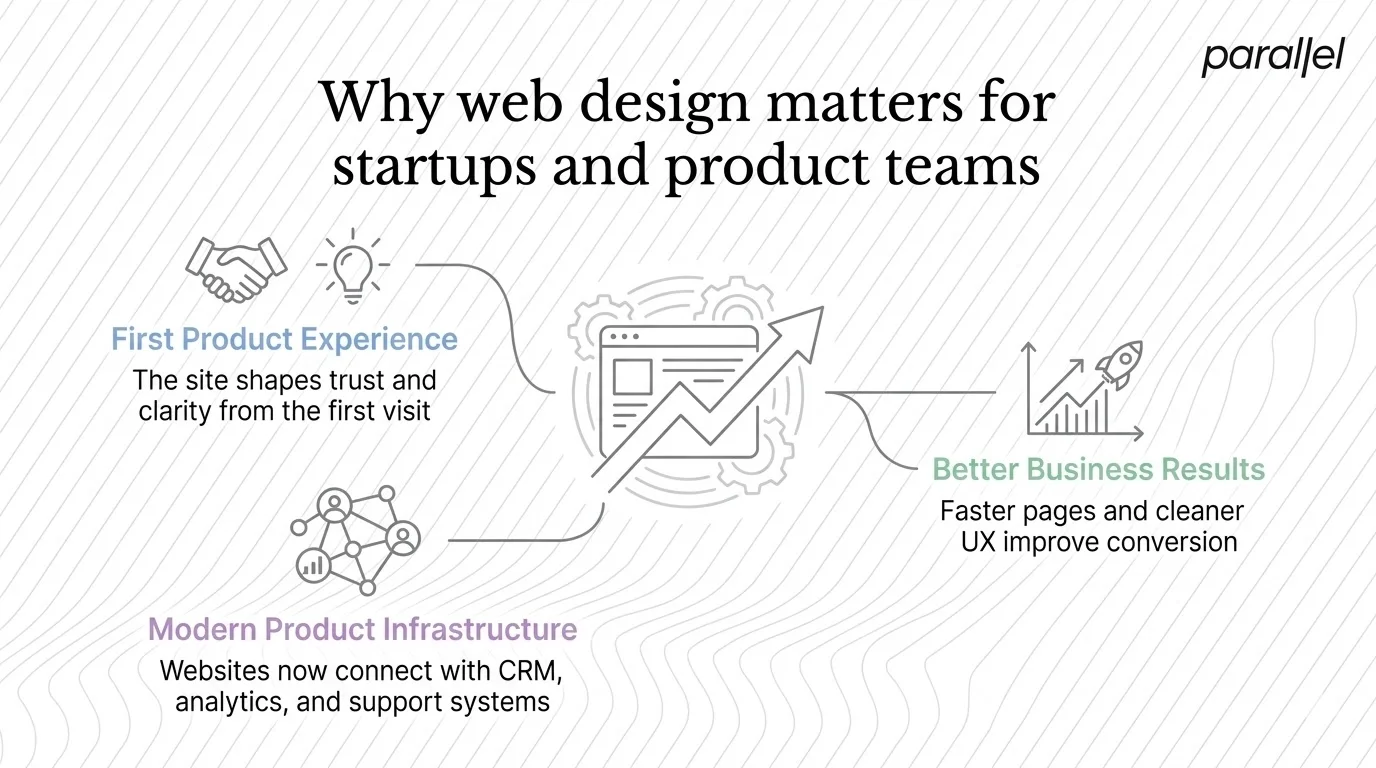
Your website is the first product experience
Most users discover a product through its website. They make split‑second judgments about trust and credibility based on load speed, clarity and tone. Data from the Baymard Institute’s research illustrates how unforgiving visitors can be: if a page takes more than three seconds to load, 40% of people leave; 32% of customers will abandon a brand after one poor experience. Poorly optimised forms are a silent revenue killer too—Baymard found that each extra form field reduces completion rates by about 11 percentage points. In my work with early‑stage founders, I’ve watched promising products suffer because the initial website created friction. That first interaction should feel like a warm welcome, not an obstacle course.
Modern web design drives business results
A site isn’t just a digital brochure; it’s a revenue engine. Industry studies show a direct connection between design quality and performance. Pages loading in one second achieve conversion rates three to five times higher than those loading in five to ten seconds. A responsive, mobile‑friendly site also influences search visibility—mobile devices drive around 64% of global web traffic, and Google has shifted to mobile‑first indexing, meaning it uses the mobile version of a site to determine rankings. Faster load times and simplified navigation aren’t just nice to have; a one‑second improvement in page speed can increase conversions by two percent. Invest in UX and the returns compound: Forrester estimates that every dollar invested in UX returns around 100 dollars. In our own projects, focusing on reducing friction—simpler onboarding flows, clearer calls to action—often yields measurable uplifts in sign‑ups or sales.
What a modern web design agency in Malaysia actually does
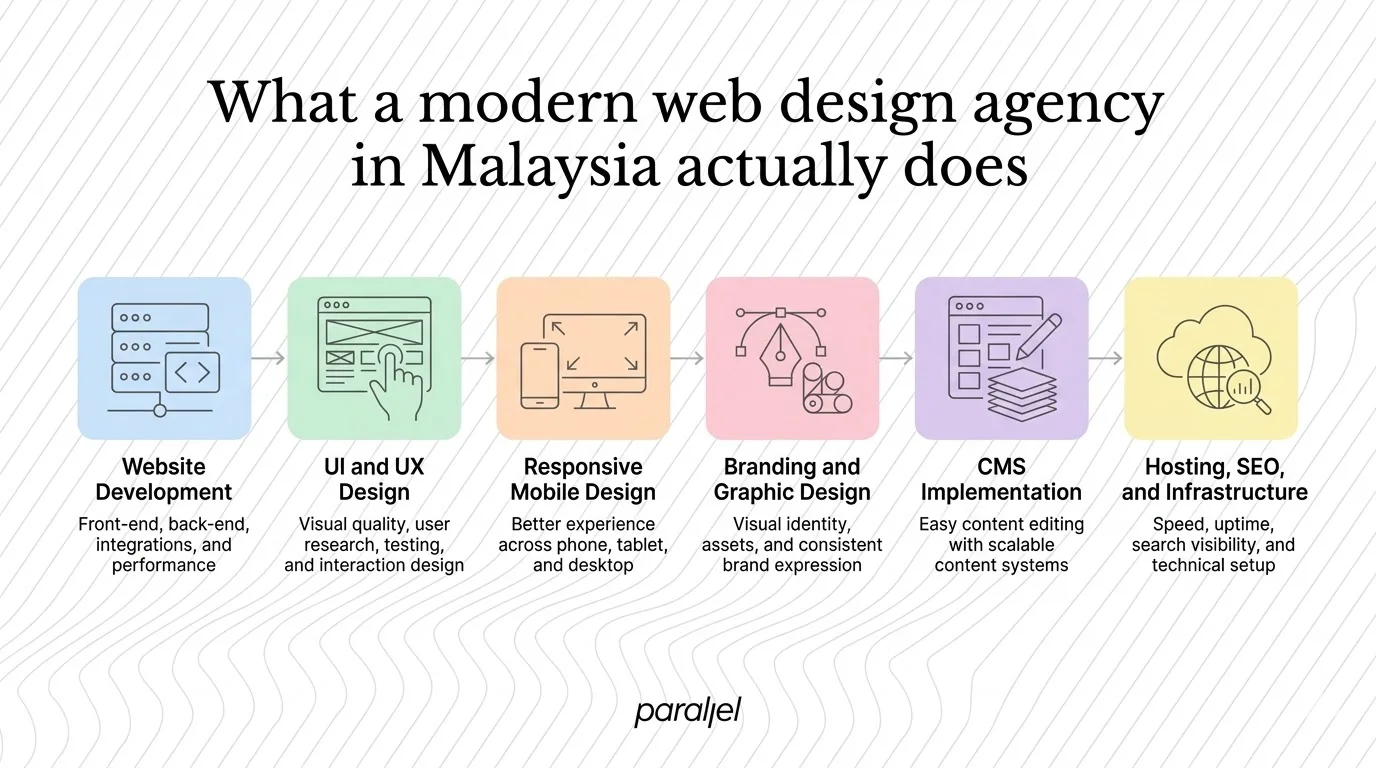
Most professional agencies are multidisciplinary. They combine product strategy, design, engineering and marketing to build digital experiences that scale. Here’s what that looks like in practice:
1) Website development
- Front‑end and back‑end development: Agencies build websites using modern frameworks (React, Next.js, Laravel etc.) and ensure clean coding standards. Back‑end work includes setting up databases, secure authentication and API integrations.
- Integration and performance engineering: A modern site is rarely a standalone brochure. It often needs to integrate with payment gateways, CRMs, analytics services or AI models. Performance engineering—minimising load times, caching content and optimising images—affects both conversions and SEO.
- Scalable digital products: Instead of static pages, the best teams think of your site as an evolving product. They plan for versioning, modular components and future features.
2) UI and UX design
- User interface design: The visual layer—typography, colours, spacing, interactions—creates the first impression. Good design reduces cognitive load and encourages exploration.
- User experience research: Experienced teams conduct interviews, surveys and analytics reviews to understand how your audience behaves. According to PwC, 73% of consumers consider customer experience an important factor in purchase decisions.
- Usability testing and information architecture: Iterative testing reveals friction points; structured navigation helps users find what they need quickly. My team often prototypes multiple versions of a page and measures which one reduces drop‑off rates.
- Interaction design: Micro‑interactions (such as button states, transition animations) provide feedback and build trust. They may seem trivial, but they contribute to an overall sense of quality.
3) Responsive and mobile‑friendly design
With more than half of web traffic coming from smartphones, responsiveness is not optional. Google’s mobile‑first indexing means it evaluates the mobile version of your site first. This shift has raised the bar: sites must look and perform well across devices, and small screens require concise content, larger tap targets and simplified navigation. If your site loads slowly on mobile, users bounce and search rankings drop. In a project for a fintech startup, trimming image sizes and deferring non‑critical scripts cut mobile load times from 6 seconds to 2 seconds. The result: a 30% increase in sign‑up conversions and improved search positions.
4) Branding and graphic design
Many web agencies also offer creative services such as logotype design, visual identity systems, and marketing graphics. Consistent branding builds recognition and trust. Whether it’s designing slide decks for fundraising or producing illustrations for onboarding flows, aligning visuals across touchpoints amplifies your message. An agency with strong branding chops ensures your website is part of a broader narrative rather than a disconnected asset.
5) E‑commerce website development
Selling online introduces additional complexity. Agencies build storefronts using platforms like Shopify, WooCommerce, Magento or custom headless solutions. Typical features include:
- Product catalogues with filtering and search
- Secure payment gateways and multi‑currency support
- Cart and checkout flows designed for conversion (Baymard’s research shows that simplifying checkout can increase conversion rates by 35%)
- Inventory management and order tracking
Global benchmarks put average e‑commerce conversion rates between 1.6% and 2.95%, depending on the source. That means most shoppers don’t buy, so every friction reduction counts. In our work, we often replace long forms with step‑by‑step processes, which increases completion rates by 35–50%.
6) CMS implementation
A content management system lets non‑technical teams publish and update content quickly. Standard options in Malaysia include WordPress, Webflow and Drupal. For businesses operating across multiple channels, headless CMS solutions are gaining traction. In fact, headless commerce has become the architecture of choice for companies focused on digital growth. Netguru reports that the headless commerce market will reach roughly US $1.74 billion by 2025 with a compound annual growth rate of 23.7%, and 92% of US brands have already adopted modular, API‑driven systems. A headless CMS decouples the backend from the front‑end, enabling content to be distributed across websites, mobile apps and social channels. According to the same study, 82% of businesses using headless CMS report simplified delivery processes.
7) Hosting and infrastructure setup
Reliable hosting and infrastructure support security, speed and uptime. Agencies often set up servers, configure SSL certificates, manage DNS, and monitor performance. In high‑traffic scenarios, auto‑scaling servers or content delivery networks (CDNs) ensure the site stays responsive. For small companies, this might mean using managed cloud services; for scale‑ups, it could involve orchestrated containerised deployments. Domain registration and hosting are small line items compared to development but essential for ownership and stability.
8) SEO optimization and performance
Modern agencies integrate search engine optimization from day one. Technical SEO includes clean URLs, metadata, structured schema, and proper heading hierarchies. Performance optimization (compressing images, minifying code) aids both SEO and user satisfaction. As our own analytics confirm, pages that load quickly and use targeted keywords rank higher and convert better. Combine this with content strategy—building landing pages around user intent—and you have a strong foundation for organic growth.
How web design agencies typically work with clients
The best collaborations feel like partnerships rather than transactions. Here’s a typical process I follow with clients in Malaysia:
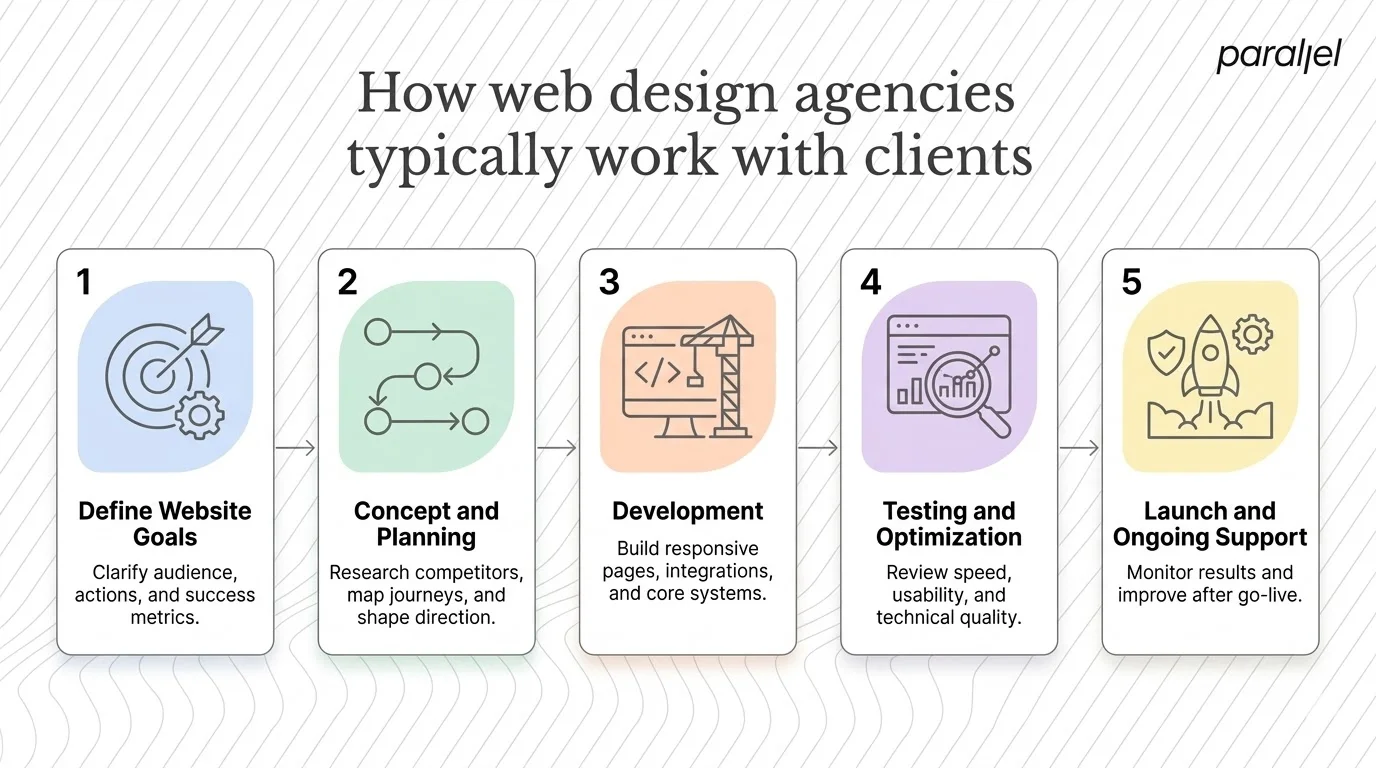
Step 1 — Define website goals
We begin by clarifying business objectives, audience personas and desired actions (sign‑ups, purchases, demos). Without a shared understanding, you risk building a site that looks beautiful but misses its purpose. We ask: What problem does your product solve? Who is your primary user? Which metrics matter? This conversation anchors the strategy.
Step 2 — Concept and design planning
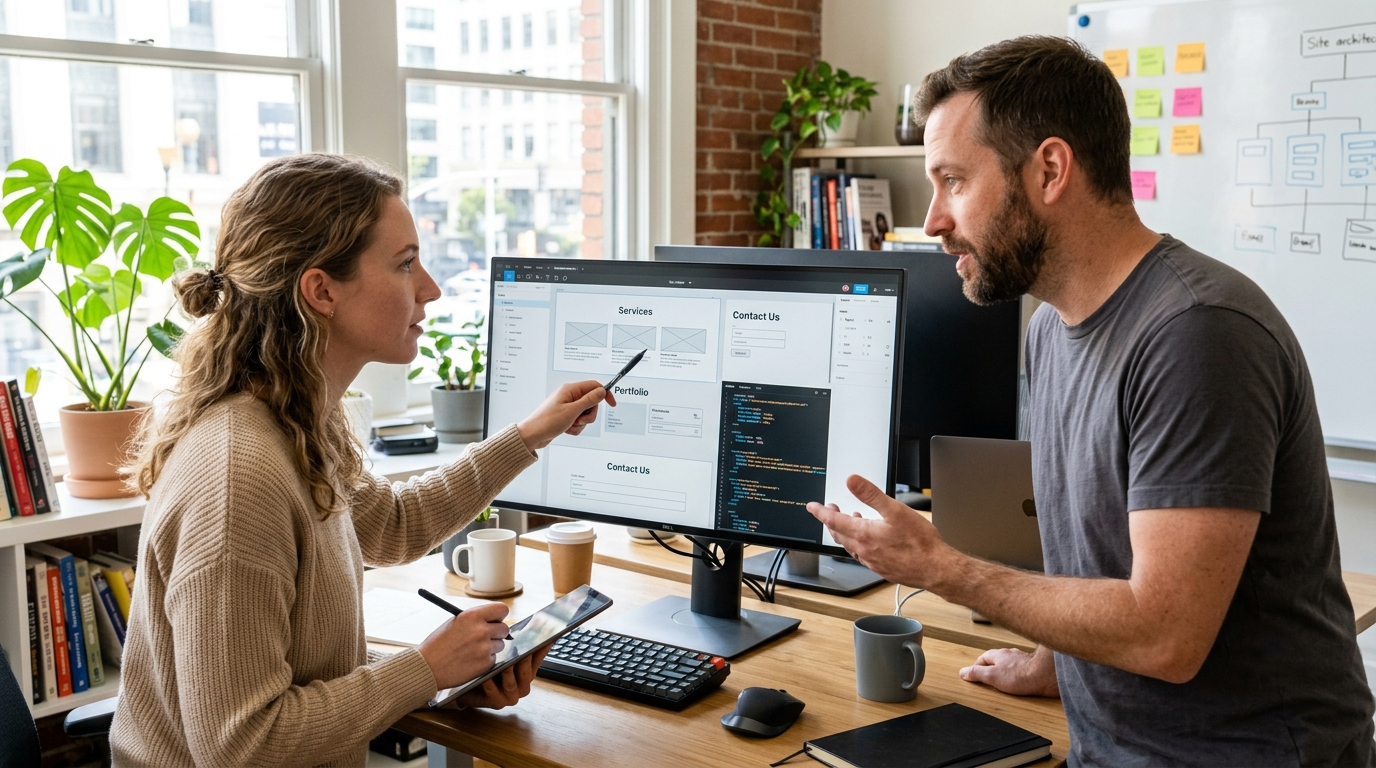
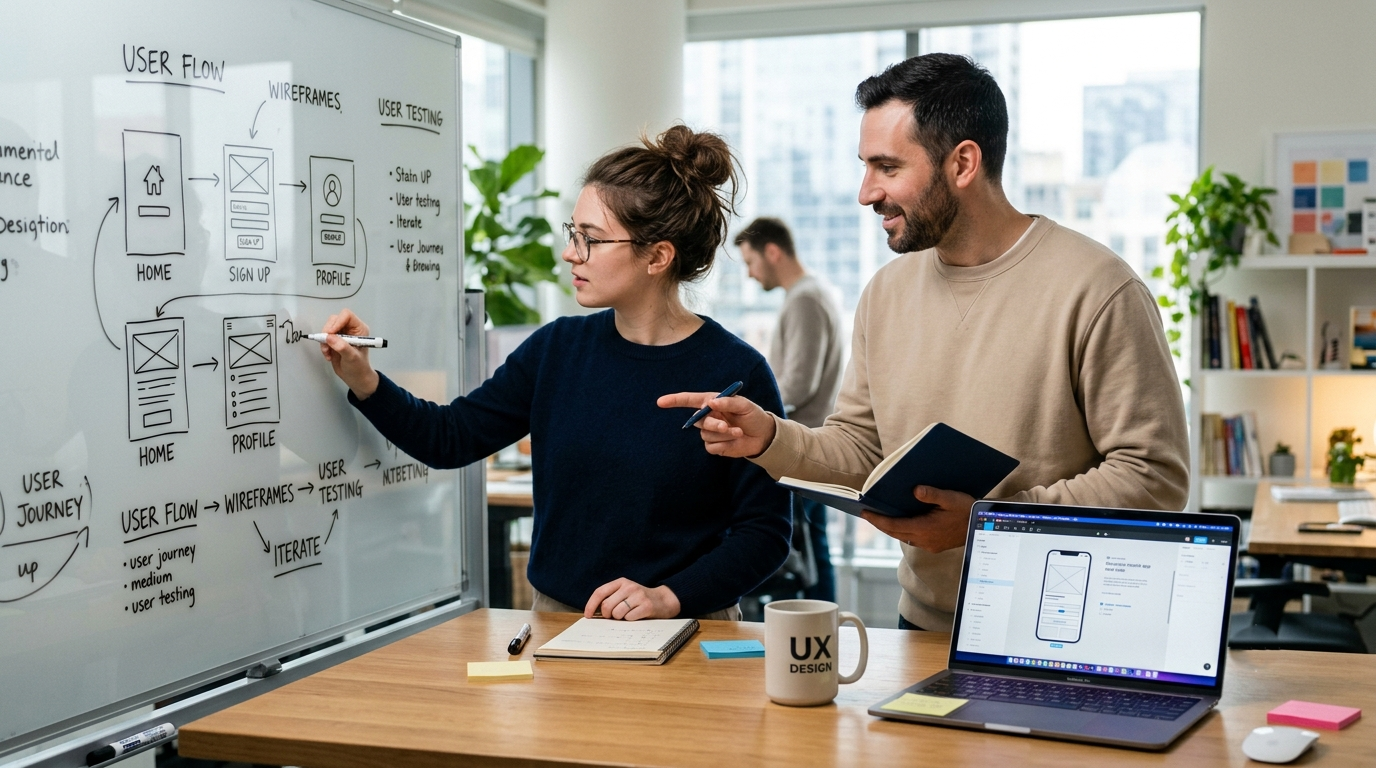
Next, we translate goals into concepts. This involves researching competitors, mapping user journeys, drafting wireframes and moodboards, and aligning on brand direction. Involving stakeholders early helps avoid misalignment. We often present interactive prototypes to gather feedback before coding begins—catching issues when they’re cheap to fix.
Step 3 — Development
Once the design is approved, developers build the site. They implement responsive layouts, integrate APIs and ensure components are accessible. Continuous collaboration between designers and engineers is key to preserving the intent of the prototype while managing technical constraints. Performance budgets and quality assurance are part of the build, not an afterthought.
Step 4 — Testing and optimization
Before launch, we test across browsers and devices. We run user tests to ensure flows are intuitive and fix any issues that surface. Tools like Lighthouse and Google Search Console help identify performance problems. We also review analytics to predict potential drop‑off points and refine content or interactions accordingly.
Step 5 — Launch and ongoing support
Launch isn’t the end. Post‑launch, we monitor metrics, fix bugs and optimise based on real‑world behaviour. Strong agencies offer maintenance packages, performance monitoring and iterative improvements. For SaaS products, ongoing work often includes developing new features, improving onboarding flows and supporting marketing campaigns.
Key factors to evaluate before hiring a web design agency
Portfolio and past work
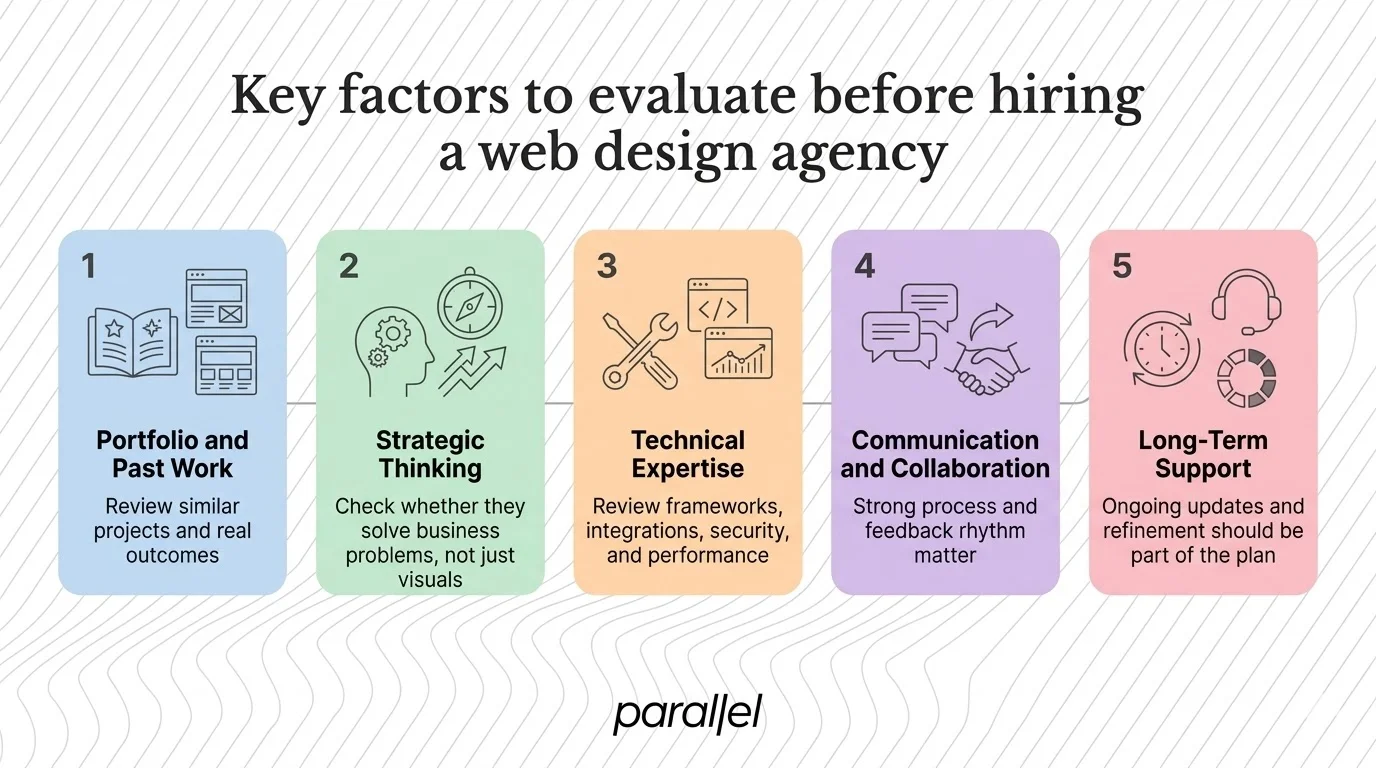
Reviewing a potential partner’s portfolio reveals how they translate business goals into digital experiences. Look for projects similar to your industry or product type. Examine design quality, clarity of user flows and performance outcomes. Ask whether their work has delivered measurable results—higher conversion rates, increased sign‑ups or improved engagement. Good agencies can articulate not just what they built but why decisions were made.
Strategic thinking
Top agencies go beyond aesthetics. They consider messaging, positioning and conversion drivers. Do they ask strategic questions during your initial discussions? Do they suggest experiments or improvements grounded in user behaviour? Beware of teams that focus solely on making pages “look pretty” without addressing underlying problems.
Technical expertise
A modern site requires more than a templated layout. Evaluate an agency’s experience with modern frameworks (e.g., React, Vue, Django) and their ability to architect scalable systems. Ask about their approach to API integrations, security and performance optimisation. For example, using a headless CMS or microservices architecture can future‑proof your platform.
Communication and collaboration
Clear communication avoids surprises. Ask how often they provide updates, which tools they use for collaboration (Figma, Slack, Notion), and how they handle feedback. Strong partnerships rely on honest dialogue and shared accountability. I prefer working in sprints with regular reviews; this keeps everyone aligned and ensures we can adapt when priorities change.
Long‑term support
Websites aren’t “set it and forget it” assets. Choose a partner who offers maintenance, performance monitoring and iterative updates. A small improvement in load speed can directly improve conversions, so you need a team willing to invest in constant refinement. Ask about their track record of maintaining sites post‑launch.
Top web design agencies in Malaysia
The Malaysian market features agencies with varied strengths. Here’s an overview of firms frequently mentioned in industry discussions:
1) ParallelHQ (our studio)
Website: parallelhq.com
ParallelHQ combines product strategy with design execution. We specialise in turning early‑stage ideas into scalable digital products. Our work emphasises product discovery, usability testing, design systems and MVP launch support. We work closely with founders and product teams—particularly in AI and SaaS—to translate complex ideas into clear interfaces. For example, we recently simplified the onboarding flow of an AI‑driven analytics platform; by reducing steps and clarifying value propositions, sign‑up completion improved by 30%. Our approach is grounded in real world patterns: avoid over‑complicating onboarding, keep content concise, and experiment based on data.
2) Bike Bear
Website: bikebear.com.my
Bike Bear is an award‑winning digital agency known for its playful brand and research‑driven design. They create custom websites on WordPress and Shopify, design landing pages, and provide SEO and marketing support. Their process is brand‑first: deep research into a client’s story, tone and audience informs the design. Bike Bear also offers ongoing support and training after launch, which is valuable for teams that want to maintain and extend their websites.
3) Syscomm Technology
Website: syscomm.com.my
Syscomm has more than two decades of experience building corporate websites, e‑commerce platforms and custom web applications. Based in Johor Bahru, they emphasise professional web design combined with SEO services and mobile app development. Syscomm’s services include domain registration, hosting and integrated SEO to help local businesses improve search visibility. They stand out for offering comprehensive digital solutions—from design to domain and hosting—making them a good option for companies seeking a single vendor.
4) MalaysiaBusiness Web Design Services
Website: malaysiabusiness.com.my
MalaysiaBusiness primarily serves small and medium enterprises. They provide affordable web design packages, domain registration, web hosting and CMS setup. Their solutions are oriented towards businesses just starting their digital presence and those who need a basic website quickly.
5) Ramotion
Website: ramotion.com
Ramotion is a global product and brand design firm that works with high‑growth startups and enterprise technology companies. Their services span product design, brand identity, UX design systems and web app development. Ramotion has a track record of supporting SaaS platforms (e.g., Stripe, Clearbit) with design systems that scale. For companies seeking world‑class design craftsmanship and strategic brand development, Ramotion offers deep expertise.
Cost of web design services in Malaysia
Prices vary dramatically depending on complexity, scope and partner. Research published in 2026 shows that basic, template‑based websites in Malaysia typically cost between RM 1,500 and RM 6,000 (roughly US $350 to $1,350). Custom websites range from RM 8,000 to RM 100,000 (US $1,800 to $22,000), while enterprise‑level solutions can exceed RM 133,997. Bike Bear’s breakdown notes that simple template sites cost around RM 2,500 to RM 12,000, whereas fully customised builds range from RM 8,000 to RM 100,000. When converting to the U.S. dollar, typical price ranges look like this:
*Exchange rates vary. These ranges are based on typical Malaysian pricing converted at approximate 2026 exchange rates.
Several factors influence cost:
- Design complexity: bespoke layouts, animations, or 3D elements increase development time and cost.
- Functionality: login areas, custom forms, booking systems, dashboards and e‑commerce features require additional development and integration.
- Integrations: connecting CRMs, analytics platforms, payment gateways or AI models can add complexity.
- Scalability: architectures built to handle spikes in traffic or new features cost more but reduce long‑term rework.
- Timeline: accelerated timelines may require extra resources.
- Ongoing support: maintenance, performance monitoring and content updates add to the total cost of ownership.
Agency vs in‑house web design team
Many startups begin by partnering with agencies, then later build internal design teams once the product matures and budgets allow. In our experience, early‑stage founders benefit from the speed and breadth of an agency. As products scale, establishing an in‑house team fosters ongoing ownership and deeper domain expertise.
Future trends in web design Malaysia
Product‑led website design
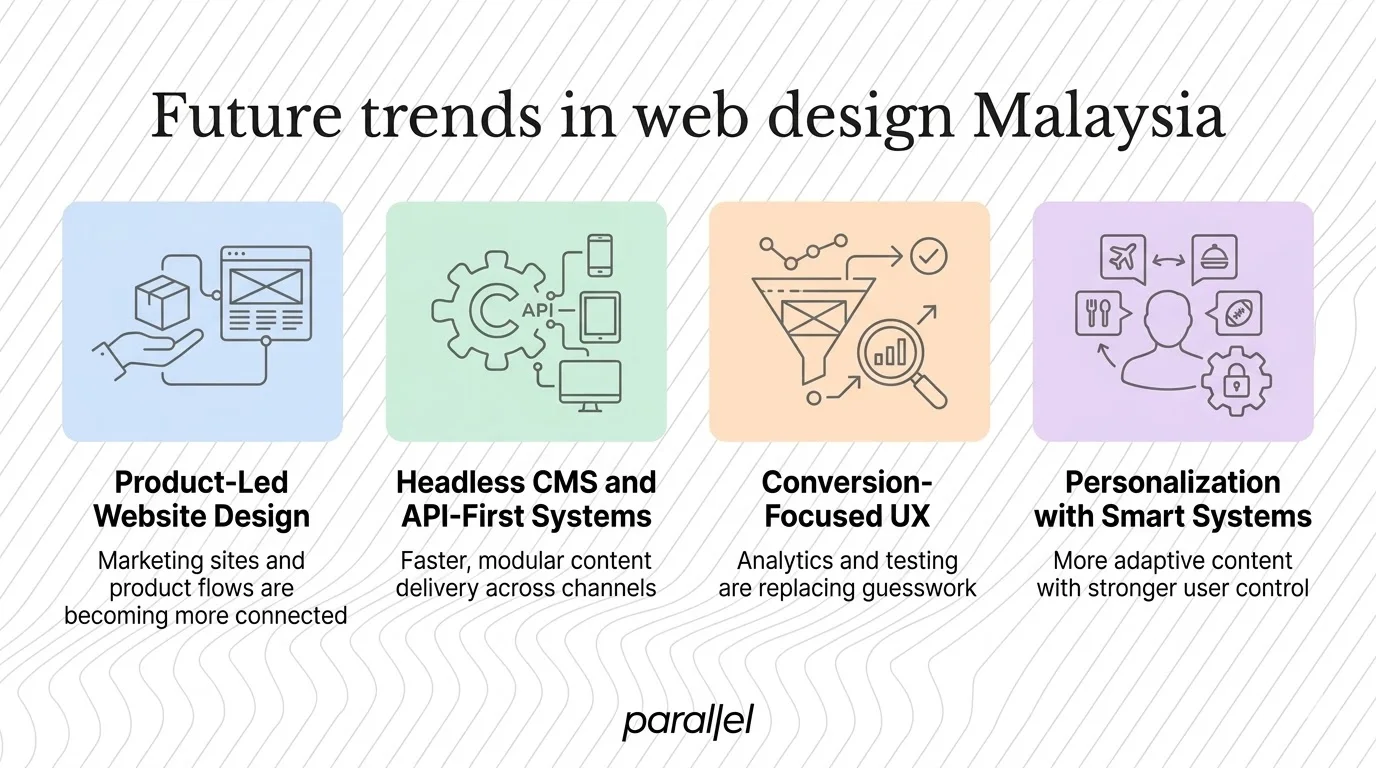
Websites are increasingly part of the product itself. For SaaS and AI startups, the marketing site and the product often share design systems and user flows. Trials are triggered from landing pages; dashboards live on subdomains. This demands closer collaboration between marketing and product teams and emphasises conversion‑focused design. Analytics and experimentation tools help teams iterate based on actual user behaviour.
Headless CMS and API‑first platforms
Traditional all‑in‑one CMS platforms are giving way to composable architectures. According to Netguru, 92% of US brands have adopted API‑driven systems and 21% plan to follow. By 2027, over 60% of mid‑sized retailers will rely on composable commerce. Headless CMS solutions separate content from presentation, enabling omnichannel delivery, faster performance, and independence from design constraints. They also allow front‑end frameworks like Next.js or Nuxt to consume data via APIs, improving developer productivity and user experience.
Conversion‑focused UX
Decisions based on analytics and testing are replacing guesswork. Tools like Hotjar, Mixpanel and FullStory help teams understand drop‑off points and iterate quickly. Baymard’s research shows that simplifying checkout flows can recover up to 35% of lost conversions. Businesses are investing more in UX research and accessibility—94.8% of websites still fail basic accessibility standards, but regulations and inclusive practices are changing that. In the near future, expect personalisation, machine‑generated layouts and real‑time adjustments driven by AI to become common.
Conclusion
Choosing a web design malaysia partner is not merely about aesthetics; it’s a strategic decision that influences product adoption and business outcomes. The right agency will help you clarify goals, design intuitive user journeys, build scalable architecture, and iterate based on data. They’ll offer honest feedback, challenge assumptions and share responsibility for results. From our experience at ParallelHQ, investing early in user experience yields outsized returns. If you’re an early‑stage founder or product leader, prioritise partners who think like product people, not just designers. Ask them how they test ideas, measure success and support you long after launch. Your website is often the first impression—and in a market where 64% of traffic comes from mobile and 32% of customers leave after one bad experience, you seldom get a second chance.
Frequently asked questions
1) What should startups look for in a web design agency in Malaysia?
Startups should prioritise agencies with strong UX expertise, product experience, and scalable development skills. Look for a track record of working with SaaS or tech companies, ask about their research and testing process, and check whether they can integrate with your existing tools and stack. Ensure they offer responsive and mobile‑first designs and understand conversion optimization.
2) How long does a typical web design project take?
Most projects span 6–16 weeks, depending on complexity. Simple marketing sites can be delivered in 4–6 weeks; product sites or platforms with custom integrations may take several months. Timelines include discovery, design, development, testing and iteration.
3) Do web design agencies include SEO services?
Many agencies build SEO foundations (structured architecture, metadata, performance optimisation). However, comprehensive SEO—keyword research, content strategy, link building—may require additional engagement or a dedicated SEO partner. Ask whether technical SEO and on‑page optimisation are included in the base scope.
4) How much does web design cost in Malaysia?
Basic websites start around RM 1,500 (~$350). Mid‑range custom sites range between RM 8,000 and RM 100,000 (~$1,800–$22,000). Enterprise platforms can exceed RM 133,997 (~$30,000). Prices vary with design complexity, functionality, integrations, and support requirements.
5) Should startups work with local agencies?
Working with a local partner in Malaysia offers advantages: understanding regional user behaviour, local languages, and market context helps shape content and design choices. However, the right expertise may come from anywhere. Evaluate agencies based on fit, portfolio and process rather than geography. For product‑led startups, choose a partner who understands your space and can help you grow beyond local boundaries.

check out these related blogs

.avif)