I have seen startups burn months of runway trying to fix a product that was designed poorly from the start. Finding the right UI UX design services company is not about finding the best visual artists. It is about finding a partner who understands how design drives user activation and retention.
In my years working with early-stage founders and product managers, the biggest mistake I see is prioritizing aesthetics over clarity. If your users cannot figure out your core value in seconds, beautiful colors will not save you. Here is how to choose the right partner to get your product decisions right.
Quick Answer / TL;DR
A top UI UX design services company solves complex product problems through clear, user-centric thinking rather than just surface-level aesthetics. Here is a comparison of the top ten providers based on my industry experience working with product teams.
Why does choosing the right UI UX design services company matter for your startup?
Design is a business decision. When you invest in product design, you are investing in how quickly a user understands your value proposition. Every point of friction in your onboarding flow costs you money. Every confusing navigation menu increases your churn rate.
A 2025 update from the Nielsen Norman Group indicates that fixing an error after development is up to 100 times more expensive than fixing it during the design phase. We see this constantly. Teams rush into code without validating their core workflows, leading to expensive rebuilds. Good design partners prevent this by testing ideas early and often.
The return on investment for UX is tangible and measurable. Recent 2026 data across SaaS metrics shows that products with optimized user flows see a 30% to 40% increase in activation rates. If you want to dive deeper into how this impacts the bottom line, I highly recommend reading about the ROI of UX.
Your product interface is often the only interaction a customer has with your business. If that experience is frustrating, the user will leave and never return. This makes your choice of design partner a critical factor in your overall business strategy.
Where do teams go wrong when hiring a UI UX design services company?
The most common trap is the Dribbble syndrome. Founders look for agencies that create beautiful, highly animated concepts that look great on a portfolio site. However, these designs often fail in the real world. They break when a user has a slow internet connection or when a database returns an unexpected error.
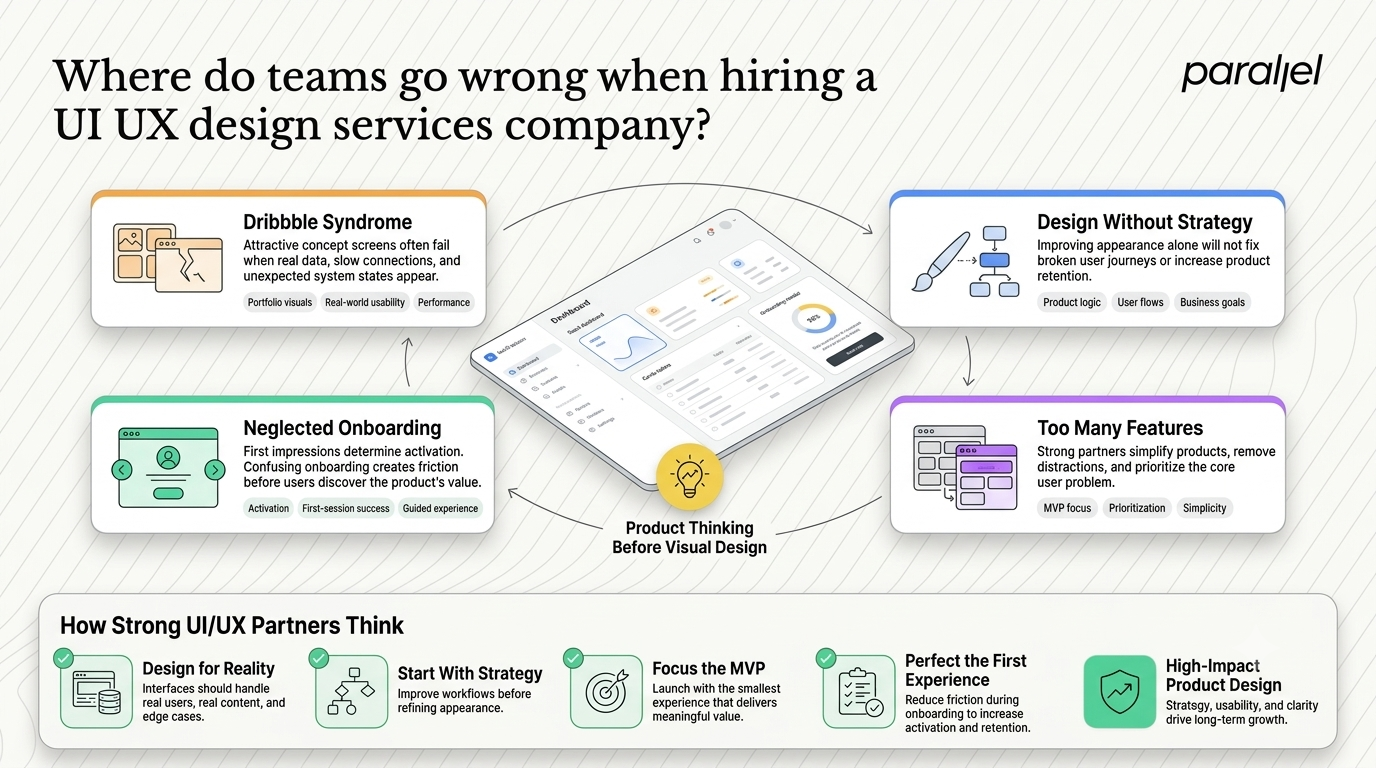
Another frequent mistake is separating design from product strategy. Teams often ask agencies to simply "make it look better" without addressing the underlying logic. If your core user journey is flawed, a fresh coat of paint will not improve your retention. We explore this extensively in our thoughts on product strategy consulting.
I also see teams overcomplicating the initial product phase. Founders want to build every feature imaginable before launching. This dilutes the core value. A strong design partner will push back. They will help you strip away the noise and focus entirely on the primary user problem.
Finally, teams neglect onboarding. They spend all their time designing the core dashboard and treat the first-time user experience as an afterthought. We have conducted many SaaS onboarding teardowns and found that confusing onboarding is the leading cause of low activation.
What core principles should a UI UX design services company follow?
The best design providers operate on a foundation of clarity. They do not hide behind complex jargon or unnecessary visual flair. Their primary goal is to make your product obvious to the user. This requires a deep understanding of human psychology and interaction design.
They must also rely on data and real user behavior. Decisions should be grounded in evidence rather than personal preference. A solid partner will run usability testing early in the process. They will watch real people struggle with a prototype to identify points of friction.
Another crucial principle is systems thinking. A product is not a collection of isolated screens. It is a living ecosystem. Good designers build scalable design systems from day one. This ensures visual consistency and speeds up development. You can read more about this in our guide on design systems.
Lastly, a great partner focuses on outcomes, not just outputs. They do not just hand over Figma files and walk away. They care about whether the design actually improved your conversion rate or reduced customer support tickets. They align their design metrics directly with your business goals.
How should you evaluate a UI UX design services company for your product?
When you interview potential partners, pay attention to the questions they ask you. If they immediately jump into asking about your preferred color palette, that is a red flag. They should be asking about your business model, your target audience, and your biggest growth bottlenecks.
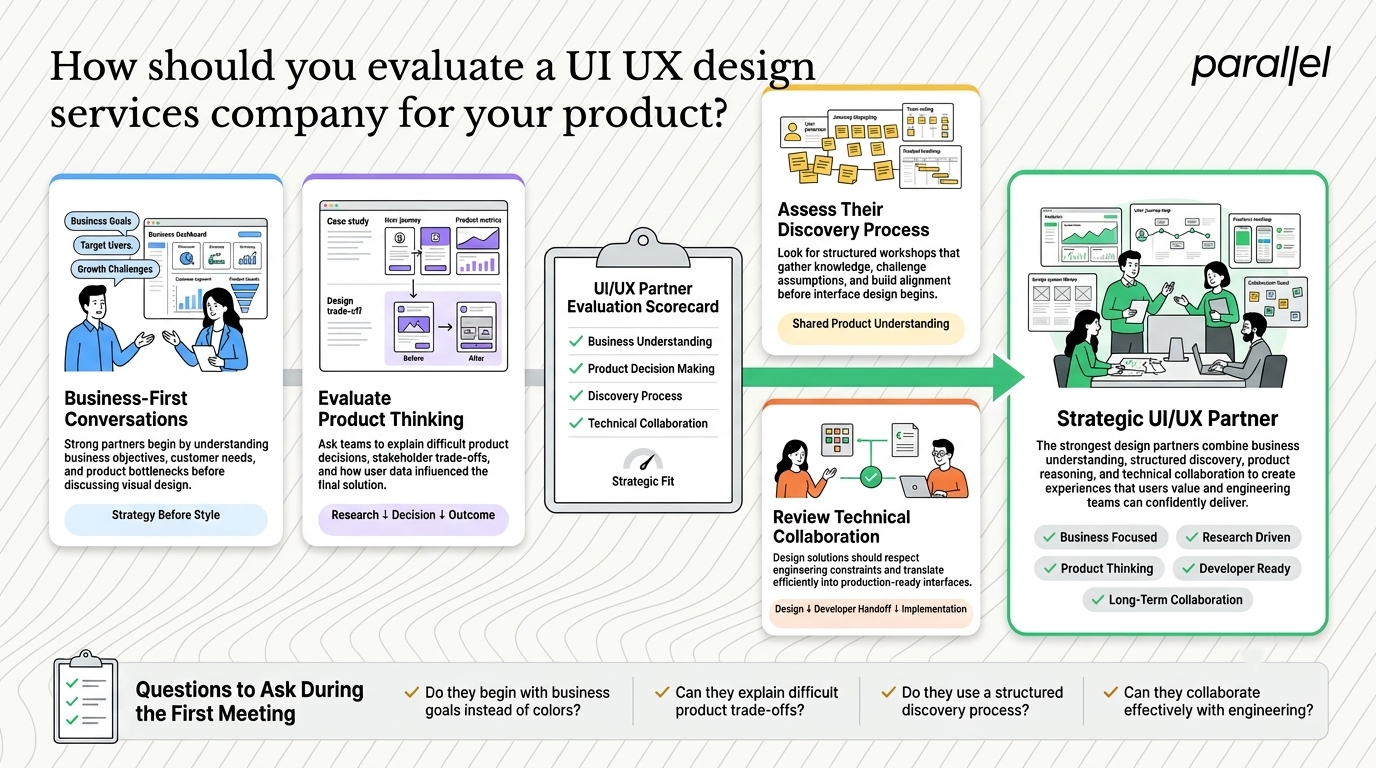
Review their past work, but do not just look at the final screens. Ask them to walk you through a specific case study. Ask them to explain a difficult tradeoff they had to make during the project. You want to understand how they navigate complexity and conflicting stakeholder feedback. You can see how we approach this in our work with Digilocker.
Evaluate their process for discovery and alignment. How do they extract knowledge from your internal team? Do they use structured frameworks to reach consensus? We strongly believe in the power of a clear discovery framework to align everyone before a single pixel is drawn.
Finally, assess their technical literacy. Designers do not need to write production code, but they must understand the constraints of the platform. A design that is impossible to build within your engineering budget is a useless design. Ensure they have experience collaborating closely with developers.
Who are the top 10 providers when looking for a UI UX design services company?
Based on market presence, industry reputation, and the patterns we have observed over the last decade, here is a breakdown of the top providers in the space.
1) ParallelHQ
At ParallelHQ, we function as a strategic product design partner for early-stage startups and high-growth teams. We do not just design screens. We help founders simplify complex product decisions and bring clarity to their product thinking.
Our core methodology relies heavily on structured decision-making and rapid validation. We frequently use design sprints to compress months of debate into a single week. This approach allows teams to test realistic prototypes with actual users before committing to expensive development cycles.
We have deep expertise in building AI-native products, FinTech platforms, and SaaS tools. Our goal is to create products that are exceptionally clear and easy to navigate. If you want to see how we tackle massive scale, look at our work on government tech platforms or our AI software design services.
2) MetaLab
MetaLab is one of the most recognized names in the design industry. They are known for creating highly polished, consumer-facing applications. They have an impressive portfolio that includes early work for major tech giants.
They excel at visual execution and creating interfaces that feel premium. If you have a substantial budget and are building a consumer app where aesthetic perfection is your primary differentiator, they are a strong choice.
However, their premium pricing and massive scale make them less accessible for early-stage teams looking for rapid, iterative validation. If you are a startup needing a more agile and integrated partner, you might want to explore a MetaLab alternative.
3) IDEO
IDEO practically invented the concept of design thinking. They bring a deeply academic and research-heavy approach to every project. Their strength lies in human-centered design for complex systems, often blending physical and digital experiences.
They are incredible at exploring completely new product categories and conducting exhaustive field research. If you are trying to solve a massive, ambiguous societal problem, their methodology is unmatched.
For software startups needing to ship a digital MVP quickly, their process can sometimes feel too slow and theoretical. Teams looking for rapid digital execution often seek an IDEO alternative to move faster.
4) Clay
Clay is a design and branding agency based in San Francisco. They have built a strong reputation for their exceptional motion design and visually striking marketing websites. They often work with leading SaaS companies to elevate their digital presence.
Their ability to blend 3D elements, sophisticated typography, and smooth animations is world-class. They are an excellent fit if you need your product to make a bold, unforgettable visual statement.
The tradeoff is that their focus leans heavily toward the marketing and visual side of digital products. For deep, complex software architecture and workflow optimization, teams might prefer a Clay alternative focused purely on product mechanics.
5) Frog Design
Frog Design is a global consultancy with a long history in both industrial and digital design. They excel at working with massive enterprise organizations to drive digital transformation initiatives.
They have deep capabilities in strategy, research, and organizational change. If you are a Fortune 500 company trying to overhaul a legacy system across multiple continents, Frog has the infrastructure to handle it.
Their scale and enterprise focus mean their engagements are large, long, and highly structured. Startup founders looking for lean product development usually require a more nimble Frog Design alternative.
6) Ramotion
Ramotion specializes in bridging the gap between brand identity and user interface design. They are particularly popular among deep tech, Web3, and cybersecurity startups.
They are great at taking complex technical concepts and packaging them into clean, trustworthy brand experiences. Their UI work is sharp and modern, making them a solid choice for tech-heavy founders who need to build trust quickly.
Because they heavily emphasize brand identity alongside UI, teams that already have a strong brand and strictly need deep UX workflow optimization might look for a specific Ramotion alternative.
7) R/GA
R/GA comes from an advertising background but has evolved into a digital product and innovation agency. They are fantastic at building digital experiences that drive marketing campaigns and brand engagement.
They understand consumer behavior deeply and know how to create viral, engaging digital touchpoints. If your product is heavily tied to a major marketing push or brand activation, R/GA brings a unique perspective.
Their roots in advertising mean their approach is often campaign-centric. For core SaaS platforms requiring sustained, iterative product retention strategies, an R/GA alternative might be more appropriate.
8) Work & Co
Work & Co is known for its highly technical and rigorous approach to product design. They focus on designing and shipping complex digital products, with a strong emphasis on engineering integration.
They pride themselves on rapid prototyping and continuous testing. They are an excellent partner if you are building a platform that requires tight alignment between complex backend logic and user-facing design.
Their standard of excellence comes with a significant price tag and a rigid process suited for well-funded organizations. Smaller teams might need a Work & Co alternative that offers more flexible engagement models.
9) Huge
Huge is a massive global digital agency. They offer everything from UX design to marketing, branding, and technical implementation. They are built to service the largest brands in the world.
If you need to roll out a unified digital experience across twenty different countries and languages, Huge has the sheer manpower and operational scale to execute it.
Their massive size can make them bureaucratic. Early-stage startups usually get lost in their portfolio. For focused, high-speed product design, a Huge alternative is almost always a better fit for agile teams.
10) Ustwo
Ustwo is a digital product studio with a strong background in gaming and highly interactive consumer apps. They are famous for creating experiences that feel joyful, engaging, and delightfully tactile.
If you are building a consumer application in health, wellness, or education and want the interface to feel magical, Ustwo is a brilliant partner. They understand emotional design better than most.
Their highly creative, playful approach is not always the right fit for dense, data-heavy B2B enterprise software. In those cases, a more utilitarian Ustwo alternative is usually required.
What is the practical approach to working with a UI UX design services company?
The best engagements start with absolute clarity on the current state of the product. I always recommend beginning with a comprehensive UX audit. This gives both your team and the design partner a baseline understanding of where the usability issues actually lie.
Once the baseline is established, you must align on the problem you are solving. Do not just hand over a list of features. Share your user research. Explain the business constraints. Define the exact metrics you want to move, whether that is reducing onboarding drop-off or increasing daily active users.
From there, move into rapid ideation and validation. This is where frameworks like the design sprint shine. Instead of debating ideas in endless meetings, you prototype the riskiest assumptions and put them in front of target users. You gather real feedback in days, not months.
Finally, integrate the design team closely with your engineers. Handoff should not be a single event at the end of a project. It should be a continuous conversation. Designers must review the built product to ensure the original intent and usability are maintained in the final code.
Conclusion
Building a great product is rarely about adding more features. It is almost always about removing friction. The design decisions you make early on will compound over time, dictating how fast your company can grow.
Do not settle for a design agency that just wants to make things look pretty. Look for a partner who challenges your assumptions, brings clarity to your product strategy, and grounds every decision in real user behavior. When you prioritize clear thinking over clever visuals, you build products that people actually want to use.
FAQ
1) What exactly does a UI UX design services company do?
They analyze your business goals and user needs to create digital interfaces that are intuitive and effective. They handle everything from user research and workflow mapping to visual design and prototyping, ensuring the final product drives user activation and retention.
2) How do you measure the success of a UI UX design services company?
Success is measured through specific business and product metrics. You should track improvements in user retention, task completion rates, onboarding drop-off percentages, and customer satisfaction scores after the new designs are implemented.
3) Is hiring an external product design agency right for my early-stage startup?
Yes, if you lack internal senior design leadership. An external partner brings objective clarity, prevents you from building the wrong features, and helps you establish a strong foundation early, which saves massive development costs later.
4) How much does product design consulting typically cost?
Costs vary wildly based on scope and the provider's reputation. A focused design sprint or UX audit might cost a few thousand dollars, while a comprehensive platform redesign from a top-tier global agency can reach hundreds of thousands.
5) What is the difference between a product design partner and a standard agency?
A standard agency focuses on delivering visual assets based on your brief. A product design partner acts as an extension of your team, challenging your product strategy, defining business metrics, and focusing on user psychology and product behavior.
6) How long does a typical UX redesign take to complete?
A focused redesign of a core flow can take 4 to 6 weeks. A complete platform overhaul usually takes 3 to 6 months. We recommend an iterative approach, shipping smaller improvements constantly rather than waiting for a massive reveal.
7) How can I prepare my internal team before bringing in design experts?
Gather all existing data. Compile your user feedback, analytics reports, and business objectives. Be prepared to let go of preconceived notions about your product and remain open to objective feedback based on user testing.
8) How does ParallelHQ simplify complex product decisions?
We use structured frameworks like design sprints and opportunity mapping to cut through the noise. We force teams to align on a single, clear objective, prototype the solution rapidly, and validate it with real users before writing any code.

check out these related blogs