When you build a software product, the interface is the first handshake with your customer. People will arrive at an opinion within seconds, and those first impressions can determine whether they sign up or close the tab. In my work leading Parallel, I’ve seen that strong interfaces aren’t only about aesthetics; they’re about reducing friction so that users get to the product’s value faster. In this article, I’ll outline why thoughtful interface work matters, what ui design companies actually do, how to evaluate potential partners, and which firms consistently deliver for early‑stage founders. Throughout, I’ll share lessons learned working on SaaS, fintech and machine‑learning‑driven products and cite recent research.
Why UI design matters for modern products
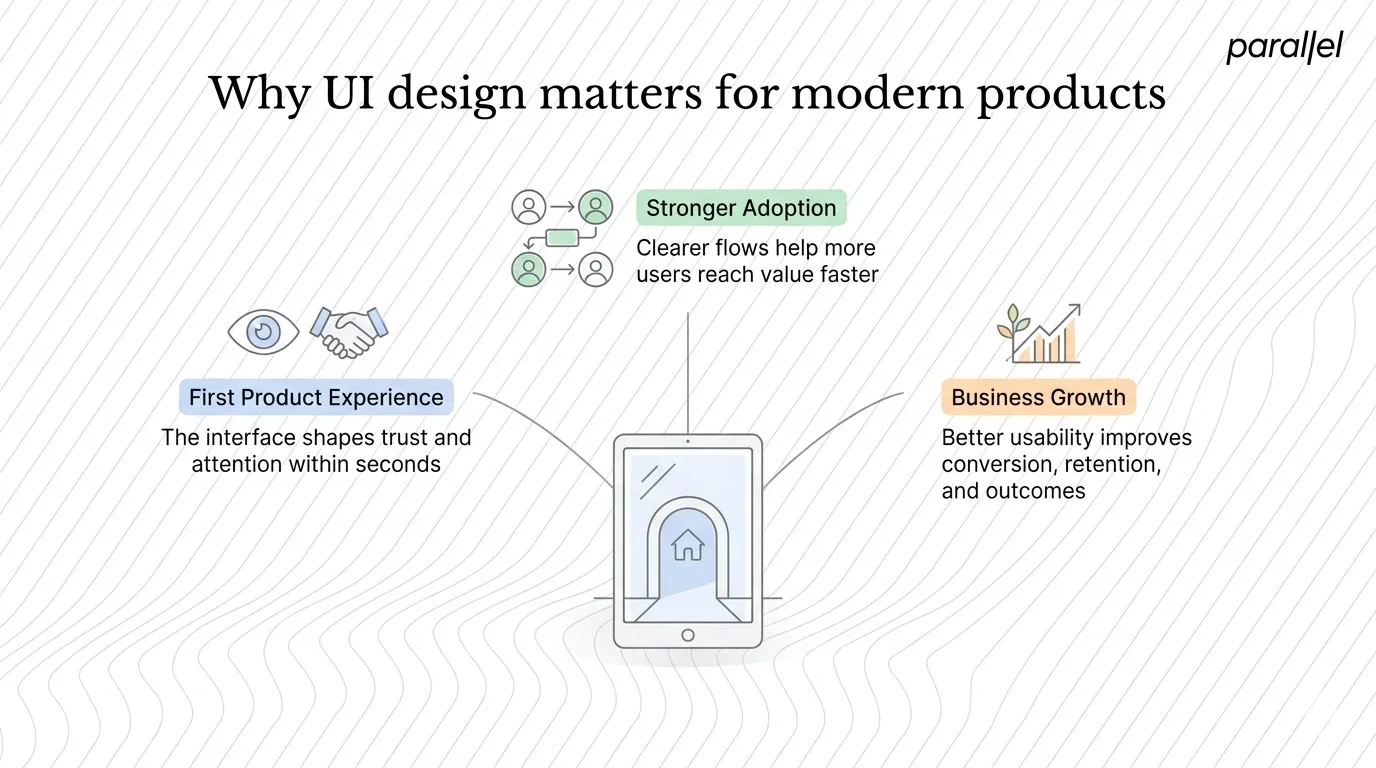
1) The interface is your first product experience
Users judge a product almost instantly. A clear layout, sensible interactions and strong visual hierarchy encourage engagement; confusion leads to abandonment. Nielsen Norman Group’s 2026 state of UX report observes that interface work is becoming commoditized by design systems and machine‑learning‑powered tools, but it remains the gateway to the entire experience. Their report cautions that although UI alone is no longer a differentiator, poor interface work can still cause people to give up early. Your initial screen sets expectations. A good layout guides the eye; responsive design ensures it works across devices; thoughtful interaction design reduces cognitive load. At Parallel we often start with simple prototypes and watch real people use them. Early sessions often uncover confusing labels or missing affordances that we didn’t see internally. Fixing these early keeps potential customers from bouncing.
2) Well‑designed interfaces drive adoption
Good interface work isn’t just about looking polished. It increases activation rates, improves onboarding completion, reduces confusion and boosts conversion. Forrester’s 2025 Total Economic Impact study for UserTesting found that continuous user research increased conversion rates by 7.2%, improved customer retention by 10% and shortened iteration cycles by 25%. Another industry analysis compiled from Forrester and Deloitte estimates that organizations adopting user testing improve revenue retention by up to 10.8% over three years and realize cost savings of over 20%. These numbers aren’t abstract; they reflect everyday decisions like refining signup flows and clarifying CTAs. In our own work, we’ve seen onboarding completion jump by 30–40% when we replaced a six‑step wizard with a progressive disclosure pattern that asks only for critical details up front. When you remove friction and design for clarity, more users get to the “aha” moment where they grasp your product’s value.
2) Interface work supports business growth
Investing in interface quality translates to bottom‑line results. The same Forrester study reports that better usability leads to $2.1 million in additional profit from optimized conversion and $2.5 million from improved retention over three years. PwC’s customer experience survey warns that 32 % of consumers will stop doing business with a brand they love after one bad experience, and 59 % will walk away after several. These numbers show how brittle loyalty is when interactions feel clumsy. Meanwhile, the 2025 Loop11 research trends article reports that teams who embed user research in all operations see 2.7× better business outcomes, including higher revenue growth and better retention. UI design also supports scaling: component libraries, design tokens and responsive layouts let teams move quickly without reinventing patterns. When your product scales, a consistent interface prevents the clutter and fragmentation that sap trust. The same research shows that 78 % of organizations now mix qualitative and quantitative research methods, showing the shift toward data‑informed decision‑making. When you view the interface as a business asset rather than decoration, you improve retention, satisfaction and growth.
What modern UI firms actually do
Although many people think of interface work as making screens pretty, mature agencies handle much more. As design systems and automation make common patterns easier to build, the value lies in deep research and product thinking. Here’s what the best ui design companies deliver:
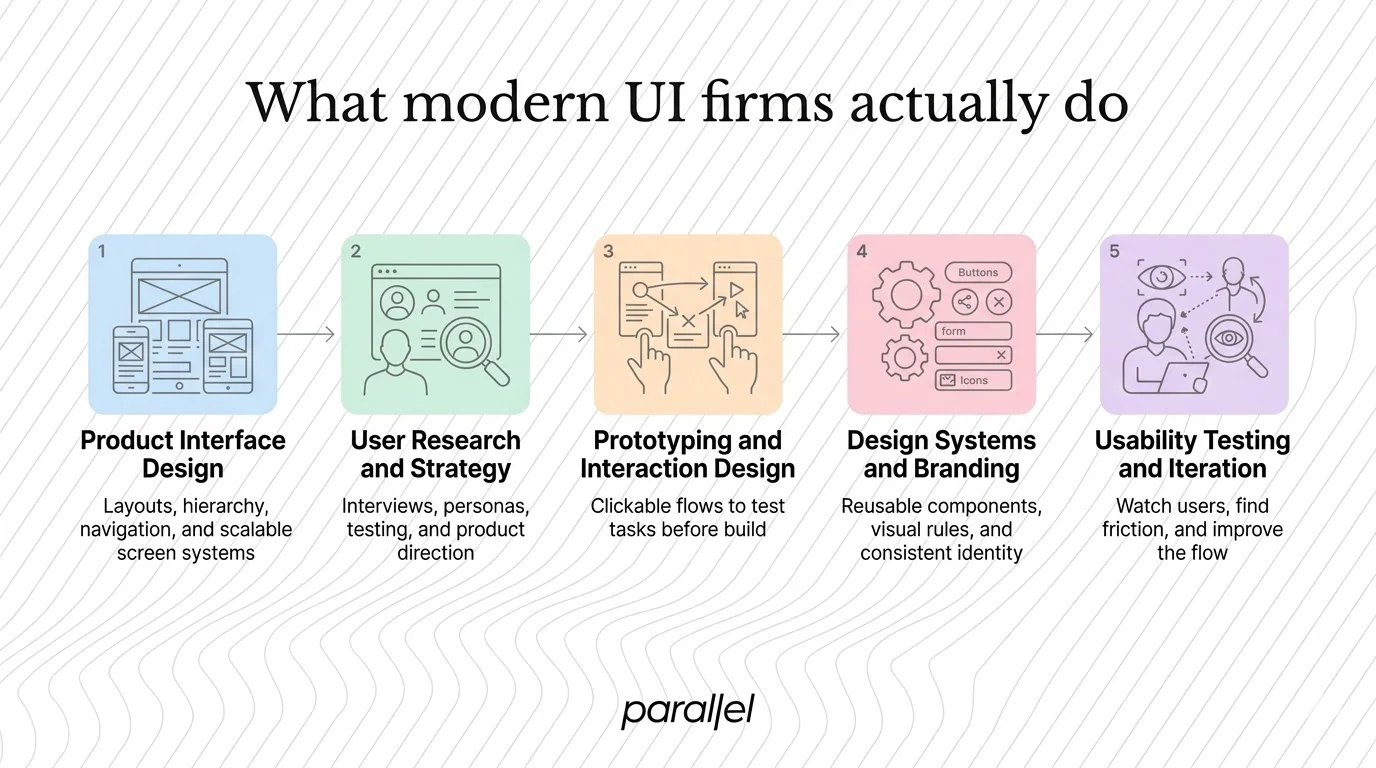
Product interface design
Teams craft layouts, define visual hierarchy, build navigation systems and assemble component libraries that respond gracefully across screen sizes. They translate abstract requirements into concrete screens and flows. This includes choosing typography and color systems that express your brand without hurting readability. For example, our work on an edtech platform involved developing a modular dashboard that could expand from a few widgets at launch to dozens as the product matured. Strong interface work is both expressive and extensible.
User research and strategy
Good agencies don’t guess; they interview users, develop personas, map out user paths and test assumptions. Loop11’s 2025 report shows that 55 % of product teams saw an increase in demand for research and that continuous discovery leads to twice‑as‑fast release cycles and 30 % higher feature adoption. Our own experience echoes this: founders often approach us with a feature list, but after a week of interviews we find that the real problem is something else entirely. By validating ideas early, you save months of development.
Prototyping and interaction design
Agencies build prototypes—clickable models that let teams test flows before coding. Prototyping helps answer questions like “Does this navigation make sense?” or “Can users complete a task without instruction?” Interactive design testing, such as unmoderated sessions or quick hallway tests, reveals friction points. At Parallel we use prototypes to simulate complex flows like multi‑step transactions or machine‑learning‑driven suggestions; early tests often surface microcopy or timing issues we wouldn’t catch otherwise.
Design systems and branding
Many firms also develop visual identities and systems. They define typography, color palettes, icon sets and reusable interface components that maintain consistency across products. A consistent system helps internal teams build faster and ensures that new features look and feel like they belong. Mature agencies also deliver brand guidelines that cover tone, illustration style and motion principles. These aren’t just cosmetic; they help your product stand out while staying usable.
Usability testing and iteration
Finally, interface work doesn’t stop at delivery. The best agencies facilitate usability testing—tasks where participants attempt real workflows while designers observe. They analyze task completion rates, collect qualitative feedback and iterate on the design. Forrester’s research shows that early usability testing can prevent costly rework and shorten iteration cycles by 25 %. At Parallel, we schedule post‑launch check‑ins to watch how new users behave and refine flows based on real usage data.
How startups should evaluate UI partners
Choosing a design partner is hard when you’re under pressure to launch. From my experience and conversations with other founders, here are essential criteria when comparing ui design companies:
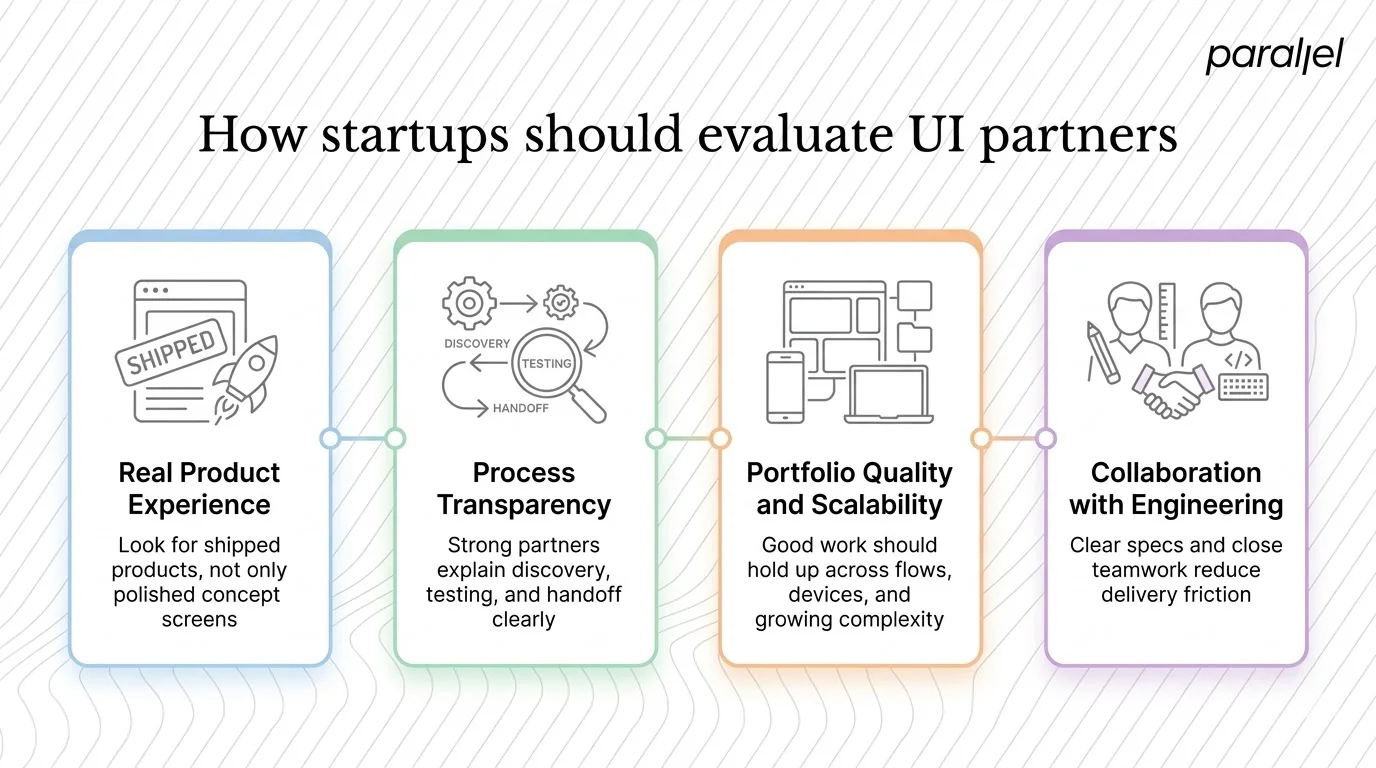
Look for real product experience
Portfolio pieces should show live products, not just concept visuals. Check whether the firm has built SaaS dashboards, mobile apps, marketplaces or data‑heavy tools. Ask about past collaborations with startups in your domain. A team that has shipped B2B fintech dashboards will understand regulatory constraints and performance trade‑offs better than a studio focused solely on marketing websites.
Expect process transparency
A reliable partner will articulate each stage: discovery, user research, wireframes, interface design, prototyping, testing and handoff. They should involve you in decision making rather than disappearing to polish screens in secret. Transparency reduces surprises and encourages shared ownership. It also signals maturity; teams with sloppy handoff processes often leave developers stuck translating ambiguous designs into code.
Evaluate portfolio quality and scalability
Move past static shots. Ask for prototypes or case studies that show how the interface scales with new features and data. Are patterns consistent? Does the visual language hold up across different screen sizes? Do interaction patterns feel thoughtful? A good partner will show how their work adapts to complexity instead of relying on one‑off hero screens.
Assess collaboration with engineering
Interface work never happens in a vacuum. The agency should collaborate with your development teams—whether they build web apps, mobile apps or cross‑platform frameworks. Ask how they handle handoff: do they provide component libraries, documentation and redlines? Do they join stand‑ups or design reviews? A firm that speaks the same language as engineers will save you time and budget.
Top 10 firms to consider
The following ui design companies have delivered standout results for startups and scale‑ups. This is not a ranking; each firm excels in different contexts. I’ve selected them based on portfolio quality, product expertise, startup experience, research practices and reputation in the design community.
- ParallelHQ – Parallel is the studio I lead. Since 2014 we’ve partnered with founders building SaaS, fintech and edtech platforms. Our team combines user research, design sprints, interface development and machine‑learning‑assisted prototyping to translate raw ideas into usable products. We helped launch India’s DigiLocker, a national document vault now used by millions. Our focus is on building minimum viable products quickly while ensuring they can scale with growth. We collaborate closely with engineering teams to translate designs into production‑ready code. Parallel is best suited for early‑stage founders looking for research‑driven design.
- Clay – Clay is a respected software product design agency with a strong aesthetic sensibility. They handle branding, interface design and product strategy across web and mobile. Clay excels at highly polished dashboards and enterprise tools and often collaborates closely with engineering. Their portfolio spans fintech, SaaS and consumer tech. Teams hire Clay when they need both a refined look and deep product thinking.
- Ramotion – Ramotion is a consultancy focused on product interfaces and branding. Their strength lies in building consistent design systems that scale across web and mobile. They work with startups and large enterprises to develop logos, visual identities and interface kits. Ramotion is known for detailed component libraries and consistent patterns. Many teams engage them at the concept stage and keep them through launch.
- Neuron – Neuron specializes in enterprise software and SaaS platforms. They focus heavily on usability research, interface design and technology strategy. Their work often involves simplifying complex workflows for industries like fintech and healthcare. Neuron’s structured process and research rigor make them a good fit for products that need to turn intricate requirements into clear interfaces.
- Qubstudio – Founded in 2007, Qubstudio combines product design and UX strategy. They emphasize human‑centered design and help startups and global companies build scalable platforms. Their services include research, interface design, prototyping and usability testing. Teams hire Qubstudio when they need a balance between user needs and business goals.
- Shakuro – Shakuro combines design and development, making them appealing for teams that want a single partner from concept to launch. They build web platforms, SaaS interfaces and mobile apps and can also handle branding and illustration. Startups choose Shakuro when they need design and technical implementation under one roof.
- UX Studio – UX Studio is research‑driven. Their structured process includes strategy, interface design, usability testing and product consulting. They often work on complex enterprise software, focusing on making products more user‑friendly and data-informed. Teams engage them to improve existing products or plan significant redesigns.
- Fantasy – Fantasy is known for forward‑looking interactive experiences. They create immersive interfaces for global technology and entertainment brands. Their work often pushes the boundaries of interaction design and creative technology. Fantasy is best suited for companies seeking high‑impact experiences and willing to invest in cutting‑edge work.
- Frog Design – Frog is one of the pioneers of industrial and technology product design. They collaborate with enterprises across technology, automotive and healthcare sectors. In addition to interfaces, Frog handles physical product design and design strategy. They’re a good fit for organizations needing broad strategic thinking and cross‑disciplinary execution.
- IDEO – IDEO popularized human‑centered design. They work across technology, healthcare, education and consumer products, applying design thinking to services and products alike. IDEO blends strategy, interface design and innovation consulting. Startups hire them for their ability to frame complex problems and prototype solutions quickly.
How to choose the right partner
Before reaching out to agencies, clarify your goals. Are you building an MVP or refining a mature product? Who are your target users? What platforms will you support? How complex is the domain? When these questions are answered, you can compare fit among ui design companies more effectively.
Next, evaluate compatibility. Does the team understand your vision and business model? Have they worked with your technology stack—be it React, Flutter or machine learning pipelines? Do their strengths fit with your roadmap? A studio excellent at marketing microsites may not thrive in data‑intensive dashboards.
Finally, start with a small project. Many founders begin with an audit, a prototype sprint or a short redesign engagement. This allows both sides to test collaboration styles and decision‑making before committing to a larger partnership. A pilot project reveals how a firm handles feedback, communicates and integrates with your development team.
Common pricing models
Pricing varies by scope and engagement style. Short projects such as audits or small prototypes are often billed hourly. Fixed‑price engagements work when the scope is clear, such as designing a defined set of screens for a new product. For ongoing work, many startups hire a dedicated design team on a retainer or embedded basis. In that model, the agency functions as an extension of your team, providing continuous design support.
What’s next for UI design partners
The next few years will transform how we design interfaces. Nielsen Norman Group observes that standardization and automation are making basic interface production less expensive. Design systems and component libraries mean that anyone can assemble decent screens quickly. Meanwhile, ui design companies are investing in intelligent tools—assistants that suggest layouts or auto‑generate code. Loop11’s research predicts that advanced tools will make research and analysis faster, cutting qualitative analysis time by up to 80 %. As interface work becomes commoditized, the value shifts to strategy, research and systems thinking. Firms will focus on integrating design and development workflows, building component‑based systems that scale and using machine learning to personalize interfaces. They’ll also work more closely with product and engineering teams to ensure that accessibility, performance and internationalization are baked in from the start. The future isn’t about more screens; it’s about deeper understanding and faster experimentation.
Conclusion
Interface design is no longer just about polish; it’s about helping users find value quickly and supporting business goals. User research and thoughtful interface work improve conversion, retention and satisfaction. At the same time, the rise of design systems and intelligent tools means that basic interface production is no longer a differentiator. To stand out, you need partners who invest in research, think strategically and collaborate closely with engineering. These firms—ParallelHQ, Clay, Ramotion, Neuron, Qubstudio, Shakuro, UX Studio, Fantasy, Frog and IDEO—exemplify that approach. As a founder, choose a partner who understands your users, your domain and your ambitions. The right design partner will help you build products people enjoy and businesses that thrive.
FAQ
1) What do UI design companies do?
They craft layouts, navigation systems and visual languages, conduct user research, build prototypes, develop design systems and run usability tests to ensure software products are usable and appealing.
2) How much do UI design companies charge?
Costs vary widely. Small audits or prototype sprints might cost a few thousand dollars. Full‑scale product design projects can reach six figures. Long‑term retainers provide dedicated resources on a monthly basis.
3) What is the difference between UI and UX design?
UX design focuses on understanding user needs, mapping tasks and ensuring that the overall experience is effective. UI design focuses on the visual interface—the screens, buttons, typography and interactions that users see.
4) When should startups hire a design partner?
Early‑stage companies benefit from bringing in a partner during product definition and MVP planning. It’s also common to engage a firm when redesigning an existing product or before launching major new features.
5) How long does a UI design project take?
Timelines depend on scope. Prototypes can be produced in two to four weeks. Full product interface projects usually take one to three months. Ongoing engagements last longer as the product matures.
6) What tools do agencies use?
Most teams work with Figma, Sketch, Adobe XD and prototyping platforms such as Principle or Protopie. They also use collaborative tools like Notion and Slack to share work with clients and developers.

check out these related blogs