I have seen too many ecommerce brands bleed revenue because they treated their platform as a pure engineering task rather than a behavioral one. The reality is that building a high-converting store is not just about making it look sharp. It is about reducing cognitive load. If you are searching for ecommerce website design & development services, you probably already know that templates will not cut it anymore. What you actually need is clarity. We have watched founders overcomplicate their tech stacks and neglect the fundamental user journey. Here is how to think about this investment and who to trust in 2026.
Quick Answer
Stop looking for typical vendors. You need a strategic partner who understands user behavior and scalable architecture. The right ecommerce website design & development services bridge the gap between design thinking and technical execution to drive actual conversions.
Top 10 Comparison Table
Why Do Most ecommerce website design & development services Fail Early-Stage Brands?
In my experience, this is where most product decisions go wrong. Teams decide they need a new website, hire an agency, and spend six months arguing about button colors and complex animations. They over-index on visual flair while ignoring the actual reasons users abandon their carts.
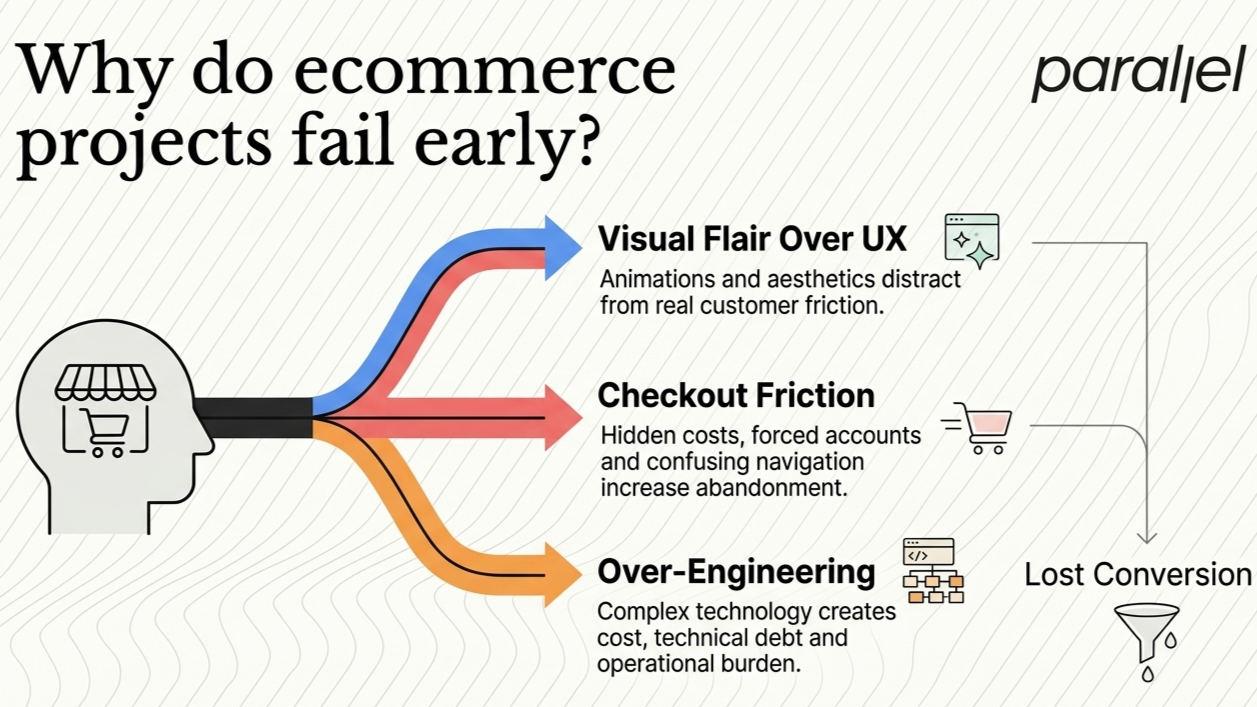
The fundamental issue is a lack of product thinking. Many agencies build what you ask for without questioning if it is actually the right solution for your customers. This leads to bloated websites, confusing navigation, and technical debt.
We routinely see teams overcomplicate onboarding and product discovery. They force users to create accounts before seeing shipping costs. They hide essential filters behind confusing icons. According to a 2026 usability study by the Baymard Institute, 69% of users still abandon carts due to basic friction in the checkout flow. If your design partner is not actively trying to eliminate that friction, they are failing you.
Another common trap is over-engineering. We have stepped in to help teams who spent hundreds of thousands of dollars on headless commerce builds when a standard Shopify setup would have served them better. They bought into the hype of "cutting edge" technology without realizing their internal team lacked the resources to manage it. You need a partner who constraints the technology to fit your actual operational reality.
The Top 10 ecommerce website design & development services for 2026
When evaluating partners, you have to look past the beautiful case studies. You need to understand how they think, how they solve problems, and how they handle constraints. Here is a breakdown of the top players in the market right now and where they actually excel.
1) ParallelHQ
We built ParallelHQ because we saw a massive gap in how products were being designed for startups. Too many agencies treat design as an assembly line. We treat it as a critical business decision.
For ecommerce brands, we focus heavily on clarity and conversion. We do not just design pretty pages. We run targeted UX audits to find exactly where your users are dropping off. We rely on rapid design sprints to test solutions with real users before we write a single line of code. When it comes to the build, our Shopify design and development services are focused on creating lightweight, highly performant stores that your internal team can actually manage.
Our approach is grounded in real user data. Whether you need a complete website redesign or specific ecommerce UI/UX suggestions, our team acts as an extension of your own.
2) MetaLab
MetaLab is a massive name in the product design world. They have designed interfaces for some of the biggest tech giants globally. Their visual execution is undeniably top-tier. However, their engagements are often scaled for enterprise budgets and timelines. If you are an early-stage startup needing to move quickly and iterate based on early market feedback, they might be too heavy of a lift. We often speak with founders looking for a MetaLab alternative because they need more agility and a tighter integration with their core product team.
3) Work & Co
Work & Co excels at deep, complex technical builds. They are engineering-heavy and partner well with massive retailers who need custom, proprietary technology stacks. They are fantastic at what they do, but their model is built for scale. For a startup looking to validate a market or scale a D2C brand on standard infrastructure, this level of custom engineering is usually unnecessary and cost-prohibitive. Teams often seek a Work & Co alternative when they realize they need speed to market over a bespoke backend.
4) Huge
Huge is exactly what their name implies. They are a massive global agency with roots in advertising and large-scale brand campaigns. If you need a global product launch with integrated marketing, media buying, and experiential design, they are a strong choice. But if your primary concern is fixing a leaky conversion funnel or refining your interaction design, a massive agency model can feel bloated. You will likely pay for a lot of overhead. Founders often look for a Huge alternative to get closer to the actual designers doing the work.
5) R/GA
Similar to Huge, R/GA is a traditional powerhouse that has pivoted heavily into digital transformation. They are brilliant at connecting brand narratives with digital touchpoints. However, their primary audience consists of Fortune 500 companies. Their processes are long, thorough, and very expensive. For a growing startup, the lack of immediate, iterative product validation can be a risk. If you need rapid product strategy consulting without the enterprise timeline, you might want to consider an R/GA alternative.
6) Instrument
Instrument builds beautiful, brand-centric digital platforms. They are highly skilled at visual storytelling. If your ecommerce brand relies entirely on an immersive, editorial feel, they are a great agency to look at. The downside is that hyper-visual sites can sometimes sacrifice basic usability conventions. Nielsen Norman Group's 2025 research on ecommerce navigation highlights that non-standard, overly creative menus reduce product discoverability by up to 42%. If conversion is your primary metric, finding an Instrument alternative that balances brand with strict UX principles is critical.
7) Code and Theory
Code and Theory is known for their work at the intersection of content and commerce. They have done incredible work for large publishers who also sell products. They understand how to map complex content taxonomies. However, if you are running a straightforward D2C brand or a SaaS product, their approach might overcomplicate your architecture. Teams looking for a more streamlined, product-led approach often explore a Code and Theory alternative.
8) Ustwo
Ustwo is famous for their mobile-first approach and app design. They build highly engaging digital products and have a strong pedigree in gaming and mobile experiences. If your ecommerce strategy is entirely native-app based, they are a stellar choice. But if you are focused on web-based ecommerce UX design and need to optimize a standard browser checkout, their specific expertise might not align perfectly with your needs. This is a common reason companies look for a Ustwo alternative.
9) Method
Method focuses heavily on corporate digital strategy and service design. They are very analytical and spend a significant amount of time in the research and discovery phases. This is great for legacy businesses trying to reinvent themselves. For a startup, however, spending months in research before prototyping can kill momentum. We believe in using a rapid discovery framework to get to testable prototypes faster. If you need speed, a Method alternative is usually a better fit.
10) Ramotion
Ramotion produces incredibly slick UI work. They are very popular among tech startups for marketing websites and brand identities. They do great work making complex tech look accessible. However, their focus is often more on the marketing surface rather than deep, complex transactional flows or backend integrations. If you are building a robust store with thousands of SKUs and complex user profiles, you might need a partner with deeper development capabilities, leading you to seek a Ramotion alternative.
How Should You Evaluate ecommerce website design & development services?
Choosing a partner is an exercise in risk mitigation. You are handing over the primary revenue engine of your business. Here is exactly how we recommend evaluating potential partners.
First, look at their approach to the problem, not just their portfolio. Any agency can show you a polished Figma file. You need to ask them how they arrive at those designs. Do they start with assumptions, or do they start with user research? We always insist on speaking directly to customers before making sweeping design changes. If an agency is willing to redesign your entire store without doing an accessibility audit or baseline usability testing, walk away.
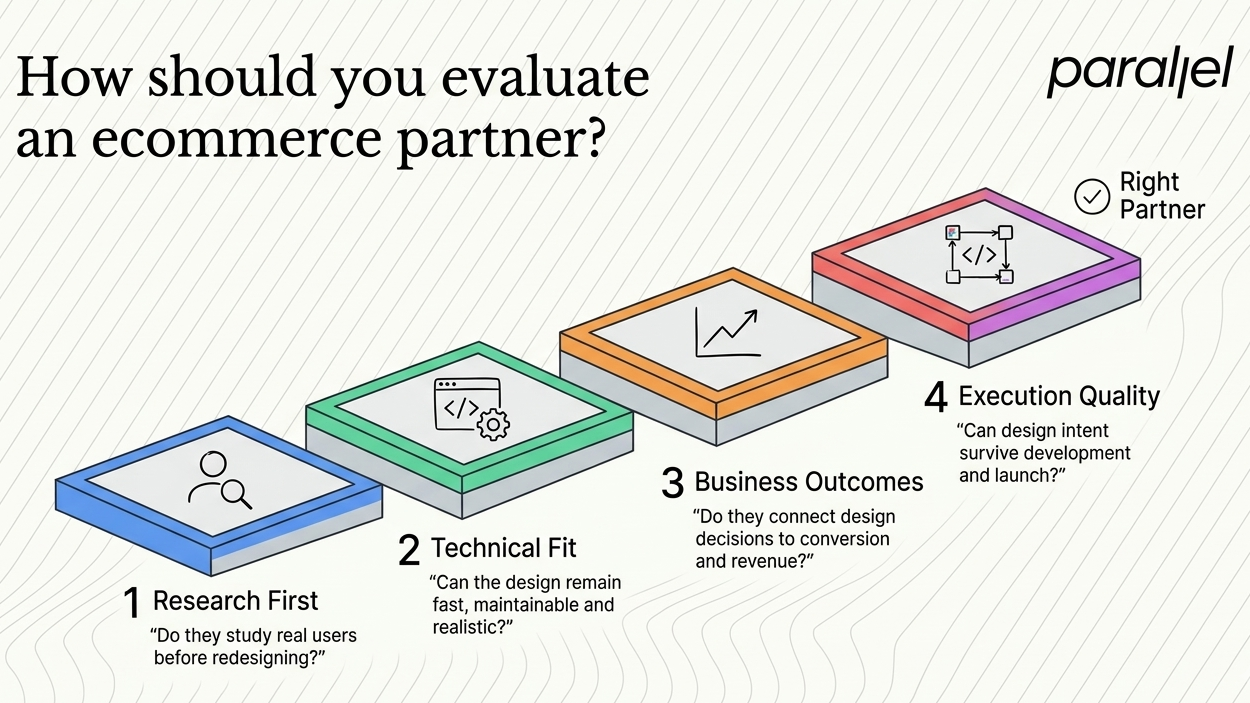
Second, examine how they handle technical constraints. The best design in the world is useless if it takes a year to build and slows down your page load time. A 2025 report from Shopify shows that stores prioritizing site speed and mobile-first interactions see a 30% higher conversion rate. Ask potential partners about their development handoff process. How do they ensure the final build matches the design intent? At Parallel, we tightly integrate our Figma design services with our development team so there is zero translation loss.
Third, look for a focus on specific outcomes. A good partner will ask you about your business metrics in the first meeting. Are you trying to increase average order value? Reduce cart abandonment? Improve repeat purchase rates? If they are only talking about aesthetics and "delight," they do not understand your business. You need someone who can implement a robust UX metrics framework to prove their design actually works.
What ROI Should You Expect From ecommerce website design & development services?
Treating design as a cost center is a mistake. It is a lever for growth. When you invest in proper product design and solid engineering, the returns should be measurable and compounding.
We look at ROI in three specific areas.
The first is a direct increase in conversion rates. By simplifying the navigation, clarifying product detail pages, and removing friction from the checkout, you capture revenue that was previously leaking out of your funnel. Forrester's 2026 design ROI report confirms that every dollar invested in UX yields a significant return when targeted at specific user pain points. We have seen minor tweaks to mobile layout resulting in double-digit percentage increases in completed checkouts.
The second area of ROI is operational efficiency. A poorly built website requires constant developer intervention. If your marketing team cannot update a banner or launch a promotion without filing a Jira ticket, your platform is failing you. Good development services build modular, easy-to-manage systems. We often implement robust design systems and flexible CMS architectures so your team can move faster without breaking the site.
The final area is brand trust. In 2026, users have zero tolerance for clunky, broken experiences. If your site feels cheap, slow, or confusing, they will assume your product is too. A highly polished, accessible, and deeply considered experience builds immediate trust. It reduces customer support tickets and increases brand loyalty. This is why investing in professional product design is not optional for serious brands.
Conclusion
Building a great ecommerce product is hard work. It requires discipline, clear thinking, and a willingness to say no to distracting features.
Do not get seduced by complex architectures or flashy trends that do not serve your users. Focus on the fundamentals. Talk to your customers, map their actual journeys, and build the simplest possible solution that solves their problems.
If you align with a partner who shares this mindset, you will not just get a new website. You will get a sustainable engine for growth. Focus on clarity, and the conversions will follow.
Frequently Asked Questions
1) What exactly are ecommerce website design & development services?
These services encompass the entire lifecycle of building an online store. This includes user research, UX strategy, visual design, frontend and backend coding, platform integration, and usability testing. It is not just about making a site look good; it is about creating a functional, high-converting digital product.
2) How do we know if we need custom ecommerce website design & development services?
You need custom services when off-the-shelf templates limit your growth. If you have a unique product configuration, complex pricing models, high cart abandonment rates, or an internal team struggling to manage a bloated backend, it is time to bring in strategic partners.
3) How much do top-tier ecommerce website design & development services cost in 2026?
Costs vary wildly based on scope and the agency's model. A massive global agency might charge upwards of $200,000 for a redesign. Leaner, product-focused partners like ParallelHQ typically structure engagements around specific sprint cycles or dedicated team models, which provides much higher value and faster time-to-market for early and growth-stage companies.
4) Should we use Shopify or build a headless commerce platform?
For 90% of early to mid-stage startups, a well-architected Shopify build is the right answer. Headless commerce provides ultimate flexibility but introduces massive technical overhead. Unless you have a dedicated internal engineering team to maintain it, headless is usually an expensive distraction.
5) How long does a typical redesign and development cycle take?
Traditional agencies might take 6 to 9 months. We believe that is too slow. By utilizing design sprints and focused opportunity mapping, a dedicated team can usually launch a high-impact, fully functional redesign in 12 to 16 weeks.
6) What is the difference between an agency and a product design partner?
An agency takes your brief and builds exactly what you ask for, often prioritizing aesthetic trends. A product design partner challenges your assumptions, conducts real user research, and focuses strictly on business metrics and usability. We act as partners, not order-takers.
7) How does UX research fit into ecommerce development?
Research is the foundation. Without it, you are just guessing. We use usability testing and user interviews to understand why people buy and why they leave. This data dictates the architecture, the page layouts, and the checkout flow before development even begins.
8) Is ParallelHQ the right fit for my startup's ecommerce project?
If you want to move quickly, rely on actual user data, and build a clean, high-performing store without agency fluff, we are likely a great fit. We work closely with founders and product leaders who value clarity and conversion over vanity metrics.

check out these related blogs