I have seen too many brilliant startup ideas fail because teams overcomplicate their product experience. When you are building an early-stage company, every design decision matters. But instead of focusing on clear and grounded user behavior, founders often get distracted by surface-level aesthetics.
If your onboarding is weak or activation is low, the problem is not just visual. It is a fundamental strategic issue. This is exactly why finding the right partner matters. If you are looking to hire UI UX design services, you need a team that thinks critically, not just one that pushes pixels. Here is my take on finding the experts who actually move the needle.
Quick answer
The best UI UX design services prioritize clarity, real user behavior, and business outcomes over mere aesthetics. A strong design partner simplifies complex product decisions, improving user activation and reducing friction from day one.
Here is how the top 10 agencies compare for 2026:
Why should startups invest in UI UX design services today?
In my experience, founders often view design as an expense rather than a core growth lever. We have seen teams treat user experience as an afterthought, only to realize their product is unusable after launch. The data for 2026 makes the business case undeniably clear.
Forrester’s latest research confirms that every dollar invested in user experience returns up to $100. That is a 9,900% ROI. Furthermore, well-built interfaces can lift conversion rates by up to 200%. When you invest in mature product design, you are buying direct conversion lifts and revenue retention.
Good design removes the friction between a user's intent and their action. A 2025 Baymard Institute study showed that fixing checkout usability alone can recover over 35% in lost conversions for large sites. Startups cannot afford to leave that kind of money on the table due to clumsy navigation or confusing form fields.
Beyond immediate conversions, design impacts long-term viability. Recent BCG research found that firms leading in AI and design outperform their peers by 1.7x in revenue growth. Fixing a design defect post-launch costs significantly more than addressing it during the strategy phase. Investing early prevents expensive engineering rework later.
Where do teams go wrong when choosing UI UX design services?
I have sat in countless meetings where product teams argue over button colors while completely ignoring fundamental workflow flaws. The most common mistake I see is hiring for 'pretty' instead of 'effective.' Teams fall into the trap of evaluating agencies purely on their visual portfolio.
This leads to what Nielsen Norman Group identified as "design theater" in their 2026 State of UX report. Companies go through the motions of adding trendy features or complex animations, but they fail to deeply understand the user’s actual problem. They build a beautiful house with no doors.
I recently looked at a B2B SaaS platform that had a stunning interface but single-digit activation rates. The design assumed the user already understood a highly proprietary workflow. The agency they hired made it look gorgeous but failed to map the user journey logically. This usually backfires and creates massive churn.
If an agency's portfolio only shows perfectly polished dashboards with made-up numbers, you should look elsewhere. You need partners who understand real-world constraints, technical feasibility, and user research. Great design is how it works, not just how it looks.
How do you evaluate the best UI UX design services for your product?
So how do you filter the signal from the noise? Look for clarity in product thinking. When evaluating agencies, pay attention to the questions they ask you in the very first meeting. If they immediately jump to talking about color palettes, they are missing the bigger picture.
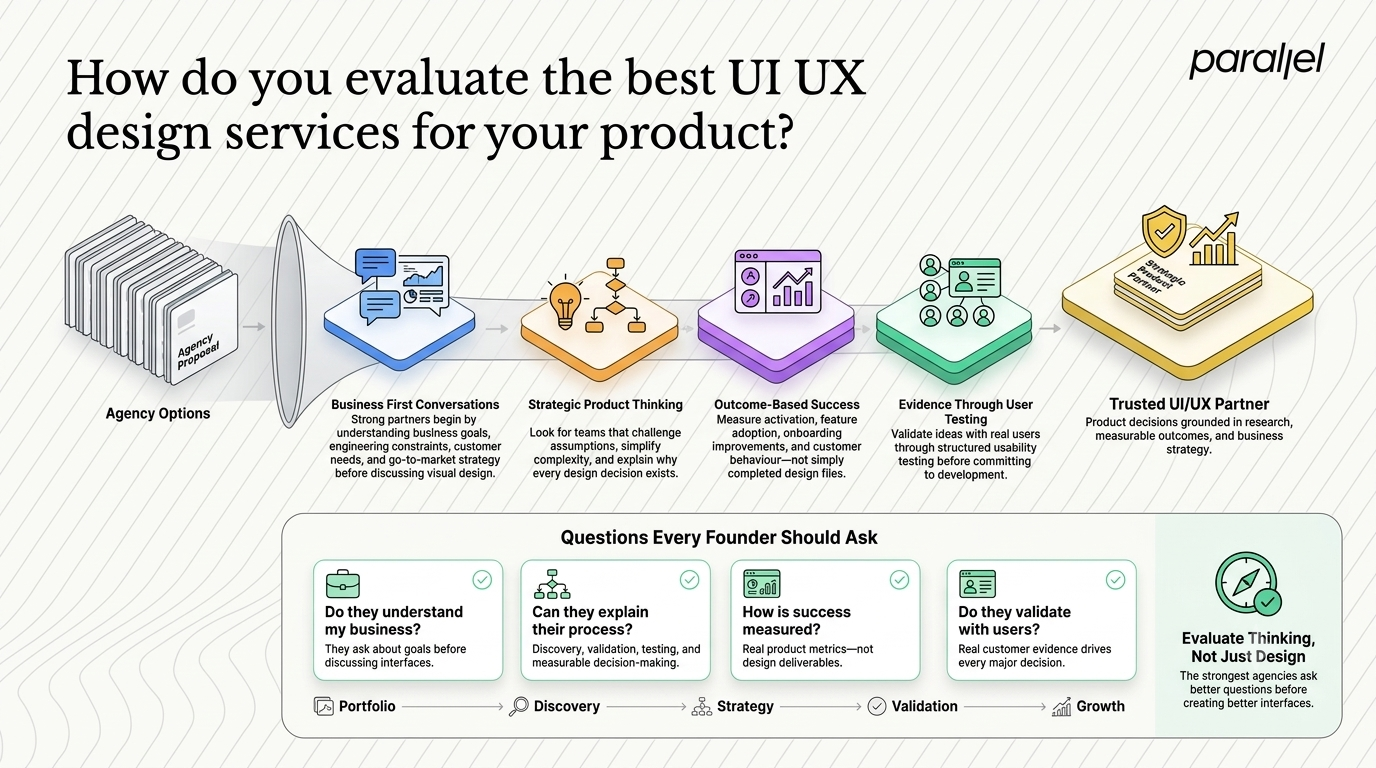
They should be asking about your business constraints, your engineering limits, and your go-to market strategy. A strong partner will want to understand your product strategy before drawing a single wireframe. They should challenge your assumptions and push back when an idea is too complex.
Ask how they measure success. It should never just be about delivering Figma files on time. It should be about specific outcomes, like reducing onboarding drop-offs by 20% or increasing feature adoption. Ask to see their discovery framework and how they validate ideas.
Do they test with real users? Nielsen Norman Group continually reminds us that testing with just five users uncovers 85% of usability issues. If your design partner is not talking to your actual users, they are just guessing. You need an evidence-based approach to design.
Which are the top 10 agencies for UI UX design services in 2026?
Finding the right fit depends entirely on your product stage, budget, and internal culture. Here is a breakdown of the top agencies defining the industry in 2026.
1) ParallelHQ
We built ParallelHQ because we saw too many early-stage teams struggle with design decisions that should have been simpler. We act as a strategic product design partner for founders and PMs. Our focus is heavily on clarity in thinking, rapid validation, and actionable outcomes.
We do not just hand over pretty screens. We run intensive design sprints to solve critical product problems in days, not months. Our team integrates closely with yours to ensure that every design decision is grounded in real user behavior and technical reality. We are the partner you choose when you need to simplify a complex product and drive actual activation.
2) MetaLab
MetaLab is legendary for designing some of the most iconic tech products in the world, including Slack and Coinbase. They are exceptional at creating premium, highly polished consumer interfaces. Their visual execution is often the gold standard in Silicon Valley.
However, their engagements are typically suited for very well-funded startups or established unicorns. If you need deep strategic unblocking on a tight timeline, you might want to look for a more agile MetaLab alternative. They excel when the product direction is already fairly concrete.
3) IDEO
IDEO basically invented human-centered design. They are a massive global consultancy that shines when tackling broad, systemic challenges. If you are trying to reimagine the future of mobility or redesign a physical retail experience alongside a digital app, they are a fantastic choice.
Their process is highly research-heavy and academic. For an early-stage SaaS founder who just needs to fix a leaky onboarding funnel, IDEO might be overkill. Teams looking for faster digital execution often seek an IDEO alternative that moves at startup speed.
4) Frog Design
Frog Design is another titan in the design world. They have a rich history in industrial design and have successfully transitioned into digital transformation for massive enterprises. They are great at aligning complex stakeholder groups within Fortune 500 companies.
Their scale allows them to tackle massive ecosystem projects. But for a nimble product team, their enterprise-heavy approach can feel slow. Startups often look for a Frog Design alternative that focuses purely on digital product agility.
5) Work & Co
Work & Co operates with a very specific, engineering-led philosophy. They believe in rapid prototyping and working entirely in code as quickly as possible. They are highly respected for their technical delivery and ability to ship complex digital products.
Their strength is execution. If you have a massive technical build and need a partner who can handle both deep design and heavy engineering, they are top tier. Companies focused more on upstream product strategy sometimes explore a Work & Co alternative.
6) Huge
Huge is a massive digital agency that blends marketing, branding, and product design. They are phenomenal at creating digital experiences that drive brand awareness and consumer engagement. If you are launching a major consumer campaign that needs a digital hub, Huge is a great fit.
Their DNA is deeply rooted in the agency model. This means they are brilliant at storytelling and visual impact. Product managers looking for deep, unglamorous workflow optimization might prefer a Huge alternative focused strictly on SaaS or complex utility products.
7) Ramotion
Ramotion specializes in working with growing SaaS and tech companies. They are particularly known for combining brand identity with product design. They create incredibly slick marketing websites and cohesive app interfaces that help startups look established.
They are visual powerhouses. If you are preparing for a Series B raise and need a complete aesthetic overhaul, they deliver exceptional polish. For teams needing deep UX research or complex architectural overhauls, a more research-focused Ramotion alternative might be necessary.
8) Clay
Clay is a San Francisco-based agency that has mastered the modern, disruptive tech aesthetic. They build beautiful, cutting-edge web experiences and digital products. Their work often features sophisticated 3D elements and advanced motion design.
They are the right choice when you want your product to feel like a premium, futuristic brand. Their focus leans heavily into the visual and interactive layer. Teams that need to untangle messy legacy systems often look for a Clay alternative that specializes in enterprise UX.
9) R/GA
R/GA is a global advertising and digital agency known for connected experiences. They excel at the intersection of technology, design, and marketing. They are best suited for global consumer brands looking to create innovative digital touchpoints.
Because of their advertising roots, they think in terms of campaigns and broad consumer engagement. A pure software startup might find their approach too marketing-heavy and may seek an R/GA alternative dedicated to digital product development.
10) Ustwo
Ustwo is a digital product studio with a unique background in gaming and immersive experiences. They are incredibly strong in mobile app design and health tech products. They bring a level of joy and playfulness to interfaces that is hard to replicate.
If you are building a consumer app that relies on habit formation and emotional engagement, Ustwo is brilliant. B2B founders building complex enterprise tools usually look for an Ustwo alternative with more experience in data-dense environments.
What is the practical approach to working with UI UX design services?
Once you have chosen a partner, how do you get the best work out of them? We have found that the best products emerge from tight, cross-functional collaboration. You cannot throw a brief over the wall and expect magic six weeks later.
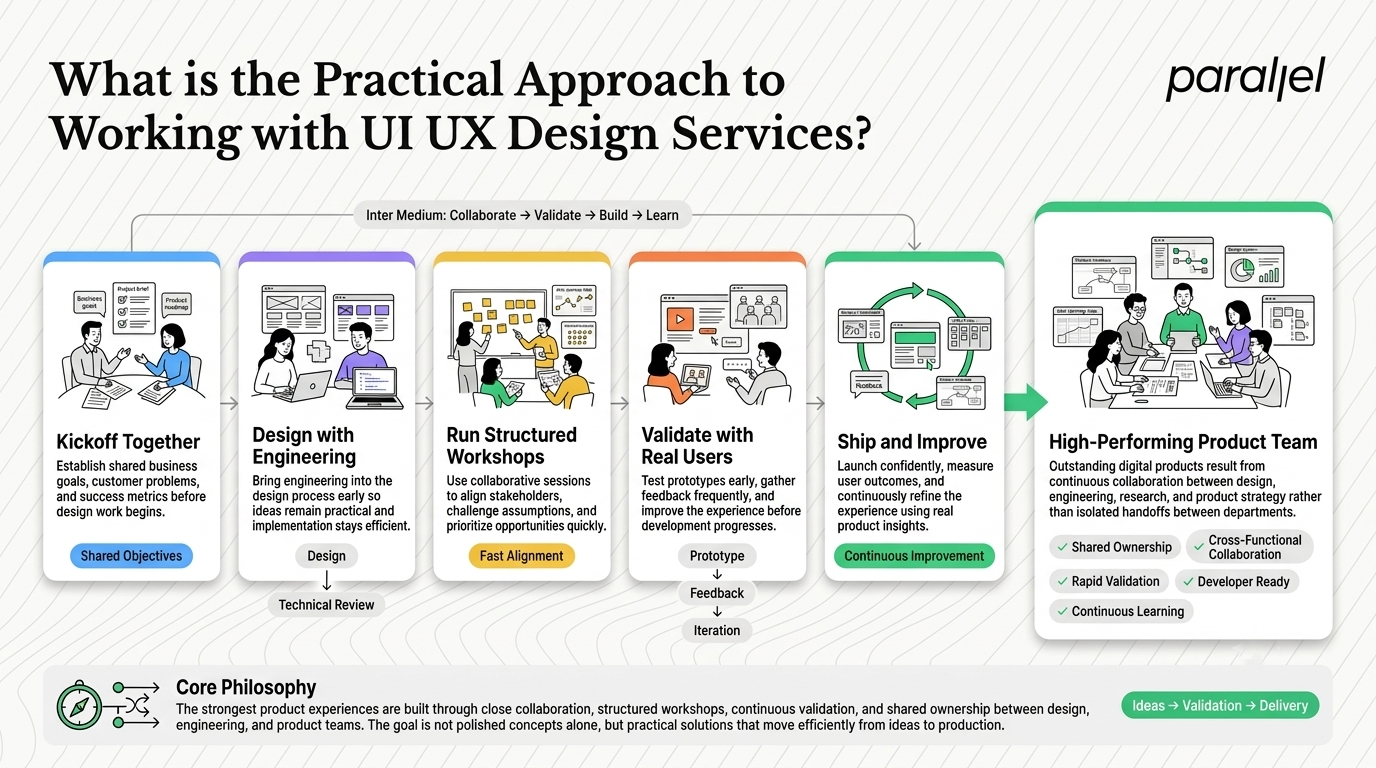
Do not isolate design from engineering. Bring developers into the design process early and often. This avoids the classic trap where a designer hands off a beautiful concept that takes six months to build. A good agency will insist on talking to your technical lead in the first week.
Use frameworks that force rapid alignment. We rely heavily on structured workshops to align stakeholders and validate ideas quickly before writing a single line of code. Fast iterations grounded in real user feedback will always beat a solitary genius working in a vacuum. Your ultimate goal is actionable thinking that ships, not a beautiful concept that dies in Figma.
Conclusion
Great product design is not about chasing the latest aesthetic trend. It is about making things simpler, clearer, and more grounded in real user behavior. The teams that win are the ones that ruthlessly eliminate friction and respect their users' time and intelligence.
When you choose a design partner, look for those who share that mindset. Look for teams that ask the hard questions, push back on bad ideas, and care more about your activation rate than their portfolio.
Frequently Asked Questions
1) What exactly do UI UX design services include?
These engagements typically cover the entire lifecycle of shaping a digital product. It starts with user research and product strategy to understand the core problem. It moves into wireframing and information architecture (UX), ensuring the logical flow makes sense. Finally, it includes the visual interface design (UI), prototyping, and usability testing to validate the solution before development begins.
2) How much should early-stage startups budget for UI UX design services?
Budgets vary wildly based on the scope and the agency's tier. A freelance designer might charge a few thousand dollars, while a top-tier global agency can charge upwards of $200,000 for a foundational project. For high-quality, strategic partners focused on startups, expect to budget between $15,000 to $50,000 for a comprehensive sprint or MVP design phase. The focus should be on the ROI of getting the product right the first time.
3) How long does a typical product design engagement take?
Traditional agency models often stretch projects over three to six months. However, modern approaches are much faster. Using a design sprint methodology, core product problems can be prototyped and tested in just a few weeks. A full zero-to-one product design for an MVP usually takes about four to eight weeks of focused, iterative work.
4) Should I hire an in-house designer or use UI UX design services?
If you have a clear, validated product and need constant, daily execution on new features, an in-house designer is invaluable. However, if you are figuring out your core product strategy, launching an MVP, or needing a massive UX overhaul, an external team brings fresh perspective, broad industry experience, and specialized frameworks that are hard to hire for early on.
5) How do I know if my product needs a UX audit or a full redesign?
Look at your metrics. If users are signing up but dropping off at a specific step, or if your support team is overwhelmed with basic "how-to" questions, you likely have localized friction. A UX audit can identify these specific bottlenecks. If the underlying technology is changing, the core user base has shifted, or the product feels fundamentally broken across all flows, a full redesign is necessary.
6) What is the ROI of investing in professional UI UX design services?
The return is measurable in both revenue and cost savings. Better design directly increases conversion rates, improves user retention, and raises customer lifetime value. On the cost side, catching usability issues during the design phase is exponentially cheaper than rewriting code post-launch. It also drastically reduces customer support tickets related to user confusion.
7) How does ParallelHQ differentiate its UI UX design services from traditional agencies?
We do not operate like a traditional agency that disappears for weeks and returns with a polished presentation. We focus heavily on clarity and product thinking. We work closely with founders and PMs through structured sprints to unblock decisions rapidly. Our goal is to simplify complex product challenges and ground every decision in real user feedback, stripping away the fluff to focus on what actually drives growth.
8) Is a design sprint right for my current product stage?
Design sprints are incredibly versatile. They are perfect when you are kicking off a new product and need to validate the concept before building. They are equally effective for mature products that are stuck on a high-stakes feature or facing declining engagement. If you need to align a team quickly, bypass endless debates, and get real user data in days, a sprint is the right tool.

check out these related blogs