Finding the right design partner is often a frustrating process. I have seen founders burn months of runway on beautiful screens that fail completely in real user testing. The core problem is that most teams buy surface-level UI when they actually need deep product clarity. Evaluating UX/UI design services requires looking past the polished portfolios to understand how a firm solves messy, complex problems. In this guide, we will break down the top providers in 2026, examine where product teams usually go wrong in the hiring process, and share a practical framework for making the right choice.
Quick answer and TL;DR
The best UX/UI design services act as strategic thought partners rather than mere pixel pushers. Choose a partner based on your company stage, product complexity, and the specific user behavior you need to change.
What makes top UX/UI design services actually deliver?
We have worked with dozens of early-stage startups over the years. The teams that succeed do not just build good-looking products. They build products that make sense to the user immediately.
When you evaluate a potential partner, you are essentially buying their decision-making framework. The best agencies do not start by asking about your color preferences. They start by mapping the user journey and identifying the riskiest assumptions in your business model.
According to a 2026 usability report by the Nielsen Norman Group, organizations that prioritize foundational user research reduce development rework by over 40 percent. This data proves that skipping strategy to rush into visual design is an expensive mistake. You need a team that will push back on your assumptions and force you to simplify your feature set.
A strong design partner brings three specific capabilities to the table.
- Systems thinking: They understand how changing an onboarding flow impacts downstream retention metrics.
- Behavioral insight: They rely on generative vs evaluative research to build what users need, not just what they say they want.
- Technical pragmatism: They design experiences that your engineering team can actually build within your current constraints.
Which are the 10 best UX/UI design services to consider in 2026?
Choosing the right firm depends heavily on what you are trying to achieve. Here is how we view the landscape of top providers this year.
1) ParallelHQ
We built ParallelHQ because we saw too many teams struggling with product decisions that should have been clearer. We focus entirely on product strategy, UX, and bringing clarity to complex systems.
- Core focus: We act as an extension of your product team. We prioritize usability, clear information architecture, and rapid validation over chasing temporary design trends.
- Best for: Founders and product managers at early-stage startups, particularly those building B2B SaaS or AI-native products.
- The tradeoff: We are not a traditional marketing or branding agency. If you need a purely visual website refresh without changing the core product experience, we might not be the right fit.
- Our approach: We rely heavily on design sprints to compress months of alignment and decision-making into weeks. We validate ideas with real users before any code is written.
2) MetaLab
MetaLab is famous for shaping the interfaces of some of the most recognized consumer tools in the world. They have a distinct, highly polished visual style.
- Core focus: Creating premium, consumer-grade aesthetics that feel incredibly smooth.
- Best for: Later-stage startups or heavily funded consumer products that need to win on visual delight.
- The tradeoff: They are a significant financial investment. For early-stage teams still finding product-market fit, spending heavily on aesthetic polish can be a misallocation of resources.
- Alternative: If you need a more iterative, strategy-first approach without the massive upfront cost, consider a MetaLab alternative focused on lean methodology.
3) IDEO
IDEO wrote the book on design thinking. They are a massive global consultancy known for tackling complex, ambiguous problems that span both digital and physical realms.
- Core focus: Broad innovation, service design, and deeply empathetic human-centered research.
- Best for: Massive corporations or well-funded ventures looking to create entirely new product categories.
- The tradeoff: Their process is thorough but slow. Startups needing to ship quickly often find traditional consultancies too heavy.
- Alternative: Teams needing faster digital execution might look for a specialized IDEO alternative.
4) Clay
Clay has built a strong reputation over the last few years for creating incredibly slick, motion-heavy web experiences.
- Core focus: Merging brand identity with digital product design, leaning heavily into motion graphics and 3D web elements.
- Best for: Tech companies that need their marketing sites and core product to share a very modern, aggressive visual identity.
- The tradeoff: High-motion UI can sometimes obscure underlying usability issues.
- Alternative: If your primary metric is task completion rather than brand perception, you may prefer a Clay alternative focused on functional UX.
5) Frog Design
Frog has a legacy of industrial design and has successfully transitioned into large-scale digital transformation over the past decade.
- Core focus: Enterprise-level organizational change driven by design and deep technical architecture.
- Best for: Fortune 500 companies modernizing legacy systems across thousands of employees.
- The tradeoff: Their engagement models are massive. They are rarely the right choice for an agile team moving quickly.
- Alternative: Check out a more nimble Frog Design alternative if you are building modern software.
6) Ramotion
Ramotion operates at the intersection of brand identity and user interface design. They are very effective at making young companies look established.
- Core focus: Brand identity, icon design, and front-end web design.
- Best for: Seed-stage startups that have a working MVP but need a credible, trustworthy visual identity to raise their next round.
- The tradeoff: They are very brand-centric. Complex workflow mapping is less of a focus than visual storytelling.
- Alternative: For deep product workflow logic, a Ramotion alternative might serve you better.
7) Work & Co
Work & Co defines themselves by their engineering integration. They do not just design screens; they ship production-ready code.
- Core focus: Highly technical product builds where design and engineering must happen in tandem.
- Best for: Companies that need an external team to handle the entire build process from wireframe to deployment.
- The tradeoff: You are paying for a massive engineering overhead.
- Alternative: If you already have a strong internal engineering team, a Work & Co alternative focused strictly on UX strategy is more cost-effective.
8) Huge
Huge is a global agency known for taking on massive digital marketing and product transformation projects.
- Core focus: Data-driven marketing, large-scale e-commerce, and global brand experiences.
- Best for: Retail giants and media conglomerates needing a unified digital presence.
- The tradeoff: You will likely be managed by a junior team unless you are their largest client of the year.
- Alternative: Startups should look for a Huge alternative that offers direct access to senior design leadership.
9) Instrument
Instrument excels at creating digital products that feel like lifestyle brands. They blur the line between a campaign and a software tool.
- Core focus: Brand-led digital product experiences with strong narrative elements.
- Best for: Consumer brands, media companies, or tech tools where emotional connection is the primary differentiator.
- The tradeoff: Their work is beautiful but can lean more toward marketing than utilitarian software design.
- Alternative: Teams building heavy B2B workflows might need an Instrument alternative.
10) Neuron
Neuron focuses specifically on B2B applications, enterprise software, and complex digital tools.
- Core focus: Simplifying dense data environments and complex user workflows.
- Best for: SaaS companies dealing with dashboards, data visualization, and multi-user enterprise roles.
- The tradeoff: Their portfolios are highly functional but rarely win awards for flashy visual design.
- Alternative: If you need a balance of B2B logic with a modern aesthetic, consider a Neuron alternative.
How do teams go wrong when evaluating UX/UI design services?
In my experience, the biggest mistake teams make is diagnosing their own problem incorrectly. A founder will come to us asking for a visual refresh because their conversion rate is low. But a visual refresh will not fix a confusing value proposition or a broken onboarding flow.
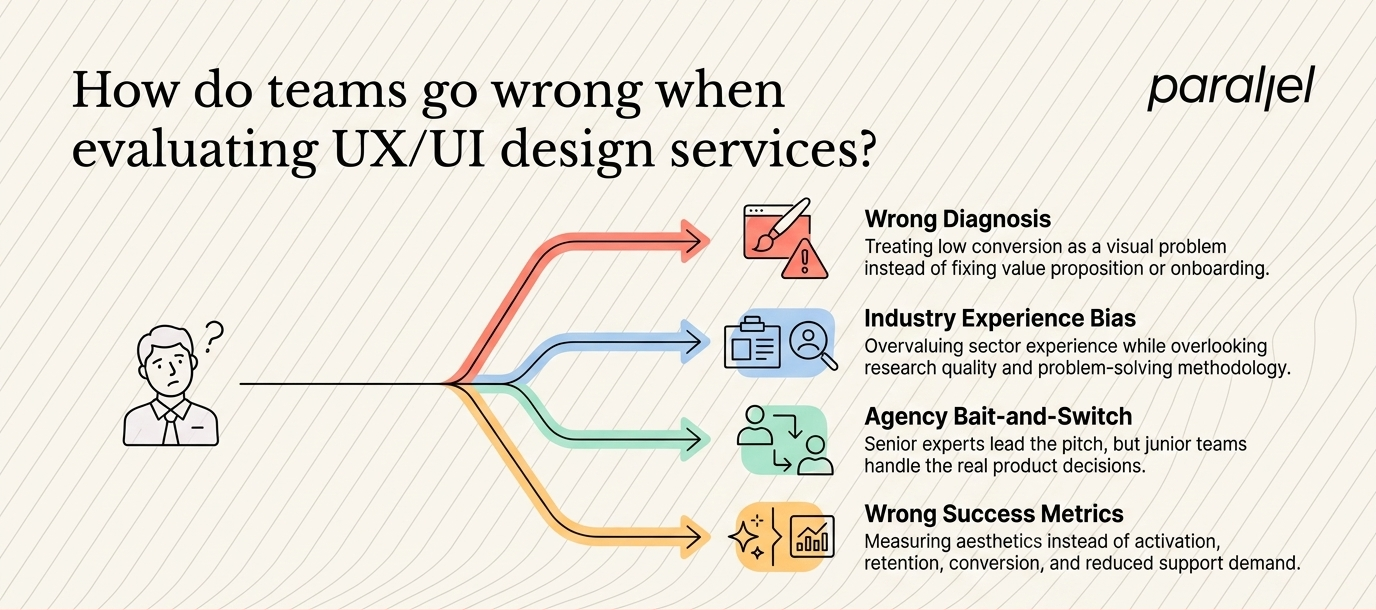
Teams also tend to overvalue industry experience and undervalue problem-solving methodology. Just because an agency has built three healthcare apps does not mean they understand the specific behavioral barriers of your specific users. You want a team that knows how to write a research plan and conduct neutral, unbiased user interviews.
Another common trap is the big agency bait-and-switch. You meet with the senior partners during the pitch process, but the actual work is handed off to junior designers with very little oversight. This creates a massive gap in product thinking. When we map out product strategy, we ensure that senior leaders are deeply involved in the day-to-day decisions.
Finally, teams fail to align on what success looks like. If you treat design as an artistic endeavor, you will measure it by aesthetics. If you treat it as a business function, you measure it by user activation, retention, and reduced support tickets.
What is a practical approach for hiring UX/UI design services?
You need to evaluate how an agency thinks, not just what they produce. The portfolio only tells you what the final output looked like. It tells you nothing about the constraints they faced, the technical debt they navigated, or the user feedback they incorporated.
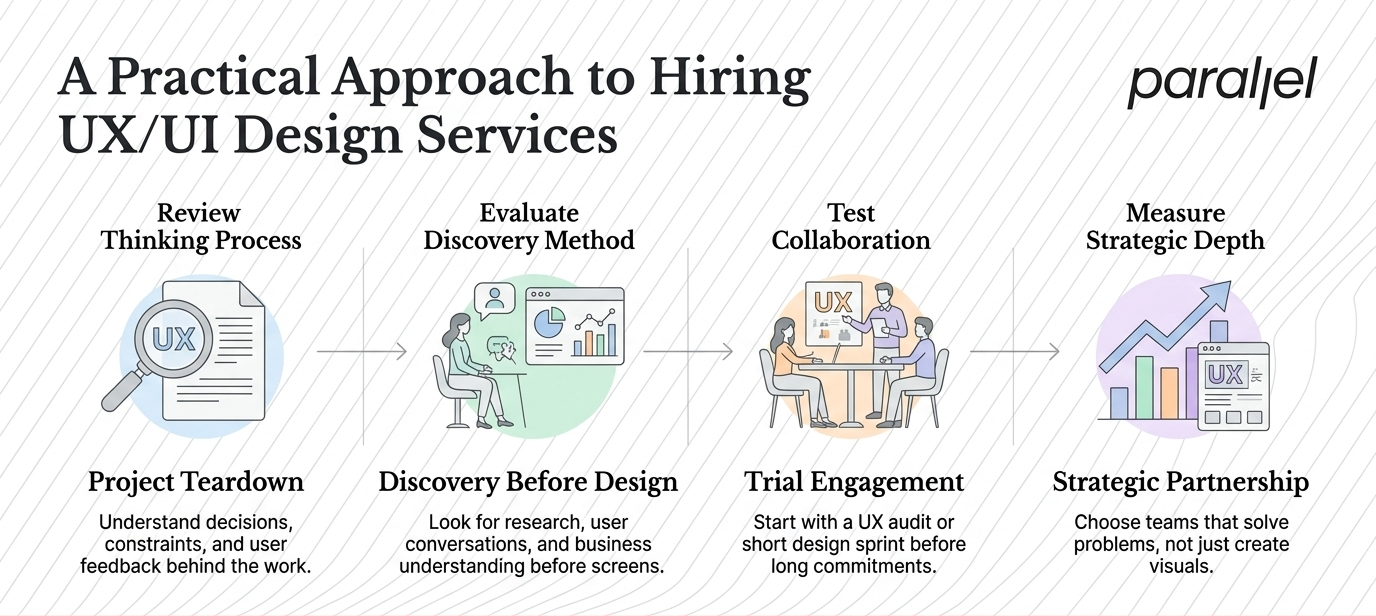
Start by asking for a project teardown. Have them walk you through a specific case study. Ask them what their original hypothesis was and how it changed after they actually spoke to users. If they cannot explain a time they were wrong and had to pivot, they are not doing real product work.
Next, audit their discovery process. A mature firm will want to talk to your users, look at your analytics, and understand your business model before they draw a single wireframe. If an agency agrees to start designing screens on day one, walk away. We use an opportunity mapping framework to ensure we are actually solving the right problem.
Consider running a test engagement. Instead of signing a six-month retainer, start with a UX audit or a two-week design sprint. According to 2026 data from the Baymard Institute, fixing usability issues upfront is exponentially cheaper than fixing them after development. A short, intensive engagement gives you a clear view of their communication style and strategic depth before you commit your full budget.
Conclusion
Great product design is fundamentally about clarity. It is about removing friction between what the user wants to do and the tool they are using to do it. The best design partners understand this intuitively. They do not aim to build monuments to their own creativity. They aim to build tools that work so well, the design itself becomes invisible. Take your time, evaluate the thinking behind the pixels, and choose a partner that challenges your assumptions.
Frequently asked questions
1) What exactly do these services include?
These services encompass everything required to build a digital product experience. This typically starts with user research and information architecture, moves into wireframing and prototyping, and concludes with high-fidelity visual design and a developer-ready design system. It is a mix of strategic problem solving and visual execution.
2) How do we measure the ROI of external design work?
You measure it through user behavior and business metrics. Look for improvements in activation rates, reductions in time-to-task completion, and lower customer support volume. A clear UX metrics framework will help you track these changes before and after the redesign.
3) What is the difference between hiring an agency and building in-house UX/UI design services?
An in-house team provides long-term continuity and deep domain knowledge, which is vital as your company scales. An external partner brings fresh perspective, speed, and specialized frameworks that your internal team might lack. Many successful startups use agencies to establish the baseline product, then hire an internal team to maintain and iterate on it.
4) Is an agency right for a pre-seed startup?
Usually, no. At the pre-seed stage, your goal is to validate a problem, not build a perfect solution. You are better off using no-code tools and off-the-shelf UI kits. Hire an agency when you have basic validation, some funding, and a need to professionalize the experience to capture a larger market share.
5) How does ParallelHQ differ from traditional agencies?
We operate strictly as a product design partner for ambitious teams. We do not do marketing sites, PR campaigns, or generic branding. We specialize in complex logic, usability testing, and rapid prototyping. We care more about how your product functions in the real world than how it looks on a presentation slide.
6) How should we budget for a design partner?
Budgets vary wildly based on the scope and the agency's prestige. Instead of asking for a fixed price for an undefined scope, budget for time and process. Define the problem clearly, and ask the agency how many weeks of research and design it will take to reach a validated prototype.
7) Should we hire a freelancer or an agency?
Freelancers are great for tactical execution when you already have strong internal product leadership. If you know exactly what needs to be built and just need screens produced, hire a freelancer. If you need help figuring out what the product should actually be, you need the strategic weight of an agency.
8) How long does it take to see value from UX/UI design services?
You should see strategic value within the first few weeks through alignment and clarity. However, measurable business impact takes longer. Depending on your development cycles, it usually takes three to six months from the start of an engagement to see the new designs live and affecting your core metrics.

check out these related blogs