Choosing among hundreds of UX design firms is genuinely hard when every agency promises "user-centered design" and shows the same Dribbble-polished portfolios. I'm Robin Dhanwani, founder of ParallelHQ, and I've spent years on both sides of this decision. This guide cuts through the noise. Whether you're an early-stage AI startup picking your first design partner or a scale-up preparing for a major product redesign, I'll show you exactly what to look for, what to ask, and how to avoid the agencies that look great in a pitch deck but struggle in execution.
How to Hire the Best UX Design Firms: TL;DR
- Evaluate UX design firms on process depth and startup fluency, not just visual portfolio quality.
- Ask for evidence of usability testing, information architecture, and design systems work, not just final screens.
- The in-house vs. agency question depends on your stage. Agencies win at early speed, in-house wins at long-term institutional knowledge.
- Red flags include vague discovery processes, no mention of accessibility standards, and inability to speak to outcomes.
What Do the Best UX Design Firms for SaaS Startups Actually Deliver?
Most founders ask what a UX design firm costs. The better question is what they actually produce. Deliverables vary enormously across agencies, and confusing "beautiful screens" with "complete UX engagement" is one of the most expensive mistakes a startup can make.
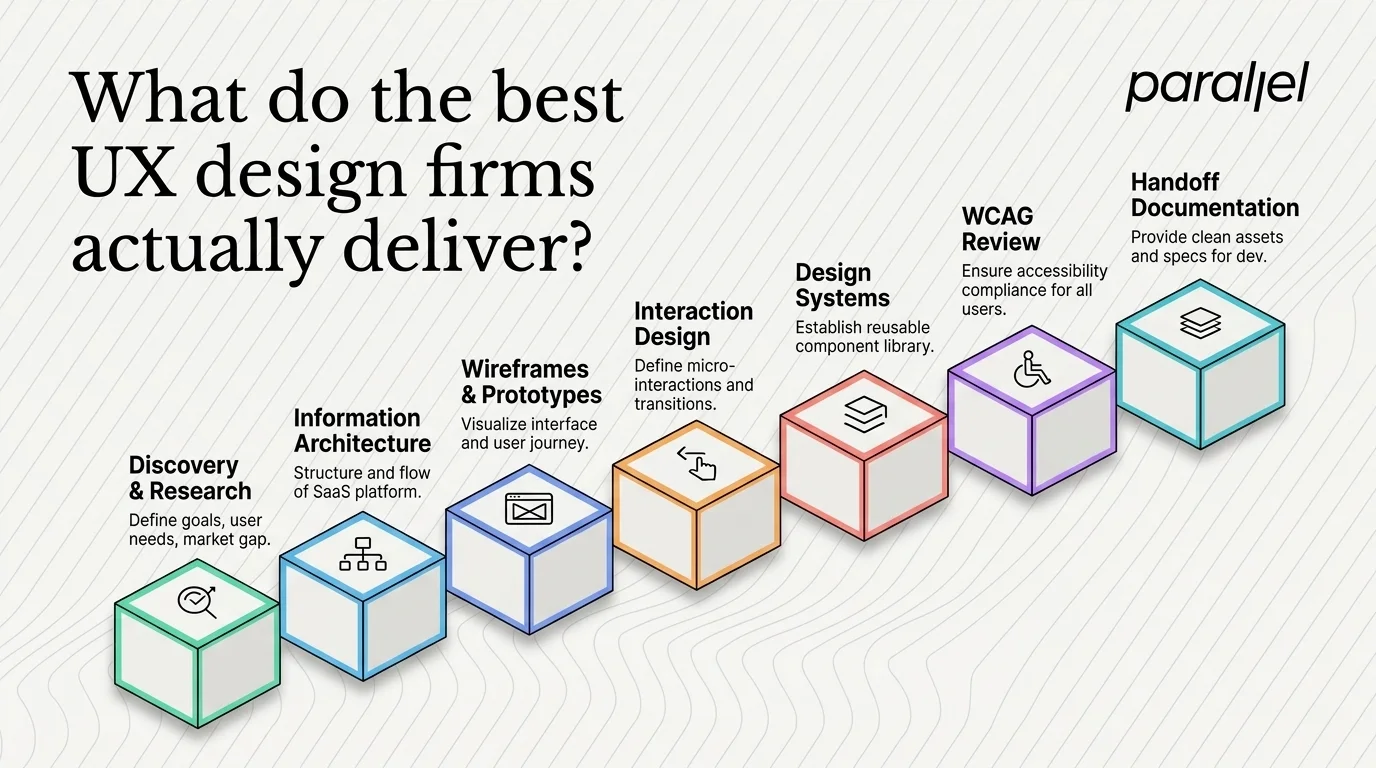
A serious UX engagement should produce layered, interconnected artifacts, not just a Figma file. Here's what a full-scope engagement delivers:
- Discovery and research: User interviews, usability testing, heuristic evaluation, and competitive analysis before a single pixel is placed.
- Information architecture: Sitemaps, content hierarchies, and navigation logic that reduce cognitive load at scale.
- Wireframing and prototyping: Low and mid-fidelity wireframes that validate structure before any visual investment.
- Interaction design: Micro-interactions, state transitions, and error handling that make a product feel coherent.
- Design systems: Component libraries in Figma that your engineering team can actually ship from, not just admire.
- WCAG compliance review: Accessibility standards baked in from the start, not bolted on after launch.
- Handoff documentation: Annotated specs, developer notes, and QA checkpoints.
For AI and SaaS products specifically, the stakes are higher. AI interfaces carry unique UX challenges: surfacing model uncertainty, managing latency expectations, and designing for adaptive and personalized experiences. A generic agency without this context will default to patterns borrowed from static SaaS products, and those patterns break under AI's non-deterministic behavior.
Customer journey mapping is another non-negotiable. Without mapping the full arc from awareness to activation to retention, a design firm is solving a fragment of your problem. The best agencies treat every touchpoint as part of a system, not a standalone screen.
A firm that skips discovery is guessing at your users' needs. Elegant guesses are still guesses.
When reviewing proposals, ask agencies to break down every phase and deliverable explicitly. If the SOW says "UI design" and nothing else, that's your answer.
How to Evaluate UX Design Firms Before Signing a Contract
The evaluation phase is where most founders make avoidable mistakes. They over-index on aesthetics and under-index on process. Here's a structured approach.
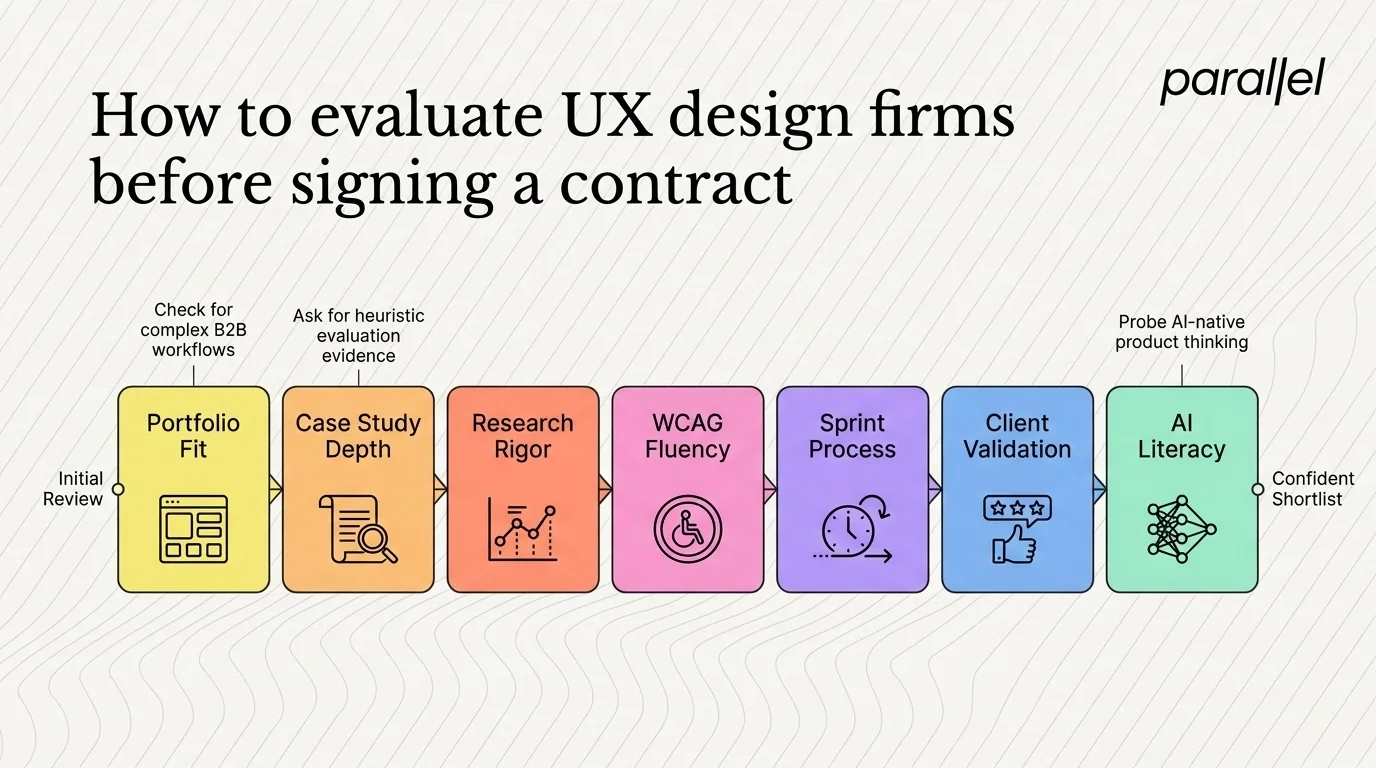
1) Audit your product type portfolio. A strong e-commerce portfolio tells you almost nothing about B2B SaaS. Look for complexity: multi-step workflows, data-dense dashboards, onboarding flows, and role-based permissions. That's where UX design firms either prove their depth or reveal their limits.
2) Read case studies for processes, not just outcomes. Any agency can show a beautiful before-and-after. Fewer can explain the research that drove the decisions. Ask: what did you learn in discovery? What did you kill and why?
3) Check their methodology against Nielsen Norman Group standards. The Nielsen Norman Group defines the industry benchmark for UX research rigor. Agencies that have never mentioned NNG, cognitive walkthroughs, or heuristic evaluation in a proposal often lack foundational research literacy.
4) Verify accessibility and WCAG fluency. Ask directly: "How do you handle WCAG 2.2 compliance in your design process?" Vague answers are disqualifying.
5) Ask for a sample design sprint structure. Agencies with genuine design sprint experience can walk you through a five-day arc instinctively. Those who have only read about it will stumble.
6) Talk to past clients, not just references. Ask references: "Where did the agency fall short?" Not just "Would you hire them again?"
7) Probe their AI and emerging tech literacy. If you're building an AI product, ask how they approach AI-native design. This is non-negotiable in 2026.
UX Design Firms vs. In-House Designers: Which Is Better for a Scale-Up?
This is one of the most debated questions among product and design leaders, and the honest answer is: it depends on what problem you're actually solving.
For early-stage startups, UX design firms almost always win. Hiring a senior UX designer full-time before product-market fit is expensive and risky. An agency brings a team with practiced design thinking, established tooling, and cross-functional patterns you'd spend 12 months building internally.
For scale-ups (Series B and beyond), the calculus shifts. If your product is the business, you need designers who wake up every morning thinking about nothing but your users. That's an in-house function. However, even mature companies benefit from agency partnerships for discrete projects: a platform redesign, a new product line, a design system overhaul, or a design operations audit.
The hybrid model works well for many scale-ups. Keep a small, senior in-house design function to own strategy and systems, and engage a specialist UX firm for high-velocity project work. ParallelHQ operates precisely in this model for several of our partners: embedded alongside in-house teams, not replacing them.
What Questions Should I Ask a UX Design Firm During Discovery?
Discovery calls reveal everything. The questions you ask shape what you learn. Here's a structured question set I'd run with any agency.
On process and methodology:
- Walk me through your discovery phase. What does week one look like?
- How do you prioritize features when business goals and user needs conflict?
- How do you approach information architecture for a product that's scaling fast?
- What's your process for prototyping and validating with users before high-fidelity delivery?
On collaboration and fit:
- How do you work with our existing engineering and product team?
- How often will we see work in progress? What does a stakeholder review cycle look like?
- Who is the day-to-day contact, and what's their seniority?
On quality and outcomes:
- Can you show me a project where the design drove a measurable improvement in conversion rate optimization or retention?
- How do you handle accessibility and WCAG compliance?
- What happens after handoff? What does post-launch support look like?
On AI and SaaS-specific expertise:
- Have you designed for AI-driven products? What unique challenges did you encounter?
- How do you handle UX writing within your design workflow?
The quality of an agency's answers to these questions tells you more than any portfolio. Confident, specific, process-driven answers signal a mature team. Vague answers padded with buzzwords signal an agency that sells better than it ships.
How to Know If a UX Design Agency Is Actually Good: Red Flags and Green Flags
Most agencies look good on the pitch. Separating signal from noise requires knowing what to look for when the deck is closed.
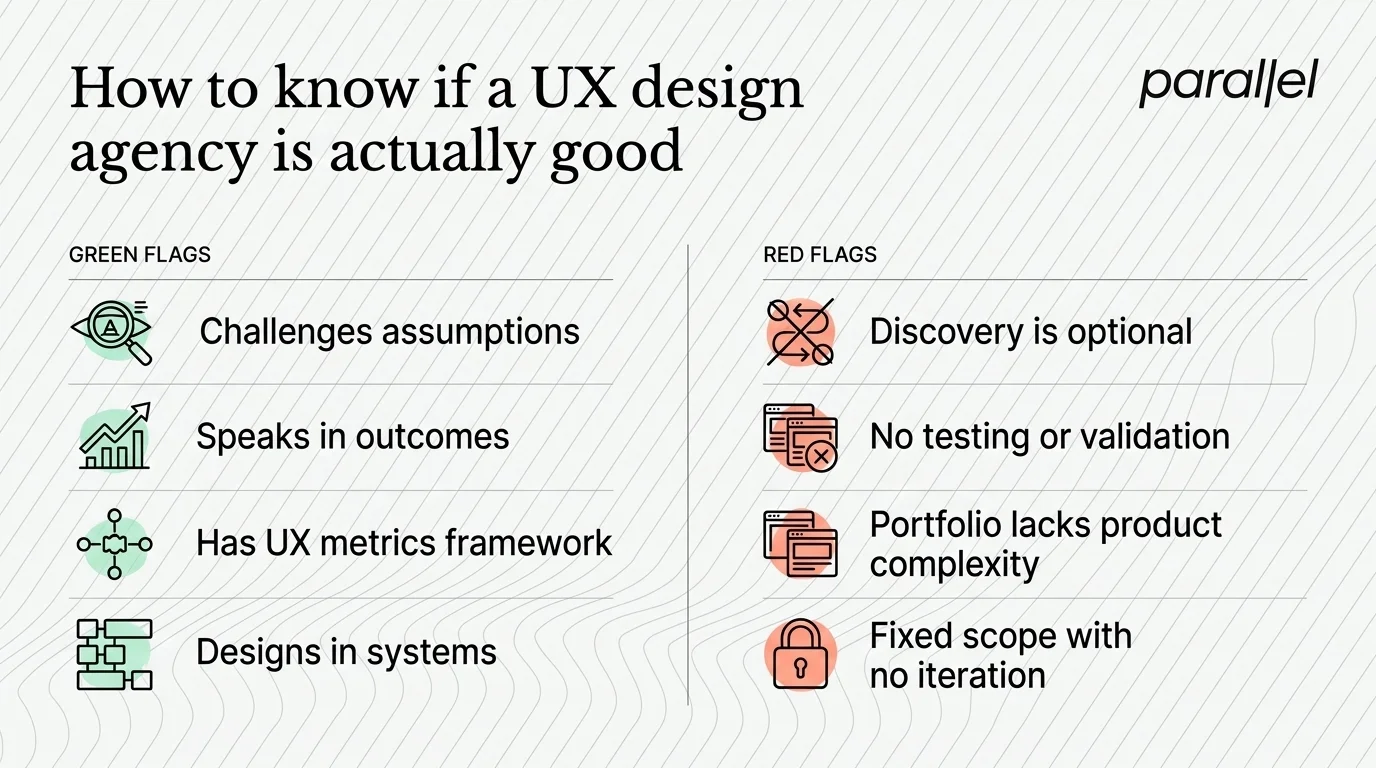
Green flags:
- They push back on your brief discovery. Agencies that challenge your assumptions early will protect you from expensive mistakes later.
- They speak in outcomes, not outputs. "We improved onboarding completion" beats "we delivered 40 screens."
- They have a documented UX metrics framework and can define how success will be measured.
- They reference service design, not just screen design. This signals they think in systems.
- Their Figma files are component-based and developer-ready, not creative moodboards with inconsistent naming.
- Ask about your product strategy before quoting you.
Red flags:
- Discovery is billed as optional or short (under a week for a complex product).
- The team presented in the field isn't the team doing the work.
- No mention of usability testing, user research, or validation at any phase.
- Portfolio is all visual branding with no product complexity.
- They can't articulate the difference between interaction design and UI design.
- Pricing is fixed-scope only with no room for iteration.
The best UX design firms are uncomfortable with fixed-scope briefs for complex products. Reality changes. Their process should adapt.
One additional signal: check how the agency talks about design thinking publicly. Blogs, frameworks, and point-of-view pieces that demonstrate genuine intellectual engagement with UX problems are a strong indicator. Agencies that only post "we're hiring" content have nothing to say.
Best UX Design Firms for AI and B2B SaaS Products in 2026
Finding the right UX design firm for an AI or B2B SaaS product requires a more specific lens than a general agency search. Here's what sets the right partners apart.
The standout agencies in this category share several traits: they've worked across the full product stack (not just marketing sites), they understand the feedback loops between product, data, and user behavior, and they've adapted their process for AI product design where interfaces need to communicate model confidence, handle failure states gracefully, and guide users through non-linear experiences.
For context on the broader landscape, UX Studio and Eleken both publish useful agency roundups that cover a range of firms across price points and specialties.
Agencies worth evaluating for AI and B2B SaaS:
- ParallelHQ: Specialized in early-stage AI and SaaS startups across the US and UK. Strong in end-to-end product design, AI-powered prototyping, and design systems. Best fit for startups moving from 0-to-1 or navigating a platform redesign.
- Clay Design Agency: Known for polished visual execution on consumer and enterprise products.
- Lollypop Design Studio: Broad portfolio across verticals with deep interaction design capability.
- OneThing Design: Strong in research-led engagements, particularly for complex B2B workflows.
What differentiates ParallelHQ from the broader list of UX design firms is the deliberate focus on startups. We don't work with every type of client. That specialization means our process, our questions, and our deliverables are calibrated for products that are still finding their shape, not products managing legacy complexity at enterprise scale.
How to Brief a UX Design Firm for a Complex Product Redesign
A strong brief is the single highest-leverage document you'll write before starting an agency engagement. Weak briefs produce misaligned work, scope creep, and strained relationships.
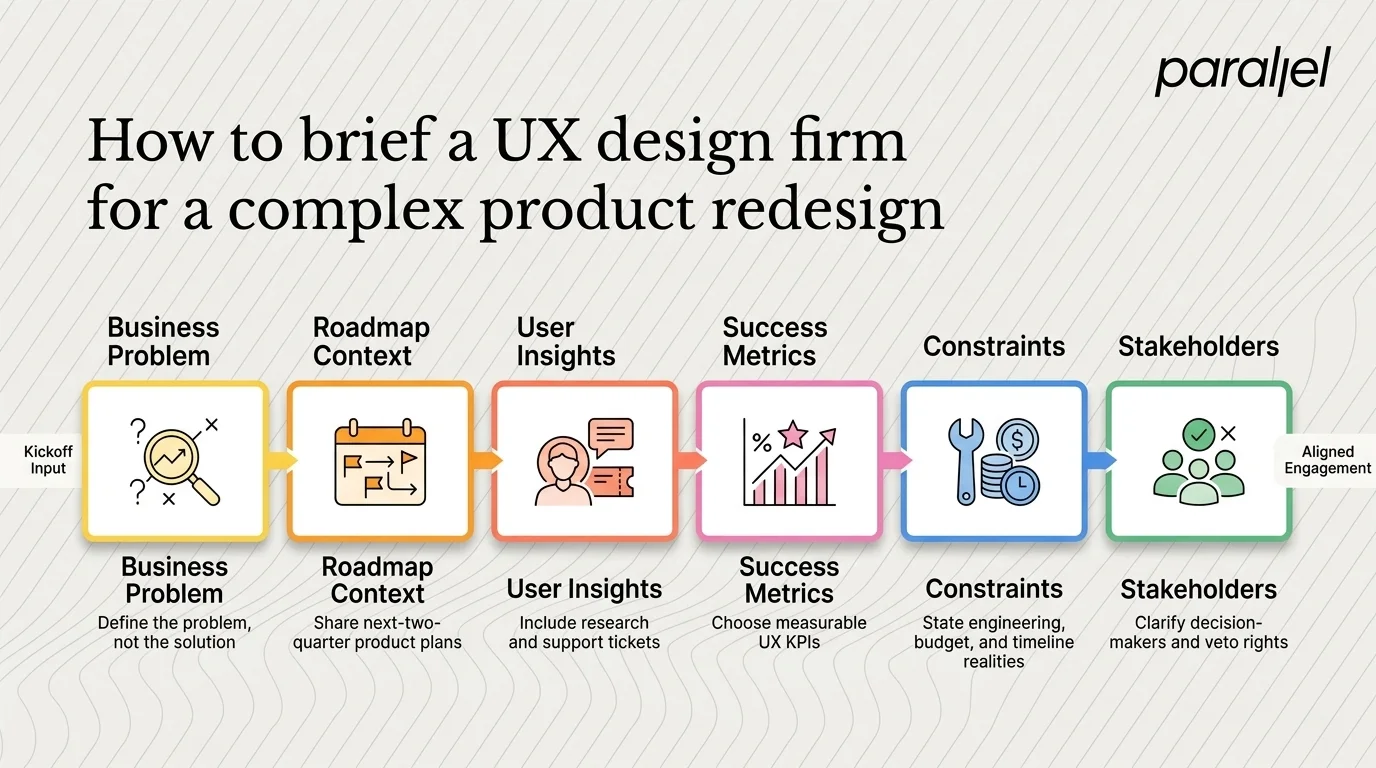
1) Define the business problem, not the design solution. Tell the agency: "Our activation rate has plateaued and churned . Users cite confusion in the first three sessions." Don't say: "We need a new onboarding flow." Let the agency discover the solution.
2) Share your product roadmap context. What's being built in the next two quarters? A redesign that ignores upcoming features creates technical debt before the ink is dry.
3) Document what you know about your users. Share existing research, session recordings, user activity data, and support tickets. Even rough qualitative notes reduce ramp-up time significantly.
4) Articulate success criteria explicitly. What does good look like in three months? Better yet, what UX metrics will you use to evaluate the outcome? Task completion rate, time-on-task, error rate, CSAT, NPS, and conversion rate optimization are all valid, but you need to pick yours.
5) Be honest about constraints. Engineering bandwidth, technology stack, brand guidelines, timeline, and budget are not obstacles to hide. Agencies who know your constraints design better within them.
6) Identify your stakeholders and decision-makers upfront. Ambiguity about who signs off on designs is the number one cause of revision spirals. Name the people, their roles, and their veto rights before kickoff.
A good brief takes two to three hours to write. It saves ten to twenty hours of misaligned work. Treat it as your first design artifact.
Conclusion
Choosing among UX design firms is a strategic decision, not a procurement exercise. The right agency will challenge your assumptions, ground decisions in real user evidence, and deliver a product that reduces cognitive load rather than adding to it. The wrong one will deliver beautiful screens that solve the wrong problems.
Key takeaways:
- Evaluate process and research depth above visual style.
- In-house beats agency for ongoing iteration at scale; agency beats in-house for speed and 0-to-1 builds.
- A strong brief is your first and highest-leverage investment.
- Red flags in discovery cost far more if you ignore them.
Frequently Asked Questions
1) How much do UX design firms typically charge for a startup engagement?
Pricing varies significantly by scope, team seniority, and agency location. Early-stage engagements (discovery plus MVP design) typically run as a fixed-scope project, while ongoing retainers scale with team size. Always request itemized pricing tied to deliverables, not hours.
2) How long does a typical UX design engagement take for a product redesign?
A full redesign covering discovery, architecture, wireframing, and high-fidelity design typically spans eight to sixteen weeks depending on product complexity and feedback cycle speed. Agencies that promise faster timelines without scoping down deliverables are usually cutting research.
3) What's the difference between a UI designer and a UX design firm?
A UI designer produces visual components. A UX design firm delivers a complete user experience strategy: research, information architecture, interaction design, testing, and handoff. One produces assets; the other solves problems.
4) Should early-stage AI startups hire a UX design firm before building?
Yes. Design thinking before engineering saves disproportionate time. UX design firms can validate core flows through low-fidelity prototyping before a single line of code is committed, dramatically reducing the cost of pivoting.
5) How do I evaluate a UX design firm's accessibility expertise?
Ask specifically about their WCAG 2.2 compliance process and request examples of accessibility audits from past projects. Agencies with genuine accessibility expertise will reference contrast ratios, focus states, screen reader testing, and inclusive design principles without prompting.
6) Can a UX design firm help with AI product design specifically?
The strongest ones can. Look for agencies with explicit AI product case studies covering uncertainty communication, error states, onboarding for non-deterministic features, and adaptive interface patterns. Generic UX agencies without this experience will apply SaaS patterns that don't hold up under AI behavior.

check out these related blogs




























.webp)