Most founders treat branding as a visual problem. Pick a logo, choose some colors, ship. That's not branding — that's decoration. Branding is the system of perception you build in your customer's mind before they ever speak to your sales team. It's what makes a stranger trust you on first click, return without a nudge, and tell colleagues about you without being asked. This guide breaks down what branding actually means in 2026, how to build it from scratch, and why it matters more for startups than for anyone else.
TL;DR
- Branding is the total perception customers hold about your company — not just your logo.
- It encompasses brand strategy, visual identity, tone of voice, and the user experience you deliver.
- For SaaS and AI startups, strong branding reduces customer acquisition costs and accelerates trust.
- Build brand positioning and identity before you over-invest in performance marketing.
What Is Branding and Why Does It Matter for Startups?
Branding is the deliberate, strategic practice of shaping how people perceive your company. The American Marketing Association defines a brand as the set of associations in a customer's mind tied to a name, symbol, or design. But in practice, branding is everything that influences that association: your product experience, your copywriting, your visual identity system, your customer support, even your pricing signals.
For startups, the stakes are higher than for established players. You don't have years of market presence or a household name working for you. Every touchpoint is making a first impression or reinforcing a fragile one. If your visual identity looks generic, your homepage copy is vague, or your onboarding experience feels disjointed, customers fill the gaps with doubt.
Here's what branding does functionally for an early-stage company:
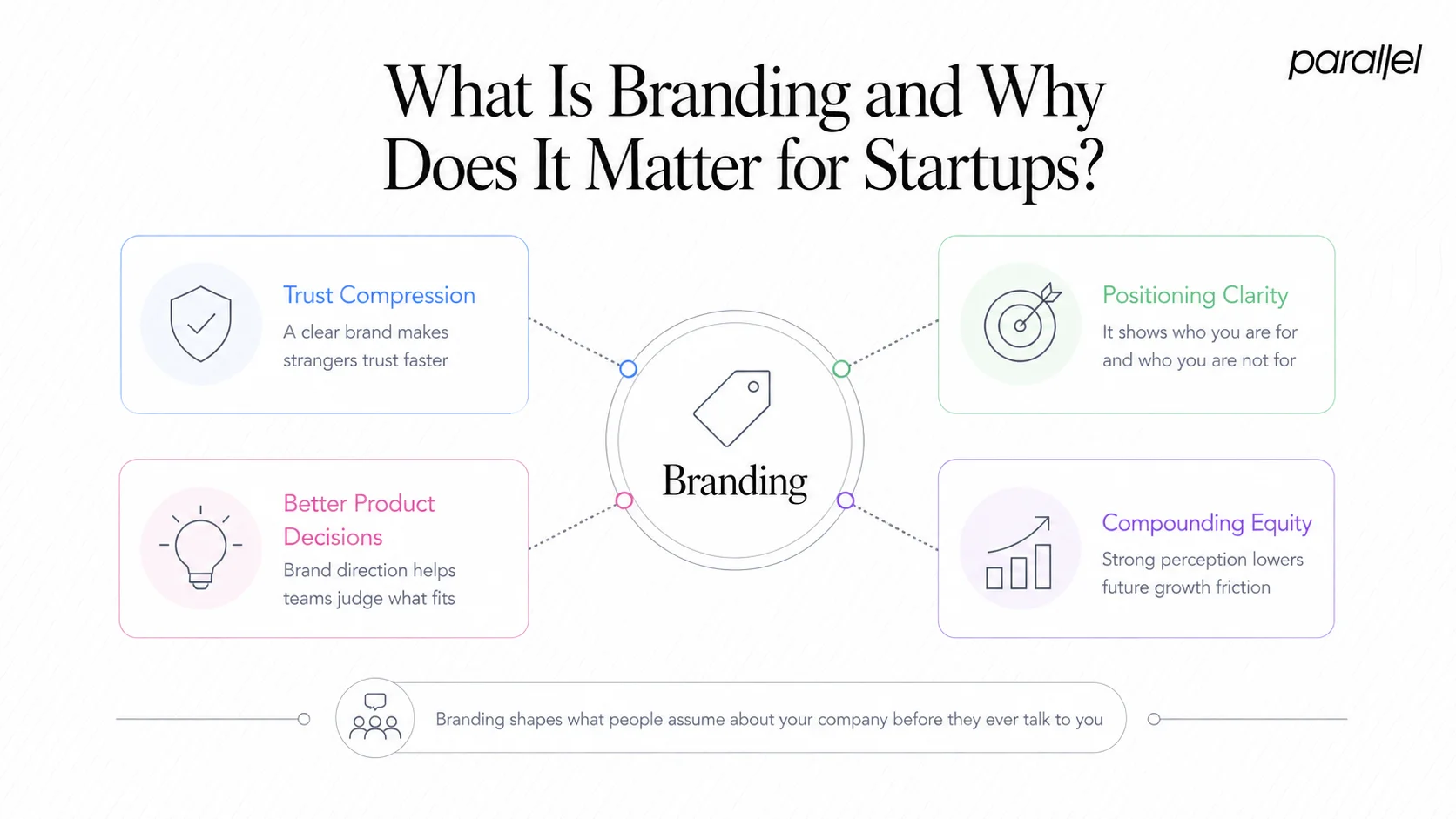
- Compresses the trust timeline: A coherent brand makes a new visitor feel like they've encountered you before. That familiarity lowers friction at every conversion point.
- Sharpens positioning: When you've done the brand strategy work, you know exactly what you stand for and, more importantly, what you don't. That clarity filters the right customers in and the wrong ones out.
- Anchors product decisions: Design, UX copy, onboarding flows — these become easier to evaluate when there's a brand foundation to test them against.
- Creates compounding equity: Unlike paid ads, brand equity accumulates. A well-positioned brand gets easier and cheaper to grow over time.
The distinction matters: marketing drives traffic, branding determines what happens to that traffic once it arrives. A startup can outspend a competitor on ads and still lose if the brand experience is incoherent.
I've seen this repeatedly at Parallel HQ. Founders come to us with a product that works, metrics that are decent, and a brand that communicates none of it. They're doing everything right operationally and leaving enormous value on the table because the experience doesn't match the ambition. Branding is not the last thing you fix — it should be one of the first things you define.
Branding vs. Marketing: What's the Difference?
This is one of the most consistently confused distinctions in startup conversations, so let's be precise.
Marketing uses your brand as raw material. It takes your positioning, your visual identity, your tone of voice, and deploys them in channels — paid search, content, email, social. If the brand is vague or inconsistent, marketing amplifies that vagueness. If the brand is sharp, marketing multiplies it.
A useful frame: branding is strategy, marketing is execution. You can run marketing without a brand strategy, but you're essentially paying to confuse people at scale.
For SaaS and AI startups specifically, the misalignment often looks like this: the product team has a clear vision, the growth team is running experiments, but there's no shared brand foundation that connects the two. The result is a company that looks different every quarter, sounds different on every channel, and earns no cumulative recognition despite significant spend.
Brand consistency across all touchpoints is what converts repeated exposure into actual recognition and trust.
The fix isn't more marketing budget. It's a brand strategy that defines your target audience, your brand positioning, your visual identity system, and your tone of voice — and then lets marketing execute against a stable foundation. That's the sequence that compounds.
What Should Be Included in a Brand Identity System?
Brand identity is the tangible, designed expression of your brand strategy. It's the system that ensures every touchpoint — your website, your app, your pitch deck, your sales email — feels like it comes from the same company.
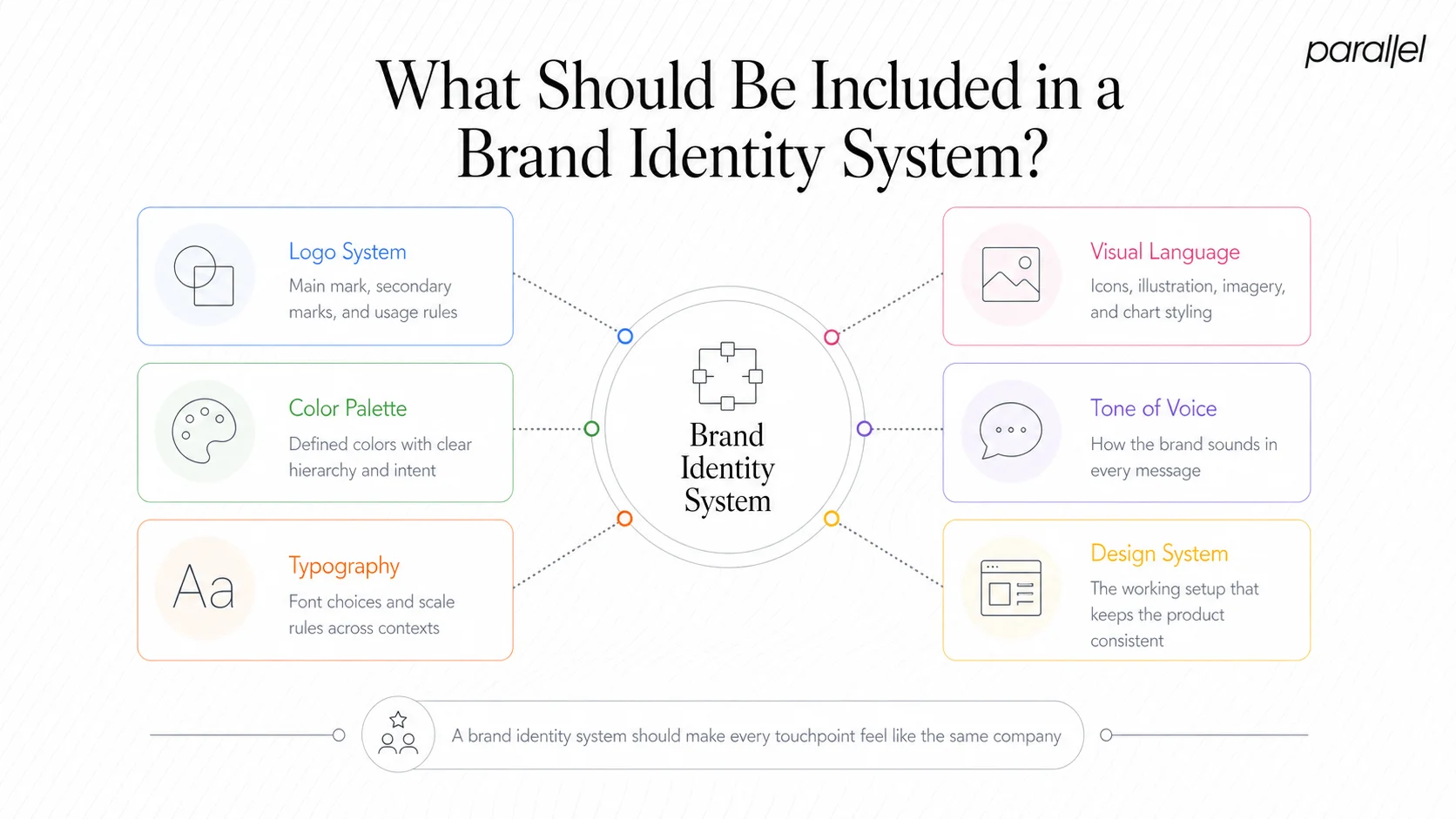
A complete brand identity system includes:
- Logo design: The primary mark, secondary marks, and rules governing their use across contexts and backgrounds.
- Color psychology and palette: Primary and secondary colors, with defined hex/RGB/CMYK values and guidance on hierarchy and usage. Color does real psychological work — blue signals trust, green signals growth, and those choices should be deliberate.
- Typography: Font families for headings, body copy, and UI elements, with defined sizing scales and pairing rules.
- Iconography and illustration style: A consistent visual language for UI icons, marketing illustrations, and data visualizations.
- Photography and imagery guidelines: Art direction for photography style, filters, and what types of imagery represent the brand.
- Tone of voice: Written guidelines covering vocabulary, sentence structure, humor levels, and how the brand sounds in different contexts (marketing copy vs. error messages vs. customer support).
- Motion and interaction principles: For digital-native brands, how elements animate and respond is part of brand identity.
- Design system and style guide: The coded, production-ready version of all the above, enabling consistent UI across every product surface.
For SaaS products, the design system is where brand identity becomes operational. If you want to understand what should be included in a design system and how the 8 principles of design apply at the component level, that's where execution gets concrete.
The most common gap I see in early-stage startup brands: logos and colors exist, but there's no tone of voice documentation, no typography scale, and no usage rules. So the brand drifts the moment a second designer or a contractor touches it.
How to Build a Brand from Scratch for a SaaS Company
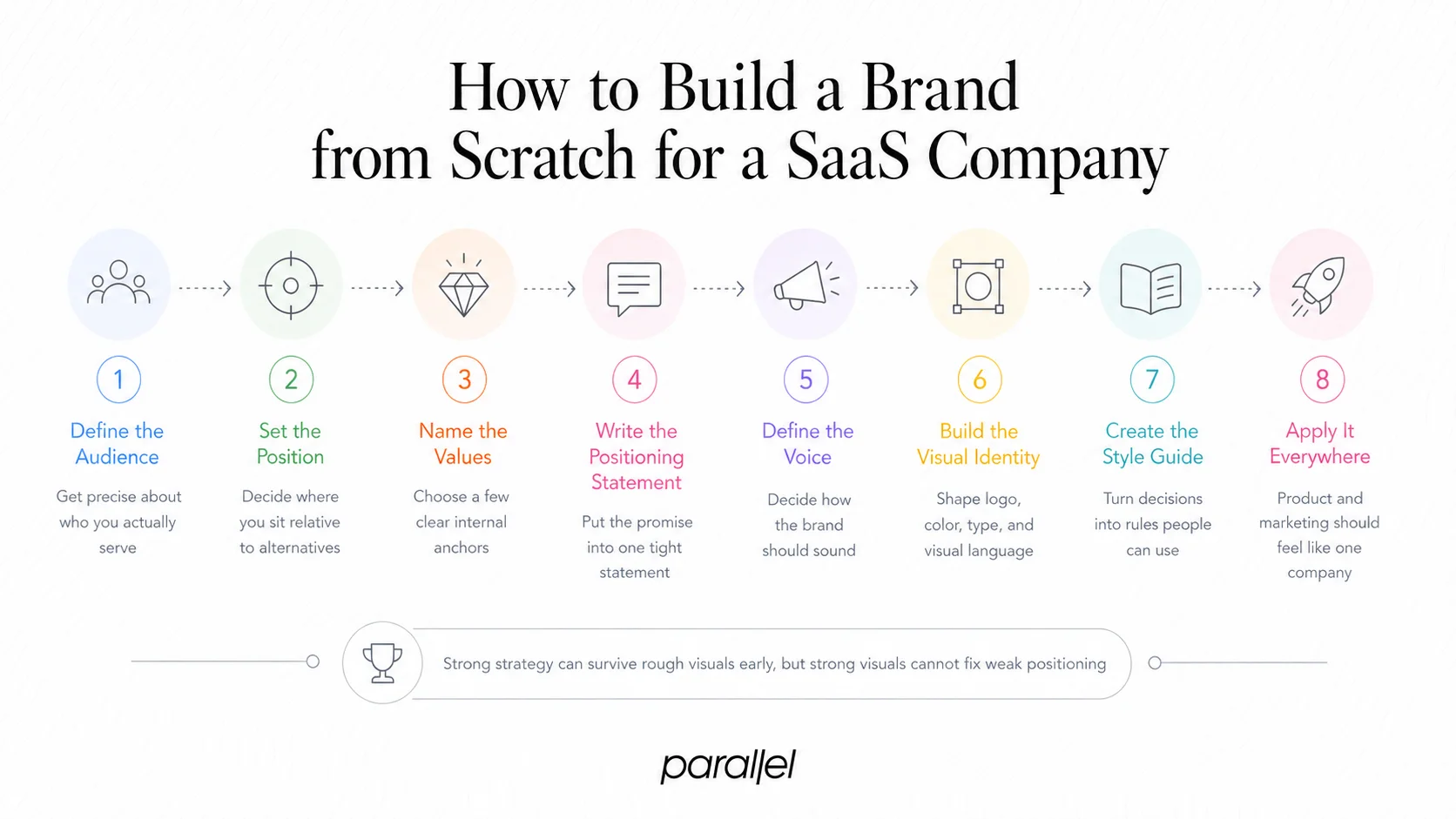
Building a brand from scratch is a strategic exercise before it's a visual one. Here's the sequence that actually works:
- Define your target audience precisely: Not "B2B SaaS companies" but "Series A AI infrastructure founders in the US who've hired their first design team and are hitting UX scaling problems." Specificity creates resonance.
- Establish brand positioning: Identify where you sit relative to alternatives and what unique value you own. If you're looking for a structured approach to how to find a gap in the market, that exercise feeds directly into positioning.
- Articulate brand values and personality: Three to five values that are genuinely differentiated, not "innovative, customer-centric, reliable." Translate these into personality traits that guide how the brand behaves.
- Write a positioning statement: One tight paragraph that states who you serve, what you do, how you differ, and why that matters. This becomes the north star for every piece of brand work.
- Develop tone of voice guidelines: Define vocabulary, formality level, use of humor, and how you sound in emotionally loaded moments (errors, cancellations, wins).
- Design the visual identity system: Logo, color palette, typography, iconography — in that order, built from the strategy foundation, not before it.
- Build a style guide and design system: Codify every decision so the brand scales without drift.
- Apply consistently across product and marketing: Your UX writing should feel like the same voice as your homepage. Your app's UI should feel like the same company as your pitch deck.
For early-stage teams, I'd argue steps one through five are more valuable than the logo. A startup with sharp positioning and a clear tone of voice can survive a mediocre logo. A startup with a beautiful logo and no positioning clarity is just expensive wallpaper.
What Makes a Brand Memorable in 2026?
Memorability isn't mystical — it's the product of specific, repeatable decisions. In 2026, with AI-generated content flooding every channel, the brands that stand out share a set of traits:
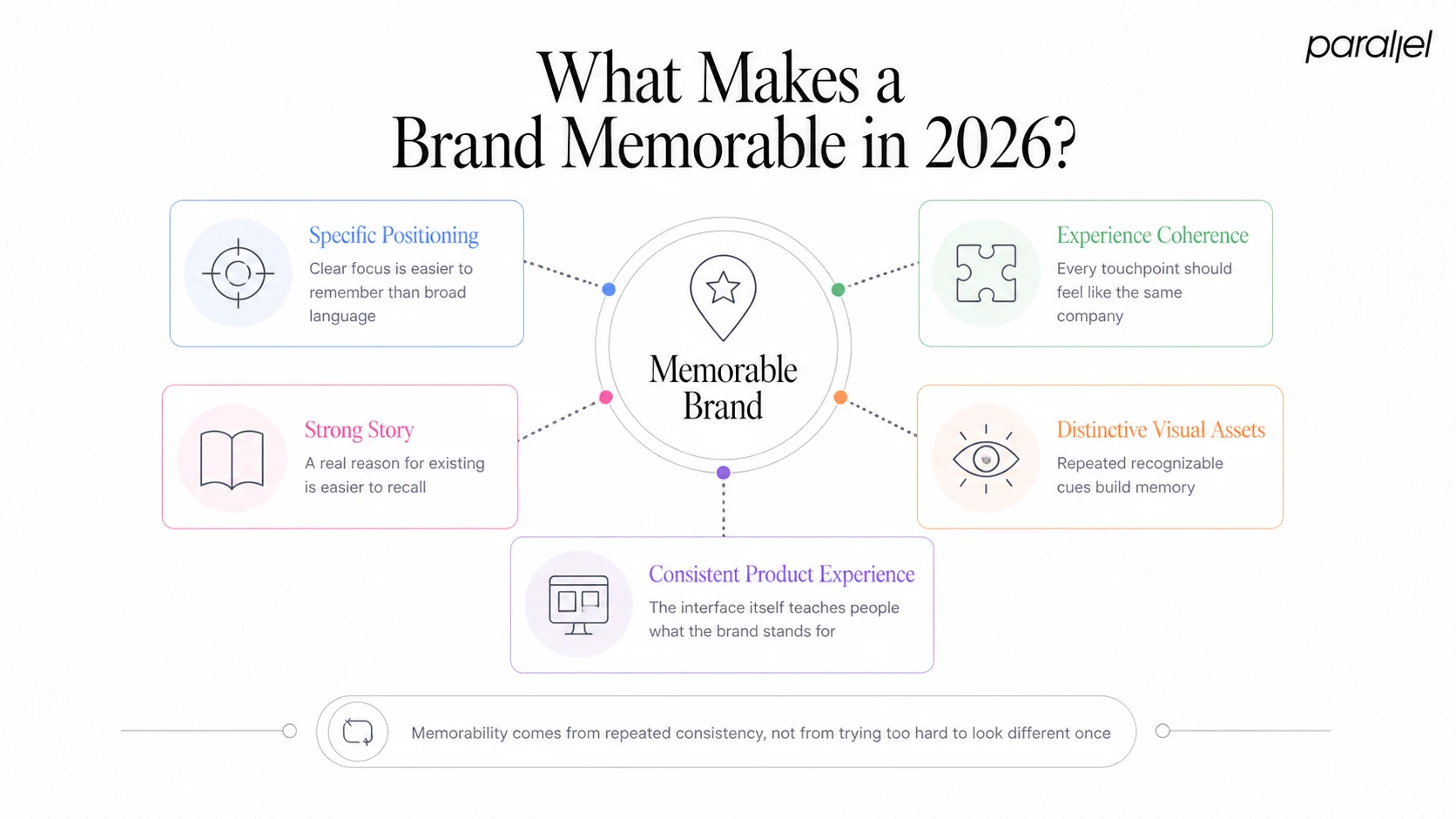
Specificity over universality. Brands that try to speak to everyone read as background noise. The most memorable brands say something specific, even if it alienates part of the market. Specificity is the price of differentiation.
Experience coherence. When the visual identity, the product UI, and the customer support email all feel like they come from the same brain, users build strong mental associations. Incoherence, even subtle incoherence, erodes memory.
Brand storytelling with substance. Not "we're disrupting X" — that's noise. Memorable brand storytelling explains the specific insight that drove the company's existence and why that insight matters to this particular customer.
Earned distinctiveness in visual identity. Distinctive assets — a specific color, a particular illustration style, a recurring typographic treatment — are built through repetition and consistency, not complexity. Many of the most recognized tech brands use remarkably simple visual systems, applied relentlessly.
User experience as a brand signal. The quality of your product experience communicates brand values more loudly than any tagline. A fast, clear, well-considered UI says "we respect your time and intelligence." A confusing onboarding flow says the opposite. For AI and SaaS products, designing interfaces for AI products is increasingly where brand perception is formed.
Consistent tone across micro-copy. Error messages, empty states, loading screens — these are the moments most brands ignore. The brands that earn outsized loyalty treat these moments as brand opportunities, not engineering afterthoughts.
Memorability compounds. Every consistent touchpoint is a deposit into brand equity. Every inconsistent touchpoint is a withdrawal.
Brand Positioning Explained for Founders
Brand positioning is the strategic decision about what place you intend to occupy in your customer's mind relative to alternatives. It's not your tagline — it's the mental real estate you're competing to own.
The classic positioning framework asks three questions:
- Who is your specific customer? Defined by role, context, pain, and moment of need — not just demographics.
- What category do you compete in? Sometimes the right move is to define a new category rather than fight in an existing one.
- What is your single most important differentiator? The one thing you do better than any alternative for this specific customer.
For startup founders, positioning mistakes tend to cluster around two failure modes. The first is positioning that's too broad — trying to be the platform for all companies rather than the obvious choice for a specific type of company. The second is positioning against features rather than outcomes. Customers don't buy features; they buy the result features enabled.
Strong brand positioning filters leads, justifies pricing, and guides product decisions. It also protects you from competitive pressure because it's difficult to copy a position that's rooted in genuine strategic clarity and operational reality.
For finding your product strategy and your brand positioning to align, they need to be developed in dialogue with each other. A brand that promises outcomes your product doesn't yet deliver creates churn. A product that delivers outcomes your brand doesn't communicate creates missed opportunities.
The output of a positioning exercise should be a single, testable statement: "For [specific customer], [company] is the [category] that [differentiated outcome] because [reason to believe]." Everything else in your brand — visual, verbal, experiential — flows from that statement.
How Do Design Leaders Approach Brand Strategy at Scale?
Design leaders at growth-stage companies face a different branding challenge than founders do. The brand exists, it's been working, and now it needs to scale across a larger team, more markets, and a more complex product surface — without losing coherence.
The operational answer is a mature design system combined with strong brand governance. But the strategic answer runs deeper.
At scale, brand strategy becomes an alignment problem as much as a creative problem. Product teams, marketing teams, sales teams, and customer success all have opinions about what the brand should communicate, and without a clear brand architecture, each team optimizes locally and fragments the whole.
What I see working at scale-ups:
- A documented brand strategy that non-designers can use: Positioning, values, audience definitions, and tone of voice written for the whole company, not just the design team.
- A design system that encodes brand decisions: Not just a component library but a system where the brand reasoning behind each decision is documented and accessible. Automating design systems with AI is changing how teams maintain this at scale.
- Regular brand audits: Structured reviews of how a brand is being expressed across channels, identifying drift before it compounds. You can connect this directly to how often stakeholders should review the project roadmap — brand health deserves the same cadence.
- Clear brand architecture for multi-product companies: As startups add products, the relationship between the parent brand and product brands needs deliberate structure. Without it, brand equity becomes siloed and doesn't compound.
The companies that get this right treat the brand as a shared operational asset, not a creative department's project. Working with a best startup branding agency can help establish this infrastructure before the team scales beyond the point where informal alignment is possible.
Conclusion
- Branding is a strategic system for shaping perception — it precedes marketing and underpins products.
- A complete brand identity system covers visual identity, tone of voice, positioning, and experience, not just a logo.
- For SaaS and AI startups, brand coherence directly influences trust, retention, and conversion.
- Build the brand strategy foundation early — waiting until you "have traction" means building on sand.
The best time to take branding seriously is before your first hundred customers form their own impressions without your help. The second best time is now.
Frequently Asked Questions
Q1: What is branding in simple terms?
Branding is the practice of shaping what people think and feel about your company. It encompasses your visual identity, your tone of voice, your product experience, and your positioning. The goal is a consistent, intentional perception — one you design rather than leave to chance.
Q2: What is the difference between brand identity and brand image?
Brand identity is what you design and control — your logo, colors, typography, and messaging. Brand image is what customers actually perceive, which may differ. Strong branding closes the gap between the two by making identity consistent, relevant, and delivered with quality across every touchpoint.
Q3: How early should a startup invest in branding?
Before your first major marketing spend. Pouring budget into paid acquisition without a clear brand position means paying to confuse people at scale. At minimum, define your positioning, target audience, and tone of voice before scaling any growth channel.
Q4: Is branding just a logo?
No. The logo is one element within a visual identity system, which is itself one layer of a complete brand. Branding also includes strategy, positioning, tone of voice, design system, and the totality of the customer experience. A logo without the rest is decoration.
Q5: What is brand equity and why does it matter?
Brand equity is the accumulated value your brand name adds to your product beyond its functional attributes. High brand equity means customers choose you over equally capable alternatives, pay a premium, and recommend you unprompted. It's built through consistency and positive experience over time.
Q6: How does UX design relate to branding?
UX is where branding is experienced, not just seen. The quality, clarity, and personality of your product interface communicates brand values more directly than any tagline. For SaaS and AI products, the product experience is often the primary brand touchpoint, making UX decisions and brand decisions.

check out these related blogs