I have spent years working with founders and product leaders at early-stage startups. The most common pattern I see is brilliant teams building products that nobody actually wants. I have seen hundreds of startups stumble simply because they misunderstand what is product management at its core. It is not about writing tickets or managing a backlog. It is about making clear, grounded decisions that connect user behavior to business outcomes. Let us cut through the noise and look at how mature teams build successful products today.
Quick answer
What is product management? It is the business discipline of guiding a product from concept to market success. It aligns real user needs with business objectives, ensuring your team builds the right thing before building it right.
Why is understanding what is product management critical in 2026?
The stakes for building digital products have never been higher. Capital is expensive, and user patience is nonexistent. A recent 2025 report by Exploding Topics shows that 90% of startups fail. Crucially, up to 42% of those failures happen because of a lack of market demand. Teams build features in a vacuum.
This is where strong product thinking comes in. Good product management bridges the gap between what a company wants to sell and what users actually want to use. It mitigates risk.
When a founder asks me to define the discipline, I usually tell them it is the art of saying no. It is the framework that prevents you from wasting engineering cycles on unvalidated assumptions. Teams that get this right move faster and build products that stick. They do not just survive the current market constraints. They thrive in them.
The evolution of the product role
The discipline has shifted dramatically over the last decade. Ten years ago, the role was heavily focused on project delivery. The goal was to ship software fast. Today, the focus is entirely on outcomes.
In 2026, the market does not care how fast you ship if the feature does not solve a real problem. The modern product leader must be deeply analytical and incredibly empathetic to the user. We have moved from a delivery mindset to a discovery mindset.
You can see this shift in how top companies structure their teams. The best organizations empower product teams to solve problems rather than handing them a list of features to build. This evolution requires a deeper understanding of what product strategy actually means. It is no longer just a timeline. It is a cohesive plan to win the market.
Where teams go wrong with product building
At ParallelHQ, we frequently audit products that feel overcomplicated. The root cause is almost always a breakdown in product strategy. Teams confuse output with outcomes.
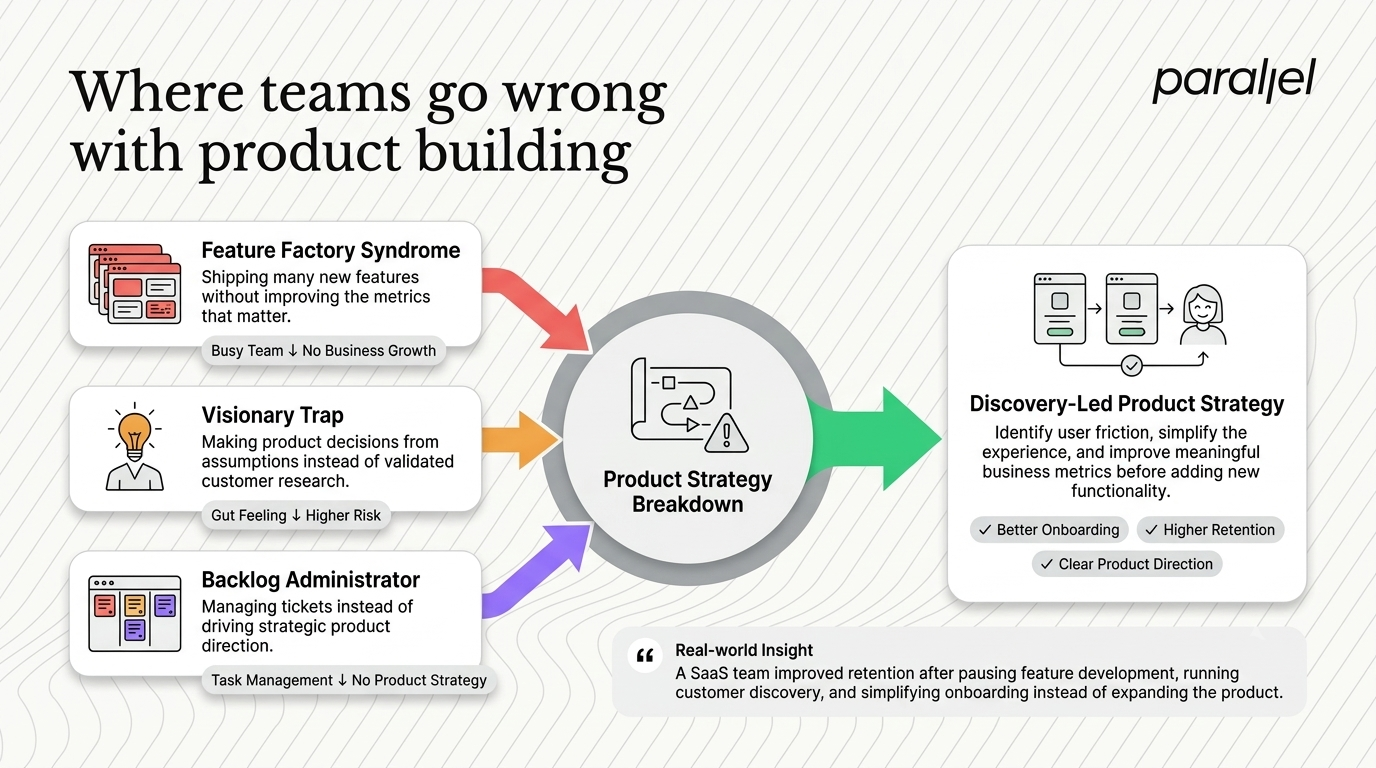
Here are the most common patterns we observe when teams misunderstand the role:
- The feature factory syndrome: Shipping twenty new features a quarter without moving a single core business metric. The team is busy, but the business is stalling.
- The visionary trap: Building entirely based on a founder's gut feeling. This completely bypasses user research and relies on luck.
- The backlog administrator: Reducing the product leader to a project manager who simply moves tickets across a board. There is no strategic thought, only task management.
I worked with a SaaS team last year that was stuck in the feature factory loop. They had a massive roadmap but terrible retention. Once we paused development and ran a proper discovery framework, we found that users were confused by the onboarding. They were not asking for more tools. Simplifying the core experience fixed their retention immediately.
Beyond the theory: what is product management in daily practice?
A successful product function operates at the intersection of business, technology, and user experience. It requires rigorous cross-functional alignment. According to McKinsey data cited in recent industry outlooks, companies that foster strong cross-functional collaboration see a 25% increase in product success rates.
Here is how effective product management breaks down in daily practice:
- Defining the problem space: You must understand the pain point before designing the solution. This involves deep user research and talking directly to customers.
- Creating a strategy: A clear strategy dictates what you will build and why it matters to the business.
- Ruthless prioritization: Deciding what to build first based on potential impact and required effort.
- Execution and iteration: Working closely with design and engineering to ship, measure, and improve the product.
To build great software, you must balance these four pillars every single day.
Core frameworks every product leader should know
You do not need to memorize every framework in the industry. However, a few mental models are incredibly useful for maintaining clarity in your product decisions.
Jobs to be done (JTBD)
People do not buy products. They hire products to do a job. When you frame your product around the job the user is trying to accomplish, your feature set becomes much clearer. If you are building a budget app, the user's job is not "to view charts." Their job is "to feel secure about my financial future."
Opportunity solution tree
Created by Teresa Torres, this visual framework helps teams map out clear desired outcomes. It prevents teams from jumping straight to solutions. You map the outcome, identify the opportunities (customer needs), and then brainstorm multiple solutions for each opportunity.
RICE scoring
When the roadmap gets crowded, prioritization is key. RICE stands for Reach, Impact, Confidence, and Effort. It provides a simple mathematical way to evaluate which features will actually move the needle. This is how you build a rigorous product roadmap rather than a wish list.
The critical link between product and design
Product managers and designers must operate as partners. Product defines the "what" and "why" while design defines the "how" and the "feel." When this relationship is siloed, products fail.
We lean heavily into prototyping and usability testing before writing a single line of code. The Nielsen Norman Group notes that prototyping and testing early reduces development costs by 40% and boosts product success rates by 30%. You should never guess what your users want when you can just show them a prototype and ask.
Investing in this phase pays off rapidly. Recent 2025 data from the Interaction Design Foundation reveals that increasing UX budgets by just 10% can drive 83% higher conversions. Product management ensures that this design investment is pointed directly at the right business goals. If you need help executing this, looking into professional UI/UX design services can bridge the gap.
How to measure product outcomes correctly
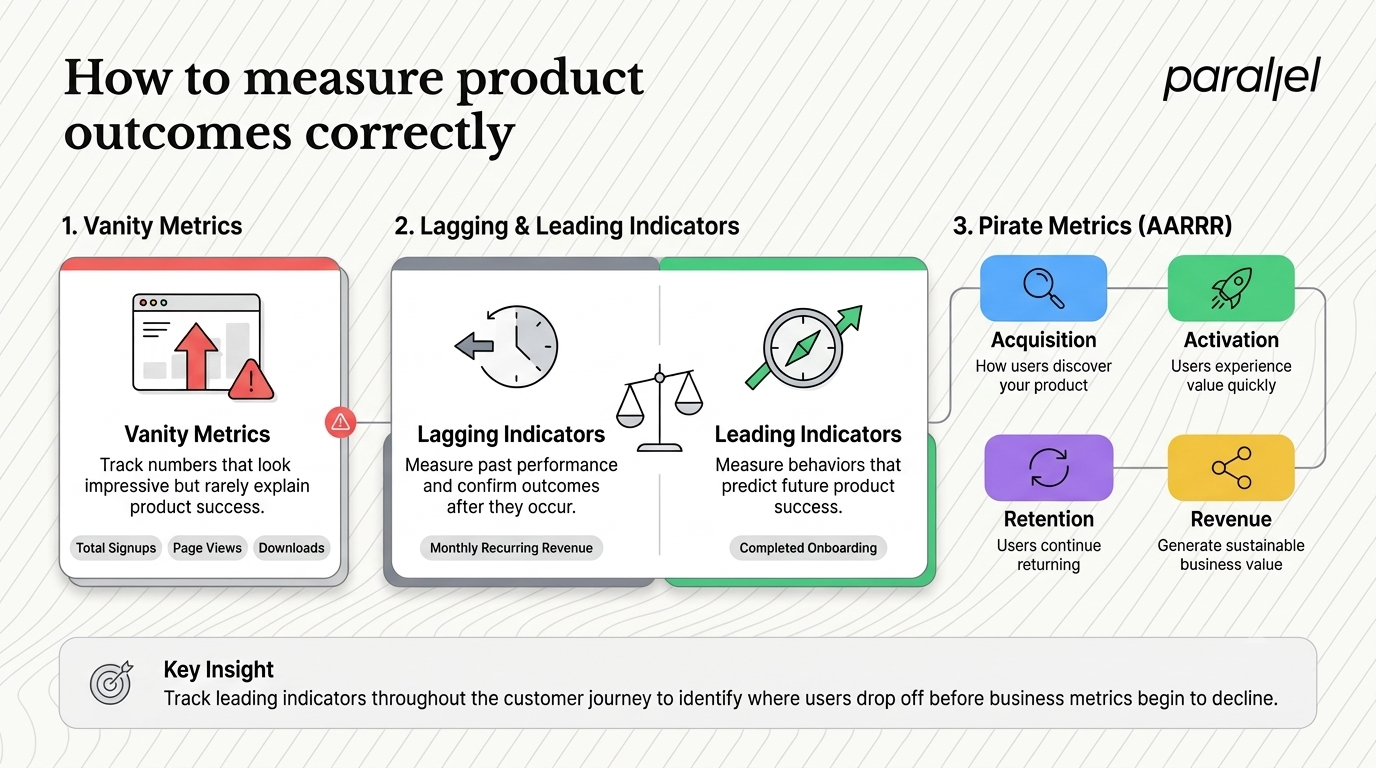
You cannot improve what you do not measure. However, many teams track the wrong numbers. They focus on vanity metrics like total signups rather than actionable metrics like weekly active users.
Leading vs lagging indicators
A lagging indicator tells you what happened in the past (like monthly recurring revenue). A leading indicator predicts what will happen in the future (like the number of users who complete onboarding). Great product teams obsess over leading indicators.
The pirate metrics (AARRR)
This is a classic framework that still holds up for evaluating the entire user journey:
- Acquisition: How do users find you?
- Activation: Do users experience the core value quickly?
- Retention: Do users come back over time?
- Referral: Do users tell others about the product?
- Revenue: How do you monetize the value you provide?
Tracking these stages helps you pinpoint exactly where your product is leaking value.
A practical approach to answering what is product management for your team
If your product feels bloated or your activation rates are low, you need to reset your approach. You do not need a massive team to start applying better product principles.
Here is a simple, repeatable framework we use in our product strategy consulting:
- Audit your current metrics: Identify exactly where users drop off in your funnels. Look for the friction points. If you are unsure, a formal UX audit is a great place to start.
- Talk to churned users: Find out why the product did not solve their problem. Do not ask for feature ideas. Ask about their workflow and where your product failed them.
- Simplify the core: Kill unused features. Simplify the interface to highlight your core value proposition. Great products are born from subtraction.
- Realign the roadmap: Ensure every item on your backlog ties back to a specific, measurable goal. If a feature does not move a core metric, remove it.
Keep it simple and focused. Product clarity always beats product complexity.
Product manager vs other roles
Titles in tech can be confusing. To understand the role fully, it helps to see how it contrasts with adjacent positions.
In early-stage startups, one person might wear several of these hats. However, as the company scales, separating strategy (Product Manager) from execution (Project Manager) becomes crucial.
When should a startup hire their first product person?
Founders are usually the first product managers. They have the vision and the initial customer relationships. But there comes a breaking point.
You need to hire a dedicated product leader when the founder becomes the bottleneck for engineering. If engineers are waiting around for requirements, or if they are shipping things that do not align with the business goals, it is time.
Another clear signal is when the team stops talking to users. If your engineers are only talking to the founder and the founder is only looking at revenue dashboards, you have lost the pulse of the market. A dedicated product person re-establishes that critical feedback loop. If you are not ready for a full-time hire, running a design sprint with an external partner can temporarily inject this discipline into your team.
The day-to-day reality of the job
The reality of the role is far less glamorous than the thought leadership posts suggest. It is a job of context switching, communication, and constant alignment.
A typical day usually starts with data. You check the dashboards to see how yesterday's release performed. Mid-morning is often reserved for engineering stand-ups and unblocking the development team.
The afternoon is where the deep work happens. This might involve reviewing a prototype with your design partner, interviewing a frustrated customer, or writing a strategy document for the next quarter. The best product people aggressively protect their calendar to ensure they have time to think, not just react.
Common myths about the product role
There is a lot of bad advice floating around regarding this discipline. Let us clear up a few misconceptions.
Myth 1: The product manager is the CEO of the product
This is the most pervasive myth in tech. A CEO has hiring and firing power. A CEO controls the budget. Product managers usually have none of these things. They must lead through influence, not authority. You have to convince engineering and design to follow your strategy using data and empathy, not mandates.
Myth 2: You need to know how to code
While technical literacy is helpful, you do not need to be an engineer. Your job is not to build the database architecture. Your job is to understand the market problem so deeply that you can guide the engineers toward the right solution. Focusing too much on the technical "how" distracts you from the strategic "why."
The mindset shift from output to outcomes
The most important transition a product thinker makes is shifting their focus from shipping features to driving results. This is what it means to truly understand what is product management at the highest level.
Anybody can manage a Jira board. Anybody can tell an engineer to add a button. But it takes a deep understanding of human behavior to know which button to add, or whether the user needs a button at all.
You must fall in love with the user's problem, not your proposed solution. When you do this, you stop getting defensive about your ideas. You start viewing every feature as a hypothesis. If the data shows the feature did not work, you remove it and try something else. This humility is the hallmark of a mature product leader.
Conclusion
At the end of the day, building software is easy. Building the right software is incredibly hard. The discipline exists to ensure your team is spending its valuable time solving real problems that people will actually pay for. Stay grounded in user behavior, validate your assumptions early, and focus on clarity over cleverness. The market rewards simple products that just work. If you build with intention, you will build products that last.
Frequently asked questions
1) What is product management defined simply?
It is the function responsible for maximizing the business value of a product. It involves discovering what users need, defining the strategy to build it, and guiding the cross-functional team to deliver it successfully to the market.
2) How do I know if I need a product manager?
If your engineering team is building features that users do not adopt, or if your founder is too busy to speak directly with customers and prioritize the roadmap, it is time to bring in dedicated product leadership.
3) Project manager vs product manager: what is the difference?
A project manager focuses strictly on execution, timelines, and resource allocation. A product manager focuses on strategy, user value, and deciding what exactly needs to be built in the first place.
4) What is product management compared to product marketing?
Product management is responsible for building the product and defining its core value based on user needs. Product marketing is responsible for bringing that product to market, positioning it, and driving demand and sales enablement.
5) How do you measure product management success?
Success is measured through business and user outcomes, not just output. Key metrics include user activation rates, monthly active users, customer retention, and overall revenue growth driven by the product.
6) Is product management the right career for me?
If you enjoy solving complex unstructured problems, have high empathy for users, and can comfortably communicate with both technical engineers and business stakeholders, it can be a highly rewarding and impactful career path.
7) How does ParallelHQ help teams with product management?
We act as a specialized product design partner for early-stage teams. We help simplify complex ideas, run deep discovery processes, and build intuitive interfaces that are grounded in real user behavior.
8) What is product management going to look like in the age of AI?
AI will automate the administrative tasks of the role, such as writing basic user stories or analyzing survey data. However, the core of the job, which is strategic thinking, user empathy, and aligning human teams, will become even more valuable.

check out these related blogs





































































.webp)


















.avif)