Most founders treat design as something you bolt on before launch. That instinct costs them users, revenue, and time. Understanding what is product design, and why it belongs at the center of your build, is the difference between a product people adopt and one they abandon after three sessions. This guide covers the full picture: the process, the roles, the team structure, and the signals that tell you it's time to bring in a specialist. Whether you're pre-seed or Series B, this is the foundation you need.
TL;DR
- What is product design: the discipline of shaping a digital product's function, form, and experience to solve real user problems and meet business goals.
- It spans user research, wireframing, prototyping, testing, and iteration, not just visual polish.
- Product design, UX design, and UI design overlap but serve distinct purposes.
- Founders should hire or partner with a product designer before they write the first line of production code.
What Is Product Design, and Why Does It Matter for Software?
At its core, what is product design is a question about intent. Product design is the end-to-end practice of defining what a digital product does, how it works, and how it feels to use. It bridges user needs with business objectives through a structured, research-informed process.
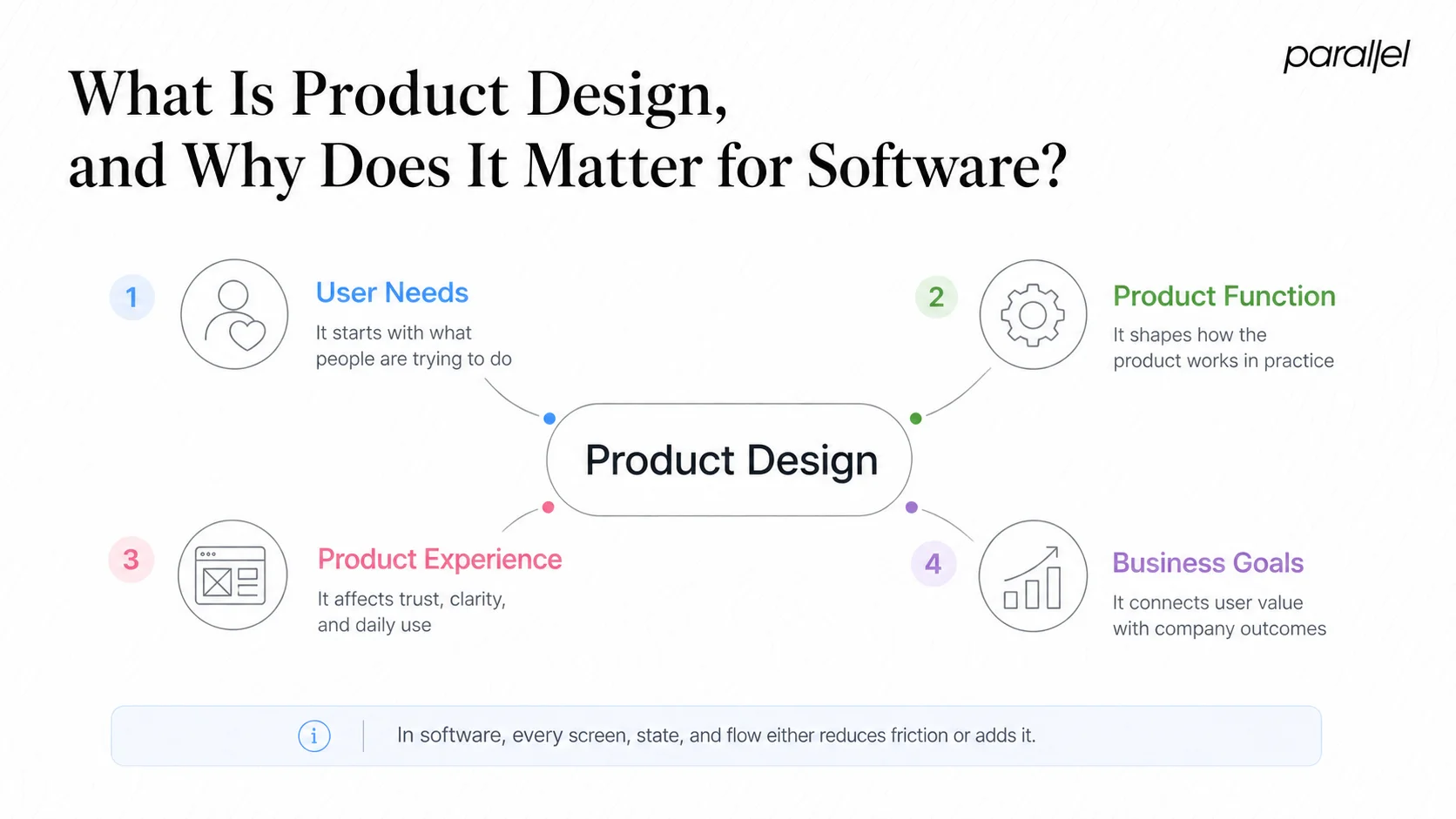
In software and SaaS specifically, product design governs every touchpoint: the onboarding flow a new user moves through, the dashboard a power user reads at 8 a.m., the empty state that greets someone who just signed up and sees nothing yet. Each of these is a design decision, and each one either builds trust or erodes it.
Figma's product design resource library frames it well: product design is not a phase you enter and exit, it's a continuous loop of understanding, building, testing, and refining. That loop is what separates products people love from products people tolerate.
The discipline draws on several overlapping fields:
- Human-centered design: starting every decision with the user's context, not the engineer's convenience
- Interaction design: defining how users move through the product and what happens when they act
- Information architecture: structuring content and features so they're findable and logical
- Usability testing: validating assumptions with real users before assumptions become shipped code
For startups, this matters more than anywhere else. You don't have the runway to rebuild a product that was designed wrong the first time. You also don't have the brand equity to survive a poor first impression. Getting product design right early is the highest-leverage investment a founding team can make.
At ParallelHQ, I've seen this pattern repeat: a founder ships an MVP with no design input, gets flat engagement metrics, then brings us in to diagnose what went wrong. Nine times out of ten, the problem isn't the feature set. It's that the product never felt trustworthy or intuitive enough to let users discover the value. Good product design removes that friction before it becomes a retention problem.
Understanding what information architecture means in practice is a useful starting point if your navigation or feature hierarchy already feels tangled.
Product Design vs UX Design vs UI Design: What's the Difference?
This is the question I get most often from founders, and the confusion is understandable because the titles overlap in messy, real-world ways. Here's the clearest breakdown I can offer.
Product design is the container. UX and UI design are practices within it. A product designer typically owns both, especially at early-stage companies where specialization is a luxury. A UX designer focuses on research, flows, and usability without necessarily owning the visual layer. A UI designer focuses on the look and feel without necessarily owning the research.
In practice at startups, you rarely have three separate people. You have one strong product designer who can move across all three layers, or a design partner like ParallelHQ that brings the whole capability as a team.
The Nielsen Norman Group has written extensively on this distinction, and their position is consistent: UX is a component of product design, not a synonym for it. Treating them as identical leads to under-investing in the strategic and systems-level work that makes products scalable.
Where UI design is often confused with branding, it's worth noting the difference is significant. Branding shapes perception before the product opens. UI design shapes experience once it does.
If you're deciding what kind of design help your startup actually needs, the honest answer is usually: start with product design. You can narrow to UX or UI specialists once you have a clear product direction and the team to support specialization.
For a deeper read on the visual side, the 8 principles of design covers the fundamentals that inform strong UI work.
What Does a Product Designer Actually Do Day to Day?
Most job descriptions for product designers read like a wish list. The reality is more focused, and understanding what the day-to-day actually looks like helps founders hire well and set realistic expectations.
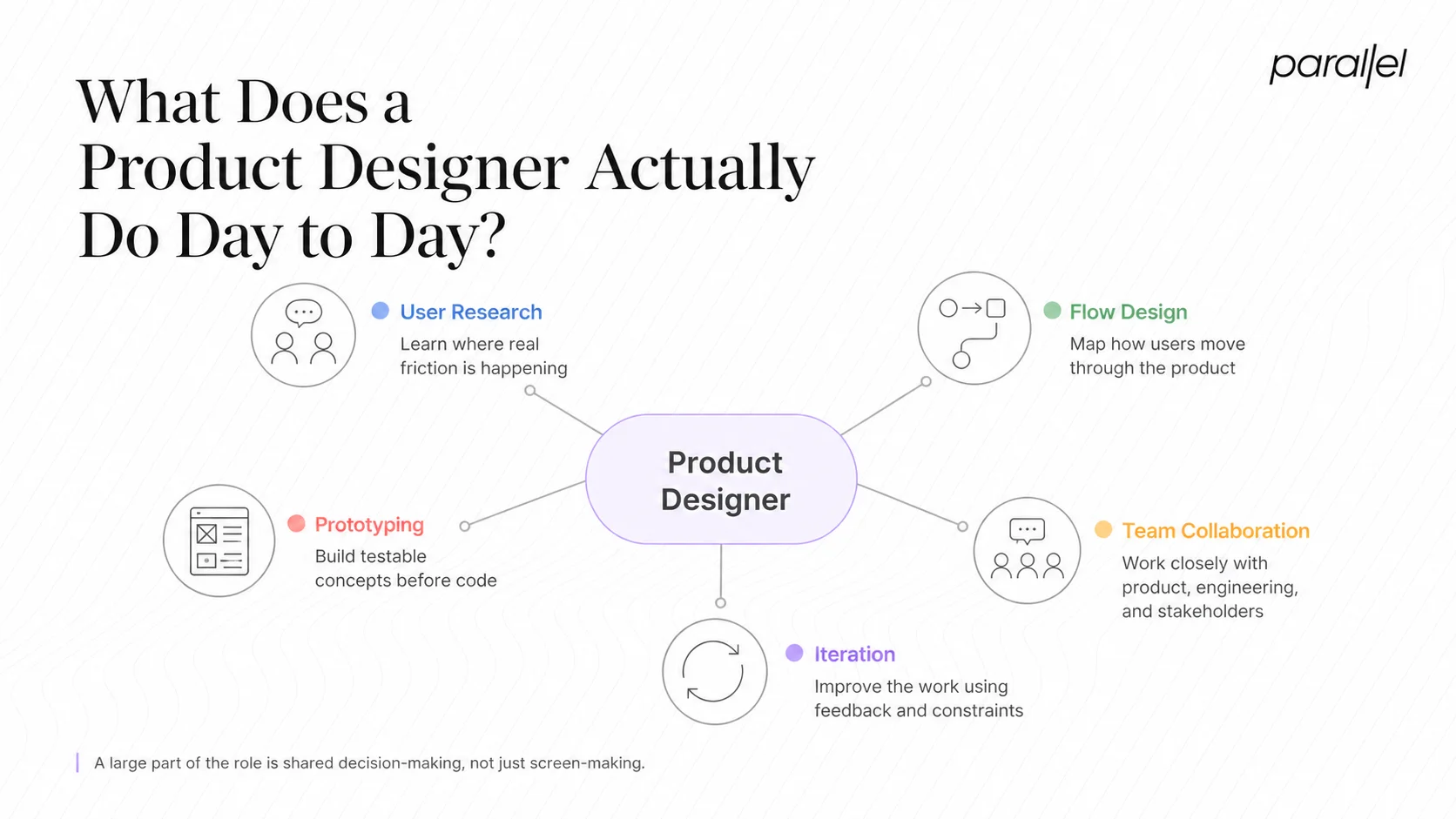
A product designer's time typically distributes across five activities:
- User research: conducting interviews, reviewing session recordings, writing usability testing questions to surface real friction points
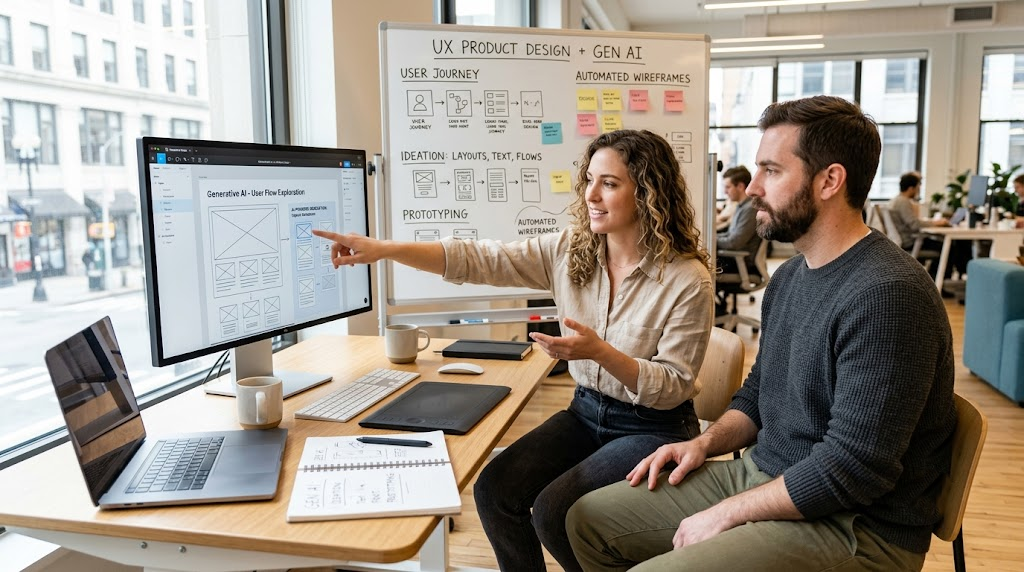
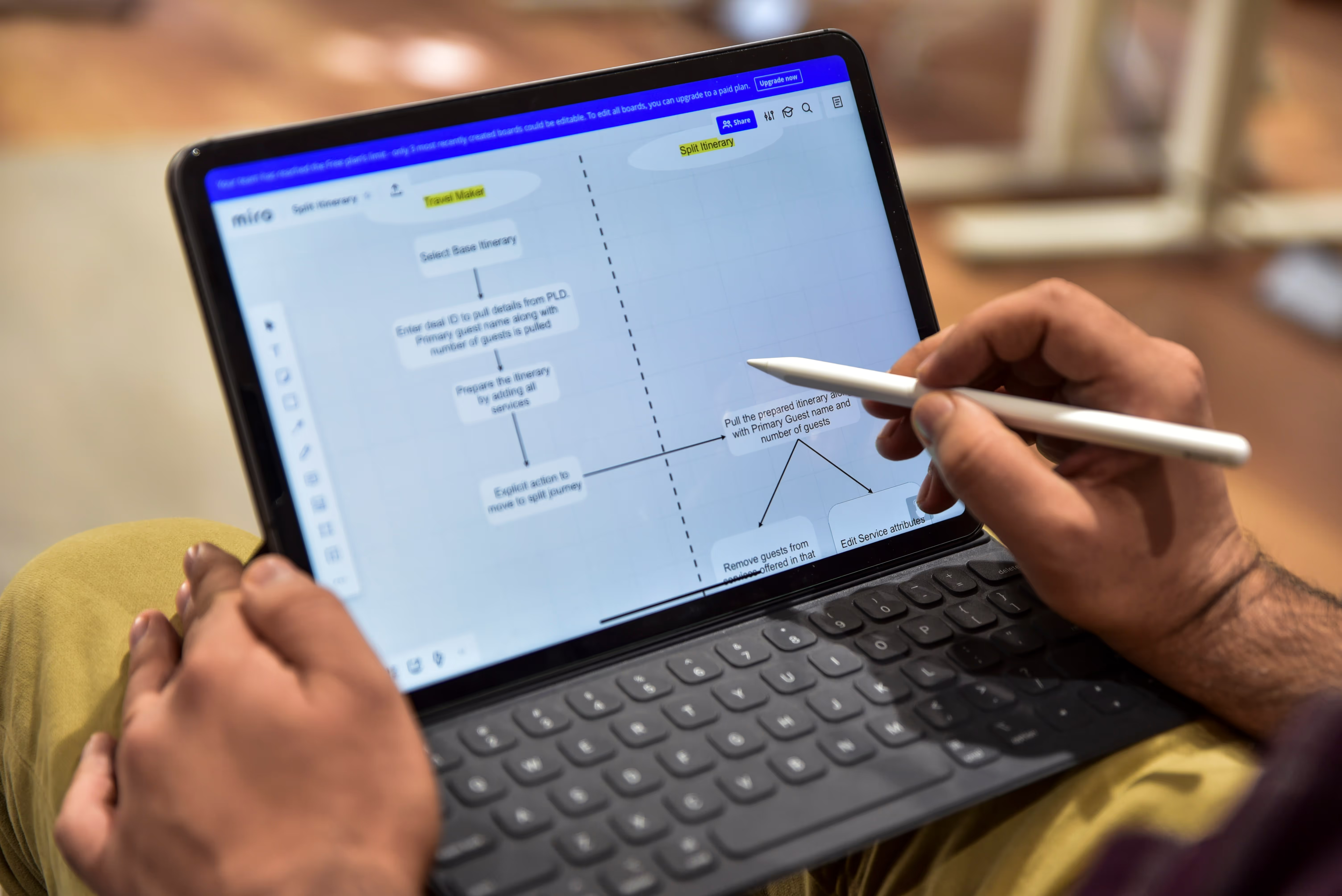
- Wireframing and flow design: sketching low-fidelity screens and user journeys before committing to visual direction
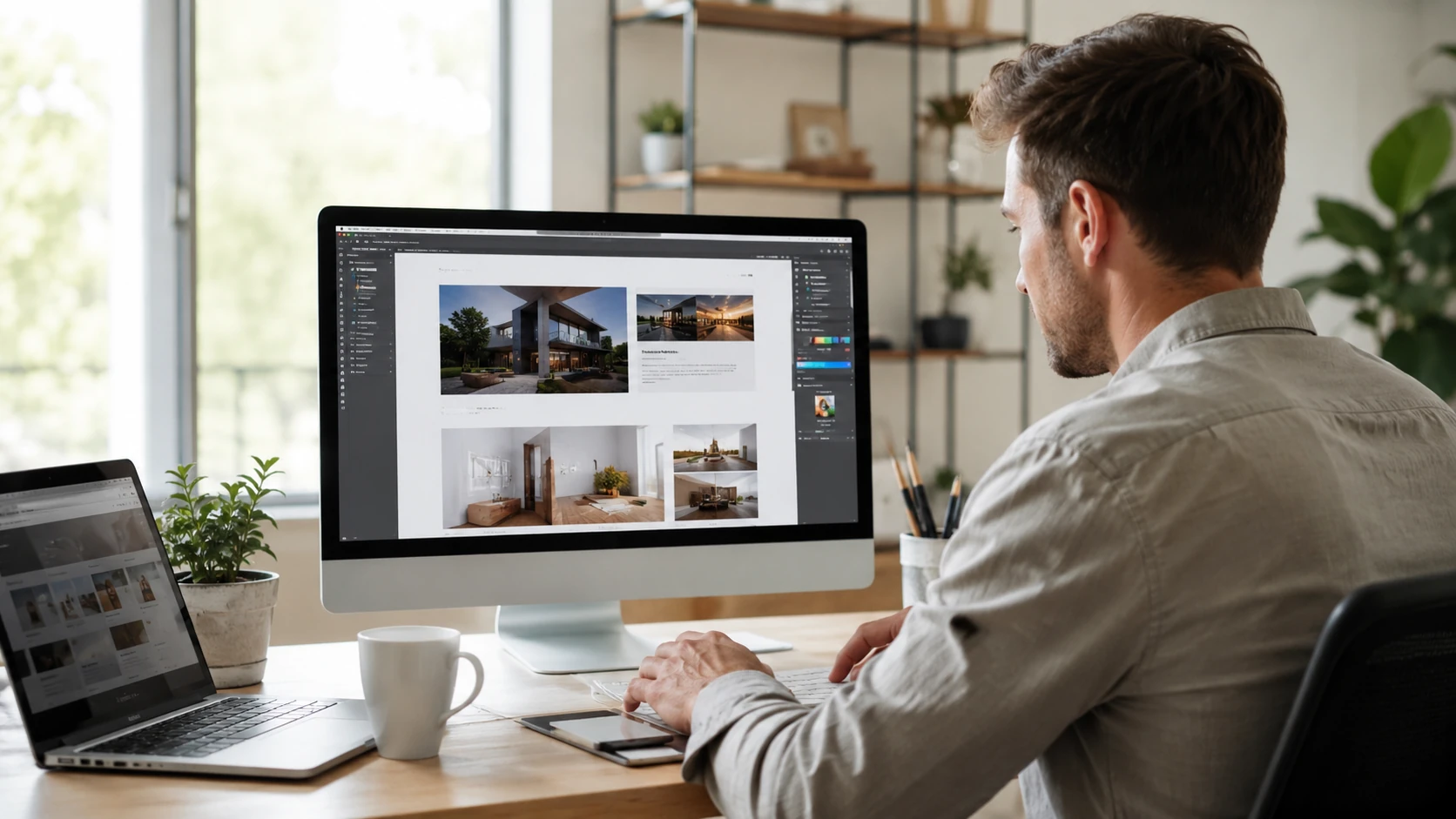
- Prototyping: building interactive mockups in tools like Figma or Adobe XD to test ideas cheaply before engineering picks them up
- Cross-functional collaboration: aligning with PMs, engineers, and stakeholders on feasibility, priority, and scope
- Design iteration: incorporating test findings, stakeholder feedback, and technical constraints into successive versions
One thing most people underestimate: a significant portion of a product designer's day is spent in conversation, not in a design tool. Alignment work, critique sessions, and stakeholder reviews are as much part of the job as screen design.
At ParallelHQ, our designers also spend meaningful time on design systems work: building and maintaining shared component libraries that let engineering move faster without breaking visual consistency. This is invisible to users but critical to product velocity.
The tools vary by team and maturity. Figma dominates in 2026, with most collaborative prototyping and handoff happening inside it. Adobe XD still has a foothold in enterprise contexts. AI-powered prototyping tools are increasingly part of the workflow, compressing the time between concept and testable prototype.
What a product designer does not do: make arbitrary aesthetic decisions in isolation, gold-plate features that haven't been validated, or design for design awards. The job is to serve the user and the business goal simultaneously.
The Product Design Process Explained for Startups
There is no single universal process, but the most functional version for startups follows a clear arc. Design thinking, as codified by IDEO, gives us a useful backbone: Empathize, Define, Ideate, Prototype, Test. In a startup context, that maps to a more practical sequence.
- Discovery: Conduct user interviews, competitive analysis, and stakeholder workshops to define the problem worth solving. This is where market validation and design research converge.
- Define: Synthesize research into a clear problem statement and user personas. Prioritize what the first version must do versus what it can defer.
- Ideate: Generate multiple solution directions. Sketch flows, challenge assumptions, and kill bad ideas cheaply on paper before they reach Figma.
- Wireframe: Build low-fidelity representations of the key user flows. These are navigational blueprints, not final visuals.
- Prototype: Create an interactive version with enough fidelity to test meaningfully. This is the artifact that usability testing is run against.
- Test: Put the prototype in front of real users. Observe, record, and note where they hesitate, fail, or ask questions.
- Iterate: Revise based on findings. Repeat as many cycles as the timeline allows before handoff to engineering.
For early-stage startups, compressing this into a Design Sprint is often the most practical path. A five-day sprint can move from problem statement to tested prototype, giving you signal before you've spent a dollar on development.
The key principle across every stage: design iteration is not a sign of failure. It's the mechanism by which good products get built. Shipping something that wasn't tested is the actual risk.
What Skills Does a Product Designer Need in 2026?
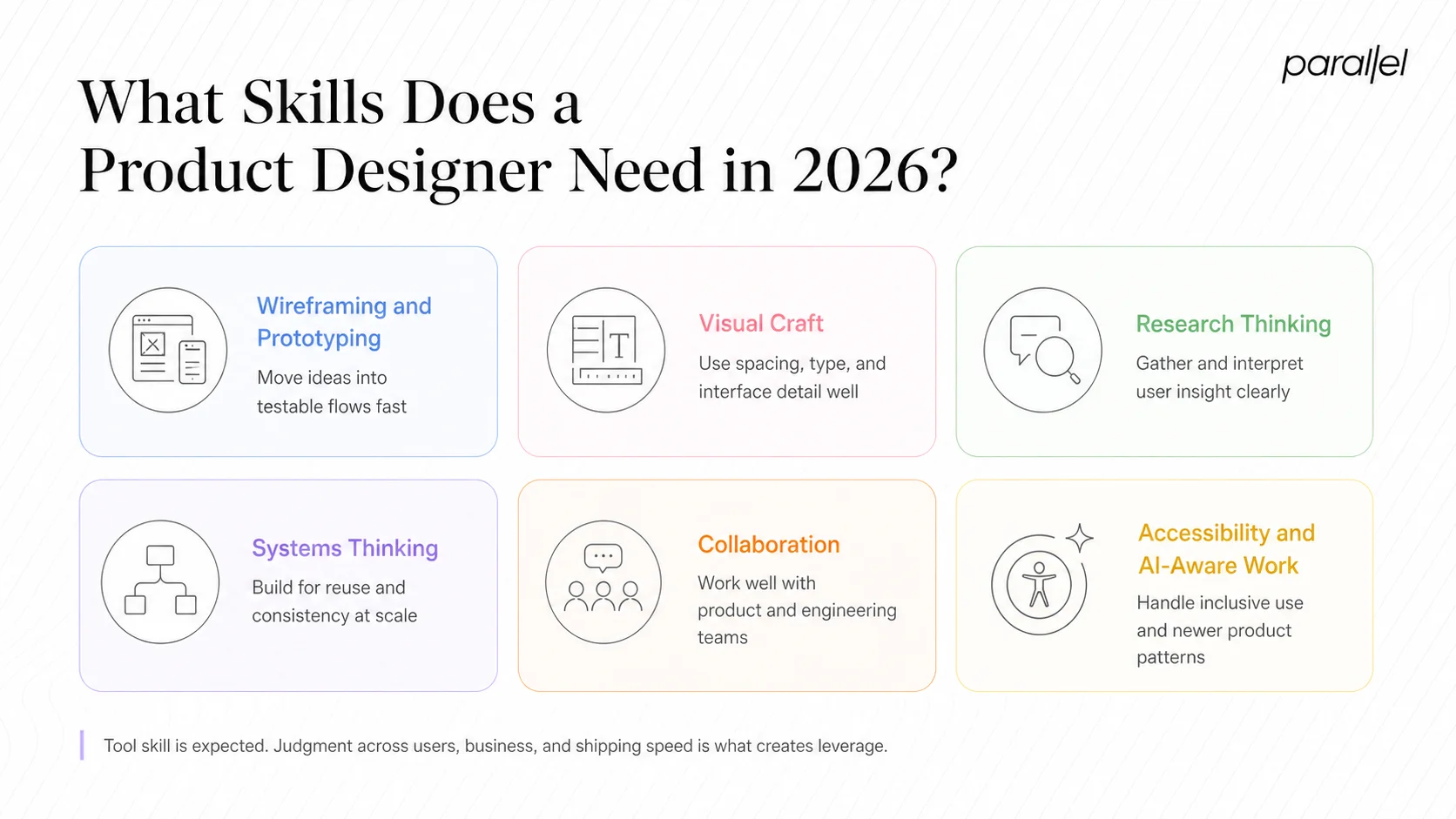
The skill profile for a strong product designer has shifted meaningfully over the past few years. Figma fluency is now baseline, not a differentiator. What separates strong designers from good ones is the layer above the tools.
Core design craft:
- Wireframing and prototyping with speed and precision
- Visual design: typography, spacing, color, and component architecture
- Design systems thinking: building for reuse and consistency at scale
Research and strategy:
- User research methods: interviews, diary studies, contextual inquiry
- Usability testing and synthesis
- Ability to translate findings into prioritized design decisions
Systems and collaboration:
- Fluency with agile workflows and sprint grooming
- Comfort working in ambiguity and pushing back on requirements that haven't been validated
- Basic understanding of frontend constraints so handoffs to engineering are clean
Emerging requirements in 2026:
- AI-native design thinking: understanding how to design interfaces for AI-powered products
- Accessibility fluency: WCAG standards are no longer optional, they're expected by enterprise buyers and regulated in an increasing number of markets
- UX writing: the ability to write interface copy that guides users, not just labels buttons
The designers who command the most leverage in 2026 are those who can own the conversation between user insight, business strategy, and shipping velocity. That's a rare profile, which is why many startups benefit from a design partner rather than a single hire.
How to Build a Product Design Team at a Startup
The decision of when and how to build a design function is one of the more consequential calls an early-stage founder makes. Build too late and you're redesigning a product users have already formed negative impressions of. Build wrong and you're paying for a design that can't survive engineering scrutiny.
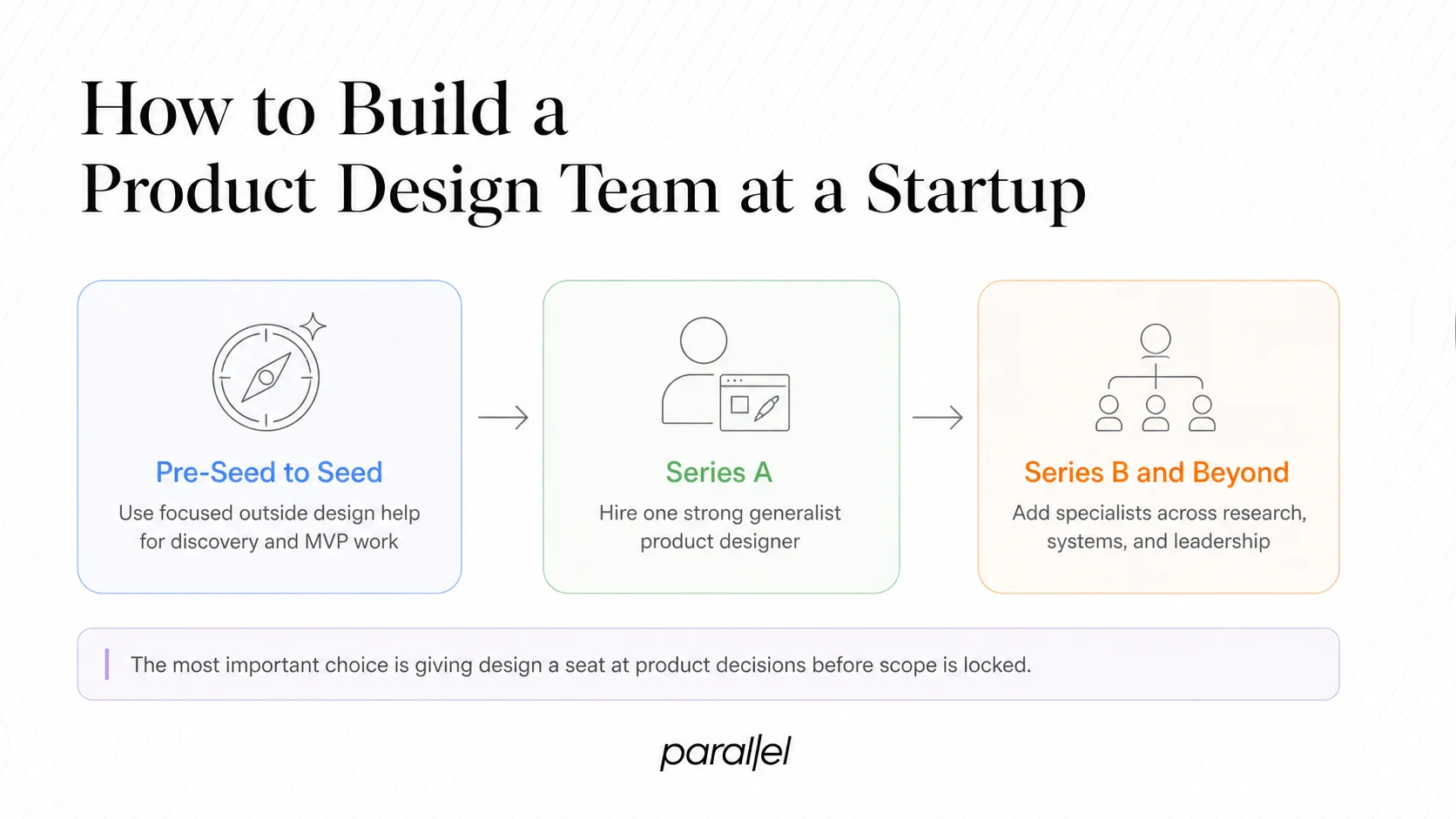
Here's how I recommend thinking about it across stages:
Pre-seed to seed:
- You don't need a full-time designer yet. You need structured design input.
- Use a design partner or fractional product designer for discovery, MVP design, and design system foundations.
- The goal is a testable, shippable product that isn't embarrassing on first impression.
Series A:
- Hire one strong generalist product designer who can own UX and UI across the product.
- This person should report directly to the founder or CPO, not to engineering.
- Pair them with a research resource, even part-time, so decisions are grounded in evidence.
Series B and beyond:
- Build specialization: separate UX research, product design, and design systems roles.
- Establish a design operations function to manage process, tooling, and quality at scale.
- Consider a design director or VP to bridge design strategy with company strategy.
Across all stages, the single most important cultural decision is whether design has a seat at the product table before features are scoped, not after. Designers who are handed requirements to "make look good" produce worse outcomes than designers who helped define the requirements in the first place.
For founders asking how to know when to hire: the signal is not headcount or revenue. The signal is when your product is making user-facing decisions and no one in the room has the expertise to make those decisions well.
How Do Founders Know When to Hire a Product Designer?
This question sits at the intersection of product strategy and resourcing, and the honest answer is: earlier than you think.
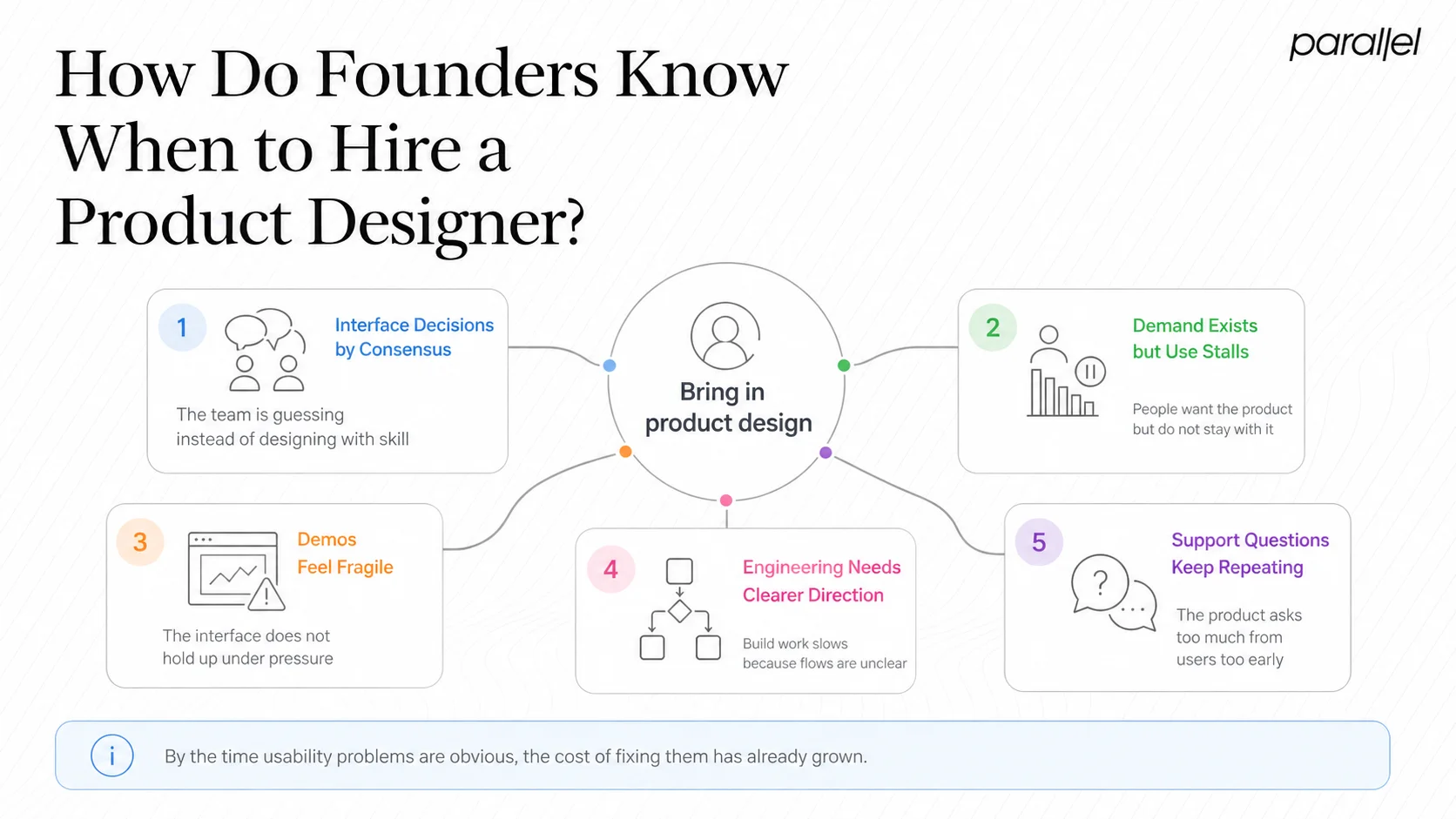
Most founders recognize the need for product design when something is visibly broken. Users drop off in onboarding. Support tickets pile up asking how to do basic tasks. A demo goes sideways because the interface is confusing under pressure. These are lag indicators. By the time they appear, the cost of fixing them is already compounded.
The leading indicators that it's time to bring in design help:
- You're making interface decisions by consensus: engineers and PMs voting on what feels right is not a design process.
- Your MVP has validated demand but engagement is low: users want the thing you built but can't figure out how to use it.
- You're preparing to raise and the product needs to survive a demo: investors form product impressions fast.
- Your engineering team is blocked by unclear requirements: good design documentation unblocks engineering and reduces rework.
An underdeveloped product design function is one of the most common reasons SaaS products plateau after initial traction.
The cost calculation is straightforward: a design sprint or structured discovery engagement with a partner like ParallelHQ costs a fraction of one engineering sprint spent building something that wasn't validated. If you're thinking about how to create a great product, the answer almost always starts with design before it starts with development.
For founders building in AI and SaaS specifically, the complexity of designing interfaces for AI products adds another layer of reason to bring in design expertise early. These interfaces carry higher cognitive load and require more deliberate design thinking to feel trustworthy.
Conclusion
What is product design, in practice, is the discipline that makes the difference between a product that converts and one that confuses. The key takeaways from this guide:
- Product design spans research, wireframing, prototyping, testing, and systems, not just visual design.
- It is distinct from, and inclusive of, UX and UI design.
- The process is iterative by design, and that iteration is what produces quality.
- Founders should engage product design before engineering begins, not after the first version ships.
If you're building a SaaS or AI product and want a structured design partner from discovery through delivery, that's exactly what ParallelHQ does.
Frequently Asked Questions
Q1: What is product design in simple terms?
Product design is the practice of deciding what a digital product does, how it works, and how it feels to use. It combines user research, structure, and visual design to create something both usable and valuable. It's less about aesthetics and more about solving the right problem the right way.
Q2: How does product design differ from graphic design?
Graphic design communicates through visuals, typically for marketing or brand. Product design shapes interactive experiences: it governs flows, logic, and behavior inside a product. A graphic designer makes things look good. A product designer makes things work well and look good in service of that function.
Q3: What tools do product designers use in 2026?
Figma is the dominant tool for wireframing, prototyping, and design systems. Adobe XD is still used in some enterprise contexts. AI-powered prototyping tools are now part of most modern workflows, compressing the time from concept to testable prototype significantly.
Q4: Can a startup skip product design and just build?
Technically yes. In practice, skipping product design means your engineering team makes design decisions without the expertise to make them well. The result is usually a product that works but isn't adopted, requiring expensive rebuilds after launch. The cost of skipping design is higher than the cost of doing it.
Q5: What is a design system and why does it matter?
A design system is a shared library of components, patterns, and guidelines that ensures consistency across a product. It lets engineers build faster by reusing validated elements, and it lets design scale without requiring every screen to be designed from scratch. For growing startups, it's foundational infrastructure.
Q6: How long does the product design process take for an MVP?
A focused discovery and design sprint for an MVP typically runs three to six weeks, depending on complexity and how much prior user research exists. That covers problem definition, flows, wireframes, a testable prototype, and one round of usability testing, enough to hand off to engineering with confidence.

check out these related blogs