When founders ask me about web design cost, they usually expect a simple menu of prices. But pricing is rarely just about pixels. In my experience working with early-stage startups and product leaders, the price tag reflects the depth of thinking required to solve your specific business problem. A site that looks pretty but fails to convert is an expensive mistake. We built ParallelHQ because we saw teams struggle with this exact disconnect. They overcomplicate the experience and underinvest in clarity. Here is how we think about pricing, value, and making grounded design decisions in 2026.
Quick Answer
In 2026, basic template setups range from $1,000 to $5,000. Custom small business sites average $5,000 to $15,000. Complex SaaS platforms, ecommerce solutions, and strategic agency redesigns typically start at $30,000 and can easily exceed $100,000 depending on scope.
Why does web design cost vary so wildly between teams?
The digital landscape is flooded with options. You can hire someone online to build a landing page for $500, or you can hire a global agency for $150,000. This massive gap exists because these two providers are selling entirely different things.
One is selling visual decoration. The other is selling business strategy and user activation.
At ParallelHQ, we have seen startups burn through their initial funding rounds by hiring agencies that focus solely on aesthetics. These teams deliver beautiful Figma files that are entirely disconnected from real user behavior. The client gets a sleek website, but their customer acquisition metrics flatline.
Visual design is only the final layer of a much deeper process. True product design requires understanding your market, identifying friction points, and mapping out a logical user journey. When you pay a premium for design services, you are paying for this foundational thinking.
We recently reviewed a SaaS onboarding flow that looked visually stunning but had a 60% drop-off rate. The previous agency had overcomplicated the steps to showcase custom animations. By simplifying the architecture and removing the visual noise, we doubled their activation rate. That is the difference between buying pixels and buying outcomes.
The hidden risk of cheap design
Low-budget providers typically skip the discovery phase entirely. They ask you what you want it to look like, pick a template, and fill in the blanks. This approach forces you to act as the product manager, UX researcher, and strategist.
If you are a founder, your time is your most valuable asset. Spending it micromanaging a junior freelancer is rarely a good investment. Furthermore, cheap design often leads to technical debt.
You might save money upfront, but you will pay for it later when you have to rebuild the entire platform because it cannot scale with your growth. I have seen this cycle repeat itself dozens of times across early-stage startups.
Where do product teams miscalculate their web design cost?
Most product leaders underestimate the amount of friction present in their current digital experience. They assume a fresh coat of paint will solve their conversion issues. This leads to wildly inaccurate budget expectations.
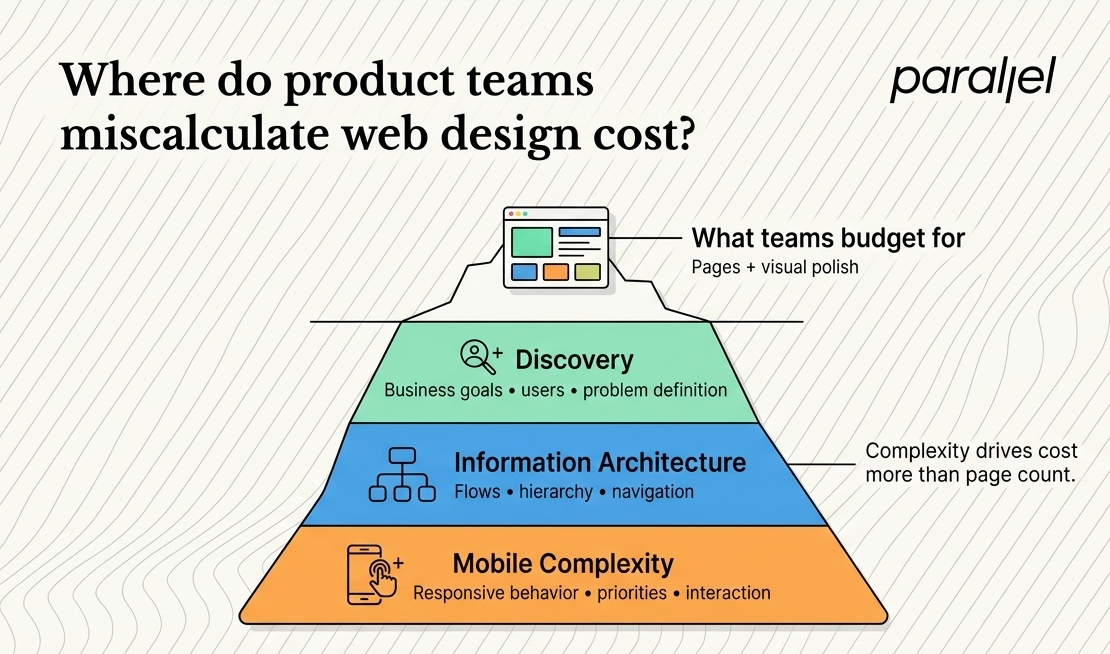
When planning a website redesign, teams often focus exclusively on the number of pages. They ask for a quote based on a 10-page or 20-page site. However, page count is one of the least important factors in determining pricing.
Complexity is what drives the required budget. A single, highly optimized SaaS pricing page with interactive sliders and clear value architecture can require more design thinking than ten standard blog pages.
Here are the three areas where teams consistently miscalculate their required investment.
1) Skipping the discovery phase
Discovery is not an optional add-on. It is the most critical phase of the project. This is where we define the core problem, understand the target audience, and align on business goals.
Teams often try to cut costs by skipping this step. They hand over a brief and expect immediate wireframes. This is a massive mistake. Without proper product strategy consulting, you are just guessing at what your users want.
A lack of discovery leads to endless revisions later in the project. It causes scope creep, missed deadlines, and a final product that fails to resonate with the market. Paying for strategy upfront is the most effective way to protect your overall budget.
2) Ignoring information architecture
Information architecture is the blueprint of your product. It determines how users navigate through your platform and find the information they need. Many teams assume this step is simple and try to rush through it.
We have seen complex enterprise software platforms built without a clear architectural foundation. The result is always a convoluted mess. Users get lost, support tickets skyrocket, and churn rates increase.
Designing a logical, scalable architecture requires deep cognitive work. It requires mapping out user flows, organizing content hierarchies, and testing navigation models. If your budget does not account for this structural work, your product will fail.
3) Underestimating mobile complexities
The mobile experience is no longer an afterthought. It is often the primary touchpoint for your users. Despite this reality, many teams still review designs exclusively on large desktop monitors.
Recent digital experience reports show that mobile bounce rates surged 54% globally in 2025. Half of all mobile users exit a site after viewing just one page if the experience is poor. Mobile error clicks also spiked dramatically.
Designing a seamless mobile experience requires more than just stacking desktop elements vertically. It requires rethinking navigation, optimizing touch targets, and prioritizing content for small screens. This adds significant complexity and directly impacts the required investment.
How does your team choice impact web design cost?
Who you hire dictates both your budget and your final outcome. Startups generally have four options when building a digital product. Each comes with distinct financial realities and risk profiles.
Choosing the right partner depends entirely on your stage of growth, your internal capabilities, and your primary business goals. Let us break down the options.
Option 1: The solo freelancer
Freelancers are usually the most budget-friendly option. You can find talented designers globally who charge very reasonable hourly rates. This route is often best for bootstrapped startups needing a basic landing page.
However, relying on a single freelancer introduces significant risk. One person rarely excels at UX research, UI design, copywriting, and technical implementation. You will likely have to hire multiple freelancers and manage the handoff between them yourself.
Freelancers also have limited capacity. If your freelancer gets sick or takes another job, your project halts entirely.
Option 2: The traditional digital agency
Traditional agencies offer a full suite of services. They have account managers, strategists, designers, and developers. They provide polish and a structured process.
The downside is the heavy overhead. When you hire a large agency, a significant portion of your budget goes toward their office space, sales team, and management layers.
Furthermore, traditional marketing agencies often lack deep product design expertise. They are great at building brand awareness sites but struggle when tasked with complex SaaS design services or application interfaces.
Option 3: The in-house team
Building an in-house design team provides maximum control and long-term alignment. Your designers will deeply understand your product and your market over time.
However, this is by far the most expensive route. According to recent industry data, the median base salary for a US-based digital interface designer reached $104,000 in early 2025. Once you factor in benefits, software tools, and management overhead, the true cost of a single mid-level hire easily exceeds $135,000 annually.
Early-stage startups rarely have the capital or the consistent workload to justify full-time hires immediately. Hiring takes months, and bad hires are incredibly costly to replace.
Option 4: The specialized product partner
This is where ParallelHQ operates. We act as an extension of your team, bringing specialized product thinking without the bloat of a traditional agency.
Specialized partners focus strictly on UX, UI, and product strategy. We do not do social media management or PR. We solve complex interaction problems and build scalable design systems.
This model offers the strategic depth of an in-house team with the flexibility of an agency. It is ideal for funded startups and product teams that need senior-level execution without the commitment of full-time hires.
Here is a quick comparison table to summarize the team structures.
Is a higher web design cost worth the investment?
I am often asked if spending $40,000 on a product redesign will actually generate a return. The answer is yes, provided the money is spent on solving the right problems.
Good design is a revenue multiplier. Bad design is a silent leak in your business model. You can spend millions on marketing to drive traffic, but if your interface confuses users, that money is wasted.
To understand this dynamic, you have to look at the ROI of UX. The return on investment comes from three specific areas.
1) Increased activation and conversion
The most immediate impact of strategic design is higher conversion rates. We focus heavily on removing friction from the user journey.
If a user cannot figure out how to sign up, or if the pricing tiers are confusing, they will leave. By simplifying the interface and clarifying the value proposition, we directly increase the percentage of visitors who become paying customers.
A well-executed UX audit can uncover simple architectural flaws that are costing your business thousands of dollars a month in lost revenue. Fixing these flaws pays for the design work very quickly.
2) Reduced engineering waste
Engineering time is incredibly expensive. Having developers write code for a poorly thought-out feature is a massive waste of capital.
Investing in high-fidelity prototyping and user testing before writing a single line of code is the smartest financial decision a founder can make. It allows you to validate concepts cheaply.
When you hand developers a fully documented design with clear states and logic, they can build faster and with fewer errors. Proper design strategy drastically reduces the time-to-market for new features.
3) Scalability through design systems
Startups often build their products piece by piece over time. This leads to inconsistent interfaces. Buttons look different on every page, and the user experience feels disjointed.
Investing in a proper design system creates a single source of truth for your digital product. It provides a library of reusable components that ensure consistency across the entire platform.
While building a design system requires an upfront investment, it drastically reduces future design and development time. Your team can launch new pages and features in a fraction of the time, making your product organization much more efficient.
What are the baseline numbers for web design cost in 2026?
Let us look at the actual data. The market has shifted significantly over the past few years. Tools have become more accessible, but user expectations have never been higher.
A 2026 report analyzing data from Clutch reveals that the average design-led agency project runs around $38,105. However, this average is heavily skewed by massive enterprise projects.
Separate survey data from GoodFirms in 2026 shows that 63% of digital agencies quote fixed-price projects somewhere between $1,000 and $15,000 for standard websites.
To give you a realistic framework, I have broken down the 2026 market rates into four distinct categories based on our observations in the industry.
1) The template-based approach ($1,000 to $5,000)
This is the entry-level tier. It involves purchasing a pre-made theme on platforms like Webflow, WordPress, or Shopify, and hiring a junior designer to customize the colors and fonts.
This approach requires minimal strategic thinking. The architecture is dictated entirely by the template.
- Timeline: 1 to 3 weeks.
- What you get: A basic online presence, standard responsive behavior, and simple contact forms.
- Who it is for: Local businesses, independent consultants, and brand new startups testing a very early concept.
2) The custom marketing website ($5,000 to $20,000)
This tier involves custom visual design tailored to your specific brand identity. It moves away from rigid templates and includes customized layouts to better support your content.
At this level, you should expect basic user research and a defined content strategy. The focus is on lead generation and clear messaging.
- Timeline: 4 to 8 weeks.
- What you get: Custom UI design, basic CMS integration, optimized landing pages, and a tailored mobile experience.
- Who it is for: Seed-stage startups, established service businesses, and small B2B companies needing a professional digital footprint.
3) The complex application or platform ($25,000 to $75,000)
This is where product design principles become mandatory. Designing a SaaS application, a fintech dashboard, or a custom marketplace requires deep structural thinking.
At this tier, the focus shifts heavily to user flows, edge cases, data visualization, and complex interactions. Research and testing are non-negotiable components of the budget.
- Timeline: 8 to 16 weeks.
- What you get: Comprehensive UX research, detailed wireframing, high-fidelity interactive prototypes, and a scalable design system.
- Who it is for: Series A startups, SaaS companies, and businesses relying on custom digital tools for their core operations.
4) The enterprise digital transformation ($75,000 to $200,000+)
Enterprise projects involve massive scale. They require aligning multiple stakeholder groups, integrating with legacy backend systems, and ensuring strict compliance with accessibility standards.
These projects are highly complex and carry significant risk. The pricing reflects the necessary project management, extensive user testing, and multi-platform consistency required at this scale.
- Timeline: 4 to 9 months.
- What you get: Global design systems, intensive foundational research, multi-language support architecture, and deep technical integration planning.
- Who it is for: Large corporations, mature post-Series C tech companies, and multinational organizations.
The variables that dictate your final quote
If you request proposals from three different agencies, you will likely receive three vastly different numbers. This happens because each agency makes different assumptions about the scope of work.
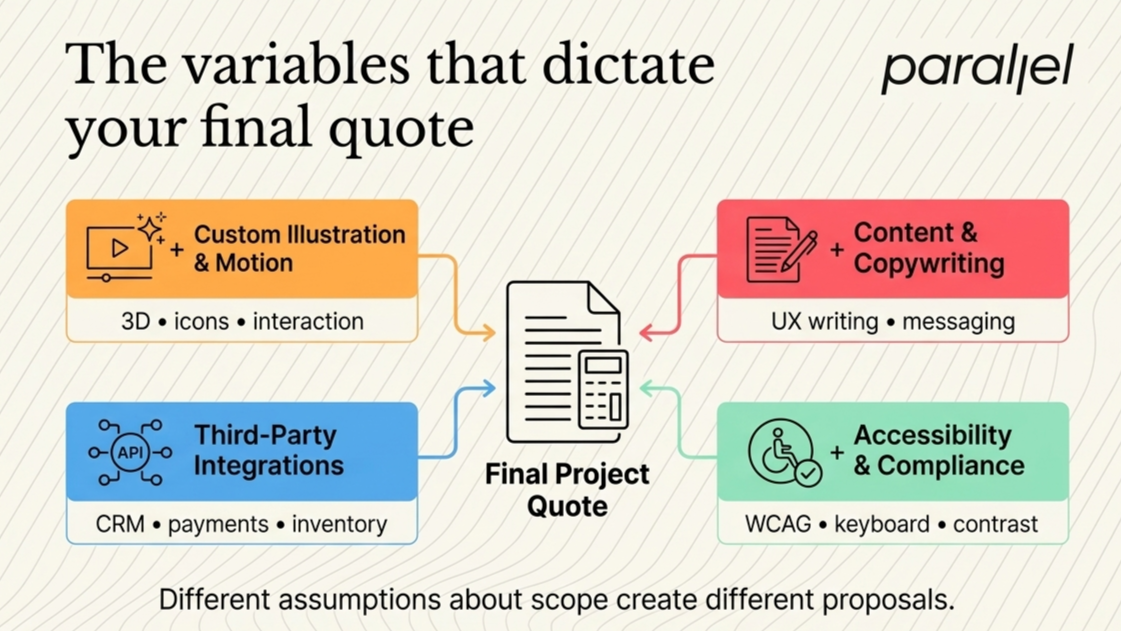
To ensure you are comparing apples to apples, you must understand the specific variables that influence a proposal. Here are the core factors we look at when scoping a project at ParallelHQ.
Custom illustrations and motion design
Visual polish takes time. If your brand relies heavily on custom 3D illustrations, bespoke iconography, or complex scroll-triggered animations, your budget will increase significantly.
These elements require specialized skills and intensive browser testing to ensure they do not ruin performance. We always advise teams to secure their UX foundation before spending heavily on motion design.
Content creation and copywriting
Design and content are deeply intertwined. You cannot design a highly converting landing page without knowing what the copy says.
Many clients assume they will write the copy themselves to save money. This almost always causes project delays. If an agency has to provide specialized UX writing or technical copywriting, it will be factored into the final price.
Third-party integrations
Connecting a website to external tools adds layers of complexity. Integrating a simple email capture form is easy. Integrating a custom CRM, a dynamic inventory management system, and a multi-currency payment gateway is difficult.
The more systems your platform needs to talk to, the more time must be spent designing error states, success states, and fallback flows.
Accessibility and compliance
Designing for accessibility is the right thing to do, and in many industries, it is legally required. Ensuring your product meets strict WCAG compliance involves specific color contrast checks, screen reader optimization, and keyboard navigation testing.
Meeting advanced compliance standards requires dedicated effort and will elevate the overall project scope.
How to evaluate design proposals
When reviewing proposals, the cheapest option is rarely the best choice, but the most expensive option is not guaranteed to succeed either. You have to look for red flags in how the provider structures their thinking.
First, look at their discovery process. If a proposal jumps straight into deliverables without detailing how they will learn about your business, discard it. They are planning to guess.
Second, evaluate their case studies. Do not just look at the pretty pictures. Look for metrics. A strong product design partner will highlight how they improved activation, reduced churn, or simplified a complex workflow.
Finally, ask about their handoff process. The best design in the world is useless if your developers cannot build it. Ensure the proposal includes time for design documentation and developer collaboration.
Conclusion
Building a successful digital product requires moving beyond the surface level. A visually stunning interface that ignores user psychology will ultimately fail in the market.
When you allocate your budget, remember that you are investing in clarity. You are paying for a team to untangle your complex business logic and present it simply to your users.
Focus on finding a partner who asks hard questions about your business goals rather than just taking orders. Grounded, thoughtful product design is a continuous process of learning and refining. Prioritize the foundation, and the results will follow.
Frequently Asked Questions
1) What is included in standard web design cost?
A standard package typically covers basic discovery, UX wireframing, UI visual design, and asset handoff. However, comprehensive projects will also include user research, copywriting, interactive prototyping, and the creation of a reusable design system. Always ask for a detailed statement of work to clarify exact deliverables.
2) How do you budget for a website redesign?
Start by defining the specific business metric you want to improve (e.g., lower bounce rate, higher trial signups). Allocate your budget based on the revenue that metric currently costs you. For early-stage startups, it is generally wise to reserve 10% to 15% of your total initial product development budget specifically for UX and UI design.
3) Agency vs freelancer: which is better for early-stage startups?
Freelancers are excellent for constrained budgets and narrow tasks like building a simple landing page. If you are building a complex SaaS application or need deep strategic alignment, a specialized product design partner or agency is better equipped to handle the multifaceted requirements of product architecture.
4) How do I know if my website needs a redesign?
Look at your user data. High bounce rates, low activation metrics, and frequent customer support tickets regarding basic navigation are strong indicators. If users are consistently failing to understand your core value proposition within the first ten seconds, your current design is actively harming your business.
5) Why is UX research priced separately from visual design?
UX research requires a completely different skill set than visual design. It involves conducting user interviews, analyzing competitor data, and mapping psychological journeys. It is often priced separately because the required depth of research varies wildly depending on how much validation your specific market concept needs.
6) How long does a typical product design sprint take?
A focused design sprint to validate a specific feature or concept typically takes two to three weeks. However, designing a complete, scalable SaaS application from scratch usually requires eight to twelve weeks of sustained effort to ensure proper architecture, testing, and developer handoff.
7) Can a higher web design cost guarantee better conversion rates?
No reputable agency can guarantee specific conversion numbers, because design is only one piece of the puzzle. Product-market fit, pricing strategy, and traffic quality also play massive roles. However, investing in strategic UX drastically increases the probability of conversion by systematically removing friction from the user journey.
8) How does ParallelHQ approach web design cost for SaaS startups?
We price based on the complexity of the problem, not arbitrary page counts. We start with a deep dive into your product strategy and user behavior to identify where you are losing momentum. We then structure our engagements to deliver clear, scalable product design that directly targets activation and growth.

check out these related blogs