Between 35% and 66% of web projects experience partial or total failure. I’ve seen this happen firsthand when founders pick a leading web design agency based on flashy portfolios rather than strategic alignment. At ParallelHQ, we’ve rebuilt countless sites where the original design looked great but actively harmed conversion and user retention. Choosing the right partner isn't about finding the best visual artists; it's about finding a team that understands how to simplify complex product decisions and ground their work in real user behavior.
Quick Answer/TL;DR
To choose a leading web design agency, prioritize firms that combine UI/UX design, conversion rate optimization, and technical execution. The best partners focus on product strategy and user behavior before designing interfaces. Budget, technical stack fluency, and startup experience are your critical filters.
Below is a comparison of the top 10 agencies for 2026.
Why Choosing the Right Leading Web Design Agency Matters
The cost of a poor foundation is entirely measurable. A confusing navigation menu or a bloated checkout process directly drains your revenue. We have seen teams obsess over minor branding details while ignoring catastrophic drops in their conversion funnels.
When hiring a leading web design agency, teams often prioritize the wrong things. They look for award-winning animations instead of looking for teams that understand cognitive load. The reality in 2026 is that users have zero patience. According to 2025 data from the Baymard Institute, the average shopping cart abandonment rate hovers around 70%. A significant portion of this is driven by overly complex flows.
Furthermore, Forrester Research consistently shows that every $1 invested in strategic user experience returns up to $100. This is a 9,900% ROI. Good design isn't about making buttons rounded; it's about preventing users from abandoning your software. You need a website that actively removes barriers. Every extra click and every confusing product variant selector costs you money. This is why choosing a partner with deep product thinking is critical. You need someone who will push back on bad ideas and focus relentlessly on what drives the business forward.
Where Teams Go Wrong in the Selection Process
In my experience, this is where most product decisions go wrong during a build or redesign. Founders lose sight of the primary goal and fall into predictable traps when evaluating a leading web design agency.
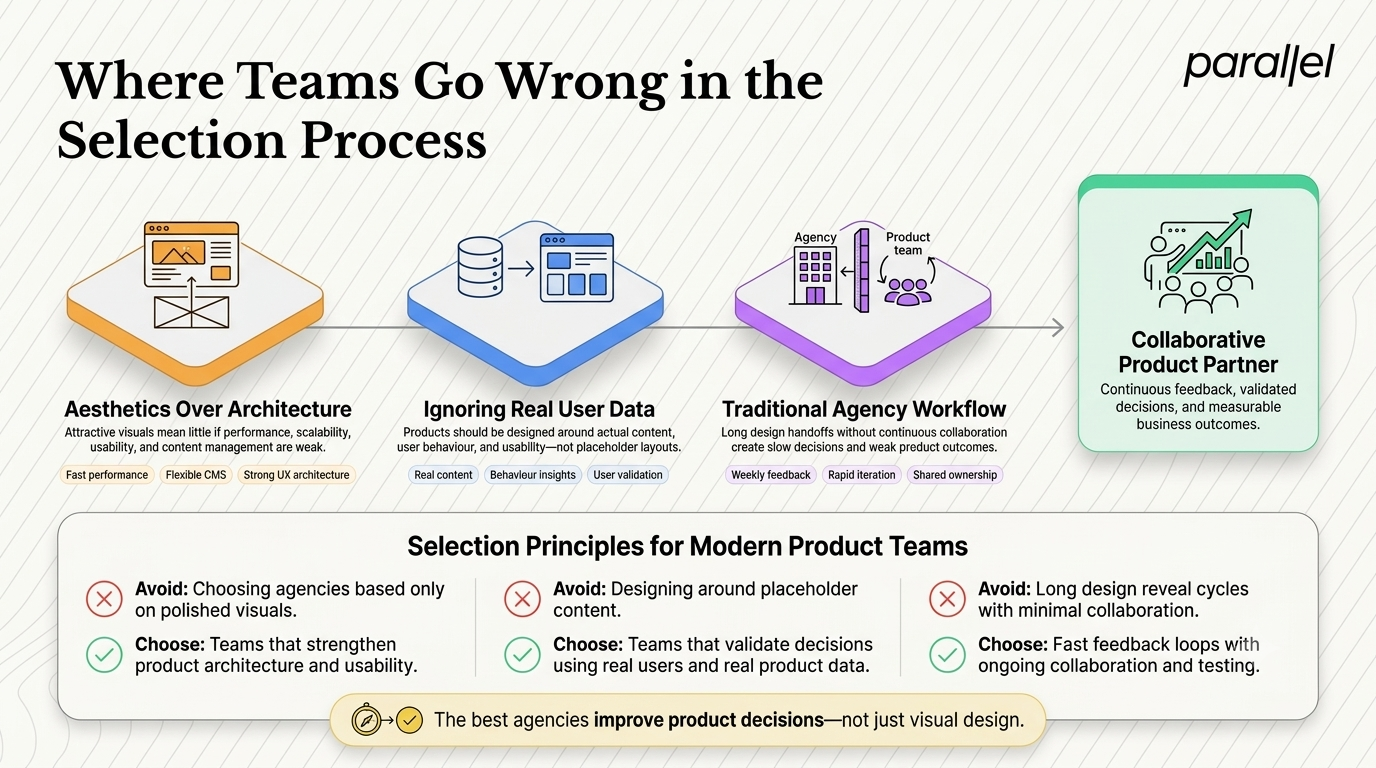
Trap 1: Optimizing for Aesthetics Over Architecture Most startups misunderstand what design actually solves. I have seen countless teams spend months perfecting their onboarding flow visuals with the latest UI trends and smooth animations, yet their drop-off rates remain unchanged. Visuals are a baseline requirement, not a differentiator. A beautiful site that takes five seconds to load and requires a developer to change a headline is a failed product.
Trap 2: Ignoring the Blank Slate and Real Data We frequently audit products where the previous agency designed screens that look beautiful when filled with dummy data, but look broken and intimidating when a real user logs in for the first time. We recently worked with a Series A health-tech startup struggling with user activation. We paused the visual work and looked at their user data. The users were not struggling with the dashboard aesthetics; they were struggling to understand the medical terminology used in the navigation. A superficial design agency won't catch that.
Trap 3: The Traditional Agency Reveal The traditional agency model is broken. Throwing requirements over a wall and waiting four weeks for a design reveal does not work for modern software teams. It leads to features built without user validation and agency-style self-promotion taking precedence over your business goals. You need a highly collaborative approach with tight feedback loops.
How to Think About It Correctly: Product Sense Over Portfolios
You have to evaluate how a potential leading web design agency thinks, not just what they produce. A shiny Dribbble profile tells you nothing about a designer’s ability to solve complex business problems.
We advise founders to ask behavioral questions during the vetting process. Do they understand your business model? Can they explain how design impacts your specific revenue drivers? A good partner will map the entire user journey before drawing a single screen. They will rely on structured usability testing rather than generic templates to uncover real friction points.
According to foundational research by the Nielsen Norman Group, testing with just five targeted users uncovers roughly 85% of a product’s core usability problems. If an agency jumps straight into UI without mapping the opportunity and testing assumptions, they are guessing. You want a partner who knows how to run a proper UX audit to establish a baseline of where the product is failing, allowing you to prioritize the highest-impact fixes before committing to a massive overhaul.
A Practical Approach to Finding Your Partner
When evaluating a leading web design agency for a startup context, these are the factors that actually separate the right partner from the rest.
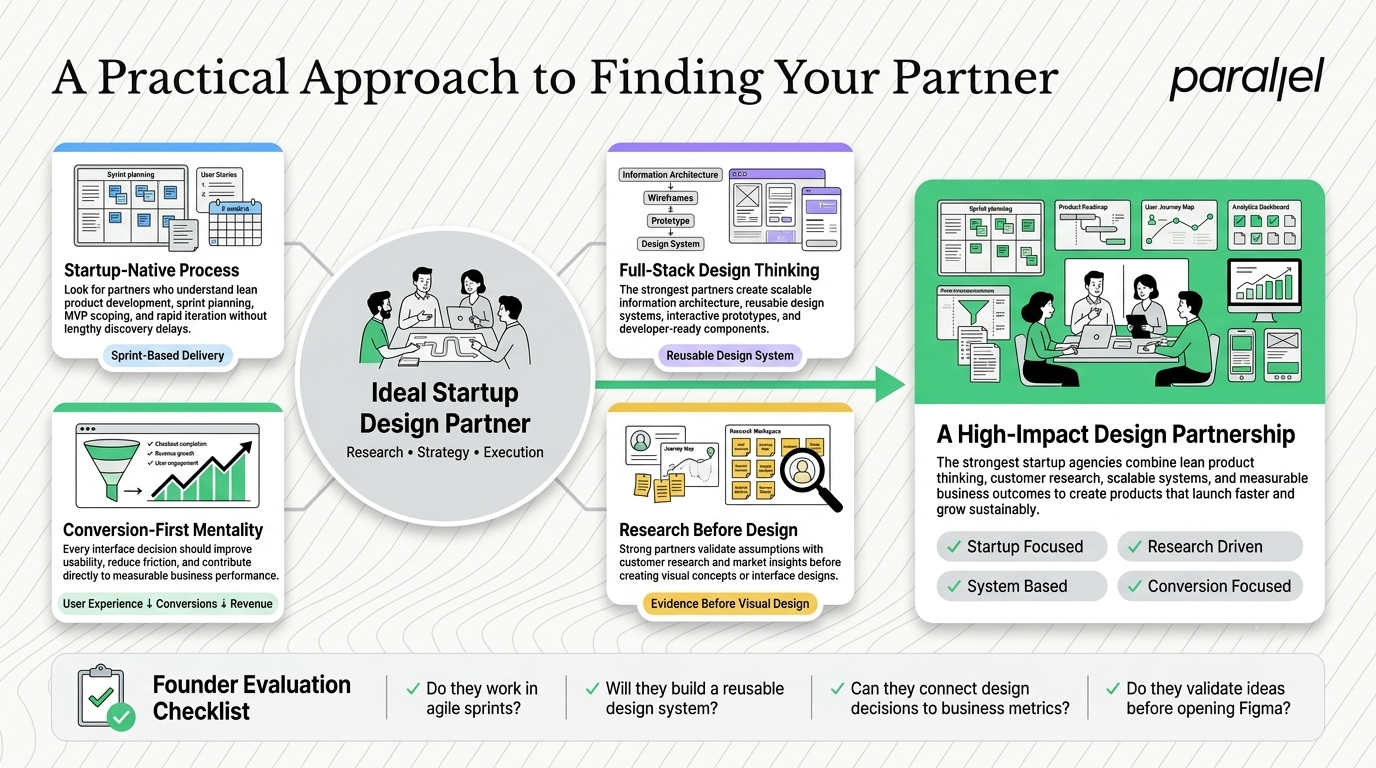
- Startup-Native Process: Do they work in sprints? Our founders and PMs don’t need to educate us on what a sprint is or why lean UX matters. That alignment makes the engagement faster and sharper. Look for teams that can scope a focused MVP without requiring a massive retainer.
- Full-Stack Design Thinking: The best agencies handle information architecture, wireframing and prototyping, and design system creation. Ask explicitly whether their deliverable includes a reusable design system or just one-off artboards.
- Conversion-First Mentality: User experience design is not decorative. Every screen decision has a measurable revenue implication. Baymard Institute’s 2025 data confirms that large eCommerce sites can recover 35.26% more conversions by fixing checkout usability alone.
- Research Depth Before Pixels: A strong partner runs user research and market validation before opening Figma. If an agency jumps to moodboards on the first call, that is a red flag.
The Top 10 Leading Web Design Agencies for 2026
If you are looking to hire a leading web design agency this year, here is my breakdown of the top players, based on real market positioning and capability.
1) ParallelHQ
I built ParallelHQ because I saw too many teams struggle with design decisions that should have been much simpler. We approach web design by combining deep user research with agile execution. We focus on clarity in thinking, ensuring your website converts and your product retains users. We work closely with early-stage startups, focusing on fixing overcomplicated product experiences and weak onboarding flows. We ground every decision in real user behavior, acting as an extension of your product team through product strategy consulting and rigorous UI/UX design. We push back on fluffy aesthetics and features built without user validation.
2) Clay
Clay is a San Francisco-based UI/UX agency known for working with modern SaaS and tech companies. They are fantastic at creating premium, brand-forward websites that win awards. However, they are built for companies with significant budgets ($50K+) needing brand, web, and product rolled into one engagement. If you need a deeper focus on rapid iteration and product mechanics on a startup budget, you might need a Clay alternative.
3) MetaLab
MetaLab is famous for designing interfaces for companies like Slack and Uber. They excel at defining the visual language for well-funded tech unicorns. If you have just raised a massive Series B and need a flawless interface, they are a strong option. However, their enterprise pricing means early-stage teams needing rapid feedback loops often seek a MetaLab alternative.
4) Ramotion
Ramotion is a veteran in the space, known for brand identity and strict UI/UX systems for B2B. They have a polished, corporate aesthetic. If you are targeting enterprise customers (like banks or healthcare) and need to look highly established and "safe," they are a solid choice for enterprise software design services.
5) Ueno
Ueno focuses on scale-ups with large brand ambitions. They are particularly strong in motion and interaction design, creating highly engaging digital experiences. They are best suited for companies where the brand experience is the primary differentiator.
6) Lollypop Design Studio
An agency with broad digital product experience, Lollypop is capable of delivering deep UX research and mobile-first design for mid-market products. They are thorough, though sometimes their process can be slower to iterate compared to highly specialized, startup-native studios.
7) IDEO
IDEO practically invented design thinking and tackles massive, systemic problems for global corporations. Their process is heavily rooted in long discovery phases. This is perfect for a Fortune 500 company rethinking its business model, but usually too slow and theoretical for a fast-moving software startup, leading many founders to look for an IDEO alternative.
8) OneThing Design
OneThing Design is compact and opinionated. They are a good fit for early-stage web apps where founders want a lean sprint delivery and a defined design point of view. However, capacity constraints can sometimes affect their delivery timelines.
9) Huemor
Huemor is known for immersive, interaction-heavy builds. They are a good choice for mid-market B2B or D2C brands that want to invest in CRO cycles and tangible uplift rather than just aesthetic refreshes. They are less suited for highly complex, data-heavy SaaS platforms.
10) Sayenko Design
Sayenko focuses heavily on the strategic side of web presence, offering thorough discovery phases to ensure alignment. They are a solid option for founders who want a guided, consultative process and robust WordPress or Webflow development.
The Deeper Insight: The Minimum Viable Test
When a startup team is spinning in circles debating features, a time-boxed exercise forces decisions. We compress months of back-and-forth into a few intensive days using design sprints.
Our approach defines the challenge, sketches solutions, builds a realistic prototype, and tests it with users all within one week. This shifts the conversation from subjective opinions among founders to objective observations of real users. We don't just build an MVP; we design the Minimum Viable Test. If you are building a complex AI workflow, your first test might just be a single text input and a hard-coded output. The goal is to create just enough illusion of functionality to observe authentic user behavior before engineering starts.
Conclusion
Choosing a leading web design agency is not about finding the vendor with the prettiest mockups. It is about finding a strategic partner who understands that every design choice is a business decision. The right partner will challenge your assumptions, simplify your complex workflows, and ground their work in how real users actually behave. Don't settle for agency fluff; demand clarity and measurable outcomes.
FAQ
1) What exactly does a leading web design agency do for startups?
A leading web design agency provides professional offerings focused on improving the overall user experience and conversion rate of a product or site. For startups, this goes beyond visuals to include user research, information architecture, UI/UX design, and rigorous usability testing to ensure the product solves real problems and drives growth.
2) How do I know if I need a web design agency or just a freelancer?
If you need a simple, one-off landing page with a low budget, a freelancer might suffice. However, if you require a complex custom website, a scalable design system, or a product that needs to convert qualified visitors efficiently, you need the cross-functional expertise (strategy, UX, UI, technical implementation) of a dedicated agency.
3) What is the typical ROI of hiring a top UX/UI design agency?
Well-executed UX design has a massive financial impact. Forrester Research data from 2025 shows that every $1 invested in strategic UX returns up to $100. Furthermore, resolving usability issues early through an agency can prevent costly engineering rework down the line.
4) How long does a typical web design project take with an agency?
Timelines vary based on scope, but a startup-focused agency should move quickly. A focused website redesign or MVP launch can take 4 to 8 weeks, while complex enterprise platforms might take several months. Look for agencies that work in agile sprints rather than long, monolithic phases.
5) Should we prioritize aesthetics or functionality when building our site?
Functionality and clarity must always come first. A beautiful site that confuses users or loads slowly will fail. A leading web design agency will ensure the strategic architecture and user flows are solid before applying the visual aesthetic layer.
6) What is the difference between a traditional design agency and a product design studio?
Traditional agencies often focus on marketing, branding, and superficial aesthetics (the "reveal"). Product design studios, like ParallelHQ, focus on how the software actually works, prioritizing user retention, activation rates, and deep integration with your engineering and product teams.
7) How can we ensure the agency understands our complex B2B SaaS product?
During the vetting process, ask behavioral questions. Don't just look at case studies; ask them to explain a time they had to compromise on a design due to technical limitations or user feedback. Look for agencies with specific experience in B2B CRO suggestions and enterprise complexity.
8) Is ParallelHQ the right leading web design agency for my company?
If you are an early-stage AI or SaaS founder looking for a partner to simplify complex product experiences, fix weak onboarding, and ground design decisions in real user behavior, we are a strong fit. If you are a massive Fortune 500 looking for a multi-year physical/digital transformation, or if you just want a cheap template, we are not the right choice.

check out these related blogs