I have spent years working with founders and product managers at early-stage startups. Time and time again, I see teams treat their marketing website as an afterthought. They focus entirely on building a brilliant core product and then leave the public-facing site to the cheapest bidder. I have watched this mistake cripple promising product launches. Your website is the very first product experience your users have. Finding a reliable webflow web design agency is not just about getting a pretty landing page. It is about building a scalable engine that communicates complex product value simply, clearly, and effectively.
Quick answer
The best agencies treat Webflow as a robust software platform, not a static visual canvas. They build for scale, prioritize site speed, and design clear user journeys that drive activation. Here are the top 10 agencies to consider in 2026.
Why does choosing the right Webflow partner matter for early-stage startups?
We have seen incredibly smart product teams overcomplicate their website builds. They treat the marketing site like a digital brochure rather than a functional piece of software. In reality, your marketing site must function as a seamless bridge to your product. If users cannot understand your value proposition within ten seconds, your exceptional onboarding flow will never see any traffic.
When you hire partners who only focus on visual aesthetics, you end up with a beautiful site that loads slowly and deeply confuses your users. Nielsen Norman Group's 2026 B2B UX Research shows that complex, unclear navigation structures account for a massive 40% drop in enterprise lead generation. Users do not want to be amazed by your scroll animations. They want to know what your product does, who it is for, and how it solves their immediate problem.
Webflow is an incredibly powerful tool. However, it gives inexperienced developers enough rope to hang themselves. Without a proper design system and strict governance, a Webflow site rapidly becomes a tangled mess of duplicate CSS classes and broken mobile layouts. I have seen marketing teams completely paralyzed because they were too afraid to publish a new blog post in case it broke the global navigation bar.
According to Webflow's 2026 State of Visual Development report, 82% of tech companies now rely on visual development to speed up their time-to-market. Speed only matters if your foundational architecture is solid. A strong partner builds a structured system that your internal marketing team can scale autonomously. You should never need to hire a developer just to fix a typo or launch a standard campaign page.
What are the hidden costs of a poorly built marketing site?
The true cost of a cheap website build is never the upfront invoice. The true cost is the technical debt you accumulate and the agility your marketing team loses. I have audited hundreds of SaaS websites over the years. When inexperienced teams build in Webflow, they almost always make the same structural mistakes.
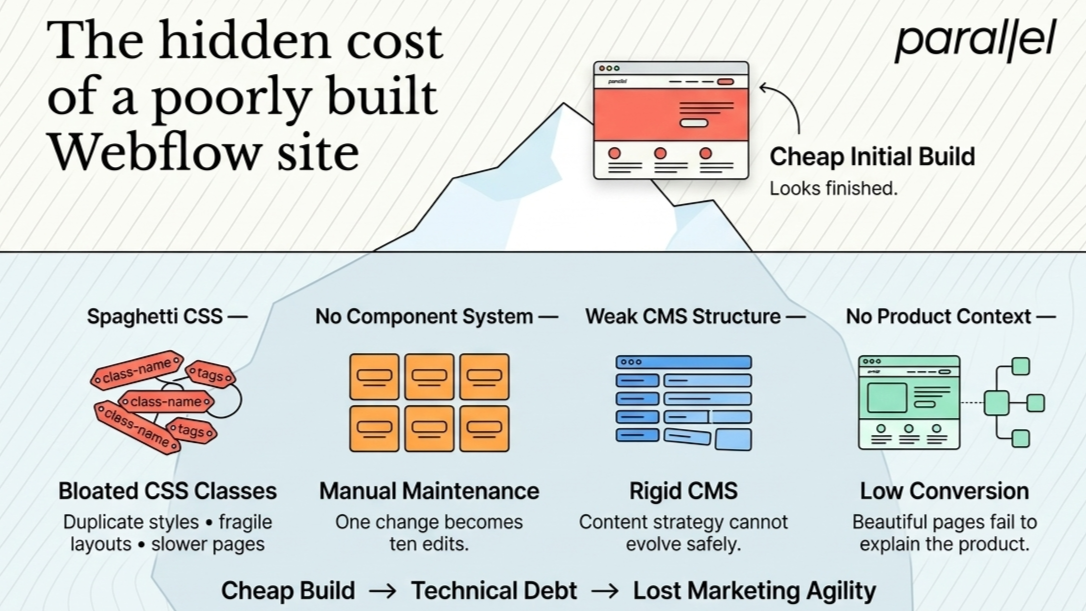
If you do not know what to look for, these issues will remain hidden until you try to scale your marketing efforts.
Spaghetti CSS classes and bloated code
Webflow writes clean code, but only if the developer uses clean logic. Without a strict naming convention like Client-First or Lumos, developers will create entirely new CSS classes for every minor visual tweak. You end up with a stylesheet filled with classes named "Button Blue New Final 2" or "Hero Text Mobile Adjust".
This bloats your site code and ruins your page load speed. More importantly, it makes it impossible for another developer to safely edit the site later. A change to one class might unexpectedly break a layout on five different pages. We spend a significant amount of our time conducting UX audits just to untangle these messy foundations for growing startups.
Ignoring scalable component architecture
Webflow allows you to build reusable symbols known as components. If an agency does not systemize your primary buttons, navigation menus, and footers, your team will have to manually update every single page when you want to change a simple link.
IDEO’s 2026 systems design framework demonstrates that utilizing scalable component systems reduces digital maintenance overhead by up to 50%. A cheap agency hardcodes everything to save time today, completely destroying your efficiency tomorrow. You need a partner who builds modular, Lego-like blocks that your team can confidently drag and drop.
Poor relational CMS planning
A robust Webflow CMS should be the engine that powers your blog, your customer case studies, and your programmatic SEO pages. Building a good CMS requires an understanding of relational databases.
If the agency simply creates basic text fields without strategic foresight, they will build a rigid structure. When your content strategy inevitably evolves, that rigid CMS will break. You will eventually have to pay a premium to have a senior developer tear the entire structure down and rebuild it from scratch.
A complete lack of product context
A website built without deep product strategy is just a digital poster. It might look nice, but it will not convert. If the agency does not take the time to understand your users, they cannot structure your information architecture correctly.
We see this constantly with complex AI and SaaS products. The founders understand the technical nuance, but the agency only understands surface-level marketing jargon. The result is a website filled with vague promises. Your bounce rates will skyrocket because users simply cannot figure out what your software actually does.
How did we evaluate the top agencies on this list?
The agencies that actually stand out in 2026 are not just moving pixels around on a screen. They think deeply about product marketing, content architecture, and long-term technical scalability.
We looked for teams that fundamentally understand how a website impacts the broader business objectives. We evaluated these agencies strictly based on three core pillars.
- Strategic product clarity: Do they know how to explain complex concepts simply? A top-tier agency will challenge your assumptions and help you refine your core messaging long before they ever open the Webflow designer.
- Technical architecture and scalability: Do they mandate standard naming conventions? A well-structured site empowers your internal team. A poorly structured site holds your marketing team hostage.
- Performance and strict accessibility: Do they prioritize site speed and adhere to WCAG accessibility guidelines? McKinsey's 2026 Design Index clearly highlights that companies prioritizing structural UX and accessibility outpace their competitors in revenue growth.
Who are the top 10 agencies operating in 2026?
Here is the detailed breakdown of the best teams operating today. We have categorized them based on their specific strengths so you can find the exact right fit for your current growth stage.
1) ParallelHQ
We built ParallelHQ because we saw a massive, recurring gap between product teams and marketing teams. Founders were building incredibly powerful software but struggling to explain its value on their websites. When we operate as a webflow web design agency, we focus entirely on product clarity and strategic foundations first.
We do not believe in fluff, dark patterns, or chasing fleeting design trends. We believe in user research and designing interfaces grounded in real human behavior.
Our approach always starts with an intensive opportunity mapping phase. We figure out exactly what your users need to hear to trust you. Only then do we design a modular Webflow system that your internal team can actually use to scale.
- Core Focus: B2B SaaS, AI-native products, fintech, and complex tech platforms.
- Our Approach: Deep product thinking combined with rigorous, scalable Webflow architecture.
- Best for: Founders and product leaders who need a strategic thought partner to clarify their product vision, not just a vendor to execute a standard mockup.
- Learn more: Explore our Webflow design and development services to see our methodology in action.
2) Finsweet
Finsweet completely changed how the professional world builds in Webflow. They are the creators of the Client-First naming convention. This system is now the undisputed industry standard for organizing CSS classes in a logical, scalable way.
They are highly technical problem solvers. If you need a highly technical webflow web design agency, Finsweet is a fantastic choice. They treat Webflow development exactly like traditional software engineering. If your project requires complex API integrations, custom JavaScript web components, or massive CMS structures with advanced filtering, they have the engineering talent to execute it flawlessly.
- Core Focus: Enterprise Webflow development and advanced technical solutions.
- Their Approach: Highly structured, developer-focused, and strictly systematic.
- Best for: Large marketing teams that require a bulletproof, highly technical foundation capable of handling enterprise traffic.
3) Relume
Relume is famous across the industry for building the ultimate Webflow component library. They have meticulously mapped out nearly every standard section a modern marketing website could possibly need.
Their agency arm leverages this proprietary library to build functional sites incredibly fast. If speed to market is your absolute top priority and you are perfectly comfortable utilizing proven, standardized layout patterns, Relume delivers unmatched velocity. They remove the friction from the wireframing phase entirely.
- Core Focus: Rapid deployment and component-based functional design.
- Their Approach: Utilitarian, incredibly fast, and highly structured.
- Best for: Early-stage startups that just closed a seed round and need a clean, professional site launched next week.
4) Edgar Allan
Edgar Allan approaches Webflow development from a deep brand and storytelling perspective. They excel at massive, enterprise-level projects where complex content architecture is the primary challenge.
If you are a large organization migrating hundreds of legacy pages, they have the strategic muscle to handle that volume. If you need an enterprise-tier webflow web design agency for a global rollout, they are an excellent choice. They build sites that prioritize editorial workflows, making them perfect for teams that publish high volumes of content daily.
- Core Focus: Enterprise content strategy and overarching brand narrative.
- Their Approach: Content-first design with a heavy emphasis on seamless editorial workflows.
- Best for: Media companies and large B2B enterprises managing massive, complex content libraries.
5) Refokus
Refokus is the agency you hire when you want your website to win international design awards. They consistently push the absolute boundaries of what is technically possible inside a web browser.
They specialize in WebGL, complex scroll interactions, and highly immersive digital experiences. While this heavy, animated approach is not right for a standard B2B SaaS utility product, it is incredibly effective for specific niches. If you are selling high-end consumer hardware, creative software tools, or web3 infrastructure, their work creates an unforgettable first impression.
- Core Focus: High-end visual development and deeply interactive digital experiences.
- Their Approach: Highly creative, animation-heavy, and experimental.
- Best for: Brands that need to make a massive visual impact and differentiate themselves through complex interaction design.
6) Brix Agency
Brix Agency is widely known for creating some of the most popular, premium Webflow templates on the market. Their agency side operates efficiently by taking these established design patterns and heavily customizing them for SaaS companies.
They understand basic software marketing exceptionally well. They consistently build clean, conversion-optimized layouts that feel instantly familiar to tech audiences. They will not reinvent the wheel, but they will ensure your wheels roll smoothly.
- Core Focus: Clean SaaS layouts and template-driven production efficiency.
- Their Approach: Practical, clean UI based strictly on proven conversion patterns.
- Best for: Early-stage SaaS startups that need a high-quality, professional baseline quickly and affordably.
7) Flowout
Flowout successfully popularized the subscription model for Webflow development. Instead of paying massive, unpredictable project fees, you pay a flat monthly rate for continuous design and development support.
This specific model is brilliant for aggressive marketing teams that run high-tempo growth experiments. If your team needs new landing pages built every single week to support different paid campaigns, Flowout acts as a reliable, integrated extension of your own team. They remove the bottleneck of standard agency quoting and contract negotiations.
- Core Focus: Subscription-based Webflow tasks and continuous, rapid iteration.
- Their Approach: High-velocity output and deeply integrated team support.
- Best for: Growth marketing teams that require constant A/B testing and endless landing page generation.
8) Halo Lab
Halo Lab is fundamentally a UI/UX product design agency that happens to use Webflow as their primary delivery mechanism for marketing sites. They are very strong visually and possess a great eye for modern software aesthetics.
They are a fantastic fit if your marketing site needs to look and feel exactly like your actual product interface. They successfully blur the line between product design and marketing design. This cohesive approach helps build deep trust with highly technical users before they even sign up.
- Core Focus: Visual UI design and modern software aesthetics.
- Their Approach: Design-led development with a strict focus on current UI trends.
- Best for: Software companies that want their marketing site to perfectly mirror their internal app interface.
9) Kota
Kota is a highly creative agency based out of London. They bring a distinct, brand-heavy flavor to all of their Webflow builds.
They are less focused on dense software utility and much more focused on emotional brand identity. If you need a webflow web design agency that prioritizes bold aesthetics, Kota is a strong contender. If you are selling a lifestyle product, a direct-to-consumer app, or a creative agency service, they build vibrant, highly memorable digital experiences.
- Core Focus: Creative branding and emotional consumer identity.
- Their Approach: Bold typography, strong art direction, and highly unique layouts.
- Best for: Consumer brands and creative agencies wanting a truly distinct, vibrant digital presence.
10) EIGHT25MEDIA
EIGHT25MEDIA approaches web design strictly through the rigid lens of B2B lead generation. They care deeply about marketing funnels, complex CRM integrations, and strict conversion rate optimization.
Their sites might not win experimental visual design awards, but they are engineered from the ground up to capture highly qualified leads. They are the ideal webflow web design agency for mature B2B companies. They excel at integrating Webflow deeply with Hubspot, Salesforce, Marketo, and other heavy enterprise marketing tools.
- Core Focus: B2B marketing funnels and deep CRM integration.
- Their Approach: Highly data-driven, strictly conversion-focused, and incredibly pragmatic.
- Best for: Mature B2B companies actively looking to optimize a complex sales pipeline.
How should your team manage the site after the agency leaves?
Building the website is only the first phase. The true test of a successful Webflow build is what happens six months after the agency hands over the keys.
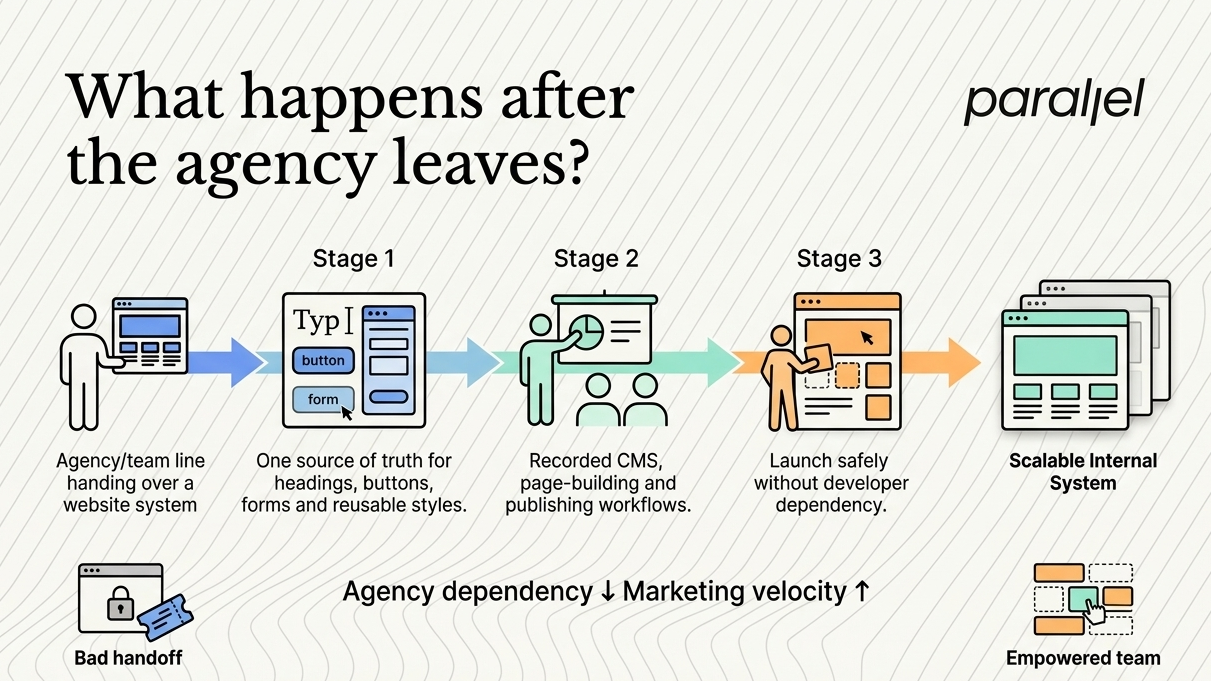
You must treat your new website as a living product. To prevent the site from degrading over time, you need a strict operating model. First, demand a comprehensive style guide page from your agency. This single hidden page should contain every heading style, button variant, and form field used on the site. When your team needs to build a new page, they should duplicate elements directly from this style guide to maintain consistency.
Second, ensure your agency provides recorded training sessions specifically tailored to your marketing team. Your content writers need to know exactly how to use the CMS efficiently. Your growth marketers need to know how to safely duplicate and launch a landing page without altering global layout structures. We regularly provide this type of transition training because we want our clients to outgrow their dependency on us.
A great website empowers your team. A bad website holds them back.
Conclusion
Your marketing website should always make your complex product easier to understand. It should never be a confusing puzzle for your user to solve.
When you sit down to evaluate potential partners, ask them hard technical questions. Ask them about their specific CSS naming conventions. Ask them exactly how they plan to structure your CMS database. Ask them how they define and measure the success of a layout post-launch. If they dodge these questions and only want to talk about clever scroll animations and brand colors, you should politely walk away.
Look for a strategic partner who actively challenges your current thinking. Look for a team that desperately wants to understand your user's specific pain points before they ever draw a single wireframe.
At the end of the day, a highly effective website is just clear, structured thinking made visual. Choose a partner who actively helps you think better.
Frequently Asked Questions (FAQ)
1) What exactly does a webflow web design agency do?
A specialized agency handles the complete, end-to-end creation of your marketing website using the Webflow platform. This comprehensive process includes deep UX research, strategic wireframing, high-fidelity UI design, component system architecture, complex CMS setup, and final code development. They successfully bridge the massive gap between static design files and a live, highly scalable digital product.
2) How much does a top webflow web design agency charge in 2026?
Pricing varies wildly based on structural complexity and strategic depth. A basic template customization from a mid-tier firm might cost anywhere from $10,000 to $15,000. Conversely, a custom, highly strategic build from a top-tier agency typically ranges from $30,000 to $80,000 or more. This higher cost directly reflects the intensive strategic product thinking, user research, and scalable technical architecture required to do the job correctly.
3) How long does a standard Webflow build usually take?
A standard, high-quality B2B SaaS website takes roughly 8 to 12 weeks from the initial kickoff meeting to final public launch. This timeline includes deep strategy sessions, wireframing, high-fidelity design approvals, development, and rigorous QA testing. Artificially rushing this timeline usually results in a poor CMS architecture and messy, unscalable code.
4) Is Webflow right for my early-stage SaaS product?
Yes. Webflow is currently the undisputed industry standard for modern SaaS marketing sites. It empowers your marketing team to control content, publish blogs, and launch landing pages instantly without ever pulling your valuable engineers away from building your core software product. It scales exceptionally well from the Seed stage all the way to Series C and beyond.
5) Webflow vs WordPress: Which is better for startups?
Webflow is generally vastly superior for modern tech startups. It offers significantly cleaner code, better native security by avoiding constant plugin vulnerabilities, and a much stronger visual development interface. WordPress is only preferable if your business requires highly specific, wildly complex database structures that fall completely outside of Webflow's native capabilities. You can read more about our approach to WordPress design and development if you are still unsure.
6) How do you ensure our Webflow site actually scales over time?
True scalability comes from strict CSS naming conventions and modular, component-driven design. We strictly mandate systems like Client-First for all our builds. This methodology ensures that every single CSS class has a predictable, documented function. We also structure your CMS database to easily accommodate future content types, actively preventing the need for a total site rebuild in two years.
7) Should we hire a solo freelancer or a full agency?
You should hire a freelancer if your total budget is under $10,000 and you already possess a perfectly defined product strategy and a complete set of wireframes. You should hire an agency if you need strategic help figuring out your product positioning, require complex CMS architecture, and desperately need a reliable, documented system that multiple internal team members can safely manage long-term.
8) Is ParallelHQ the right webflow web design agency for me?
If you want a highly experimental agency that obsesses over flashy scroll animations and fleeting design trends, we are absolutely not the right fit for you. However, if you want a strategic partner who focuses entirely on product clarity, deep user understanding, and building clean, highly scalable infrastructure, we should talk. We exist to help early-stage startups turn complex, technical software into simple, high-converting digital experiences.

check out these related blogs