I have seen countless teams treat their platform as a dumping ground for plugins and complex themes. This approach always backfires. A website should be a clear extension of your product thinking. When founders look for wordpress website design and development services, they often settle for visual fluff instead of architectural clarity. Your platform needs to load fast, scale predictably, and guide users without friction. We built ParallelHQ because we noticed teams struggling with basic design decisions that should have been grounded in real user behavior. Here is a breakdown of the top partners who actually understand how to build robust digital experiences this year.
Quick Answer/TL;DR
The best wordpress website design and development services focus on custom architecture, user experience, and performance. We evaluated the top providers for 2026 based on their ability to build scalable, business-driven digital products rather than just brochure websites.
What Should You Expect From Premium wordpress website design and development services?
The standard for web experiences has shifted drastically over the last few years. You cannot get away with buying a bloated template and modifying the colors. Users expect your marketing site to feel as fast and responsive as the core product they use every day.
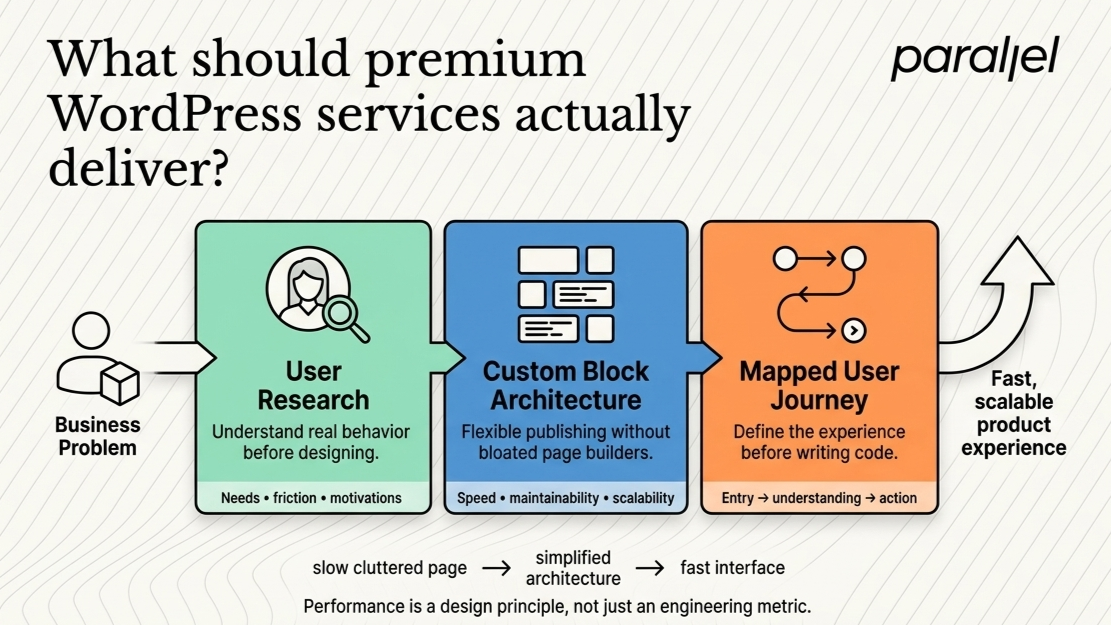
According to 2026 data published by W3Techs, this specific content management system still powers over forty percent of the web. However, the gap between a poorly assembled site and an enterprise-grade build is wider than ever. We tell founders that their website is often the very first product feature a user interacts with. If the site is slow or confusing, the user assumes the actual software will be identical.
To build a high-performing site, you need to expect three things from your agency partner. First, they must prioritize user research. Without qualitative data, you are just guessing what your audience wants. Second, they must understand custom block architecture. The era of visual page builders that slow down page speed is over. Finally, they need to map your entire user journey before writing a single line of code.
The Role of Performance in User Activation
Performance is not just an engineering metric. It is a core design principle. When a page takes longer than two seconds to load, activation rates plummet. This is why we focus heavily on technical architecture during any website redesign. You have to strip away the unnecessary elements and focus purely on what drives value for the user.
Who Provides The Top 10 wordpress website design and development services For 2026?
Finding the right partner depends entirely on your current stage, your internal technical debt, and your ultimate business goals. Here is how the top providers stack up based on our industry observations.
1) ParallelHQ
At ParallelHQ, we do not just build websites. We partner with founders and product leaders to bring absolute clarity to their digital presence. We have spent years working with early-stage startups and massive enterprises to solve problems like weak onboarding and overcomplicated user experiences.
Our approach is rooted in product thinking. We start by auditing your existing user behavior. We look for friction points where potential customers drop off. From there, we build out a scalable design system that ensures your marketing site and your core product speak the exact same visual language. We rely on clean, custom block themes that give your marketing team the flexibility to build pages without breaking the underlying design rules. We believe that clarity always wins over cleverness.
2) 10up
10up is a massive player in the enterprise space. They focus heavily on content creators and high-traffic publishers. If you are running a news organization or a media brand that pushes hundreds of articles a day, they have the infrastructure to support you.
Their team excels at editorial workflows. They understand how journalists and editors interact with the backend of a site. They build customized publishing tools that streamline the editorial process. However, their services are geared almost exclusively toward enterprise budgets. If you are an early-stage startup looking for rapid iteration, their processes might feel too heavy.
3) Human Made
Human Made has carved out a specific niche in headless architecture. They decouple the backend content management from the frontend presentation layer. This allows brands to use React or Vue for the frontend while keeping the familiar backend interface for their marketing teams.
This approach is highly technical and requires a mature internal engineering team to maintain over time. We often see large global brands use Human Made when they need to push content to multiple channels simultaneously, such as a website, a mobile app, and digital kiosks. They are phenomenal engineers, but this architecture is overkill for ninety percent of startups.
4) XWP
XWP is known for performance engineering. They often collaborate directly with Google to push the boundaries of what the core software can do regarding Core Web Vitals. If you have a legacy site that takes ten seconds to load and is severely penalizing your search engine rankings, XWP is equipped to rebuild it from the ground up.
They take a deeply analytical approach to page speed. They audit every script, every font file, and every database query. Their work is highly specialized. Similar to 10up, their typical client is a massive publisher or a global tech company with complex legacy infrastructure.
5) WebDevStudios
WebDevStudios provides solid, reliable custom builds for mid-market B2B companies. They have been in the ecosystem for a long time and have contributed heavily to open-source tools. They are a safe choice if you need a standard corporate website built correctly without relying on bloated off-the-shelf themes.
Their process is highly structured. They follow strict coding standards and ensure that everything they build is accessible and secure. They are less focused on high-level product strategy and more focused on executing a defined technical brief. If you already have your UX perfectly mapped out and just need a reliable development partner, they execute well.
6) Crowd Favorite
Crowd Favorite positions themselves as a digital support partner for complex platforms. They work with companies that have highly integrated ecosystems. For example, if your site needs to connect with a custom CRM, an external inventory management system, and a bespoke learning management system, they can untangle that web.
They focus on digital transformation. They help traditional businesses move their operations online in a secure and scalable way. Their discovery process is lengthy and detailed. They spend a significant amount of time mapping out data architecture before they begin any design work.
7) Multidots
Multidots is the agency of choice for large-scale migrations. We see many companies outgrow platforms like Drupal or legacy proprietary systems. Moving thousands of posts, user accounts, and media files without destroying search engine rankings is a massive undertaking.
Multidots specializes in this exact problem. They have automated tools and rigorous QA processes to ensure data integrity during a migration. Their design work is secondary to their technical migration capabilities. You hire them when you need to move a massive amount of data safely and efficiently.
8) DevriX
DevriX operates on a retainer model geared toward scaling SaaS companies. Instead of doing fixed-bid projects, they embed themselves into your team for ongoing technical improvements. They focus on continuous iteration, releasing small updates every month rather than doing a massive redesign every three years.
This model works well if you do not have an internal web development team but need constant updates to your marketing pages. They focus heavily on conversion rate optimization and technical SEO. They are a functional, data-driven agency.
9) Vipe Studio
Vipe Studio focuses primarily on e-commerce and headless architecture. While Shopify dominates the simple e-commerce market, many large B2B companies require the customization that WooCommerce provides. Vipe Studio builds these complex, high-volume stores.
They understand inventory syncing, complex tax calculations, and dynamic pricing models. If your product involves a highly customized checkout experience that standard platforms cannot handle, Vipe Studio has the specific expertise required to build it out safely.
10) WDG (Web Development Group)
WDG operates mostly in the non-profit, government, and association space. These organizations have very specific needs regarding accessibility standards and stakeholder management. WDG is excellent at navigating large organizational hierarchies to get projects approved and launched.
Their design approach is deeply rooted in brand strategy. They spend a lot of time on brand positioning, messaging, and visual identity before they start building. They are a traditional digital agency that happens to specialize in this specific content management system.
Where Do Teams Go Wrong With wordpress website design and development services?
In my experience, this is where most product decisions go wrong. Founders treat their website as an IT project rather than a product initiative. They hand it off to a junior developer or an outsourced shop with no context on the user journey. The result is a site that looks fine on the surface but fundamentally fails to convert.
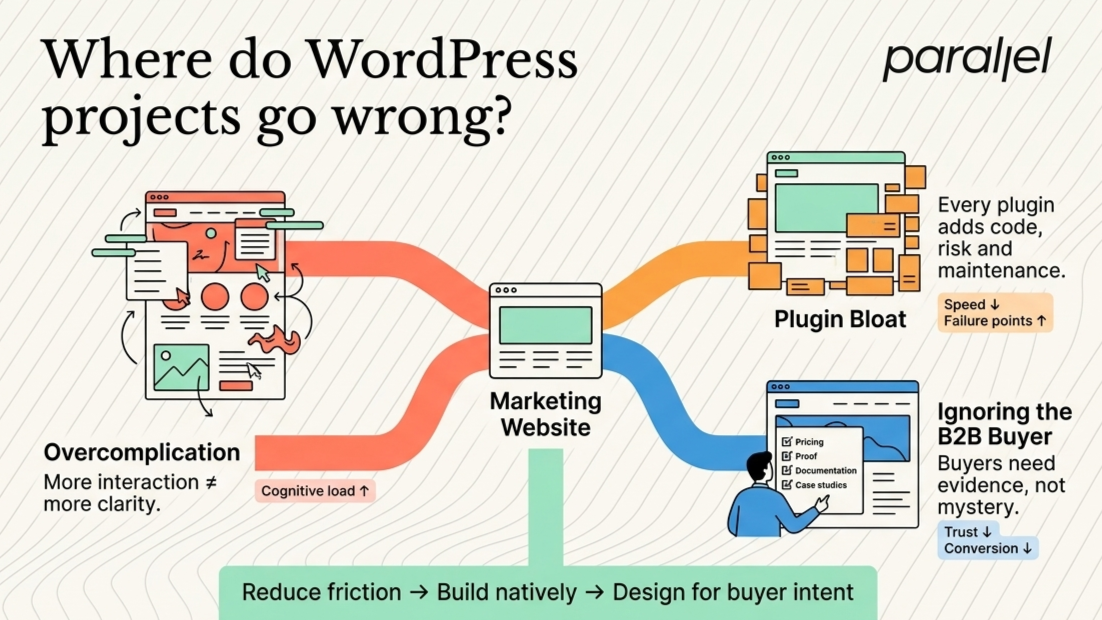
The Trap of Overcomplication
We consistently see teams overcomplicate the user experience. They add heavy animations, complex mega-menus, and scroll-jacking effects because they think it looks modern. According to a 2025 report from the Nielsen Norman Group, complex navigation structures directly correlate with increased user abandonment rates. Users do not want to be entertained by your marketing site. They want to understand what your product does and how much it costs.
When you add friction to this process, you lose them. This is why we regularly perform a UX audit before we write a single line of code. We need to identify exactly where users are getting confused and eliminate those roadblocks entirely.
Relying on Plugin Bloat
Another massive mistake is solving every functional problem with a new third-party plugin. Need a form? Install a plugin. Need SEO optimization? Install a plugin. Need a slider? Install a plugin.
Every single plugin you add introduces a new point of failure. It adds extra code that the browser has to load, and it creates massive security vulnerabilities. We have audited websites for funded startups that were running over fifty active plugins. The site took eight seconds to load. You cannot scale a business on a foundation like that. The right approach is to build functionality natively into the custom theme whenever possible.
Ignoring the B2B Buying Journey
Consumer sites can afford to be highly emotional and visual. B2B software sites cannot. A 2026 study by the Baymard Institute highlights that friction in B2B lead generation forms is the number one cause of marketing budget waste.
Teams go wrong when they design for themselves rather than the buyer. The buyer usually needs to justify this purchase to a committee. They need clear documentation, transparent pricing, and concrete case studies. If your site hides this information behind clever copywriting and vague animations, the buyer will simply go to your competitor. You have to design for clarity and trust.
How Can You Rethink wordpress website design and development services?
To fix these problems, you have to change your underlying philosophy. You must stop thinking of the website as a static brochure and start treating it as a dynamic product. Here is how we approach this methodology.
Start with Product Strategy
Before you look at a single visual layout, you need to define the fundamental strategy. Who is coming to the site? What is their state of mind? What is the one specific action you want them to take?
We use product strategy consulting frameworks to answer these questions. We map out the entire ecosystem. We define the user personas not based on arbitrary demographics, but on real behavioral patterns. We figure out exactly what information the user needs to make a purchasing decision and we strip away everything else.
Embrace Modular Design Systems
Consistency builds trust. If a user clicks a primary button on your homepage and it is blue, and then they click a primary button on your pricing page and it is green, they subconsciously lose trust in your brand. It feels fragmented.
We solve this by building comprehensive modular design systems. We define the typography, spacing, interactive states, and component behaviors in a centralized system. When we build the actual site, we are simply assembling these pre-defined components. This approach ensures total consistency across hundreds of pages. It also means that when your marketing team needs to build a new landing page next year, they have a library of approved blocks they can use without needing a developer.
Focus on Content Hierarchy
Design should never dictate content. Content must dictate design. One of the most common mistakes is designing a beautiful layout with placeholder text, only to realize later that your actual messaging does not fit the design.
We advocate for a content-first approach. We map out the exact messaging hierarchy in a plain text document. We ensure the logical flow of information makes sense. Only when the argument is sound do we start applying visual design to support and elevate that argument. We use UX laws and design principles like Hick's Law to ensure we are not overwhelming the user with too many choices at any given moment.
How Do You Measure The ROI Of Your wordpress website design and development services?
You cannot improve what you do not measure. A beautiful website is useless if it does not drive business outcomes. When you invest in a custom build, you need to hold your agency partner accountable to specific, measurable metrics.
Core Web Vitals and Technical Health
Google has made it explicitly clear in their 2026 Web.dev guidelines that Core Web Vitals are a primary ranking factor. You need to measure Largest Contentful Paint, Interaction to Next Paint, and Cumulative Layout Shift.
A premium build should hit the green metrics across the board on both mobile and desktop. This requires rigorous technical discipline during the development phase. It means optimizing images at the server level, deferring non-critical JavaScript, and ensuring the DOM size remains small. We track these metrics obsessively because they directly impact your organic acquisition costs.
Conversion Rate Optimization
Traffic is meaningless if it does not convert. You need to measure the conversion rate of your primary calls to action. We establish baseline metrics before we begin a redesign. Once the new site launches, we monitor how users interact with the new architecture.
We look at scroll depth, click-through rates on pricing tables, and form completion rates. If a specific page is underperforming, we do not guess why. We run qualitative user tests to watch real people try to use the page, identify the friction, and iterate on the design. This is the difference between an agency that just ships a project and a partner that actually cares about your business outcomes.
Conclusion
Building a robust digital presence is never just about code or visual layouts. It is an exercise in extreme clarity. Every time you add a new page, a new feature, or a new animation, you are taxing the user's cognitive load.
The best teams understand that subtraction is usually more powerful than addition. They ruthlessly prioritize the user journey. They invest in scalable architecture that can grow with their business, rather than temporary patches that will need to be torn down in eighteen months. When you approach your digital presence with this level of rigor, your website stops being a cost center and becomes your most effective product advocate.
Frequently Asked Questions
1) What exactly do wordpress website design and development services cover today?
Today, these services must cover end-to-end product thinking. This includes generative user research, technical SEO auditing, UI/UX design, custom block theme development, and rigorous performance optimization. It is no longer just about installing a theme and filling in the blanks. It is about building a secure, scalable software application that serves as your primary marketing engine.
2) How long does a custom enterprise build typically take?
A true custom build from an established partner takes anywhere from twelve to sixteen weeks. This timeline accounts for deep strategic discovery, wireframing, high-fidelity design, custom development, and extensive quality assurance testing. Attempting to compress this timeline usually results in skipped research and accumulated technical debt.
3) Is headless architecture right for my early-stage startup?
In my experience, absolutely not. Headless architecture solves specific problems for global enterprises managing omnichannel content distribution. For a startup, it introduces massive overhead, complicates publishing workflows for your marketing team, and requires dedicated engineering resources just to maintain basic functionality. Stick to a well-built, custom monolithic setup.
4) What is the difference between a premium theme and a custom build?
A premium theme is built to appeal to the widest possible audience, which means it includes hundreds of features you will never use. This bloats the codebase and destroys page speed. A custom build is engineered specifically for your exact business requirements. It contains only the code necessary to run your specific features, resulting in a vastly faster and more secure platform.
5) How should we handle transitioning from a legacy CMS?
Migration is a delicate process that requires careful planning. You must start by mapping your existing URL structure to ensure you do not break established SEO equity. Next, you need to clean your database to avoid migrating years of useless data. Finally, a staging environment should be used to test the new architecture rigorously before pushing the live site.
6) How does UX research fit into the web development lifecycle?
Research is the foundation of the entire project. We use qualitative interviews and behavioral analytics to understand how your actual customers try to solve their problems. This data directly informs the site architecture, the copywriting strategy, and the interface design. Skipping research means you are building based on assumptions, which is incredibly risky.
7) Can we integrate our existing CRM with a custom build?
Yes. A properly developed custom site can integrate with almost any major CRM like Salesforce, HubSpot, or Marketo. Instead of using heavy, generic plugins for these integrations, a strong development team will build custom API connections. This ensures data passes cleanly between your site and your sales ecosystem without slowing down the user experience.
8) Why choose ParallelHQ for wordpress website design and development services?
We approach your website exactly like we approach complex software products. We do not do superficial visual makeovers. We partner with founders to deeply understand the business logic, map out clear user journeys, and build robust design systems that scale. We ensure your digital presence is simple, exceptionally fast, and entirely grounded in real user behavior.

check out these related blogs
















































































.avif)