Choosing the wrong platform for your real estate web site design costs you leads before a visitor even scrolls. I've seen early-stage PropTech founders spend months rebuilding on a second platform because the first couldn't handle IDX integration or mobile-first design at scale. This guide cuts through the noise. Whether you're a startup founder, a product leader, or a growing agency, these ten solutions give you a clear, ranked view of what actually works for property search functionality, lead generation forms, and conversion rate optimization in 2026.
TL;DR
- The best real estate web site design solutions balance IDX integration, responsive web design, and strong call-to-action placement.
- Webflow and WordPress lead for customisation; Squarespace and Wix suit lean early-stage teams.
- Custom design (via agencies like ParallelHQ) wins for SaaS PropTech products needing scalable UX architecture.
- Your choice hinges on team size, MLS listing needs, and how fast you need to move.
What Are the Best Real Estate Website Design Solutions in 2026?
The field has matured. The platforms and agencies worth your attention in 2026 each solve a different part of the real estate web site design problem, from raw property search functionality to automated lead nurturing.
Why the top ten? Each solution here has a demonstrable answer to at least three of the five core real estate UX problems: property search functionality, mobile-first design, lead generation forms, real estate CRM integration, and Google Core Web Vitals compliance.
The gap between platforms is increasingly design execution rather than feature parity. Placester and AgentFire both offer native IDX, but their templates follow predictable visual hierarchy patterns that savvy buyers have learned to tune out. Webflow and custom-built solutions let your brand do actual work.
For founders building on top of real estate data (think PropTech SaaS, rental marketplaces, or AI-assisted property matching), a no-code platform will always hit a ceiling. That's the moment to invest in product-level UX design rather than another template swap.
One practical filter: if your roadmap includes interactive floor plans or virtual property tours, eliminate any platform that can't support embedded 3D viewers or iframe integrations without breaking Core Web Vitals scores.
Real Estate Website Design Platforms Compared for Startups
Early-stage startups face a specific tension: move fast on a template, or invest in a foundation that won't need rebuilding at Series A. Here's how the main options stack up against startup constraints.
Webflow is the strongest middle ground. It gives design teams full visual control, supports responsive web design natively, and integrates with IDX providers like iHomeFinder via embed or API. The learning curve is real, but for a startup with even one technical designer, it's worth it.
WordPress with RealHomes or Houzez themes remains the most IDX-complete solution for budget-conscious teams. The plugin ecosystem is vast, RETS and RESO API connections are well-documented, and you can stand up MLS listings in days. The trade-off is maintenance overhead and a heavier Google Core Web Vitals footprint if you're not careful with plugin load.
Squarespace is often chosen for aesthetics but consistently underdelivers on property search functionality. It works if your core conversion mechanism is a contact form, not a live search experience.
Wix has improved meaningfully. Its App Market now includes IDX providers, and its editor is genuinely fast for lean builds. For a founder validating a real estate concept pre-seed, Wix is a legitimate starting point, not a compromise.
The startup-specific question is really about how to build your product strategy around your design platform rather than retrofitting later.
Startups that begin with a custom design system instead of a theme are significantly better positioned to maintain design consistency as their product scales, because the system grows with the product rather than against it.
For PropTech founders specifically, the platform decision should follow the data model. If your listings come from a single MLS feed, WordPress handles it well. If you're aggregating from multiple sources or building proprietary search logic, you need a custom front end.
How to Design a Real Estate Website That Converts Leads
Conversion rate optimization in real estate web site design comes down to five structural decisions made before a single pixel is placed.
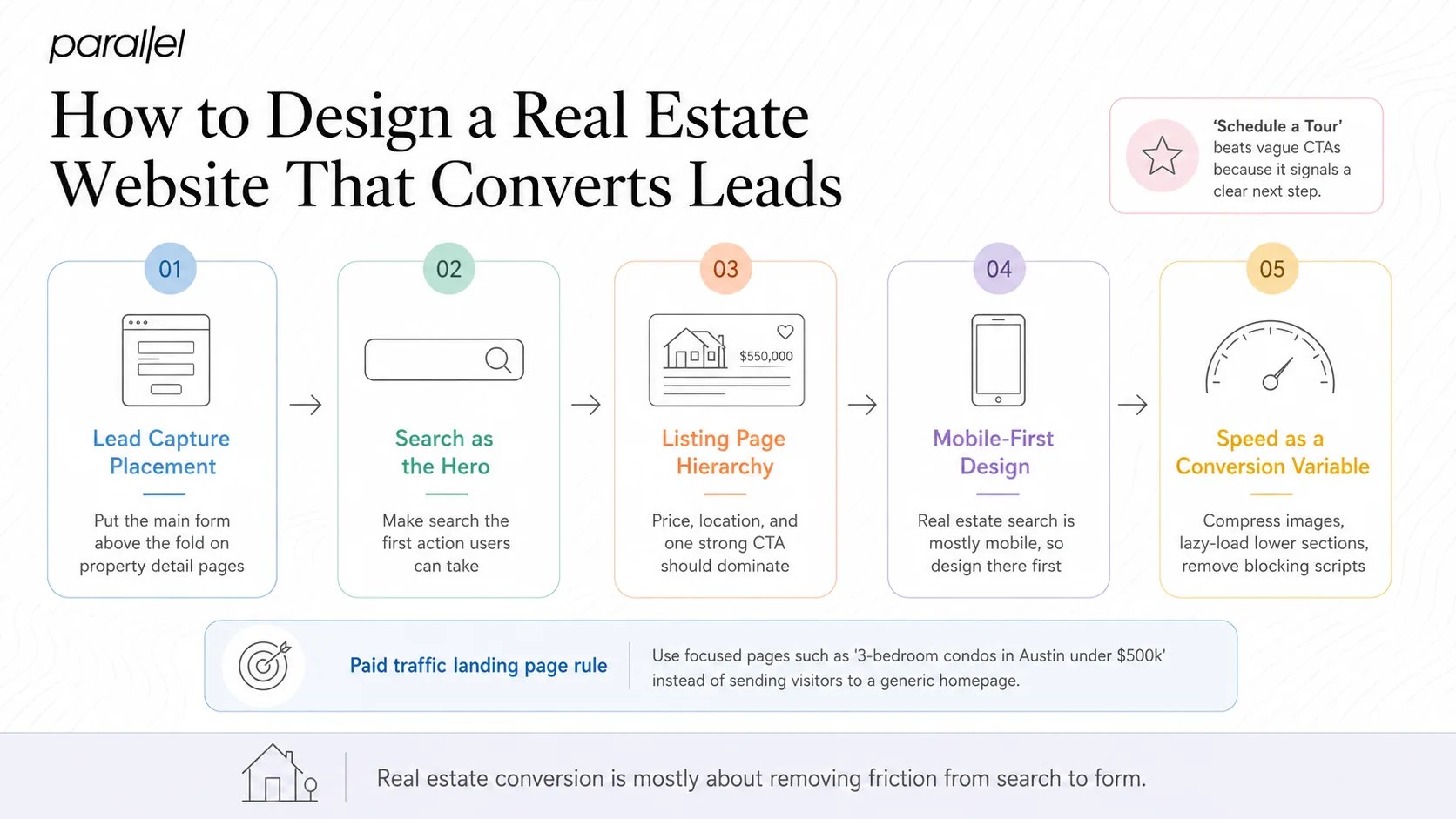
- Lead capture placement: Put your primary lead generation form above the fold on every property detail page, not just the homepage. Visitors arriving via search are already in decision mode.
- Search as the hero: Property search functionality should be the first interactive element a user sees. Zillow and Realtor.com both anchor their homepages on search, and there's a reason for that.
- Visual hierarchy on listing pages: Price, location, and a single CTA should dominate the visual hierarchy. Secondary information (agent bio, similar listings) lives below the fold.
- Mobile-first design from day one: Real estate search is predominantly mobile. Any design decision that degrades the mobile experience, including sticky sidebars, heavy image carousels, and modal overlays, kills conversion.
- Speed as a conversion variable: Google Core Web Vitals directly affect both ranking and bounce rate. Compress listing images, lazy-load below-the-fold content, and eliminate render-blocking scripts.
For landing page optimization on paid campaigns, the highest-converting real estate pages use a single property type focus (e.g., "3-bedroom condos in Austin under $500k") rather than generic homepage traffic. This is basic funnel architecture applied to property marketing.
Call-to-action placement matters more than CTA copy in real estate. "Schedule a Tour" outperforms "Contact Us" not because of the words, but because it implies a specific next step. Pair that with a real estate CRM integration (HubSpot, Follow Up Boss, or LionDesk) so every form submission triggers an automated follow-up sequence within minutes.
UX writing best practices apply here too: every form label, button, and error message is a micro-conversion opportunity.
What Makes a High-Converting Real Estate Website Design?
The anatomy of a high-converting real estate web site design is more specific than most founders expect. It's not about beautiful photography (though that helps). It's about removing friction from the path between "I'm interested" and "I've submitted my information."
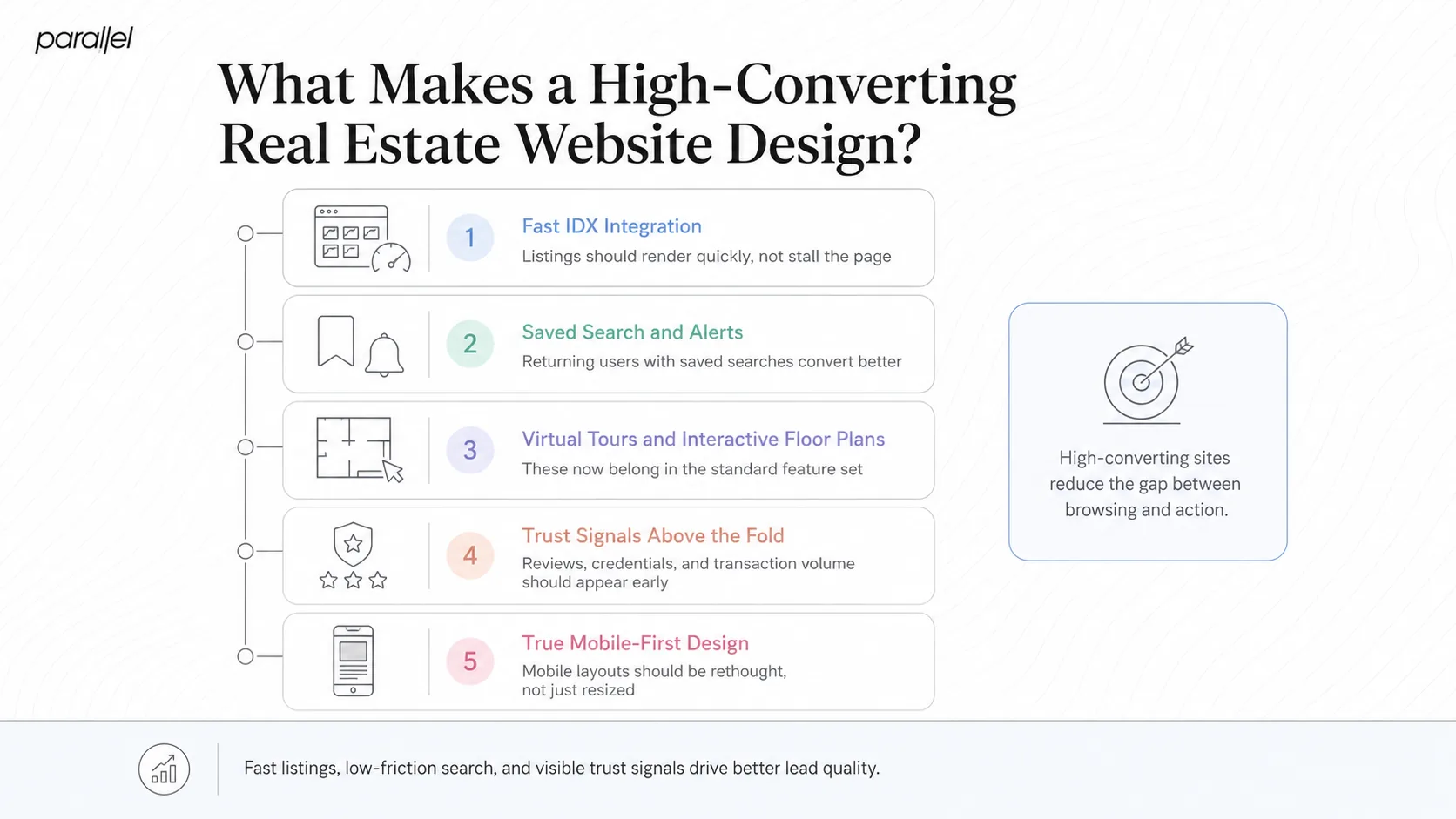
The five non-negotiable elements:
- IDX integration that loads fast: If MLS listings take more than two seconds to render, users leave. Use a server-side IDX solution over JavaScript-heavy client-side rendering where possible.
- Saved search and alert functionality: Returning users who save searches have dramatically higher conversion rates than anonymous visitors. This feature also feeds your real estate CRM with intent data.
- Virtual property tours and interactive floor plans: These are no longer premium features. They're table stakes for any listing above median market price, and they meaningfully reduce unqualified viewings.
- Trust signals above the fold: Reviews, transaction volume, and agent credentials should appear on the homepage, not buried in an "About" page.
- Responsive web design that doesn't just resize: A genuine mobile-first design rethinks the navigation, form length, and image strategy for a 390px viewport, not just scales down a desktop layout.
How to increase user engagement on your website covers the behavioural side of this in more depth, but the structural principle is the same: reduce the number of decisions a user has to make to get to value.
The sites worth studying from a design perspective include the best real estate website designs catalogued by Colorlib, which show how top performers handle listing grids, filter UX, and neighbourhood content.
Best Real Estate SaaS Website Design Inspiration for Founders
PropTech SaaS products have a distinct design challenge: they need to communicate platform value, not just listings. The homepage isn't a property search; it's a product pitch to a buyer, seller, or agent persona.
The strongest real estate SaaS sites in 2026 share a structure:

- Hero section: Problem statement + single CTA. No carousels.
- Social proof: Named customers or transaction volume. Anonymous testimonials do little.
- Feature demonstration: Show the product, ideally in motion. Static screenshots underperform animated demos for SaaS.
- Integration proof: MLS, CRM, and third-party tool logos. Buyers want to know it fits their stack.
- Pricing or qualification CTA: Don't bury pricing. Even a "starts at" anchor reduces friction.
For founders working on AI-assisted property matching or automated valuation tools, the AI-native design approach is increasingly the right frame. The interface needs to communicate confidence in the model's output without overwhelming users with raw data.
Designing interfaces for AI products is a nuanced skill set, and it's where generic real estate templates fall completely flat. An AI-powered real estate platform that looks like a 2019 property portal is signalling the wrong thing to sophisticated buyers and investors.
The DesignRush gallery of real estate website designs is a useful benchmark for visual direction, particularly for luxury and commercial segments.
How to Choose a Real Estate Website Design Solution at Scale
Scale introduces problems that early-stage teams don't see coming. The right real estate web site design solution for a 50-listing portfolio is not the same as the right solution for a 50,000-listing marketplace.
Decision criteria by stage:
At scale, the questions shift from "what platform?" to "what design system?" A responsive design approach built on reusable components means your engineering and design teams move faster on new features without regressions on existing pages.
The other scale-specific consideration is CRM depth. BoomTown and Sierra Interactive both offer deep real estate CRM integration that lighter platforms can't match. For teams running hundreds of agent relationships with thousands of leads, that integration is worth the higher price point.
Finally, consider the website redesign process before committing to a platform. If you anticipate a major redesign within 18 months (which most scaling startups do), choose a platform where that redesign doesn't also mean a re-platforming.
Conclusion
- The best real estate web site design solution depends entirely on your stage: templates work for MVPs, custom design wins at scale.
- IDX integration, mobile-first design, and Google Core Web Vitals compliance are non-negotiable across every platform.
- PropTech SaaS founders need product-level UX thinking, not real estate templates.
- Conversion optimization is structural: lead form placement, search hierarchy, and CTA specificity matter more than aesthetics.
If you're building a real estate product and want a design that compounds rather than constraints, ParallelHQ works with startups to build exactly that.
Frequently Asked Questions
Q1: What is the best platform for real estate web site design in 2026?
Webflow is the strongest all-round choice for design-led teams. WordPress with RealHomes or Houzez suits budget-conscious agents needing native IDX. PropTech SaaS founders building beyond listings should consider a fully custom design system.
Q2: Do I need IDX integration on my real estate website?
Yes, if you're displaying live MLS listings. IDX integration keeps listings current automatically and is a legal requirement for displaying MLS data in most US markets. Platforms like Placester, AgentFire, and BoomTown include native IDX.
Q3: How does mobile-first design affect real estate lead generation?
Real estate search is predominantly mobile. A mobile-first design reduces friction on the device where most searches begin, directly improving form submission rates and overall conversion rate optimisation. Designing desktop-first and scaling down consistently underperforms.
Q4: What is the difference between IDX and MLS in real estate website design?
MLS is the database of property listings. IDX is the technology that pulls MLS data onto your website in real time. Your real estate website needs IDX integration to legally and technically display live MLS listings to visitors.
Q5: How important are Google Core Web Vitals for a real estate website?
Highly important. Core Web Vitals affect both search rankings and user experience. Heavy listing pages with unoptimised images and slow-loading IDX feeds consistently fail Core Web Vitals thresholds, hurting both SEO and bounce rates.
Q6: When should a real estate startup invest in custom website design instead of a template?
When your product differentiates on user experience rather than listing volume. If your roadmap includes AI-assisted search, virtual property tours, interactive floor plans, or proprietary data visualisation, a template will constrain you within 12 months. Custom design is a foundation, not a luxury.

check out these related blogs




































.avif)