I have spent years working closely with founders and product teams. Often, they build heavy internal processes that only serve to slow them down. They ask what is agile methodology, hoping for a magic solution to their delivery problems. But agility is not about Jira tickets or rigid two-week sprints. It is about shipping value, learning from real user behavior, and iterating fast. If your team spends more time managing a backlog than talking to customers, your process is fundamentally broken. Let us fix that.
Quick Answer
Quick answer: If you are wondering what agile methodology is, it is an iterative approach to software development. It prioritizes cross-functional collaboration, frequent customer feedback, and small releases over rigid planning and massive, delayed product launches.
Why does understanding what agile methodology matters for modern product teams?
Many leaders misunderstand this concept completely. They adopt the modern terminology but keep their legacy waterfall habits. I see early-stage startups bogged down by daily standups that feel like interrogations. They miss the entire point of being adaptable.
The landscape for building software has shifted dramatically. In 2026, capital is heavily focused on efficiency and clear unit economics. You simply cannot afford to spend six months building a feature nobody actually wants.
According to the 2025 State of Product report by Pendo, 68% of new features built by SaaS companies are rarely or never used. That is a massive waste of design and engineering resources. The gap lies entirely in execution.
Teams get stuck in a loop of shipping for the sake of shipping. They go through the motions without embracing the mindset required to pivot when necessary. When we help teams with product strategy consulting, we often find their internal processes actually prevent them from talking to users.
The true goal of any product team is to learn faster than the competition. Iterative development is the mechanism that allows you to do that. It is about reducing business risk by putting working software in front of real people as quickly as possible.
Where do founders go wrong when defining what is agile methodology?
The most common mistake I observe is overcomplication. Teams layer on complex frameworks without understanding their underlying purpose. This creates a bloated product experience and a deeply frustrated team.
I remember a recent fintech client who insisted on a six-week discovery and documentation phase before a single line of code was written. They thought this rigorous planning was necessary to avoid mistakes. In reality, it was just a waterfall process dressed up in modern terminology.
Another pattern we see is the feature factory mentality. Teams measure their success by how many story points they burn down in a sprint. They forget to measure whether those points actually moved the needle for the business. You can read more about tracking the right outcomes in our guide to SaaS metrics.
Research from the Nielsen Norman Group consistently highlights that user experience debt accumulates rapidly when teams rush development without proper discovery. Speed should not mean skipping research. It means doing research continuously and in smaller chunks.
Stop guessing what your users want. Build just enough to test your riskiest assumption. If you are not somewhat embarrassed by your first release, you probably launched too late.
How should leaders reframe what is agile methodology in 2026?
Agility requires immense clarity in thinking. It is not an excuse for sloppy design, poor architecture, or a lack of documentation. It is a highly structured way to handle uncertainty in product development.
To make this work, you must integrate your design and engineering efforts. We call this dual-track development. While engineers build the current sprint, designers and product managers validate the concepts for the next one. This ensures the engineering team always has validated, high-confidence work ready to go.
A 2026 study by McKinsey & Company on software excellence found that companies tightly integrating continuous user research into their delivery cycles see a 30% higher customer retention rate. This is because they fix usability issues before they become entrenched in the core product.
If you want to see how this impacts a live product, consider running a UX audit. We regularly identify critical usability roadblocks that teams can fix in their very next development cycle. Small tweaks often yield massive conversion improvements.
What are the core principles of product agility for early-stage startups?

Founders often get lost in the academic definitions of software frameworks. At ParallelHQ, we strip away the theory and focus on what actually works for fast-moving teams. The principles below are non-negotiable if you want to build a product that users love.
- Individuals and interactions over processes and tools. Your team needs to talk to each other. A quick five-minute call resolves issues faster than a long thread of comments on a design file.
- Working software over comprehensive documentation. Users do not care about your internal wikis. They care about whether the button works. Focus your energy on shipping a functional product.
- Customer collaboration over contract negotiation. Treat your early users as design partners. Bring them into the process early. Use user research to validate every major decision.
- Responding to change over following a plan. Your roadmap is a guess. When user data contradicts your plan, you must have the courage to change the plan immediately.
We have seen startups fail because they stubbornly stuck to a roadmap that their users actively hated. You have to remain humble enough to let the market dictate your direction.
How does dual-track iterative development actually work in practice?
The biggest complaint designers have about rapid development cycles is that there is no time to think. They feel pressured to feed the engineering machine. Dual-track development solves this tension perfectly.
It involves running two parallel streams of work. The discovery track focuses on learning what to build. The delivery track focuses on building it efficiently.
Here is how a healthy team structures this process.
- Discovery Track: The product manager and lead designer focus on next month's problems. They conduct interviews, map user journeys, and build rough concepts. They validate these ideas quickly using wireframing and prototyping.
- Delivery Track: The engineering team focuses on this week's sprint. They take the fully validated designs from previous discovery cycles and turn them into production code.
- The Overlap: The designer remains available to the engineering team to answer questions and provide QA for the current sprint.
This approach stops teams from building blindly. It ensures that every feature entering the backlog has already survived contact with a real user. It brings sanity back to the design process.
What are the warning signs that your product team is faking agility?
It is surprisingly easy to spot a team that is faking agility. They hold all the necessary meetings, but they exhibit none of the required flexibility. They use the vocabulary without adopting the mindset.
We evaluate teams constantly when we take over website redesign projects. We look for specific anti-patterns that indicate systemic process issues. If you recognize these symptoms, your process needs an overhaul.
Here is a breakdown of how we spot the theater versus true product thinking.
If your team falls into the "Fake Agility" column, you are wasting money. You are moving fast in the wrong direction.
How can AI tools accelerate your iterative design process?
The introduction of AI has fundamentally changed how fast teams can move through discovery and delivery. In 2026, teams that leverage AI correctly are outpacing their competitors by wide margins.
You should not use AI to replace critical thinking. You should use it to eliminate repetitive tasks. This frees up your human talent to focus on complex user psychology and product strategy.
For example, we use AI-driven tools to rapidly synthesize user interview transcripts. What used to take a designer three days can now be done in an hour. This allows us to inject qualitative data into weekly sprints without slowing down the timeline.
Furthermore, generative UI tools help us establish foundational layouts instantly. If you are building an enterprise platform, you can accelerate your baseline work significantly. You can explore our approach to this in our AI software design services offerings.
What are the practical steps to implement what is agile methodology correctly?
You do not need an expensive certification to build software effectively. You need discipline and a relentless focus on real user needs. Here is how we guide startup teams to simplify their approach and ship better products.
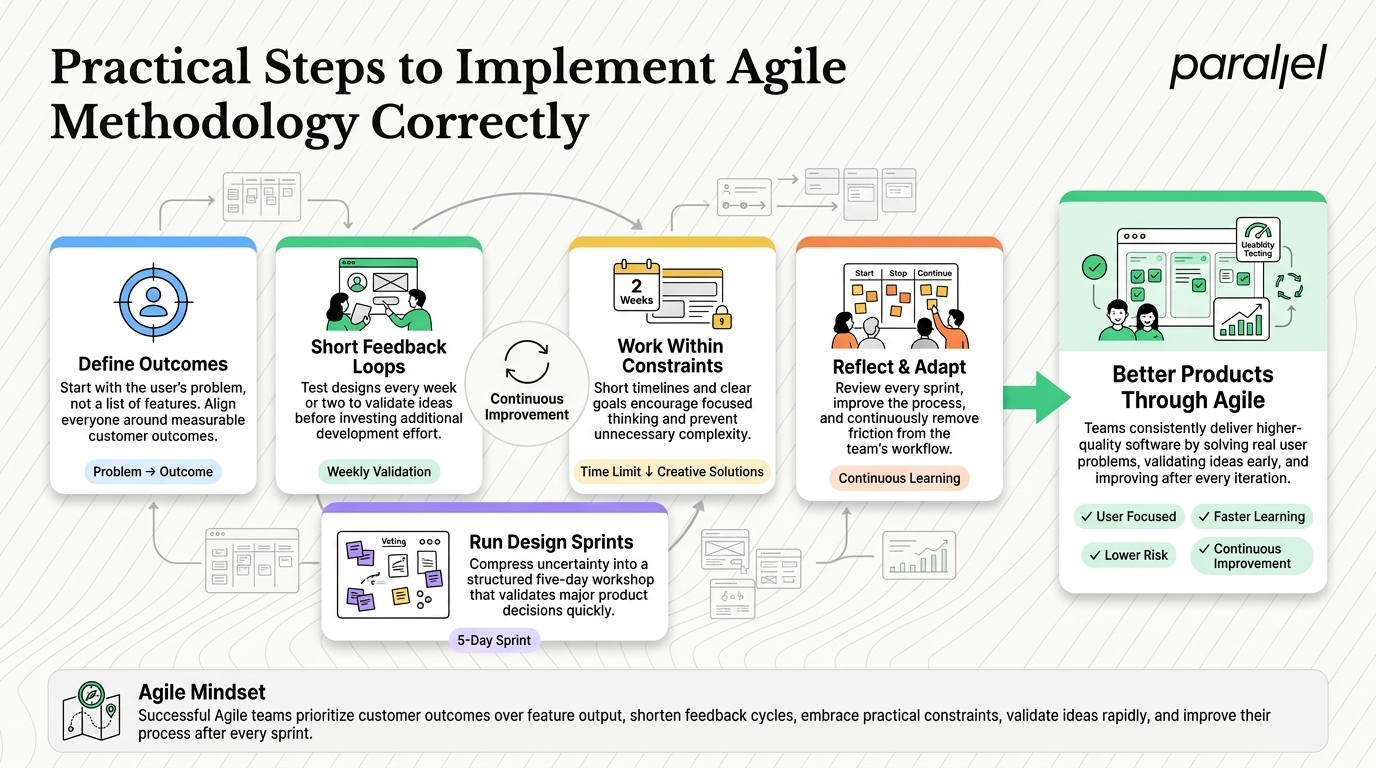
- Define clear outcomes over outputs. Do not hand your engineering team a list of features to build. Give them a specific user problem to solve. Use tools like opportunity mapping to align everyone on the biggest pain points.
- Shorten your feedback loops. If you wait a month to show new work to a user, you are moving far too slowly. We recommend running usability testing weekly or bi-weekly. This ensures you do not waste engineering cycles on confusing interfaces.
- Embrace strict constraints. Give a team two weeks and a clear goal, and they will find a creative, simple solution. Give them six months, and they will over-engineer a complex monster. Constraints breed creativity.
- Run intensive workshops. When facing massive uncertainty, do not guess. We rely heavily on design sprints to validate big ideas in just five days. It compresses months of debate into a single week.
- Reflect and adapt relentlessly. The retrospective is the most critical meeting on your calendar. If you are not actively changing your internal process based on what is failing, you are missing the point entirely.
How do you balance speed with maintaining a high-quality user experience?
One of the biggest fears founders have is that moving fast will ruin their product quality. They worry that iterative cycles will result in a fragmented, messy interface. This is a valid concern, but it is entirely preventable.
The secret to moving fast without breaking your UX is a robust foundation. You cannot rethink your entire visual language every sprint. You need standardized components.
Investing in design systems early pays massive dividends later. A strong system acts as a single source of truth. It allows your designers and engineers to assemble new screens rapidly, focusing their energy on solving complex user flows instead of debating pixel padding.
Additionally, you must bake technical and UX debt remediation into your process. Dedicate at least 20% of every development cycle to cleaning up old code and fixing minor UI inconsistencies. If you ignore this debt, your product will eventually become impossible to iterate on.
How does product leadership support an adaptive environment?
Founders and product managers need to step back from micromanaging the backlog. Your job is to manage the product vision and provide context. If you dictate every button placement, you strip your team of their autonomy.
We see this frequently when working on B2B UX design projects. The software is inherently complex. If the leadership team tries to spec out every edge case upfront, the project grinds to a halt.
You have to trust your cross-functional teams to discover the edge cases as they build and test. Provide the strategic guardrails. Define the metrics for success clearly. Then, get out of the way and let the team figure out the best execution path.
True leadership in software development is about creating an environment where it is safe to fail small and learn fast. If your team is terrified of shipping a bug, they will never move at the speed required to win the market.
Conclusion
Good product decisions always come from clarity, not complex frameworks. The tools, software, and processes you use should eventually fade into the background. Your primary focus must always remain on the user and the value you are delivering to them.
If your current setup feels heavy, bureaucratic, or slow, it is time to strip it back to the absolute basics. Start small, talk to your customers honestly, and iterate based on hard evidence. Let the quality and impact of your work speak for itself.
Frequently Asked Questions
1) What is an agile methodology in simple terms?
It is a project management and software development approach that values fast, incremental updates. Instead of planning a massive project for a year, teams break the work into small chunks. They build, test, and improve these chunks continuously based on real feedback.
2) How does it differ from traditional waterfall development?
Waterfall requires sequential phases like planning, designing, building, and testing. You cannot move to the next step until the previous one is entirely finished. The newer approach overlaps these phases. Teams design, build, and test small pieces of the product simultaneously.
3) Is this framework right for my early-stage startup?
Yes. Early-stage startups operate in high-uncertainty environments. You do not know exactly what the market wants yet. An iterative approach allows you to pivot quickly when you discover that your initial assumptions were wrong. It saves both capital and time.
4) What is an agile methodology compared to scrum?
Think of the broader concept as a philosophy or a set of core values. Scrum is a specific, practical framework used to implement that philosophy. Scrum gives you the actual rules, roles like the Scrum Master, and meeting structures like the daily standup.
5) How do you integrate UI and UX design into an iterative workflow?
You must work one step ahead of the engineering team. Designers should be validating concepts and running user tests during the current sprint. This ensures that developers have clear, tested prototypes to build in the very next sprint. It requires tight daily communication.
6) What is the agile methodology best used for?
It is best used for complex software projects where user requirements are expected to change frequently. It is ideal for SaaS platforms, mobile applications, and digital products where continuous improvement and rapid market adaptation are necessary for survival.
7) How do you measure success in an iterative product team?
You measure success strictly by business outcomes and user activation. Do not measure success by how many features were shipped or how many story points were completed. Look at hard metrics like task completion rate, user retention, and time to value.
8) How does ParallelHQ help teams improve their product design?
We partner with startups and product leaders to simplify their user experiences. We cut through the noise of heavy internal processes. By using fast validation frameworks, we help teams make clear, evidence-based design decisions that align perfectly with real user behavior.

check out these related blogs







.webp)