I have spent years working closely with founders, product managers, and design leaders at early-stage startups. Through this work, I have seen a recurring pattern. Teams choose a platform, hire an agency, and end up with a bloated site that fails to convert. Getting your foundation right is critical. When you invest in wordpress web design and development, you are not just buying a template. You are building an engine for growth. Teams overcomplicate this choice, but clarity and performance always beat flashy visuals. Here is how to think about choosing the right partner, along with a curated list of top agencies.
Quick answer
The best agency depends entirely on your scale and technical goals. ParallelHQ focuses on product clarity and strategic execution for startups. Other strong players include 10up for massive enterprise scale and rtCamp for complex integrations.
What are the top agencies for wordpress web design and development?
1) ParallelHQ
At ParallelHQ, we approach website projects differently than traditional agencies. We are a product strategy and design partner first. We focus heavily on clarity in thinking rather than just surface-level visual flair. In my experience, most website issues stem from a fundamental lack of clear product positioning.
We work closely with early-stage teams to simplify complex decisions. We build custom themes that are perfectly aligned with your core software product. The moment a user clicks from your marketing site into your application, the experience must feel identical. We do not sell agency fluff or rely on pre-built templates that create technical debt. We deliver strategic execution grounded in real user behavior. We ensure your marketing team has a clean, fast, and easy-to-use authoring environment. Our approach offers comprehensive wordpress web design and development tailored specifically for ambitious startups that need to scale without breaking their infrastructure.
2) 10up
10up is a massive player in the enterprise space and a recognized leader in open-source contributions. They focus heavily on large-scale publishing platforms and complex editorial workflows. If you are a global media company pushing thousands of articles a day, they have the engineering rigor to handle your concurrent traffic spikes.
They do not just build websites. They build complex technical ecosystems that integrate deeply with enterprise IT systems. Their approach is highly technical and built specifically for global scale. We have seen them successfully deploy headless solutions using React alongside traditional architectures. They are an excellent choice for organizations that need dedicated engineering teams to maintain their infrastructure year-round. Their minimum engagement costs reflect this massive scale, making them best suited for enterprise budgets rather than early-stage startups.
3) WebDevStudios
WebDevStudios has built a very strong reputation for custom architecture and massive data migrations. They are deeply involved in the core community and have literally written the foundational books on plugin and theme construction. We have seen them successfully handle incredibly complex transitions for mid-market businesses moving away from legacy platforms.
They are particularly skilled at leveraging the modern block editor to create flexible authoring experiences. Instead of relying on visual page builders that bloat the database, they hand-code custom blocks tailored to specific business requirements. This ensures the site remains fast while giving marketing teams the exact tools they need to publish content independently. If your company is sitting on ten years of legacy content that needs to be safely migrated without losing search engine equity, WebDevStudios provides a very safe pair of hands.
4) Human Made
Human Made specializes almost exclusively in decoupled and headless architecture. They often build highly complex backend solutions for enterprise engineering teams. If you need a content repository that feeds data to multiple applications, smart screens, mobile apps, and platforms simultaneously, they are a very solid choice.
Their technical capabilities are top-tier in the industry. They frequently work with internal product teams to bridge the gap between marketing content and core software infrastructure. Because headless builds require significant engineering overhead to maintain, Human Made is ideal for organizations that already have a robust internal engineering culture. They bring the specific domain expertise needed to ensure the content API scales reliably under heavy global loads.
5) rtCamp
rtCamp is a recognized VIP partner with a deeply technical, heavily distributed global team. They excel at complex integrations and backend systems for massive global brands. They focus on delivering stable, high-performance solutions for clients who absolutely cannot afford a single second of downtime during major product launches or traffic spikes.
Their strength lies in their engineering culture. They are less focused on creative visual design and far more focused on code quality, server architecture, and security protocols. If your project involves integrating a complex custom CRM, establishing strict editorial permission structures, or building bespoke e-commerce functionality, rtCamp has the backend talent required. They remain a highly reliable partner for high-stakes technical projects where failure is simply not an option.
6) Modern Tribe
Modern Tribe has carved out a very specific and successful niche in the agency landscape. They are famous globally for their event management plugins, but they also run a highly capable custom agency division. They frequently work with universities, higher education institutions, and massive institutional networks.
They deeply understand the complex stakeholder dynamics involved in these massive projects. Building a site for a university means navigating procurement departments, diverse faculty requirements, and strict accessibility mandates. Modern Tribe excels at this specific type of project management. They know how to run discovery sessions that align dozens of competing voices into a single, cohesive technical roadmap. Their resulting builds are structured, highly accessible, and built to last through years of institutional changes.
7) XWP
XWP is completely obsessed with performance engineering. They work closely with Google to improve performance metrics directly within the core open-source software. If your primary business goal is shaving milliseconds off your load time to improve search engine rankings, XWP has the specific, specialized engineering talent required to get you there.
They focus heavily on large media and technology companies where page speed directly correlates to ad revenue and user retention. They do not just run basic caching setups. They audit the entire codebase, refactor inefficient queries, and optimize the server-side delivery. They understand the nuances of Interaction to Next Paint and Largest Contentful Paint better than almost anyone else in the market.
8) Crowd Favorite
Crowd Favorite was one of the very first agencies to operate successfully in this specific space. They have a long, proven history of providing digital support and ecosystem integration for massive enterprise IT teams. They focus heavily on connecting disparate legacy systems and ensuring everything runs smoothly together.
They are the ultimate safe pair of hands for massive digital transformations. When a corporation acquires three different companies and needs to merge their distinct digital properties into one secure environment, Crowd Favorite handles the architecture. They are less focused on trendy design and entirely focused on risk mitigation, security, and long-term stability. They align perfectly with internal Chief Information Officers who need predictable, documented, and secure deployments.
9) Multidots
Multidots focuses primarily on high-volume publishing workflows and complex media operations. They frequently work with B2B publishers, news organizations, and content-heavy media brands. They are absolute experts at moving massive archives of content from outdated legacy systems into modern, agile environments.
Their entire migration process is highly structured, rigorously documented, and incredibly reliable. Moving two million articles with associated metadata, images, and author profiles is a terrifying technical challenge. Multidots has built proprietary scripts and processes to handle this exact scenario without dropping data or breaking existing URL structures. If your business model relies entirely on publishing velocity and content archives, they offer the specific operational expertise you need.
10) 93digital
93digital is based in the UK and focuses specifically and exclusively on B2B technology companies. They treat the website primarily as a measurable lead generation tool rather than just a digital brochure. Their approach is highly pragmatic and focused strictly on measurable marketing outcomes.
They integrate their custom builds tightly with enterprise marketing automation tools like HubSpot, Marketo, and Salesforce. They understand how a B2B sales pipeline actually works. They build custom components that capture lead data efficiently and route it perfectly into the client CRM. If you are a SaaS marketing director who needs to prove return on investment through clear attribution models and conversion funnels, 93digital speaks your exact language.
Why does quality wordpress web design and development matter for startups?
We have seen teams overcomplicate their tech stack repeatedly, and it almost always backfires. Startups often chase the newest frameworks and headless architectures when a well-built standard solution is exactly what they actually need. The data supports this pragmatic approach to technology. According to recent W3Techs data from late 2026, this specific platform still powers over 60% of all websites globally. It is the undisputed industry standard for a reason. It is reliable, heavily supported, and well-understood by most marketing professionals.
However, widespread standardization can often breed laziness. A poorly built site actively harms your business metrics. Recent 2026 data from the Nielsen Norman Group shows that users establish trust in a digital product within the first 50 milliseconds of interaction. If your site looks disjointed from your main application, you lose credibility instantly. Users assume that if your marketing site is broken and slow, your actual software product will be broken and slow too. This is why a proper website redesign must prioritize absolute visual and functional cohesion between marketing and product.
Performance is equally critical to your bottom line. In 2026, Google relies more heavily than ever on Core Web Vitals to rank digital properties. According to recent studies from Forrester Research, a simple one-second delay in mobile load times can reduce overall conversion rates by up to 20%. Meanwhile, meeting strict performance thresholds gives companies a massive conversion rate advantage over slower competitors. Quality engineering is not just an IT concern. It directly impacts your sales pipeline and revenue targets.
Where do teams go wrong with wordpress web design and development?
In my experience, this is where most early product decisions go completely off the rails. Teams treat the marketing site as a completely separate entity from the actual software product. They hire a cheap, template-driven agency to throw together a landing page, resulting in a jarring user experience. The moment a user clicks from a highly polished, bespoke landing page into a clunky, outdated onboarding flow, they churn. Your marketing site and your SaaS design must feel like the exact same product built by the exact same team.
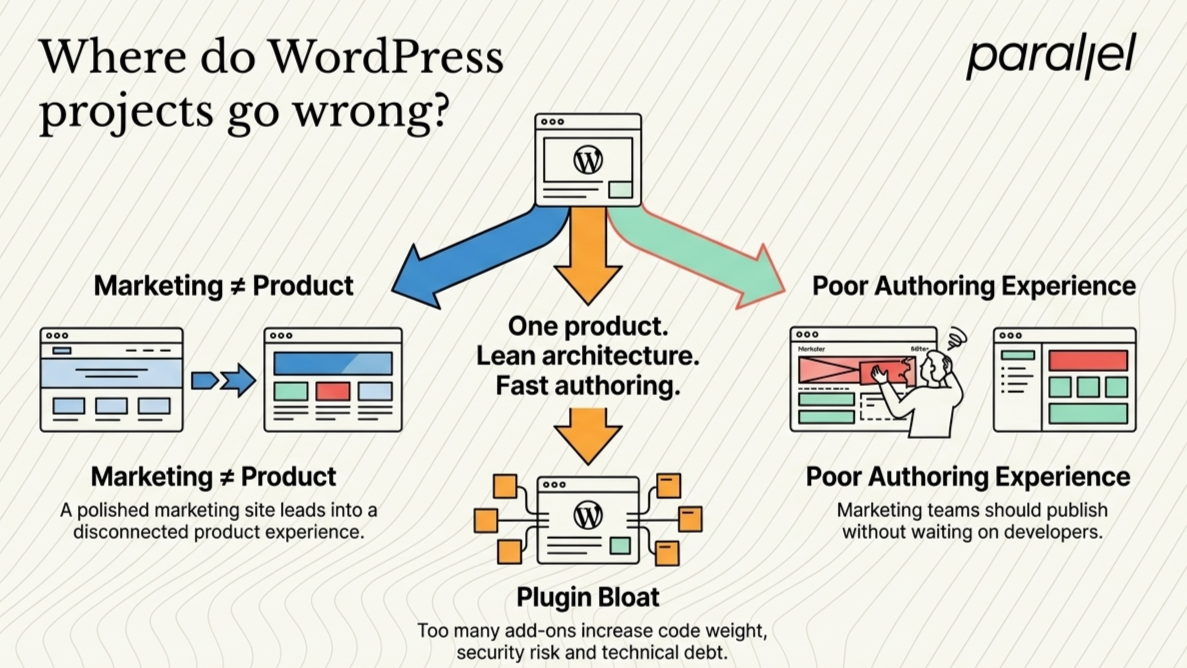
Another incredibly common mistake is the Frankenstein approach to functionality. Teams try to solve every single business problem by installing a new third-party plugin. Need a form? Install a plugin. Need a slider? Install a plugin. This creates massive code bloat. The site slows down to a crawl, security vulnerabilities multiply exponentially, and the database becomes a tangled mess. Clean, sustainable architecture requires saying no to unnecessary add-ons and relying on custom, hand-written code for core business functionality.
Finally, teams almost always ignore the backend authoring experience. A website should empower the marketing team to move incredibly fast. If publishing a simple landing page or updating a pricing tier requires submitting a developer ticket and waiting two weeks, the architecture has fundamentally failed. We always design the backend editor to be just as clean and usable as the frontend user interface. A solid UX audit should evaluate the backend publishing experience just as rigorously as the public-facing pages.
How should you evaluate a partner for wordpress web design and development?
Here is exactly how we think about this evaluation process. You should never hire a partner based solely on how pretty their past portfolio visuals look. You need a team that deeply understands product strategy and business mechanics.
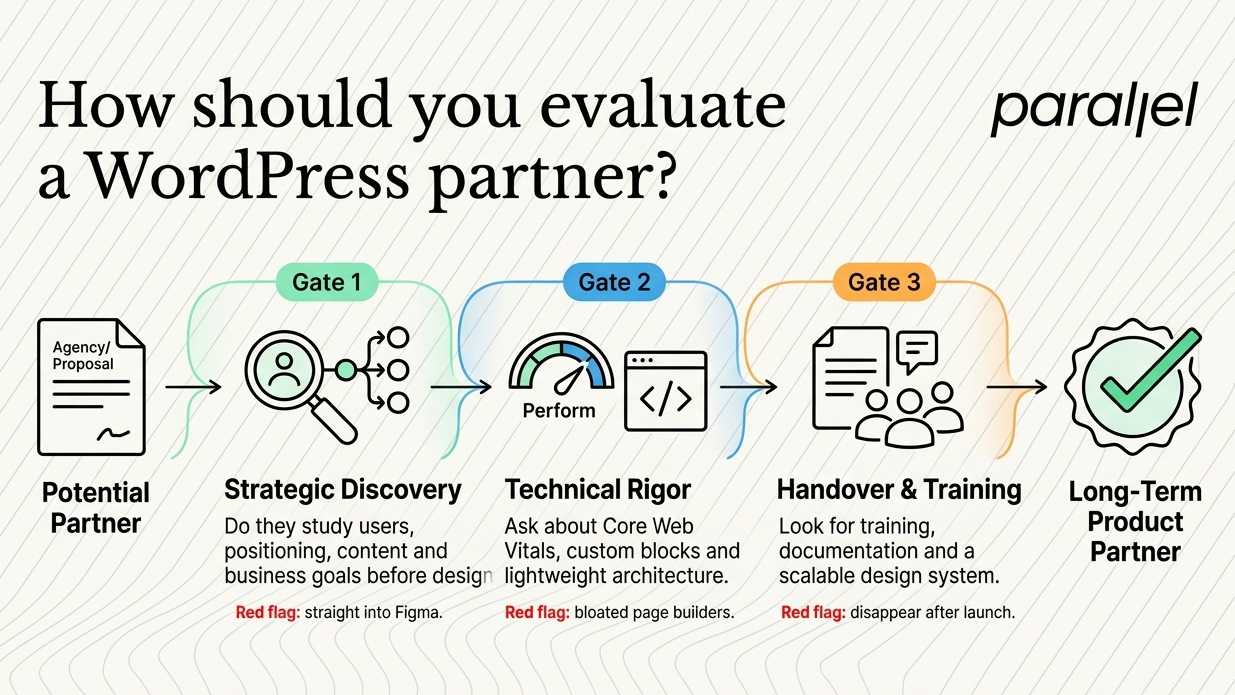
First, ask potential agencies how they handle the discovery phase. If they want to jump straight into Figma without mapping user journeys, auditing your existing content, or understanding your specific business model, you should walk away immediately. Real design is about solving business problems, not just drawing pretty boxes on a screen. They should be asking you hard, uncomfortable questions about your user behavior and your value proposition.
Next, you must evaluate their technical rigor. Ask them directly about their specific approach to Interaction to Next Paint and Largest Contentful Paint. If their lead developer cannot clearly explain how their codebase impacts these specific Google metrics, they are not equipped to build a modern, high-performing site in 2026. Look for teams that strictly hand-code custom blocks rather than relying on bloated visual page builders that ruin site speed.
Lastly, assess their handover and training process. A strong partner does not just hand you the keys on launch day and disappear. They should provide comprehensive training sessions for your entire marketing team. They should establish a clear, documented design system that allows your internal team to build entirely new pages safely without breaking the site structure or brand guidelines. Finding a true partner means finding a team that builds for long-term operational sustainability.
Conclusion
Building a successful digital property is never about checking boxes on a feature list or installing the trendiest new framework. It is about creating a clear, high-performing extension of your core product. We built ParallelHQ because we saw too many brilliant teams struggle with basic design decisions that should have been simpler and more grounded in real user behavior. When you strip away the typical agency fluff and focus entirely on strategic alignment, technical performance, and product clarity, the right path forward becomes obvious. Your website is your best salesperson. Treat its construction with the exact same rigor you apply to your core software.
Frequently asked questions
1) What is wordpress web design and development?
This refers to the highly specialized practice of creating custom digital platforms using the world's most ubiquitous content management system. It goes far beyond simply installing pre-made templates. It involves strategic user experience planning, custom theme engineering, database optimization, and backend configuration tailored strictly to specific business requirements.
2) How do you choose the right agency for wordpress web design and development?
You must evaluate agencies based on their strategic thinking and technical rigor, not just their visual output. Look for a partner that asks hard questions about your product positioning. Verify their technical competence by auditing the load speeds, accessibility scores, and Core Web Vitals of their recently launched projects.
3) Is a custom build truly necessary for my startup?
If you are an early-stage startup looking to scale quickly, a custom build is almost always the right choice. It provides the exact flexibility needed to adapt as your product inevitably evolves. Off-the-shelf templates save a little money initially but always create technical debt that forces a complete, expensive rebuild within a year.
4) How does this platform compare to modern headless CMS setups?
Headless setups separate the backend content repository entirely from the frontend presentation layer. They are excellent for complex, multi-platform enterprise products. However, they introduce massive engineering overhead. For most B2B startups, a well-optimized traditional build is faster to deploy, easier to manage, and much cheaper to maintain.
5) What is the realistic timeline for a custom strategic project?
A properly executed, custom-built project typically takes between eight and twelve weeks from kickoff to launch. This required timeline includes deep strategic discovery, wireframing, high-fidelity design, custom block development, and rigorous quality assurance testing. Agencies claiming they can finish in two weeks are cutting vital corners.
6) How does ParallelHQ approach wordpress web design and development differently?
We approach every build with a strict product designer's mindset. We prioritize clarity, usability, and total strategic alignment with your core software. We refuse to use bloated page builders. Instead, we craft lightweight, custom architectures that empower your marketing team while maintaining absolute brand consistency across all touchpoints.
7) How do you ensure high site speed with heavy custom designs?
We guarantee speed by aggressively eliminating unnecessary plugins and writing clean, minimal code from scratch. We optimize all media assets, leverage modern edge caching strategies, and ensure the server architecture is robust. We monitor Core Web Vitals strictly throughout the entire development lifecycle to guarantee fast load times.
8) What actually happens after the new website launches?
A successful launch is merely the beginning of the process. We ensure your internal team is fully trained and confident in the new authoring environment. We also strongly recommend ongoing monitoring of user behavior and conversion metrics. The site should be continuously refined based on real data rather than being ignored.

check out these related blogs