I have seen dozens of healthtech products fail because founders treat patient trust as a visual design problem. In healthcare, friction is sometimes necessary, and clarity is a matter of safety. When teams ask me how to navigate this, they are usually looking for the best healthtech design agencies for startups. But finding the right partner requires looking beyond generic portfolios. You need a team that understands compliance, data density, and patient cognitive load. Here is how we think about simplifying complex product decisions and choosing the right partner for 2026.
10 Best Healthtech Design Agencies for Startups
The right agency balances clinical safety with user activation. Below is a comparison of top partners based on core focus and startup suitability to help you make an informed decision.
Why healthtech product design is fundamentally different
Designing for healthcare is not like designing a food delivery application. A mistaken click in a standard SaaS tool causes mild annoyance. A misunderstood label in a dosing application causes a medical error.
The stakes require a completely different approach to user experience. When we run a UX audit on early stage health platforms, we consistently find that founders underestimate the cognitive load of their users. Patients are often stressed, distracted, or in pain when using these products. Clinicians are facing severe burnout and alert fatigue.
A 2025 study by the Nielsen Norman Group found that reducing cognitive load in telemedicine interfaces improved patient completion rates by 42%. You cannot simply copy consumer trends and expect them to work in a clinical setting. Your design must prioritize absolute clarity over aesthetic novelty.
We evaluate healthtech design through three distinct lenses:
- Regulatory awareness: The interface must guide users safely within the bounds of HIPAA, GDPR, or FDA guidelines without feeling like a legal document.
- Clinical empathy: The product must accommodate edge cases, accessibility needs, and high stress environments as default states.
- Data density: Medical professionals require high information density, while patients require progressive disclosure to avoid feeling overwhelmed.
Evaluating the best healthtech design agencies for startups
The market is flooded with studios claiming healthcare expertise. We have categorized the top players based on the specific problems they solve best.
1) ParallelHQ
At ParallelHQ, we focus on untangling complex product decisions. Healthtech is fundamentally complex because it involves multiple stakeholders like patients, doctors, and insurers. We help early stage teams build clear, compliant, and highly activated product experiences.
Our approach is grounded in real user behavior and iterative testing. We do not just design screens. We simplify the underlying product logic. We recently helped a digital health platform streamline their patient intake, resulting in a 35% increase in activation.
If you are looking for the best healthtech design agencies for startups that prioritize deep product thinking over superficial UI, we are built for that. We integrate closely with founders to ensure every design decision is technically feasible and clinically safe.
- Core focus: Simplifying complexity and AI native product design.
- Best for: Startups needing healthtech design services backed by strong product strategy.
- Engagement model: Embedded teams and structured design sprints.
2) IDEO
IDEO is a legendary name in the broader design industry. They excel in environments where physical hardware meets digital interfaces. If you are building a novel medical device or a wearable monitor, their human centered design approach is highly effective.
We have observed that startups often hire them for foundational research rather than agile UI delivery. Their process is deeply research heavy and requires significant time investment.
Choose IDEO if you are defining a completely new category of healthcare interaction. If you need a leaner, faster execution model, you might want to look for an IDEO alternative.
3) MetaLab
MetaLab builds beautiful, consumer grade interfaces. They are highly effective for direct to consumer health products, wellness applications, and platforms where aesthetic appeal drives user acquisition.
They bring a distinct visual style that works well for non regulated health spaces. If your startup operates in the fitness, nutrition, or mental wellness space, their polish can help you stand out in a crowded app store.
They are an excellent fit if your primary growth lever is looking more like a consumer tech product than a clinical tool. Startups needing strict B2B clinical compliance might seek a MetaLab alternative focused on deeper workflow architecture.
4) Frog Design
Frog focuses on large scale systemic design. They are adept at mapping out the entire patient journey across physical hospitals, clinics, and digital touchpoints.
Their engagements are usually massive and better suited for enterprise healthcare providers rather than lean startups. They understand how to move large organizations toward digital transformation.
Engage Frog if you need to overhaul an entire hospital system's patient experience. Early stage founders often prefer a Frog Design alternative for faster product iterations.
5) Work & Co
Work & Co operates with a tight focus on digital product development. They prototype quickly and work in highly iterative cycles alongside engineering teams.
They embed closely with technical teams to ensure what is designed can actually be built efficiently. This makes them a strong partner for startups with aggressive engineering timelines.
They are a great option if your startup is heavily engineering led and needs a design partner to match a rapid deployment schedule. Teams needing more upfront strategy might consider a Work & Co alternative.
6) Ramotion
Ramotion combines brand identity with digital product design. In healthtech, establishing a trustworthy brand is half the battle, especially in emerging markets like biotech.
They do a great job aligning the marketing website with the actual product experience. This consistency helps build trust with wary patients and investors alike.
Look to Ramotion if you are building your brand from scratch and need the product interface to reflect that new identity. Founders looking strictly for complex software architecture might explore a Ramotion alternative.
7) Clay
Clay specializes in behavioral design and micro interactions. For health apps that require daily logging, habit tracking, or chronic care management, their focus on behavioral psychology is highly relevant.
They utilize motion and interaction to create a calming, engaging user environment. This is critical when designing for long term patient adherence.
Choose Clay if your product relies on daily active usage and habit formation. If your product is a pure clinical utility tool, a Clay alternative might be more efficient.
8) Instrument
Instrument builds digital brand experiences. They are skilled at storytelling and creating platforms that educate users. In healthtech, educating a patient about a novel treatment is often the biggest hurdle to adoption.
They shine in creating comprehensive digital ecosystems that guide a user from initial awareness to deep product usage. Their work bridges marketing and product seamlessly.
They are ideal for complex treatments or therapeutics that require significant patient education before conversion. Startups focused only on backend clinical tools might want an Instrument alternative.
9) Ustwo
Ustwo has significant experience in digital therapeutics and regulated health products. They understand how to build products that require clinical validation and rigorous testing.
They successfully integrate gamification into health tracking without making it feel trivial. This balance is incredibly difficult to strike in healthcare.
If your product needs FDA approval or involves clinical trials, Ustwo understands the rigors of that environment. Teams building unregulated wellness tools can easily utilize a Ustwo alternative.
10) Neuron
Neuron focuses purely on B2B product design. If you are building EHR software, clinical dashboards, or medical billing platforms, they deeply understand information architecture.
They excel at reducing screen clutter for doctors and nurses who suffer from alert fatigue. They know how to organize complex tabular data efficiently.
If your end user is a clinician rather than a patient, Neuron is highly capable. Startups needing consumer facing aesthetics might prefer a Neuron alternative.
Where teams go wrong with healthtech products
Over the years, we have conducted countless audits for SaaS design services and healthtech platforms. We consistently see smart teams fall into the same three traps.

The seamless fallacy
Founders often assume that consumerizing healthcare means stripping away all friction. They want the onboarding to feel as fast as signing up for a social network. But when dealing with sensitive health data, excessive speed erodes trust.
According to a 2026 digital health report by Rock Health, 55% of patient drop offs in early stage applications stem from a lack of perceived data security during the onboarding flow. Good healthtech design introduces positive friction. It slows the user down intentionally when they need to verify insurance details or consent to data sharing.
Designing for the buyer, not the user
In B2B healthtech, the person buying the software is rarely the person using it. Founders often design dashboards that look incredible in a pitch meeting to hospital administrators. However, these same dashboards fail miserably on the clinic floor.
Clinicians do not need beautiful data visualizations. They need rapid data entry, high contrast text, and keyboard navigation. When you prioritize the buyer's aesthetic preferences over the clinician's workflow reality, adoption plummets.
Ignoring legacy interoperability
Startups love to imagine a world where their software exists in a vacuum. The reality is that your product must live alongside archaic Electronic Health Records and legacy hospital systems.
Recent data from the Healthcare Information and Management Systems Society in 2026 indicates that 68% of new clinical tools fail to achieve adoption due to poor integration into existing hospital routines. If your design does not account for how users will switch between your tool and their legacy systems, the product will be abandoned.
Practical steps for choosing your partner
Finding the best healthtech design agencies for startups requires looking at how they solve problems, not just their final UI outputs. You need a partner who can translate regulatory constraints into usable interfaces.
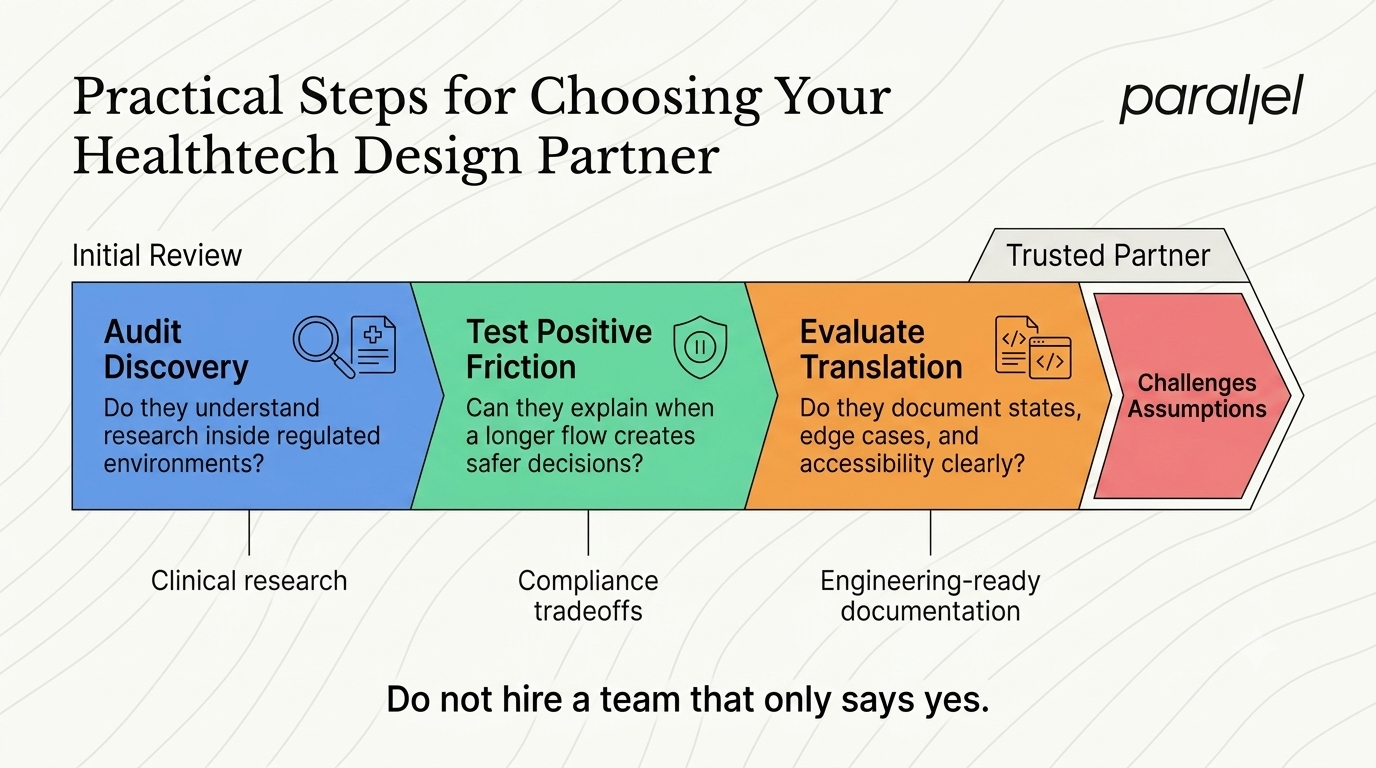
I always tell founders to use this evaluation framework:
- Audit their discovery process: Ask how they conduct user research in regulated environments. If they rely purely on unmoderated online surveys for clinical workflows, they do not understand the industry. They should talk about shadowing, synthetic data, and interviewing subject matter experts.
- Test their knowledge of positive friction: Ask them to walk you through a specific tradeoff they made in a past project between usability and compliance. The right partner will proudly explain why they made a flow longer to ensure patient comprehension.
- Evaluate their technical translation: Healthcare data models are complex. Ask how they hand off designs to engineering. They should have a clear methodology for documenting states, edge cases, and accessibility requirements.
Do not hire an agency that simply says yes to your feature list. Hire a team that challenges your assumptions and anchors your product strategy consulting in clinical reality.
Conclusion
The stakes in healthtech are higher than in almost any other industry. You cannot afford to prioritize trendy UI patterns over clear, safe, and effective user experiences. A misunderstood interface does not just hurt your retention metrics. It can hurt real people.
The right partner will challenge your assumptions and help you ground your product in the reality of clinical workflows and patient needs. When you are ready to stop guessing and start building with clarity, reviewing the best healthtech design agencies for startups is your logical first step. Focus on finding a team that values deep thinking just as much as deep execution.
Frequently asked questions
1) What makes the best healthtech design agencies for startups different from standard agencies?
Standard agencies focus primarily on engagement metrics and aesthetic appeal. Specialized healthtech agencies understand regulatory compliance, clinical workflows, and how to design for users experiencing high cognitive load. They prioritize clinical safety and clarity over design novelty.
2) How much should a startup budget for healthtech UX design?
Costs vary wildly based on the scope of work. An early stage UX audit might cost between $15,000 and $30,000. A comprehensive product build with a top tier firm can easily exceed $150,000. Focus on finding a partner who offers a phased approach so you can validate early concepts before committing massive capital.
3) When is the right time to hire one of the best healthtech design agencies for startups?
Bring a design partner in right after you have validated the clinical or business need, but before you write extensive code. Changing product architecture to fix compliance or usability issues later is incredibly expensive. Design strategy should lead your technical development.
4) Should we prioritize B2B or B2C experience for our healthcare app?
It depends entirely on your core user. If you sell to hospital systems, optimize for clinical efficiency and integration with existing EHRs. If you are building a direct to consumer wellness application, focus on onboarding flow and habit retention. Both require distinct approaches to information architecture.
5) How long does a typical engagement with the best healthtech design agencies for startups take?
A standard initial engagement takes between 6 and 12 weeks. This usually covers discovery, user research, wireframing, and a high fidelity prototype. Complex regulatory environments or requirements for deep clinical testing will extend this timeline significantly.
6) How do design agencies handle HIPAA and patient data privacy during research?
Experienced agencies never use real patient data during design and testing. They rely on anonymized personas and synthetic data. They also architect the product experience to ensure personal health information is masked, encrypted, and accessed only through proper authentication flows.
7) Is a specialized agency better than a general product studio?
Usually, yes. Healthcare has unique constraints. A general product studio might suggest standard onboarding tactics that inadvertently violate patient consent laws. The best healthtech design agencies for startups already know where the regulatory guardrails are, saving you immense time and legal risk.
8) Is ParallelHQ the right fit for my healthtech startup?
If you are an early stage founder or product leader struggling with low activation, complex clinical workflows, or messy feature bloat, we are a great fit. We do not just make screens look nice. We simplify the underlying product logic. If you need a partner to bring clarity to your decision making, we should talk.

check out these related blogs


















.webp)