I've reviewed a lot of design briefs over the years. And one pattern keeps repeating: early-stage B2B SaaS founders come to us after wasting months on a generalist agency that shipped pretty Figma files their engineers couldn't build and their users couldn't navigate. Picking from the best saas design agencies for b2b saas isn't just a vendor decision, it's a product decision. This guide cuts through the noise. I'm Robin Dhanwani, founder of ParallelHQ, and everything here is drawn from lived experience.
Top-Rated SaaS Product Design Agencies for 2026
When evaluating who belongs on the best saas design agencies for b2b saas shortlist, I looked for demonstrated evidence of shipping live B2B software, not just conference-ready case studies. Here is a consolidated comparison across the agencies most consistently cited this year:
Top SaaS design agencies in 2026 charge anywhere from $25 to $199+ per hour, depending on location. Central and Eastern European firms deliver comparable quality to US agencies at 3x lower rates. Full MVP design can range from $15,000–$60,000 at budget tier, $35,000–$100,000 at mid-tier, and $50,000–$200,000+ at premium.
What Makes a Good B2B SaaS Design Agency?
Not all SaaS design is the same. The best UX design agencies for B2B SaaS specialize in designing subscription software products sold to other businesses, where the core design challenge is not acquisition but the full adoption cycle, multi-role workflow complexity, feature onboarding, and the retention economics that determine whether a customer expands or churns. The discipline differs fundamentally from consumer product design because a B2B SaaS product must simultaneously serve the buyer who approved the procurement, the administrator who configures it, and the end user who depends on it daily, each with different permissions, workflow priorities, and definitions of success, all within the same interface.
Multi-role information architecture is the first structural requirement that separates B2B SaaS UX from nearly everything else. The same product must serve the buyer who approved the purchase, the administrator who configures it, and the end user who opens it several times each day, each with different data permissions, workflow priorities, and expectations of what the interface should show them. Building those distinct workspaces inside a single coherent product requires a working understanding of business process logic, progressive disclosure, and how permissions shape the experience at each role boundary.
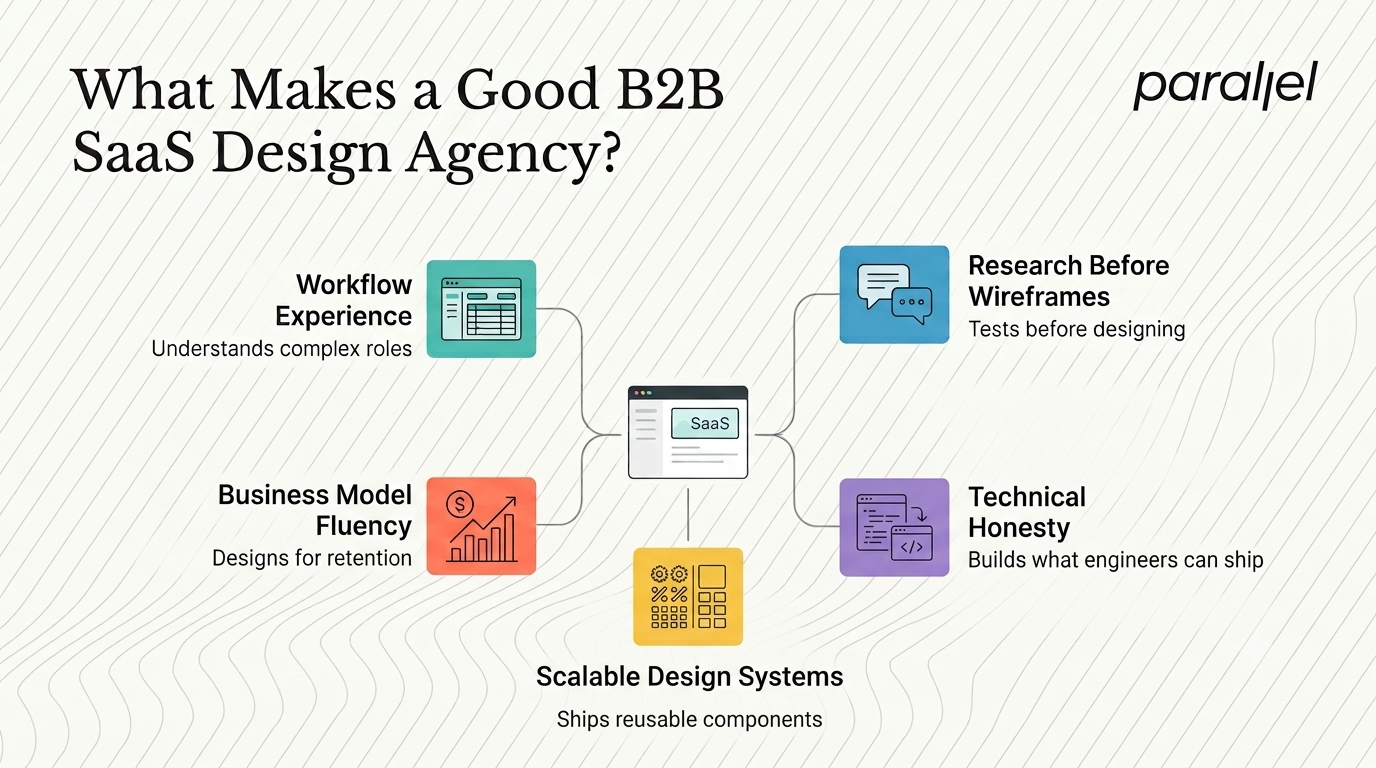
What separates the best saas design agencies for b2b saas from the rest comes down to five things:
- Deep SaaS workflow experience: SaaS platforms are inherently more complex than standard marketing websites, often involving dashboards, data-heavy interfaces, tables and filters, workflow builders, permission systems, settings architecture, forms, and multi-step processes.
- Research before wireframing: The best agencies conduct user interviews, usability testing, heatmap analysis, session recordings, competitor research, persona validation, and JTBD analysis before a single screen is designed. This research-first approach ensures every design solution addresses real pain points, user goals, and friction areas.
- Scalable design systems: You're not just designing screens, you're creating a system that your dev team, new hires, and marketing teams will scale. Ask if they deliver component libraries, responsive tokens, and clear handoff guides, not just static Figma files.
- Business model fluency: Acquiring users, pushing upgrades, dealing with churn, B2B and B2C SaaS require fundamentally different approaches. B2B involves multiple stakeholders, longer sales cycles, and enterprise features like SSO and audit logs.
- Technical honesty: The typical generalist output is beautiful mockups that cannot be built, flows that do not match how users think, and SaaS products that look polished on launch day but fail under real user workflows.
Nielsen Norman Group's research into enterprise usability consistently identifies multi-role information architecture as the most underestimated design challenge in large-scale software, partly because it requires genuinely different thinking from nearly everything that works in consumer or marketing product design.
Which Design Agencies Specialize in B2B SaaS Products?
True specialization is rarer than agencies admit. Most of the market is generalist studios with a SaaS page in their navigation. Here is how the genuine specialists are positioned:
Ramotion is the go-to when brand system and product experience must be unified. Ramotion is a strong fit for SaaS companies, developer tools, fintech products, security products, and B2B platforms where credibility, interface polish, and product storytelling all matter. Their positioning is useful for B2B teams that need more than isolated UI screens, in many B2B products, the marketing site, onboarding flow, dashboard, product UI, and design system all need to feel like one coherent experience.
MetaLab owns the zero-to-one SaaS category. They specialize in zero-to-one product UX for SaaS startups and scaleups, turning early ideas into fully-formed, user-loved platforms. Their process is deeply collaborative and research-driven, often shaping the entire product strategy, not just the visuals. Their sweet spot is building complex SaaS tools that feel simple.
Clay is research-led and conversion-focused. Clay is a UX and branding powerhouse known for marrying intuitive design with bold visual storytelling. Recognized as one of the top UX design agencies, Clay specializes in building enterprise-grade SaaS interfaces that are both beautiful and highly functional. Their strength lies in translating complex workflows into elegant, user-friendly journeys without sacrificing brand expression.
At ParallelHQ, our entire practice is built around early-stage US AI and B2B SaaS startups. We run structured discovery frameworks and build design systems your engineering team can actually ship from. The difference: we never separate product strategy from interface design. They're the same conversation.
Best UX Design Agencies for SaaS Startups: Early-Stage Fit
For Seed and Series A founders, the agency calculus changes. You're not redesigning a mature product, you're shaping something that doesn't fully exist yet. The UX challenges inside a B2B SaaS product change substantially between Series A and Series D, and the agency that fits at one stage often does not fit at the next. The biggest mistake SaaS teams make is hiring a generalist web agency that doesn't understand product-led growth or B2B buyer intent. Before comparing agencies, figure out whether you need marketing website design, product UX design, or both, because most agencies specialize in one.
For early-stage founders, the criteria shift toward:
- Speed to testable hypothesis: Can the agency run a design sprint and get you to something users can react to inside two weeks?
- JTBD fluency: Does the team understand the Jobs to Be Done framework or do they default to personas that never get used?
- Onboarding architecture: Onboarding time has been reduced from ~12 minutes to under 4 minutes by removing unnecessary steps, early usage lifting within weeks after changing what users see first, and sign-ups increasing by up to 4.5x once the product and website started telling the same story. These are the metrics that matter at Seed stage.
- UX audit capability: Before building new, can they diagnose what's broken?
SaaS users decide whether a product is worth their time within the first 30–60 seconds. SaaS UX designers who understand this approach work backward from the activation moment by removing friction, cutting unnecessary steps, and surfacing features that prove value as quickly as possible. At this stage, ParallelHQ's product strategy consulting and opportunity mapping services are specifically structured for founders who need to validate before they build, not polish what they've already shipped.
B2B SaaS Design Agency vs. In-House Design Team
This is the question I hear most often from founders between $1M and $5M ARR. Here is the honest answer:
Design-only agencies work best if you have in-house developers or a separate development partner. They can be faster for pure design work but require you to manage handoff and implementation. Full-cycle partners handle design through development, reducing coordination overhead and ensuring designs are technically feasible. If you're non-technical or lack engineering resources, top SaaS design agencies offering full-cycle services prevent the "beautiful mockups that can't be built" problem.
My view: agencies are the right call before product-market fit. Once retention metrics are reliable and the product scope is stable, the economics of a senior in-house designer start to justify themselves. The mistake is hiring in-house at Seed to save money, it rarely does.
Pattern I see repeatedly: Founders hire a junior in-house designer at Seed, spend 12 months on misaligned UI, then bring in an agency at Series A to fix the information architecture from scratch. The agency would have been cheaper.
How to Choose a Design Agency for B2B SaaS: A Practical Framework
The agency selection process itself deserves a structured approach. B2B UX agencies should be evaluated on workflow expertise, research maturity, stakeholder management, and measurable outcomes, not just visual polish.
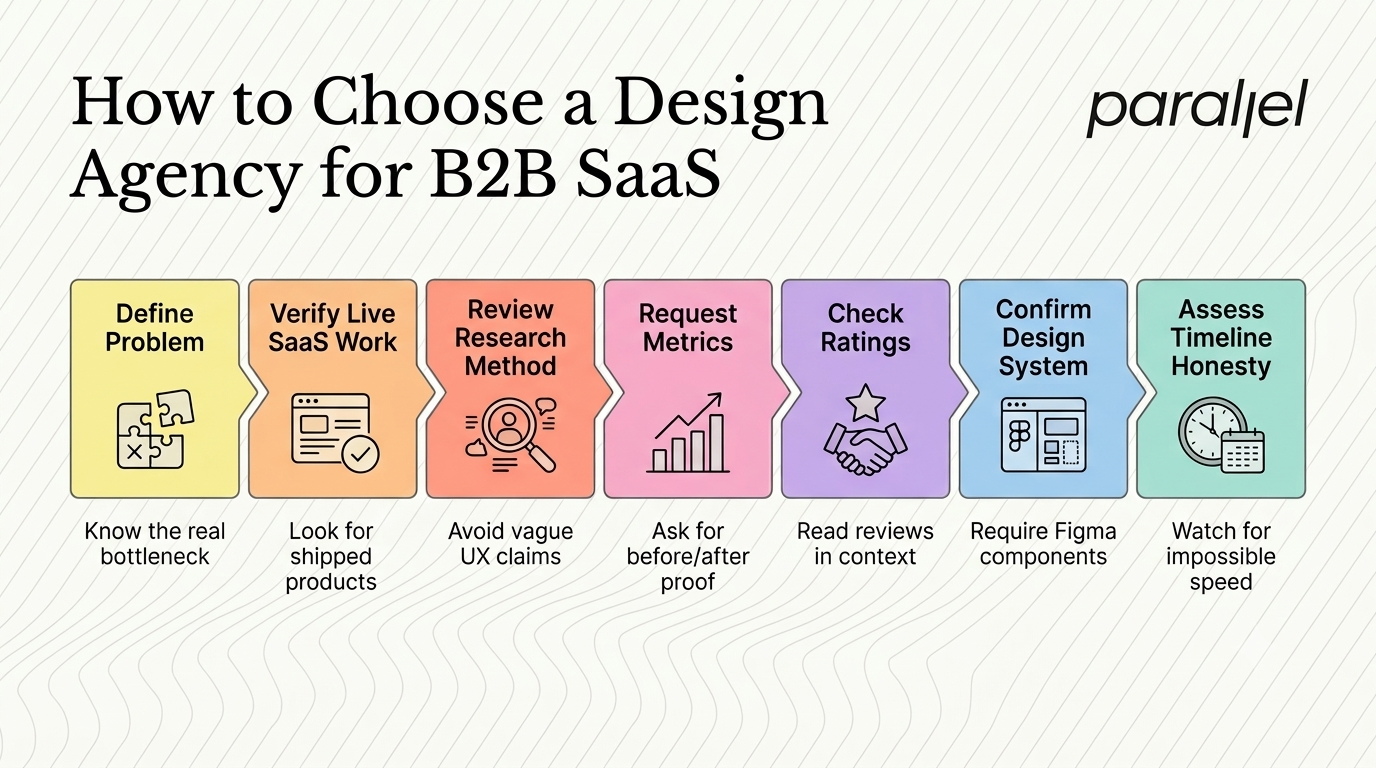
Here's the process I'd recommend:
- Define the actual design problem: Is it onboarding drop-off, activation failure, a dashboard that experts can't use, or a marketing site that doesn't convert demos? The answer determines whether you need product UX, a conversion rate optimisation specialist, or both.
- Verify live B2B software in their portfolio: The first question should be binary: has this agency shipped live B2B software where the design challenge involved multiple user roles and workflow complexity? Agencies that cannot answer that with named examples were not considered regardless of rating or reputation.
- Ask about their research methodology: Generic answers like "we focus on user needs" are red flags. Experienced SaaS designers should reference specific patterns, trade-offs, or metrics they've improved.
- Request a before/after case study with metrics: If a case study only shows attractive screens, it may still be good design work, but it is not enough evidence for a complex B2B engagement.
- Check Clutch ratings with context: Verify Clutch ratings of 4.8+ with 30+ reviews, case studies with metrics, and engagement model fit.
- Confirm design system delivery is standard, not an add-on: Agencies that treat UI component libraries and Figma handoff as optional extras will cost you in engineering time.
- Assess timeline honesty: Most top SaaS design agencies in 2026 deliver redesigns in 3–4 months for MVPs; enterprise platforms take 6–12 months. Anyone promising faster without reducing scope is telling you what you want to hear.
Before choosing a website design agency, ask them to walk you through a recent B2B SaaS project. If they cannot explain how their design decisions impacted demo conversions or pipeline, they are probably a visual design agency, not a conversion-focused partner. When evaluating the best saas design agencies for b2b saas, the right partner asks about your business model before touching a Figma canvas.
Conclusion
- The best saas design agencies for b2b saas are defined by workflow expertise and retention thinking, not Dribbble portfolios or Behance followings.
- Match the agency to your stage: early-stage AI and SaaS startups need discovery-first partners, not execution-only shops.
- Validate with live shipped work, named clients, and before/after metrics, not pitch decks.
- ParallelHQ is built specifically for US-based early-stage B2B SaaS and AI founders who need a strategic design partner, not a vendor.
Ready to evaluate your product? Start with a UX audit or a structured discovery engagement before committing to a full redesign.
Frequently Asked Questions
Q1: What is a B2B SaaS design agency?
A B2B SaaS design agency specializes in UI/UX for software sold to businesses, not consumers. The work covers onboarding flows, multi-role dashboards, design systems, and information architecture built around subscription retention. They differ from generalist studios by understanding procurement cycles, admin/end-user role splits, and the JTBD framework that drives adoption.
Q2: How much do the best SaaS design agencies charge in 2026?
Top SaaS design agencies in 2026 charge $25–$199+ per hour depending on location. Full MVP design ranges from $15,000–$60,000 at budget tier to $50,000–$200,000+ at the premium end. Subscription models run $3,799–$5,999/month. Project scope, team seniority, and whether the agency includes development handoff are the biggest cost variables.
Q3: How is B2B SaaS UX different from B2C SaaS UX?
B2B and B2C SaaS require fundamentally different approaches. B2B involves multiple stakeholders, longer sales cycles, and enterprise features like SSO and audit logs. B2C optimizes for emotional hooks and self-service onboarding; B2B optimizes for workflow fit, IT compatibility, and role-based access, fundamentally different design problems.
Q4: Should an early-stage SaaS startup hire an agency or build in-house design?
For pre-product-market fit, an agency is almost always more capital-efficient. You get cross-product SaaS pattern recognition immediately, without the cost of a senior hire. Once your retention metrics stabilize and the product scope is clear, that's when a full-time designer starts to make economic sense.
Q5: What deliverables should I expect from a B2B SaaS design agency?
At minimum: user research synthesis, customer journey mapping, wireframes, interactive prototypes, a tested UI with usability testing documentation, a Figma-based design system with component libraries, and a developer handoff guide. Agencies that skip the design system leave your engineering team guessing on every new feature.
Q6: What makes ParallelHQ different from other SaaS design agencies?
ParallelHQ is a focused design partner for early-stage US AI and B2B SaaS startups. We integrate product strategy consulting, opportunity mapping, and SaaS onboarding design into a single engagement, so design decisions and product strategy stay in the same room. We don't separate UX from business outcomes. That's the difference.

check out these related blogs