Healthtech is unforgiving. If a food delivery application fails, someone eats a late dinner. If a digital health product fails, patient care is compromised. Over the years, I have seen founders overcomplicate medical interfaces because they assume complexity equals clinical accuracy. It does not. Finding the best product design agencies for healthtech is about finding partners who understand how to translate dense medical workflows into clear, actionable interfaces. Let us look at the top firms getting this right in 2026.
10 Best Product Design Agencies for Healthtech Startups
The best product design agencies for healthtech balance clinical rigor with user simplicity. Here is the 2026 comparison of the top ten partners for your next digital health product.
What separates the best product design agencies for healthtech from generalists
Designing for healthcare requires a fundamentally different mindset. We are not just building applications to capture attention. We are building tools that people rely on during vulnerable moments. A generalist agency often focuses on making things look highly polished. A specialized healthtech partner focuses on cognitive load, trust, and clinical safety.
Nielsen Norman Group consistently highlights that high cognitive load in professional interfaces leads directly to user error. In a healthcare setting, a user error can result in a misdiagnosis or a missed medication dose. We rely on this principle heavily when we audit existing platforms. You can learn more about how we uncover these issues through a formal UX audit.
Recent 2026 statistics on digital health retention show that 68% of patients abandon health applications within the first two weeks if the data entry process feels overwhelming. Trust is fragile. If an interface feels confusing or hides critical information, users will simply revert to phone calls or physical paperwork.
When you evaluate a design partner, you must look at their ability to structure information. They need to know how to handle Protected Health Information securely without making the user experience feel like a fortress. They must understand the difference between a patient-facing portal and a provider-facing dashboard. These are entirely different environments that require entirely different design languages.
Where early-stage healthtech teams go wrong
We have worked with many founders and product managers at early-stage startups. We see the same patterns of failure repeatedly. The most common mistake is building for the buyer rather than the user. Teams will pack a clinical dashboard with fifty different metrics to impress hospital administrators during a sales pitch.

The actual clinician using the tool does not want fifty metrics. They want the three metrics that help them make a decision right now. This lack of clarity in product thinking leads to bloated software that requires hours of training to use. We counter this by utilizing a strong discovery framework to align business goals with real user behaviors.
Another major failure point is the onboarding experience. Health applications inherently require a lot of sensitive information. Teams often present users with a massive intake form on the very first screen. This destroys activation rates. Users need to see the value of the application before they hand over their medical history.
We always recommend progressive profiling. You ask for the minimum amount of data required to get the user to the next step. You build trust gradually. If you are struggling with user drop-off during the first five minutes of usage, it is usually an onboarding problem. We routinely help teams fix this through targeted SaaS onboarding teardowns.
The top 10 list in detail
When ranking the best product design agencies for healthtech, we look at how well these teams simplify complex data. We evaluate their strategic approach, their reliance on real user research, and their ability to ship practical solutions. Here is a deeper dive into the top ten firms operating today.
1) ParallelHQ
We built ParallelHQ because we saw teams struggle with design decisions that should have been simple and grounded in reality. We consistently rank among the best product design agencies for healthtech because we do not just paint screens. We focus heavily on product strategy, user psychology, and clarity.
Our approach is built around rapid validation. We use design sprints to take abstract clinical concepts and turn them into testable prototypes in a matter of days. This prevents healthtech founders from spending months building features that clinicians ultimately reject. We have applied this methodology successfully to complex compliance workflows, patient tracking systems, and clinical decision support tools.
We also understand that healthcare products cannot exist in a vacuum. They must scale systematically. This is why we integrate robust design systems early in the process. A good design system ensures that as your medical platform grows, the interface remains consistent, accessible, and safe for users. If you are looking for a partner that combines strategic product thinking with high-craft execution, we are built for that exact intersection. Explore our healthtech design services to see our methodology in action.
2) IDEO
IDEO is a legendary name in the design industry. They pioneered the concept of design thinking and have a long history of working in the healthcare space. Their strength lies in deep, ethnographic user research. They will send researchers into hospitals to observe surgical teams and interview patients in their homes.
They are an excellent choice if you are tackling a massive, ambiguous healthcare challenge that requires behavioral change on a societal level. They excel at service design, mapping out the entire patient journey from the hospital parking lot to the digital follow-up application.
However, IDEO is a massive consultancy. Their timelines are long, and their engagements require significant capital. They are often less suited for agile startups that need to ship a minimum viable product quickly. If you need a more rapid, product-focused approach, you might want to explore an IDEO alternative.
3) Frog Design
Frog Design blends physical and digital experiences better than almost anyone else in the market. In the healthtech sector, this is incredibly valuable. Many modern health solutions involve a connected device, like a continuous glucose monitor or a wearable ECG tracker, paired with a mobile application.
Frog understands how to make the hardware and the software feel like a single cohesive product. They have deep expertise in industrial design and complex systems architecture. They are fantastic at ensuring that the physical interaction with a medical device matches the digital feedback on the screen.
Like IDEO, Frog is a premium, enterprise-tier agency. Their processes are thorough but can move slower than a seed-stage founder might prefer. Startups looking for leaner, faster digital execution often seek a Frog Design alternative.
4) MetaLab
MetaLab is known for creating some of the most beautiful consumer interfaces in the world. They have designed platforms that you likely use every single day. When it comes to healthtech, their strength lies in consumerizing the patient experience.
If you are building a direct-to-consumer health product like a digital pharmacy, a telehealth therapy application, or a wellness tracker, MetaLab brings unparalleled visual polish. They know how to make medical software feel as engaging and premium as a top-tier lifestyle application.
Their focus is heavily weighted toward high-fidelity UI and visual perfection. For deeply complex, provider-facing clinical dashboards built on legacy infrastructure, their consumer-first approach might require adaptation. Teams needing deep B2B clinical workflow design sometimes look for a MetaLab alternative.
5) Work & Co
Work & Co operates on a unique model. They are a design agency, but they think like an engineering firm. They emphasize shipping working software over delivering static presentation decks. In healthtech, where data architecture and backend compliance dictate the user interface, this technical integration is highly valuable.
They excel at building highly functional, reliable digital products that scale easily. They work closely with technical teams to ensure that their designs are not just visually appealing but structurally sound.
Their highly technical, code-forward approach is brilliant for mature products. However, early-stage teams still trying to figure out their core value proposition might need a partner more focused on initial discovery and rapid prototyping. In those cases, a Work & Co alternative focused on early product strategy might be a better fit.
6) Clay
Clay is a UI and UX design agency based in San Francisco. They are known for striking visual identities, smooth motion design, and highly modern interfaces. They have a strong portfolio in the consumer tech space and bring that modern aesthetic to healthcare.
If your digital health product relies on brand differentiation to stand out in a crowded market, Clay is a strong contender. They build applications that look futuristic and sophisticated. They are very good at using animation to guide users through complex flows, which can be useful in medical onboarding.
Because their focus is heavily anchored in visual innovation and brand storytelling, they are best suited for patient-facing products. For backend medical logistics or heavy data visualization, teams might consider a Clay alternative.
7) Ramotion
Ramotion specializes in combining brand identity with product design. They are an excellent fit for early-stage healthtech startups that need to build everything from scratch. They can design your logo, define your visual guidelines, and design your mobile application all in one continuous motion.
This unified approach ensures that your health brand feels trustworthy and consistent across every touchpoint. They are efficient and produce clean, highly usable interfaces that follow modern design conventions perfectly.
Their primary strength is in the startup ecosystem. As products scale into massive, multi-faceted clinical platforms, the required design architecture becomes significantly more complex. For deeply entrenched enterprise health systems, exploring a Ramotion alternative might be necessary.
8) Method
Method approaches design through the lens of business strategy and systems thinking. Healthcare is notoriously fragmented. Method excels at looking at the entire ecosystem, understanding how the payer, the provider, and the patient interact within a single digital environment.
They are a strategic partner that helps companies figure out what to build before they start designing screens. Their work is highly analytical, making them a great fit for health insurance platforms, large hospital networks, and digital therapeutics companies.
Their strategic depth means they spend a lot of time in the research and modeling phases. Founders who need to launch a core feature set next month might find their process too comprehensive. Those founders often seek a Method alternative for faster execution.
9) Instrument
Instrument is a digital agency that builds powerful, narrative-driven experiences. They are fantastic at storytelling. In healthtech, storytelling is an underutilized tool. Instrument knows how to build platforms that educate patients, build empathy, and guide users through difficult medical journeys.
They often work with large organizations to launch major health initiatives or digital campaigns that seamlessly connect to functional product experiences. Their work is highly polished and emotionally resonant.
They operate at the intersection of marketing and product design. If your needs are strictly functional, like designing a high-density data grid for radiologists, a highly specialized Instrument alternative focused purely on utilitarian UX might be required.
10) Neuron
Neuron is a UX/UI design agency that focuses heavily on B2B and enterprise software. They are arguably the most pragmatic agency on this list. They do not get distracted by flashy trends. They focus on productivity, efficiency, and clear information architecture.
For healthtech companies building electronic health records, practice management software, or clinical analytics tools, Neuron is a very safe pair of hands. They understand how to design for expert users who spend eight hours a day inside a software application.
They are deeply practical. While they might not provide the consumer-level visual flair of a MetaLab, they deliver highly effective enterprise tools. Startups wanting a blend of enterprise functionality and consumer aesthetics might compare them against a Neuron alternative.
How to think about your product design approach correctly
Choosing among the best product design agencies for healthtech requires looking beyond visual portfolios. You have to evaluate their thinking process. Healthcare products fail when designers prioritize aesthetics over clarity.
First, consider the mental models of your users. A doctor looking at a patient chart has a very specific way of processing information. They look for abnormalities first. They look at trends over time. If your design partner tries to force a consumer-style layout onto clinical data, the product will fail in usability testing. We tackle this by conducting rigorous user research with actual medical professionals. You cannot guess what a clinician needs. You have to watch them work.
Second, consider accessibility. Accessibility in healthtech is not an optional feature. It is a fundamental requirement. Your application will be used by patients with vision impairments, motor difficulties, and cognitive decline. Your interfaces must meet strict WCAG standards. Buttons must have proper contrast. Typography must be legible. Navigation must be predictable. We mandate standard accessibility audits for all healthcare products we work on to ensure compliance and usability.
Finally, consider the speed of learning. Early-stage startups cannot afford to spend six months designing a product in a vacuum. You need to validate your assumptions quickly. This is why we advocate for tight, focused iteration cycles. You build a prototype, put it in front of users, measure the friction, and refine the interface.
Practical steps for building better health products
If you want to improve your healthtech product today, start by mapping out the critical user journeys. Identify the single most important task your user needs to accomplish. For a patient, it might be booking an appointment. For a doctor, it might be reviewing lab results.
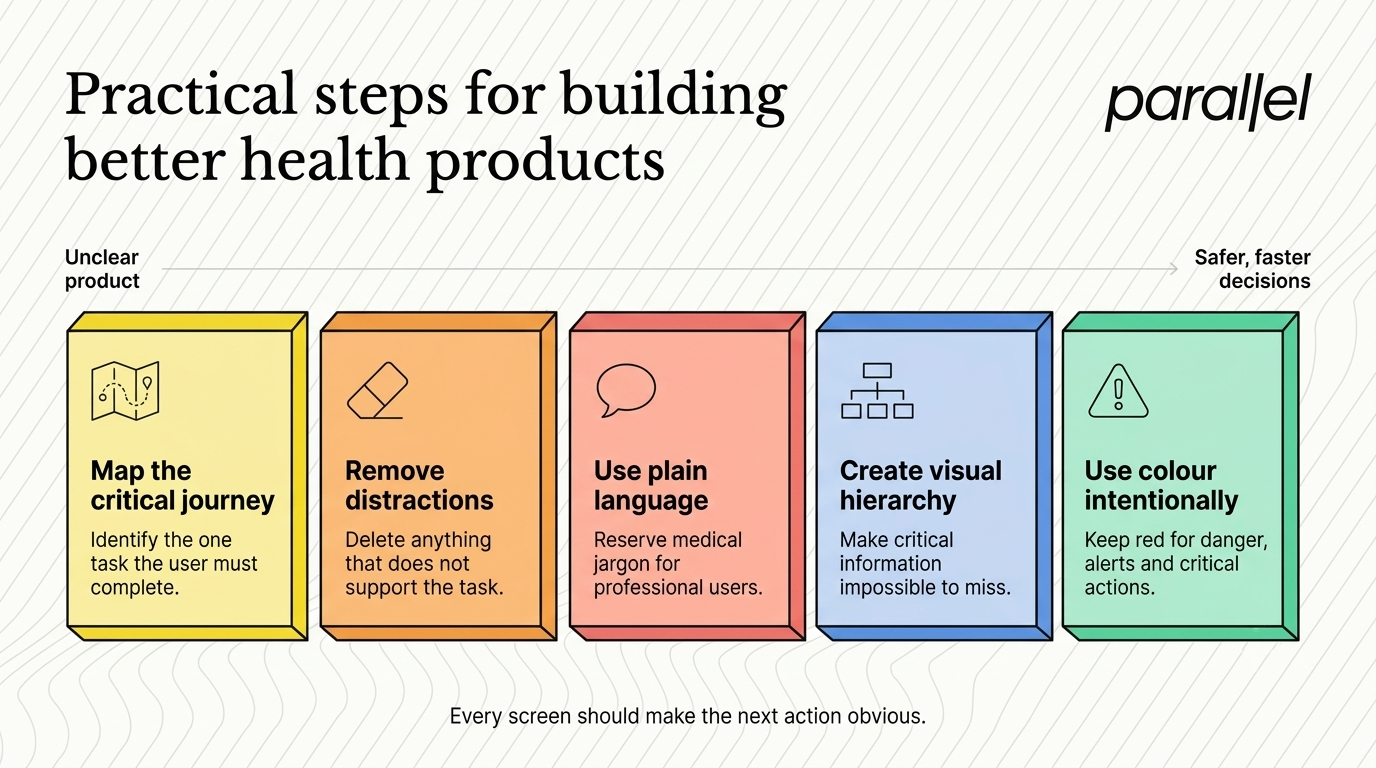
Strip away everything on the screen that does not directly support that task. Use clear, unambiguous language. Medical jargon should only be used when speaking to medical professionals. When speaking to patients, use plain language.
Establish a clear visual hierarchy. The most important information should be the most prominent thing on the screen. Use color sparingly and intentionally. In medical interfaces, red means danger or critical action. Do not use red for your primary brand buttons if it is going to confuse the user's clinical interpretation. We focus heavily on these fundamentals in our UI/UX design practice.
Conclusion
Building software for healthcare is an immense responsibility. The interface is the bridge between a patient in need and the care they require. Partnering with one of the best product design agencies for healthtech is an investment in patient safety and clinical adoption.
The most successful healthtech founders I know do not view design as a coat of paint applied at the end of development. They view design as a core strategic function that dictates how their technology is understood by human beings. Keep your product simple. Keep your workflows clear. Base your decisions on real user behavior, not assumptions. When you prioritize clarity over cleverness, you build products that actually make an impact.
Frequently asked questions
1) What makes a healthtech design agency different?
A specialized healthtech agency understands the regulatory landscape, such as HIPAA and FDA guidelines for software as a medical device. They know how to handle complex, high-density data visualizations without overwhelming the user. They also have established methodologies for recruiting and interviewing highly specialized medical professionals for user testing, which generalist agencies often struggle to do.
2) How do you evaluate the best product design agencies for healthtech?
You evaluate the best product design agencies for healthtech by reviewing their approach to cognitive load and compliance. Ask them how they balance clinical accuracy with user simplicity. Look for case studies that show measurable improvements in user activation or reductions in task completion time. A great agency will talk about product strategy and user behavior long before they talk about visual aesthetics.
3) How much does healthtech product design cost in 2026?
Costs vary wildly depending on the scope of the project and the agency tier. A focused engagement for a minimum viable product with a specialized agency might range from $40,000 to $100,000. Engaging a top-tier global consultancy for a massive ecosystem overhaul can easily exceed $500,000. The key is to map the investment to the stage of your company. Early-stage teams should invest in rapid validation and core workflows.
4) Should we hire an agency or build an in-house design team?
Early-stage companies often benefit from the speed, established frameworks, and objective perspective of an agency. An agency can help you find product-market fit quickly without the overhead of recruiting a full-time team. As you scale and reach Series B or C, building an in-house team becomes critical for long-term maintenance. Many successful companies use an agency to establish the foundation and design system, then transition the execution to an internal team.
5) How does ParallelHQ approach complex healthcare workflows?
We rely heavily on structured discovery and rapid prototyping. We start by unpacking the clinical logic and mapping the user journey to identify friction points. We then use design sprints to build high-fidelity prototypes of the core workflow within days. We test these prototypes with actual users to validate our assumptions. This ensures that the interface makes sense to the people actually using it before a single line of production code is written.
6) What is the typical timeline for a digital health design project?
A foundational design sprint to validate a core concept takes about two to three weeks. Designing a complete minimum viable product typically takes between eight and twelve weeks. Redesigning a massive, legacy electronic health record system can take six to nine months. We always recommend breaking large projects into phased deliverables so engineering teams can begin development while the design team works on subsequent modules.
7) How do design sprints work for medical software?
Design sprints are highly effective for medical software because they force cross-functional alignment. We bring the product managers, clinical experts, and designers into a focused workshop. We define the core challenge, sketch solutions, and build a realistic prototype. By the end of the week, we test that prototype with target users. It compresses months of debate and speculation into a few days of definitive learning.
8) Is a specialized agency right for a seed-stage startup?
Yes, but you must choose an agency that understands startup constraints. Seed-stage startups do not have the time or budget for endless research cycles. They need actionable product strategy and interfaces that allow them to raise their next round of funding. Engaging a partner that offers focused product strategy consulting helps seed-stage founders translate complex medical innovations into clear, usable products that investors and early adopters can instantly understand.

check out these related blogs