Most B2B SaaS products suffer from a common, expensive problem. They look beautiful on a monitor but fail to solve the actual workflow challenges of their users. I see founders burn through capital on aesthetic redesigns that do not improve retention or activation. Finding a partner who understands complex software logic over mere aesthetics is incredibly difficult today. If you are looking for the best product design agencies for B2B SaaS, you need teams that think in systems, not just screens. Here is how to navigate this space and find a partner that actually drives product metrics.
10 Best Product Design Agencies for B2B SaaS
The right design partner depends entirely on your growth stage and software complexity. Below is a breakdown of the top ten agencies based on my years of evaluating product teams and their outcomes.
Why business software design requires a different mental model
Consumer applications rely on rapid engagement loops and emotional design hooks. Business software operates on a completely different paradigm. It relies on efficiency, task completion, and managing incredibly dense information architectures.
I frequently see startup teams hire consumer-focused designers to build enterprise tools. This approach almost always backfires. The agency delivers stunning visual files but misses the core user journey completely.
According to a recent 2025 report by the Nielsen Norman Group, enterprise users prioritize predictable navigation and data density over novel micro-interactions. They want to get their work done, not marvel at your animations.
This distinction is exactly why selecting from the best product design agencies for B2B SaaS is critical for your survival. You require a specialized partner. You need a team that understands role-based access controls, nested data structures, and complex onboarding workflows.
We have noticed a distinct pattern across product teams that struggle with low activation rates. They treat product design as a surface-level exercise. They debate button colors instead of fixing their broken information architecture. True product design is about solving fundamental business problems.
Evaluating the top 10 partners for your software
Finding the right fit requires mapping your specific product complexity to an agency's core expertise. Here is my detailed breakdown of the top ten options in the market today.
1) ParallelHQ
We built ParallelHQ because we saw a massive gap in how traditional agencies approach complex software. We do not just paint screens and hand over design files. We clarify your entire product thinking.
We work closely with founders and product managers to untangle messy features. We build design systems grounded in actual user behavior. Our focus is squarely on driving real metrics like user activation and long-term retention.
We start by aligning your internal team. You can read about our approach to product strategy consulting to see how we connect design decisions to your business goals. We thrive on untangling complexity.
2) Clay
Clay excels at creating beautiful digital experiences and compelling marketing sites. They are widely known for their high-end visual polish and seamless brand integration.
If your company has a massive budget and needs a consumer-grade feel for a simple SaaS tool, they are a very strong option. Their client work is undeniably gorgeous and highly regarded in the industry.
However, their intensive process can sometimes be overkill for early-stage teams. Startups often need rapid iterations and functional problem-solving over pixel-perfect branding. If you want a more agile approach, you might explore a Clay alternative.
3) MetaLab
MetaLab has a legendary reputation for designing famous interfaces like Slack and Pitch. They bring a highly polished, consumer-like feel to complex business tools.
They are a fantastic fit for established scale-ups with significant funding rounds. They know exactly how to make software feel friendly, approachable, and market-ready.
The primary downside for early-stage founders is often the engagement speed and the premium cost. Nimble startups might find more flexible partners among the best product design agencies for B2B SaaS. If budget is a constraint, look into a MetaLab alternative.
4) Ramotion
Ramotion is excellent at blending corporate brand identity with user interface systems. They are a solid choice for Seed to Series A startups looking to establish a strong visual foundation.
Their client work is consistently clean, modern, and highly scalable. They do a great job of ensuring your marketing site visually matches your internal product dashboard.
They lean heavily into visual design and initial branding. If your core problem is deep software logic rather than aesthetics, you may need a specialized Ramotion alternative.
5) Neuron
Neuron focuses heavily on enterprise software usability and architectural complexity. They tackle convoluted B2B workflows and aim to make dense applications feel intuitive.
If your product deals with massive datasets or legacy system integrations, they have a proven track record. They understand the enterprise buyer persona very well.
Their work is highly functional and logically sound. If you are looking for teams that prioritize structure over flash, they are a great benchmark. You can also review a Neuron alternative for comparison.
6) UX Studio
UX Studio takes a rigorous, research-heavy approach to product improvements. They embed user researchers into the design process from day one.
This methodology is highly effective for data-heavy products that require deep user testing before writing any code. They will not guess at what your users want to see.
Their process is thorough, which means it can take longer to reach the high-fidelity design phase. If you need rapid prototyping, you must balance their user research timelines against your aggressive launch goals.
7) Frog
Frog is an absolute institution in the global design world. They handle massive enterprise transformations and physical industrial design projects.
They are a powerhouse for Fortune 500 companies needing a complete structural overhaul. They bring decades of proven methodology to the table.
While their pedigree is unmatched, their massive scale and overhead often make them unsuitable for agile SaaS startups. Early-stage founders usually seek a more specialized Frog design alternative.
8) Work & Co
Work & Co focuses on building digital products with a heavy emphasis on engineering alignment. They do not just design interfaces. They often build and ship the final product.
They are ideal for established tech companies that need a partner to own the entire product lifecycle from concept to code. Their technical rigor is excellent.
Their engagements are typically large and comprehensive. Startups looking only for strategic UX guidance might prefer a focused Work & Co alternative.
9) Instrument
Instrument beautifully blends brand storytelling with digital product creation. They are fantastic for market leaders who need to tell a cohesive, emotional story.
They ensure your brand voice echoes perfectly inside your software application. Their creative direction is always top-tier.
They often work with massive consumer brands. For a highly technical B2B product, you might want a partner closer to the software metal. Consider an Instrument alternative if logic is your primary bottleneck.
10) R/GA
R/GA is a massive global agency known for digital innovation and advertising. They handle connected products and large-scale digital transformations.
They are brilliant at creating entirely new digital ecosystems. Their strategic thinking is designed for global scale.
For a nimble SaaS startup, their intensive process might feel far too heavy. They are much better suited for global enterprises. A startup should look for an R/GA alternative for faster execution.
Where product teams go wrong in the hiring process
Founders often index too heavily on beautiful portfolios. A flashy portfolio tells you absolutely nothing about how an agency solves a technical constraint.
I have seen teams hire based on visual aesthetics alone. Six months later, their engineering team cannot build the designs. The agency completely ignored the actual technical architecture.
Recent 2026 data from the Product Development and Management Association indicates that 45% of SaaS redesigns fail to meet their business objectives. The primary reason is a lack of technical feasibility in the design phase.
When evaluating the best product design agencies for B2B SaaS, you must test their strategic thinking. Ask them how they approach edge cases in data tables. Ask them to explain a time they pushed back on a client.
If an agency simply says yes to all your feature requests, they are not a strategic partner. They are just a pair of hands executing bad ideas. You need a team that will challenge your assumptions.
How to structure your evaluation criteria
You need a systematic way to assess potential partners. Do not rely on gut feeling or smooth sales pitches.
First, evaluate their discovery process deeply. Do they jump straight into drawing screens? Or do they spend time understanding your business model and user pain points? A mature product team always starts with discovery.
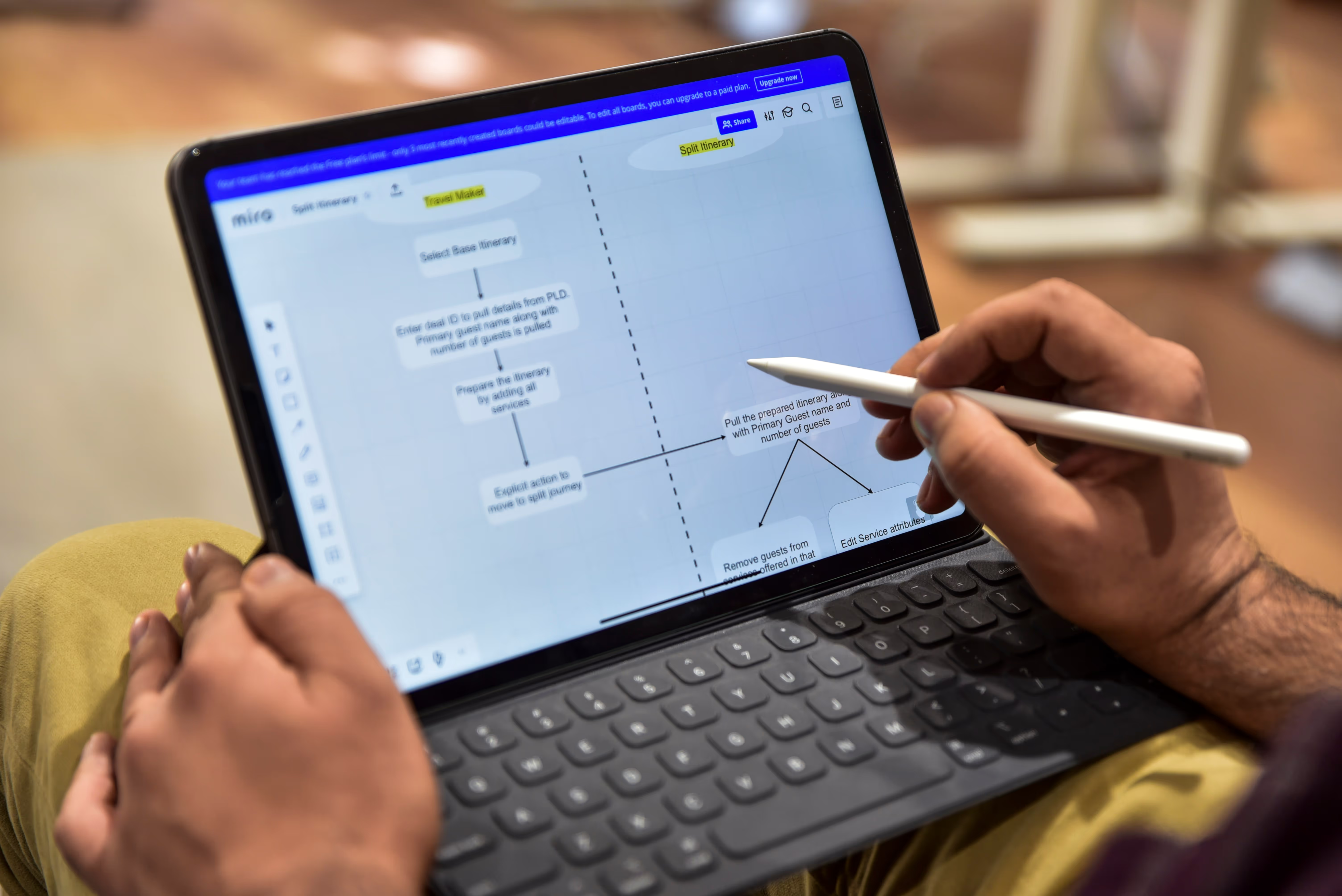
Second, look at their experience with complex logic. Ask to see a project where they simplified a multi-step user workflow. You want to see their messy whiteboards and logic flows, not just the polished final output.
Finally, consider their approach to continuous testing. According to 2026 guidelines on human-centered software by IDEO, iterative testing is completely non-negotiable for enterprise tools. Ensure your chosen partner among the best product design agencies for B2B SaaS incorporates usability testing into their standard workflow.
The true cost of bad product design
Bad design in business software is not just an aesthetic issue. It is a massive financial liability. It actively destroys your unit economics over time.
When software is confusing, your customer support tickets skyrocket. Your sales team has to spend extra hours explaining basic features on demo calls. Your onboarding process becomes a manual bottleneck.
A 2025 study by McKinsey on Design found that enterprise companies in the top quartile of design maturity see 32% higher revenue growth. Good design is a measurable growth lever.
We see this constantly in our own work. Teams come to us with a churn problem. They think they need more features. In reality, their users cannot navigate the features they already have.
Fixing these fundamental usability issues changes the trajectory of a company. It lowers acquisition costs because the product actually sells itself through product-led growth.
Red flags to watch out for during your search
Through years of auditing failed product design projects, I have identified several warning signs. You should walk away if you spot these during the proposal phase.

First, beware of agencies that do not ask to speak to your users. If they believe they can redesign your software based solely on stakeholder interviews, they are guessing. Great design requires primary research.
Second, avoid agencies that price their services based on the number of screens. Software design is not a volume business. A brilliant designer might reduce a twenty-screen workflow down to three screens. You should pay for the simplification, not the volume.
Third, watch out for teams that over-index on animation and micro-interactions during the pitch. B2B users do not want bouncy buttons. They want to export their CSV file quickly. Prioritize agencies that talk about data architecture.
How to prepare your internal team before hiring
Bringing in an external agency will expose the cracks in your internal alignment. You must prepare your team before the kickoff call.
Start by defining a clear metric of success. Are you trying to reduce the time it takes a user to complete their first core task? Are you trying to decrease support tickets related to reporting? Write this goal down.
Next, designate a single internal decision-maker. Design by committee will stall the project and dilute the final outcome. The agency needs one clear voice to provide final approval on strategic direction.
Finally, gather your existing user data. Compile your support tickets, user session recordings, and product analytics. The agency will need this raw data to inform their initial UX audit.
How to approach a product overhaul practically
Do not try to redesign your entire platform at once. This is a guaranteed way to stall your engineering team and frustrate your existing users.

Start with a highly targeted intervention. Identify the single most critical friction point in your software. Usually, this is the initial user onboarding flow or the core daily task.
Once you isolate the problem, run a structured workshop. We often use design sprints to solve these specific challenges in a matter of days. You map the problem, sketch solutions, and test a prototype with real users rapidly.
This iterative approach reduces your risk massively. The best product design agencies for B2B SaaS will insist on this kind of phased, measurable rollout. They will never recommend a blind, sweeping redesign without validating the smaller pieces first.
Building a foundation for future speed
Your goal should not just be a better-looking product today. Your ultimate goal must be faster shipping velocity tomorrow.
A good agency leaves you with a scalable foundation. This means creating comprehensive design systems. A design system is a library of reusable components that your engineers can plug and play immediately.
When you have a strong component library, you stop designing from scratch. Your product managers can wireframe new features using established patterns. Your developers spend significantly less time writing custom code.
We have seen teams increase their feature release speed by 40% simply by implementing a strict design system. This operational efficiency is the hidden return on investment when hiring a great design partner.
Navigating the era of AI in SaaS
Every SaaS product is currently trying to integrate artificial intelligence. Most are doing it quite poorly. They just slap a generic chat interface on top of a legacy database.
Good AI design requires deep product thinking. You have to consider trust, transparency, and error states carefully. If the AI hallucinates, how does the interface handle it gracefully?
According to a 2026 forecast by Gartner, over 80% of enterprise SaaS applications will incorporate generative AI features. However, user adoption depends entirely on how intuitively those features are integrated into existing workflows.
If you are building AI features, you need a partner experienced in this specific domain. You can review our thoughts on AI UX design to see how we approach these new interaction models. The paradigms are shifting rapidly. Do not let an agency treat AI as a gimmick.
Final thoughts on your product partner
Choosing a design agency is essentially choosing a temporary co-founder for your product experience. The stakes are incredibly high for early-stage software companies.
Do not settle for teams that just want to deliver pretty screens and walk away. Look for partners who actively challenge your assumptions. You need people who bring total clarity to your product vision.
The right design decisions will pay dividends long after the agency has handed over the final files. Let the quality of the thinking speak for itself.
Frequently asked questions
1) What defines a B2B SaaS product design agency?
A specialized agency focuses heavily on business software interfaces. They prioritize data density, user permissions, and complex workflows over consumer engagement loops. They deeply understand the nuances of recurring revenue models.
2) How do I evaluate the best product design agencies for B2B SaaS?
Look far beyond their visual portfolio on social media. Ask to see detailed case studies showing how they simplified a complex user problem. Evaluate their discovery process and their ability to collaborate directly with engineering teams.
3) Should I hire an agency or an in-house designer?
It depends entirely on your current growth stage. An agency brings diverse experience and a proven process to solve large architectural problems quickly. An in-house designer is much better for long-term, incremental maintenance once the core product strategy is established.
4) What is the difference between UI/UX and product design?
UI/UX often focuses narrowly on the interface and the immediate user journey. Product design encompasses the entire holistic business problem. It aligns the user experience directly with your go-to-market strategy and your technical constraints.
5) How much do the best product design agencies for B2B SaaS typically charge?
Pricing varies wildly based on agency size and geographic location. Top-tier global agencies can charge upwards of $100,000 for a core redesign. Specialized, agile partners often range between $20,000 and $60,000 for comprehensive product strategy phases.
6) How long does a typical product design engagement last?
Most strategic design projects for early-stage SaaS take between six to twelve weeks. This timeline usually includes deep discovery, wireframing, high-fidelity design, and initial usability testing with target users.
7) Is an agency the right choice for my seed-stage startup?
Yes, specifically if you lack clarity on your core product experience. An agency can help you validate your direction and build a highly scalable foundation. If you just need a few basic screens to raise a friends and family round, a freelancer might suffice.
8) How does ParallelHQ differ from the best product design agencies for B2B SaaS?
We focus strictly on clarity and executive decision-making. We do not just deliver static files. We run intensive workshops to align your entire team. Our goal is to untangle your complex product decisions and ground them in real user behavior.

check out these related blogs



















































































.avif)