I've spent years helping early-stage AI and SaaS founders make smart design investment decisions. One of the most consistent friction points? Pricing opacity. Founders receive wildly different quotes for the same brief and have no framework to evaluate them. This guide removes that fog. Whether you're scoping your first UX design investment or re-evaluating your current partner, here's exactly what ux design cost looks like in 2026, and what actually drives it.
TL;DR
- UX design cost in 2026 ranges from $25/hour for a freelancer to $200+/hour for a senior agency designer.
- Full project costs range from $5,000 to $150,000+ depending on scope; a properly scoped mobile app MVP with 15–25 screens typically costs $15,000–$40,000.
- Hourly rate and total project cost are two different things, a cheaper rate can produce a more expensive outcome.
- Every dollar invested in UX returns $100, a 9,900% ROI, according to Forrester's most widely cited UX research.
What Does UX Design Actually Cost? The 2026 Pricing Breakdown
Before quoting a number, you need to understand what's actually inside it. UX design cost isn't a single line item, it's a stack of phases, each with its own time requirement and skill premium.
Here's how the major deliverable categories break down in 2026:
UX design cost depends more on uncertainty, complexity, research depth, and team seniority than on screen count. A UX audit may cost $1,500–$18,000, while full product design can reach $400,000+ for complex products.
One thing most people miss: hourly rate and total project cost are different things. A $150/hr designer who works in 4 focused weeks often costs less than a $70/hr designer who drags the same project across 3 months with unclear milestones.
The phases that add the most cost to a project: user research, usability testing, multiple revision rounds, WCAG compliance and accessibility standards checks, design system documentation, and developer handoff.
A cheap quote can become expensive if it skips research, accessibility, edge cases, or developer-ready documentation.
What you should always ask before signing: What's included? What's explicitly excluded? How are revisions handled? How is developer handoff structured?
How Do UX Designers Charge for Their Work? Pricing Models Explained
There are four live pricing models in 2026. Each fits a different scenario.
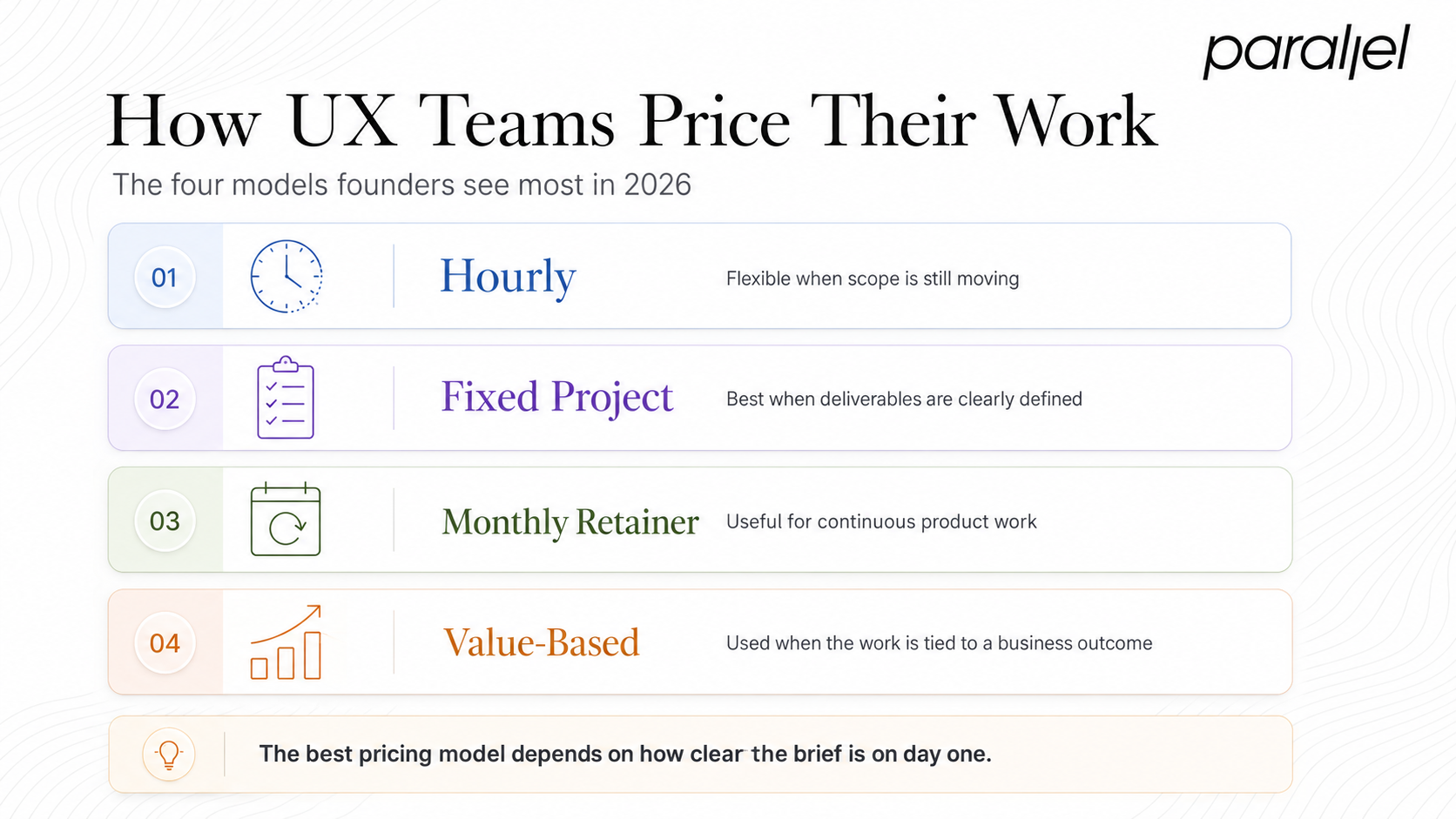
1. Hourly billing: You pay for time tracked. Flexible, transparent, and well-suited to projects where scope evolves. If your design project doesn't have a proper scope and has more unpredictability, the hourly model is appropriate. It allows the client to pay only for hours worked, making it a transparent and fair model. The risk: without a weekly burn-rate review, budgets drift.
2. Fixed project price: A defined scope, defined deliverables, defined cost. Fixed pricing works well when the scope is clear. It is common for audits, landing pages, redesigns, and defined research sprints. The risk is that unclear assumptions become change requests. Ask what is included, what is excluded, and how revisions are handled.
3. Monthly retainer: An ongoing engagement, often structured as a set number of hours or deliverables per month. For businesses needing ongoing design support, monthly design tasks, iterative testing, continuous UX improvements, agencies may offer retainer agreements, structured as fixed monthly fees or on an hourly basis. Retainers typically run $3,000–$20,000/month depending on the agency tier and scope.
4. Value-based pricing: The designer prices against expected business outcomes rather than hours. More common with senior specialists and boutique studios working on SaaS product design or conversion rate optimisation engagements. Harder to evaluate without a track record from the provider.
At Parallel HQ, we typically recommend fixed-scope engagements for discovery and MVP phases, and transition to a retainer once the product cadence and design velocity become predictable. This protects your budget early and scales cleanly as the product grows.
UX Design Pricing Guide 2026: Hourly Rates by Experience and Region
The single most common mistake founders make is evaluating ux design cost by hourly rate alone without anchoring that rate to experience level and geography.
Here's where the market sits in 2026:
As a junior designer with less than two years of experience, you might charge between $30–$60 per hour. Mid-level designers with 2–5 years typically command $60–$100 per hour. Senior designers with over five years and a proven track record can charge $100–$200+ per hour. Geography moves these numbers significantly. US and UK rates are higher: $80–$150/hour for senior-level work. Offshore teams in India and Latin America typically charge $25 to $65/hr. Specialists and niche experts, UX researchers, accessibility consultants, or motion designers, charge $150–$300+/hour for projects requiring very specific expertise.
One nuance worth noting for SaaS founders: agencies working in interaction design or wireframing and prototyping for complex data-heavy products often command a premium over generalist studios, because domain pattern recognition cuts iteration cycles significantly. Senior designers typically charge more than their junior colleagues, but they need fewer hours as their experience means they can make better decisions faster.
What Should a Startup Budget for UX Design? Cost Benchmarks by Stage
This is the question I get most often from early-stage founders. The answer depends on your stage more than your ambition.
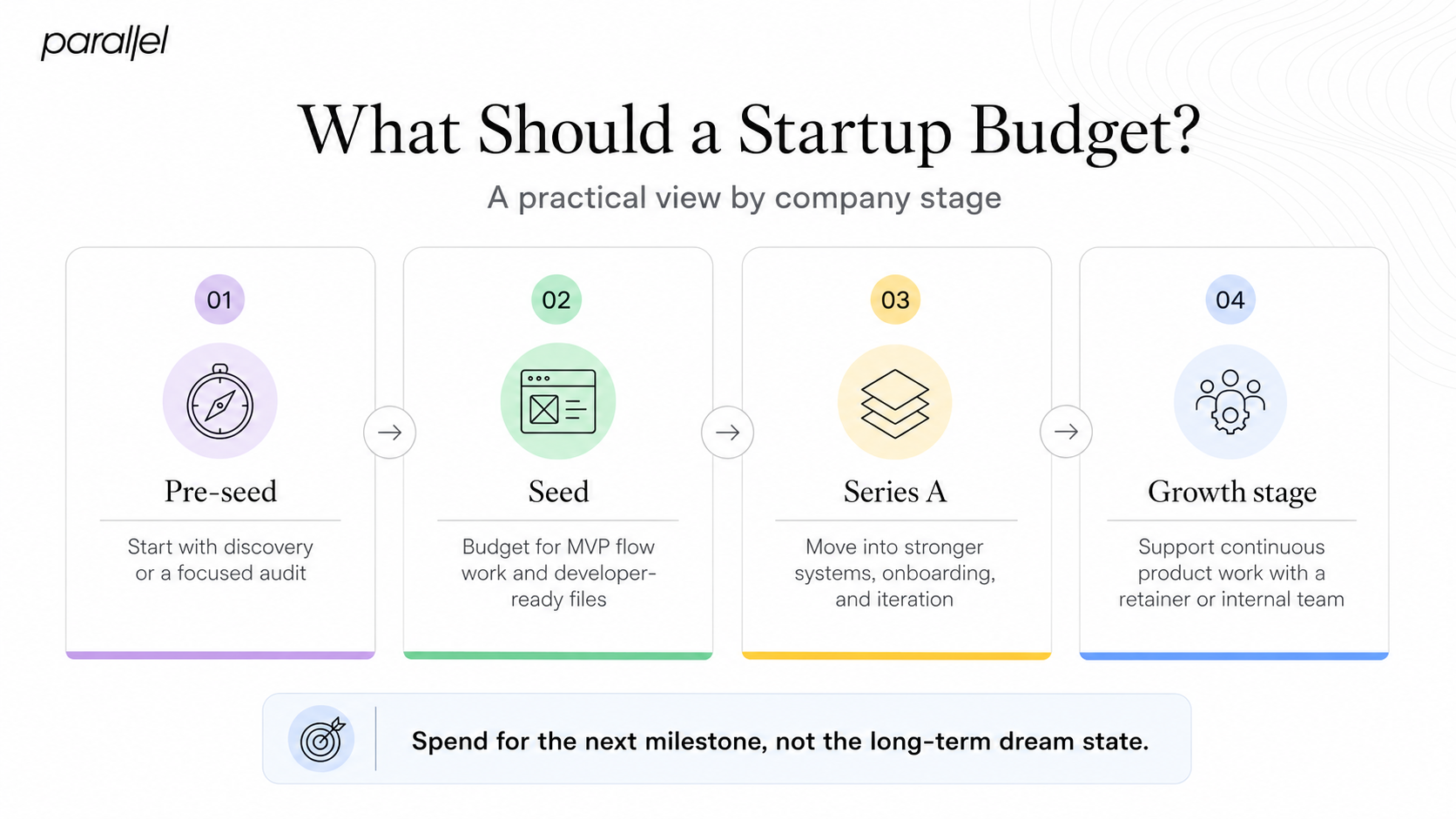
Pre-seed / idea validation: Your primary need is a design sprint or discovery framework to test assumptions cheaply. Budget: $5,000–$15,000. You're buying reduced risk, not a finished product.
Seed / MVP: You need wireframing, high-fidelity UI, Figma prototyping, and dev handoff. A properly scoped mobile app MVP with 15–25 screens typically costs $15,000–$40,000. Apps with complex user roles, custom animations, or data flows sit at the upper end.
Series A / growth: You're now dealing with onboarding optimization, conversion rate optimisation, feature expansion, and the beginnings of a design system. Budget: $40,000–$100,000+ across the year, depending on velocity.
Scale-up: Ongoing design partnership via retainer, embedded in product sprints. For growth-stage SaaS teams with ongoing design needs, a $5,000–$15,000/month agency retainer typically delivers better ROI than managing three freelancers in parallel. Allocate 15% to 25% of your total product development budget to design.
If that number makes you uncomfortable, start with a UX audit, a focused, time-boxed engagement that shows exactly where your current product bleeds retention and conversion, before committing to a full redesign.
Freelance UX Designer Rates vs Agency Pricing: An Honest Comparison
Both models work. Neither is universally better. What matters is the fit to your project's actual complexity and your team's management bandwidth.
Hire a freelancer when the scope is clearly defined, you can manage the project internally, and speed matters. Hire an agency when the project needs multiple disciplines, strategy, UX, UI, and research, and you want one point of accountability.
On a project covering user research, wireframes, hi-fi UI, prototype, and design system with 2 revision rounds, a freelancer can appear 38% cheaper on the quote. The true cost is only 13% cheaper after accounting for hidden costs like management overhead and rework.
A full agency price includes everything that would otherwise fall on your team: user interviews, synthesis, wireframing, prototyping, visual design, testing, and handoff documentation. Agencies also absorb risk in ways freelancers cannot. If the lead designer gets sick or leaves, the agency assigns a replacement. If the project scope expands, the team adapts without you hiring additional people.
For early-stage AI and SaaS startups with a first product under $25,000, a senior freelancer often delivers excellent value. Once you're iterating across onboarding, mobile app design, and design systems simultaneously, the coordination math tips toward an agency.
What Factors Affect UX Design Pricing?
Understanding what drives ux design cost is the fastest way to scope smartly and avoid scope creep.
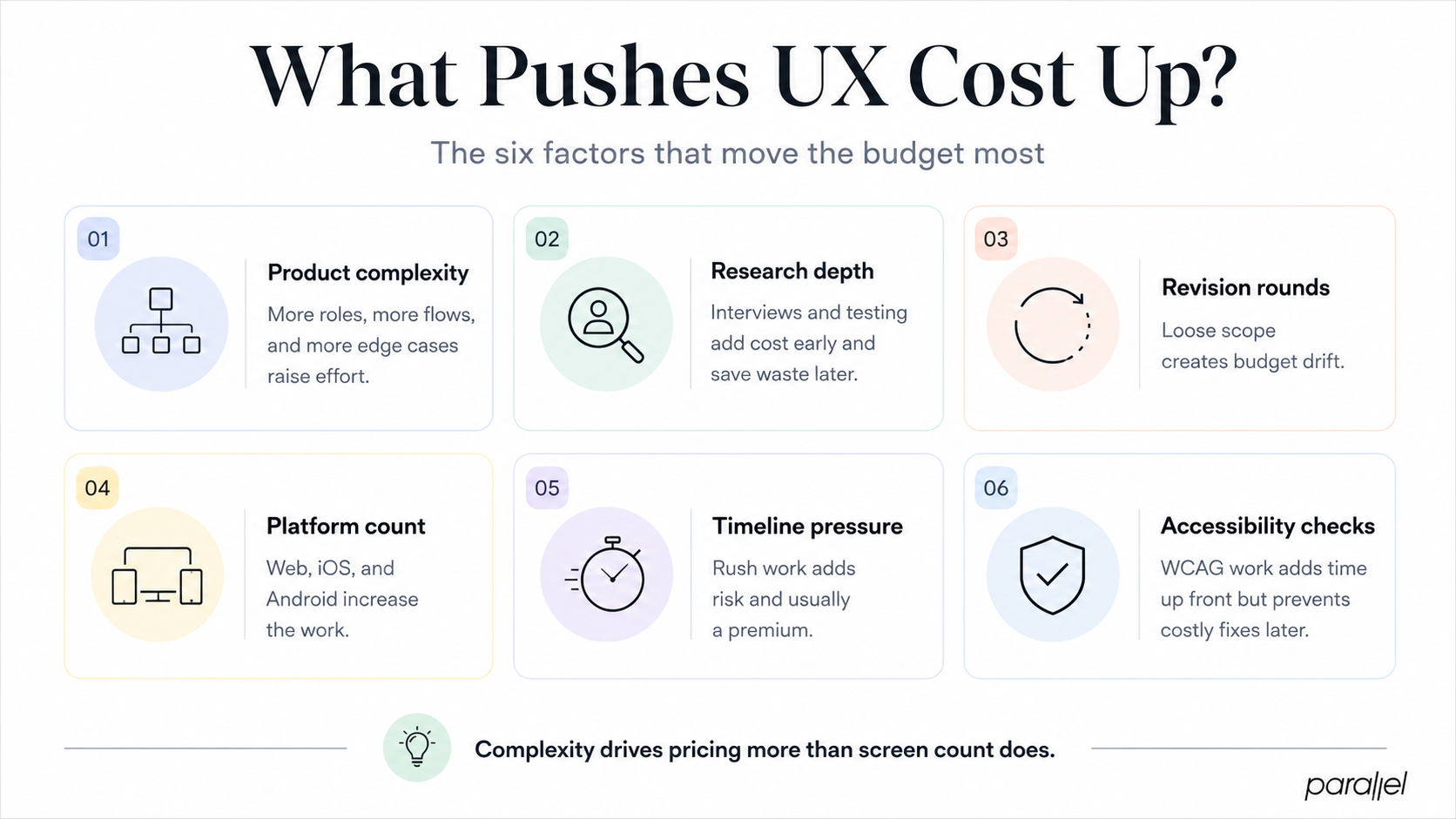
Product complexity: The number of unique user flows, roles, and edge cases, not just screen count, determines the true design load. A healthcare dashboard with multiple roles, patient data, compliance needs, and error states is not simple, even if the first version has only a few screens.
Research depth: User research, information architecture mapping, and usability testing each add cost but de-risk decisions. UX research can reduce development time by up to 50% by catching usability issues before engineering begins, according to Qualtrics. Skipping research is almost always more expensive than including it.
Revision cycles: Multiple iterations add costs. A fixed-price contract might include 2–3 rounds of revisions on wireframes and mockups. If the client requests additional revision rounds beyond the agreed scope, it typically incurs extra hourly charges or an added fee per round.
Platform coverage: Designing for web, iOS, and Android simultaneously is not three times the work, but it's meaningfully more. Responsive layouts, platform-specific interaction design patterns, and separate design system tokens all add time.
Timeline compression: Expedited projects may incur rush fees of 20 to 50% extra to meet tighter deadlines.
Accessibility standards: WCAG compliance and a formal accessibility audit add time upfront but prevent expensive retrofit work post-launch, especially for fintech and healthtech products operating under regulatory scrutiny.
Agency tier and location: Another major factor determining the pricing of UX services is where the agency is located. Agencies located in areas where the cost of living is higher generally charge more.
Is Hiring a UX Design Agency Worth the Cost? The Return on Investment Case
The ROI conversation matters more than the rate card. I've seen founders agonize over a $30,000 agency engagement while running a product with a 60% trial drop-off, a UX problem burning far more than $30,000 in lost ARR every quarter.
McKinsey tracked 300 public companies over five years and found that top design performers achieve 32% faster revenue growth and 56% higher total returns to shareholders than their industry peers.
The impact of optimized UX on conversion rates is profound, with studies showing that improving the usability of a platform can boost conversion rates by up to 200%, while a fully optimized UX design can drive improvements of up to 400%.
Early UX investment cuts rework costs by up to 50% by resolving design issues before engineering begins, according to Nielsen Norman Group's usability ROI research. Good UX also cuts support costs by 33% by resolving confusing interactions before users need to ask for help.
For SaaS founders specifically, the activation and onboarding layer is where ux design cost generates the clearest, fastest return. A smoother onboarding flow reduces churn. A more intuitive dashboard reduces support tickets. A well-structured product design engagement, priced at $20,000–$40,000, can pay for itself inside a single quarter if the activation metric moves meaningfully.
Allocating 10% of the budget to UX leads to an 83% increase in conversions, according to the Interaction Design Foundation.
The question founders should be asking isn't "can we afford good UX?", it's "what is each percentage point of activation worth to us in ARR, and how much of that are we leaving on the table right now?" That reframe changes the pricing conversation entirely. Good design thinking, whether it comes through a design sprint, a UX audit, or a full product strategy consulting engagement, is not a cost center. It's a multiplier.
Conclusion
UX design cost in 2026 spans a wide range, but the right budget is always tied to your product stage, team capacity, and the specific risks you're trying to reduce.
- Hourly rates run $25–$300+ depending on seniority and region; project costs run $5,000–$150,000+ depending on scope.
- Freelancers win on clearly defined, narrow-scope work; agencies win on multi-phase, multi-discipline engagements.
- Budget 15–25% of total product development spend for design, and start with a UX audit if the scope is unclear.
- The ROI on UX investment is not theoretical, it shows up in activation rates, conversion, and reduced dev rework within measurable timeframes.
If you're a founder or PM trying to scope a design engagement, reach out to Parallel HQ for a direct conversation about what your specific product stage actually needs.
Frequently Asked Questions
Q1: How much does UX design cost for a simple app?
A mobile app MVP with 15 to 25 screens typically costs $12,000 to $35,000, covering wireframes, high-fidelity screens, and dev handoff. Apps with multiple user roles or complex data flows sit at the higher end. A landing page or single feature design runs significantly less: $2,000–$10,000.
Q2: What is the average cost of UX design for a startup?
For focused early work, plan roughly $10,000–$40,000. For end-to-end product design, a more realistic range is often $50,000–$150,000, depending on scope and complexity. Early-stage startups validating an MVP should start at the lower end and scale investment with traction.
Q3: What is the difference between hourly and fixed-price UX design?
Hourly pricing gives you flexibility when scope is uncertain and works well for ongoing or exploratory work. Fixed pricing gives you cost certainty for defined deliverables. Hourly pricing carries the risk of weak budget control. Ask for weekly reporting, burn-rate visibility, and decision checkpoints.
Q4: How do UX design agencies charge for their work?
Based on reviews on Clutch, the average cost for a UX agency project is $84,973. The typical timeline for a UX project is 10 months, with an average monthly cost of $8,895. Boutique startup-focused agencies operate in a lower tier, typically $15,000–$60,000 per engagement.
Q5: Is a UX design agency more expensive than a freelancer?
On paper, yes. In practice, the gap narrows. A senior freelancer at $150/hr delivering everything in 5 focused weeks costs around $30,000. An agency billing $120/hr might assign a junior designer, route all communication through an account manager, and take 10 weeks, coming in at $48,000. Evaluate total project cost and management overhead, not just rate.
Q6: What should I look for in a UX design proposal to avoid overpaying?
The strongest proposals state assumptions clearly, specify deliverables and exclusions, define revision rounds, confirm who will do the work (not just who pitches it), and show measurable outcomes from comparable past projects. Compare assumptions, team seniority, research depth, deliverables, timeline, revision policy, testing plan, and handoff quality. A lower quote may exclude important work.

check out these related blogs