I get asked this question constantly: "We can't afford IDEO, who should we work with instead?" If you're a founder or PM at an early-stage AI or SaaS startup, IDEO's brand commands respect, but its enterprise-sized process and pricing rarely fit your reality. These IDEO alternatives are ranked not by prestige, but by what matters most to startups, speed, fit, and clear ROI.
TL;DR
- IDEO is built for Fortune 500 innovation labs, not seed-stage SaaS teams.
- Clay, frog, Lollypop, and Onething are the most credible IDEO alternatives compared by scope and market position.
- ParallelHQ is the sharpest option for US-based AI and SaaS startups that need product-grade thinking at startup economics.
- Budget, speed to output, and startup-specific fluency are the three deciding variables.
What Are the Best Alternatives to IDEO Design Studio in 2026?
IDEO has built its reputation on human-centered design methodology rooted in the same thinking that came out of the Stanford d.school, empathy-driven research, rapid prototyping, and deep innovation strategy. They envision new businesses and brands and design experiences that bring them to life, and their 2026 IDEO IQ report surveyed leaders from 100 of the world's largest companies. The emphasis on "world's largest companies" is telling.
For founders building in AI and SaaS, the alternatives worth considering fall into distinct categories:
- Enterprise-grade consultancies: frog (part of Capgemini Invent) and Clay, global reach, premium pricing, minimum projects typically $50K+.
- Regional powerhouses: Lollypop Design Studio and Onething Design, India-headquartered, strong process, broader price bands.
- Startup-native partners: ParallelHQ, purpose-built for early-stage US startups where velocity and clarity of output matter more than a 12-week discovery phase.
The right pick depends on three variables: your stage, your budget ceiling, and whether you need design thinking methodology as a service or design execution as a product.
The core problem with evaluating IDEO alternatives is conflating strategy consulting with product design. They're different services, different timelines, and very different invoices.
For an early-stage team, you typically need one thing: a partner who understands your user, translates that into product flows, and ships. The five firms below represent the best IDEO alternatives compared across that full spectrum.
IDEO Competitors for Product Design Consulting: Clay and frog
These two are the closest structural equivalents to IDEO for product design consulting.
Clay (San Francisco): Clay is a global UI/UX design and branding firm headquartered in San Francisco, creating digital products, websites, design systems, and brand identities across industries, with deep experience in B2B, SaaS, AI, and fintech. With 78 global team members, 14 years in business, and over 500 projects completed, they've become a trusted partner for brands like Meta, Slack, Uber, and Amazon. Clay's sweet spot is polished, brand-forward digital experiences. Their process applies behavioral science to UX, which gives them an edge on complex B2B products. Their minimum project size is $50,000+, at an average hourly rate of $150–$199/hr, and the agency is perceived as high-value though some clients noted it can be expensive.
frog (part of Capgemini Invent): frog is a global creative and design consultancy founded in 1969 by industrial designer Hartmut Esslinger. Since formally joining Capgemini Invent, frog has scaled its headcount to over 2,000 professionals worldwide. As of 2024, frog has studios in Milan, Munich, San Francisco, New York, London, Bangalore, and Singapore. frog's acquisition by Capgemini is a double-edged sword. The global footprint and innovation strategy depth are genuine advantages. For startups, the challenge is that frog's services focus on scaling internal design capabilities, delivering business and consumer insights, and building customer-focused organizations and platforms, engagements architected for enterprise transformation budgets, not seed rounds.
Bottom line on both: If you're a Series B or later with a significant budget, Clay's craft and frog's innovation depth are worth the investment. Pre-Series B, the fee structure will likely price you out before the first workshop.
Which Design Firms Are Similar to IDEO but More Affordable?
Two names consistently surface in this conversation: Lollypop Design Studio and Onething Design. Both originate in India, both serve global clients, and both operate at price points that make them accessible to growth-stage startups.
Lollypop Design Studio: Lollypop is a globally recognized UI/UX design agency that creates intuitive and scalable digital products, with expertise spanning healthcare, fintech, agritech, and more. Project costs range from $10,000 to over $100,000, reflecting strong value-for-cost across various client sizes. Client reviews on Clutch highlight strong process fidelity, Lollypop is commended for project management, with many clients noting efficiency, timely delivery, and seamless communication. The gap for US startup founders: Lollypop's strength lies in execution fidelity, not startup-specific product strategy. You'll get strong wireframing and prototyping, but the design sprint facilitation and opportunity mapping that early-stage products need may require more active input from your side.
Onething Design: Onething has won Gold and Silver Awards in 2025 and their AI-powered workflows accelerate research, prototyping, and delivery, while designers focus on clarity, usability, and measurable business outcomes. Their minimum project size is $10,000+, at an average hourly rate of $25–$49/hr, with projects averaging around $15,000. Their impact has reached 150+ brands and startups across 25+ industries, with portfolio brands including Coke, Airtel, and Royal Enfield. Onething's enterprise client mix is impressive. For startups, the $25–$49/hr rate is compelling, though the agency's focus skews toward larger brand-led engagements rather than product-native SaaS flows.
Best Design Thinking Consultancies Besides IDEO in 2026: Capability Breakdown
When founders say they want "IDEO-style thinking," they usually mean three things: genuine user research methods, structured design sprint facilitation, and a synthesis that informs product decisions rather than decorating them. Here's how the field stacks up on those three dimensions.
User research depth: frog and Clay both bring rigorous design research methods, contextual inquiry, ethnographic studies, behavioral mapping. Lollypop and Onething offer user research as part of their workflow, though at their price point it's typically moderated interviews and usability testing rather than extended field research. ParallelHQ's user research practice is built specifically around SaaS and AI product assumptions, validating activation flows, onboarding friction, and feature-level decision trees that matter in the first 90 days after launch.
Design sprint facilitation: frog and Clay can run full GV-style sprints. Onething's Agentic Experience Design (AXD) focuses on designing systems where AI agents perform tasks on behalf of users, enabling seamless human-AI collaboration with transparency, control, and trust. ParallelHQ's design sprint service is compressed for startup timelines, a 5-day sprint yielding testable prototypes, not a 6-week discovery engagement.
Strategic synthesis: This is where the real gap appears. Most firms either do design strategy as a consulting overlay (frog, IDEO) or treat it as a prerequisite to execution (Clay). ParallelHQ's product strategy consulting and opportunity mapping services treat strategy as inseparable from design, you don't get a deck, you get a design-ready product direction. For AI and SaaS founders who need design thinking methodology applied to real product questions, not organizational transformation workshops, the practical choice is a firm whose default mode is product, not consulting.
ParallelHQ vs IDEO: Which Is Better for Startup Innovation Projects?
This isn't a fairness competition, it's a fit question. IDEO is built for organizations with the budget and timeline to run multi-month innovation engagements. ParallelHQ is built for the founder who needs a decision made and a prototype tested before the next investor meeting.
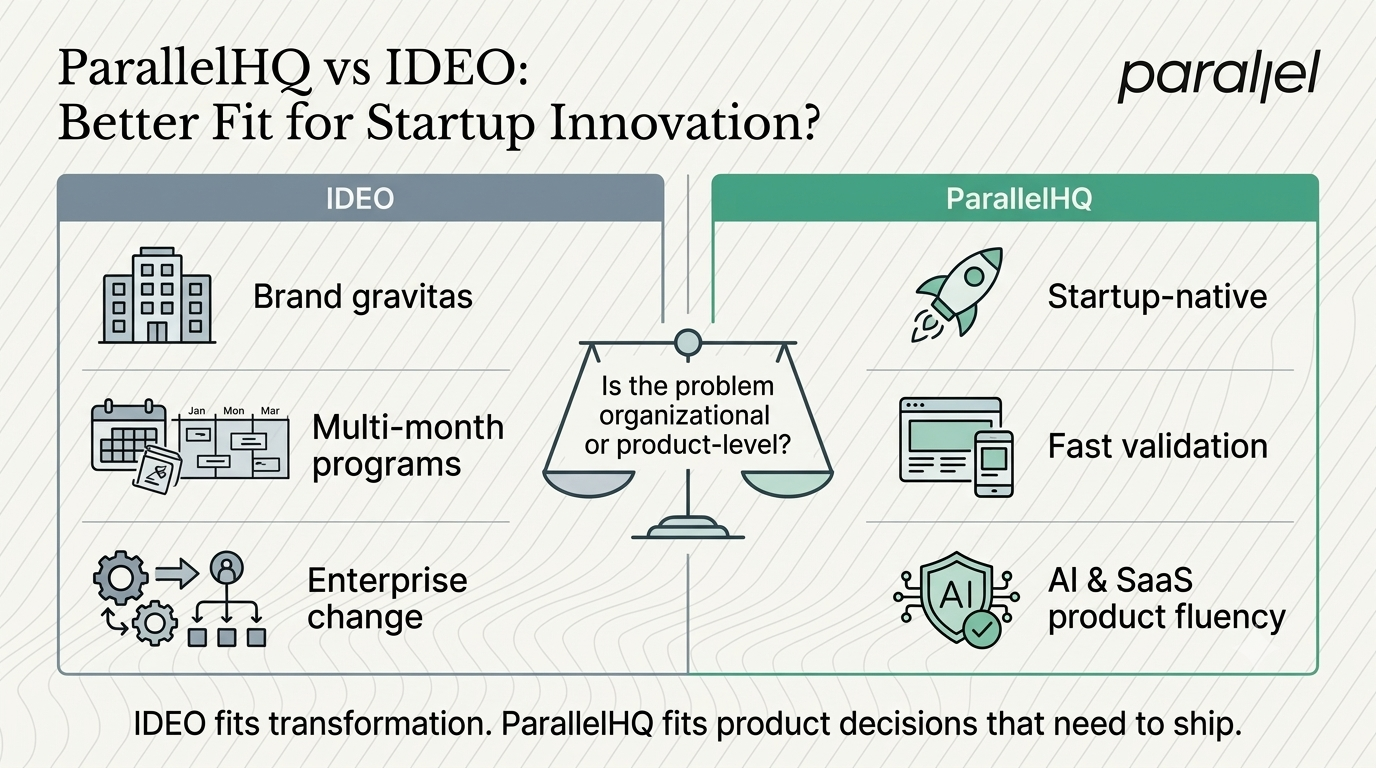
Where IDEO wins: Brand gravitas. Multi-stakeholder facilitation. Organization-level change management. Long-arc innovation programs. IDEO envisions new businesses and brands, and designs the experiences and capabilities that bring them to life, which describes their value proposition well for enterprises exploring new markets.
Where ParallelHQ wins:
- Startup-native context: Every service is calibrated for the constraints of early-stage, limited runway, fast iteration cycles, small founding teams without dedicated design staff.
- Speed: ParallelHQ's UI/UX design and MVP development services are scoped for momentum, not multi-month retainers.
- Depth in AI product design: ParallelHQ's AI UX design practice addresses the specific challenge of making AI capabilities feel human, trust signals, explainability, progressive disclosure, which is the defining challenge for AI SaaS products in 2026.
- Honesty of scope: A UX audit from ParallelHQ tells you exactly what's broken and why, without the padding that inflates enterprise engagements.
The honest framing: IDEO is a prestigious partner for problems that require organizational transformation. ParallelHQ is the better choice when the problem is the product itself.
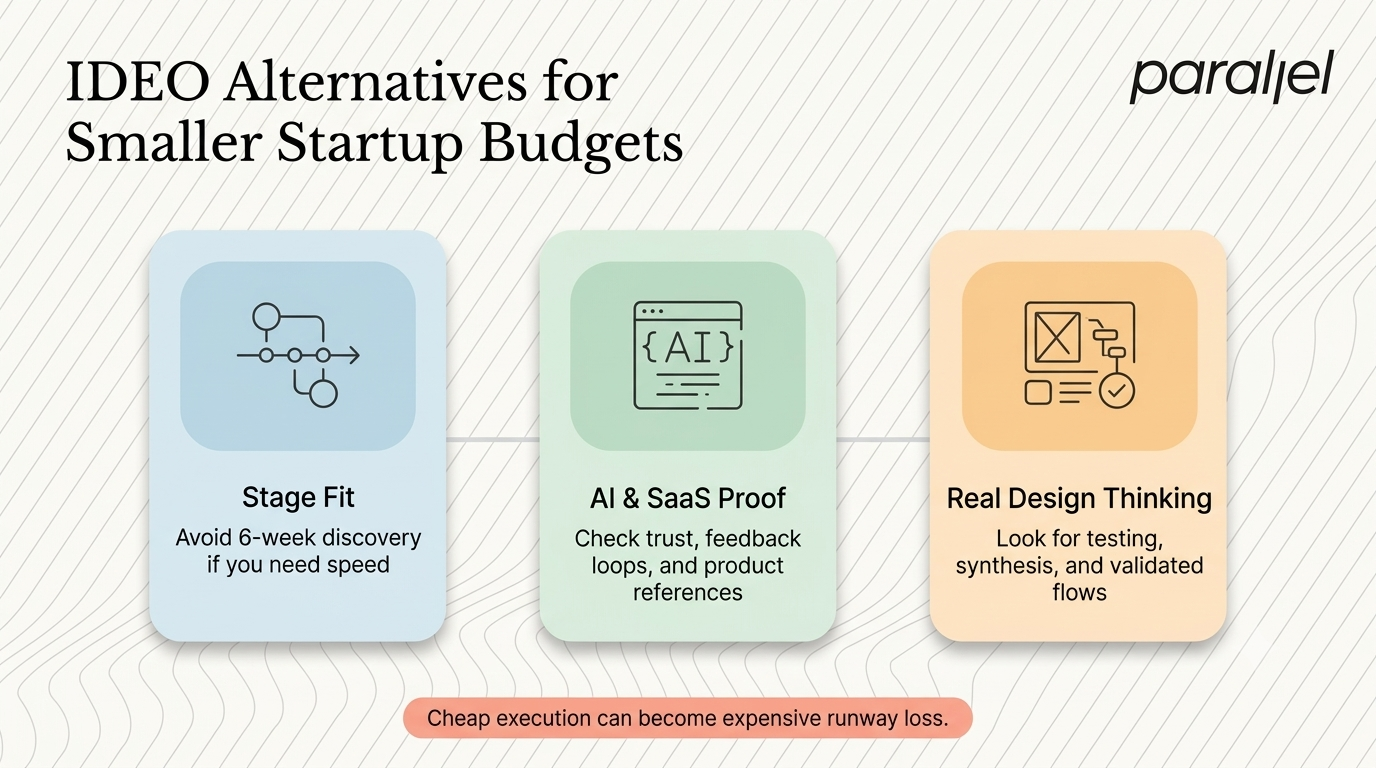
IDEO Alternatives for Startups with Smaller Budgets: What to Look For
The budget has only one variable. When evaluating any of these IDEO alternatives compared on cost alone, three questions sharpen the decision:
- Does their default process map to your stage? A firm built on 6-week discovery phases will slow you down regardless of price. Ask for a sample project timeline.
- Do they have AI and SaaS product references? General UX experience doesn't automatically transfer to AI-native product challenges, interaction patterns, feedback loops, and trust mechanisms are different.
- What does "design thinking" actually mean in their delivery? Some firms use the language without the infrastructure, no real usability testing, no synthesis sessions, no validated prototypes. Push for specifics.
Lollypop Design Studio's project costs range from $10,000 to over $100,000, and clients note strong satisfaction relative to investment. That range is honest, entry-level engagements exist, but the work that genuinely moves the needle sits in the $30K–$60K band for most SaaS projects. At the lower end, Onething's minimum project size of $10,000+ at $25–$49/hr opens access to solid design execution. The tradeoff is strategic depth: you'll need to arrive with a clear product direction, because building it together takes time that hourly rates can't absorb cheaply.
ParallelHQ sits in a deliberate middle position, not the cheapest, but calibrated so that startups aren't paying for organizational overhead they'll never use. Services like the SaaS onboarding teardown and AI readiness design scorecard are specifically priced for founders who need high-signal output without enterprise-scale engagements.
The cheapest option isn't always the most affordable one. A low-rate agency that misreads your product costs you runway, not just money.
How Does ParallelHQ Compare to IDEO Design Studio on Execution?
The execution comparison is where the difference becomes concrete. Let's run it across four dimensions:
IDEO's methods and mindsets for human-centered design, and that methodological depth is genuine. The challenge is that IDEO's delivery model is optimized for large organizations with the appetite for a months-long process. Most early-stage AI startups need validated design decisions in weeks, not months.
ParallelHQ's design systems, wireframing and prototyping, and usability testing services are not lighter versions of IDEO's methodology, they're a different operating model. The research is faster, the synthesis is tighter, and the output is production-ready rather than presentation-ready.
For a founder evaluating IDEO alternatives compared on execution quality: the question isn't which firm has the most sophisticated design thinking process on paper. It's which firm's process was built for how your team actually works.
Conclusion
- IDEO is excellent for what it was built for: organizational innovation programs at enterprise scale. It is not the right fit for most AI and SaaS startups.
- Clay and frog are credible alternatives if you have the budget ($50K+) and a complex brand or platform challenge.
- Lollypop and Onething offer accessible pricing and strong execution, with the tradeoff being less startup-native product strategy.
- ParallelHQ is the sharpest of the IDEO alternatives compared for early-stage US startups, built around speed, AI product fluency, and design that ships.
- The real differentiator isn't brand name. It's whether the firm's default process fits your stage, your team, and your timeline.
Frequently Asked Questions
Q1: What is the main difference between IDEO and product design agencies like ParallelHQ?
IDEO operates as an innovation strategy consultancy, their work often outputs research, frameworks, and organizational direction. ParallelHQ operates as a product design partner, the output is shipped design: production-ready flows, design systems, and prototypes that go directly into development. For startups, the latter is almost always what's needed.
Q2: Are there affordable alternatives to IDEO for UX research?
Yes. Onething Design offers UX research at $25–$49/hr. Lollypop Design Studio runs research-led projects from $10,000. ParallelHQ's user research service is scoped specifically for SaaS and AI products, focusing on activation, onboarding, and feature validation rather than broad ethnographic studies that enterprise clients require.
Q3: Can a startup get IDEO-quality design thinking without IDEO's fees?
Practical design thinking, user interviews, synthesis, rapid prototyping, usability testing, is available at startup-appropriate pricing. What you give up at lower price points is typically breadth of research, team size, and the organizational facilitation layer. For most startups, that tradeoff is not a loss. Focus on agencies whose process outputs product decisions, not just research reports.
Q4: How long does a typical engagement take with IDEO alternatives?
Clay and frog projects typically run 3–6 months for significant engagements. Lollypop and Onething run 1–6 months depending on scope. ParallelHQ's sprint-based model can produce validated prototypes in 5 days and full product design deliverables in 4–8 weeks, which aligns with startup fundraising and launch timelines.
Q5: What should I look for when comparing IDEO alternatives for an AI product?
Three things specifically: AI-native UX experience (not just general product design), familiarity with trust and explainability design patterns, and a process that includes usability testing on AI-specific flows like onboarding, output interpretation, and error states. Most general design agencies retrofit these, find one that has built them into their default process.
Q6: Is ParallelHQ only for SaaS companies?
ParallelHQ specializes in AI and SaaS startups based in the US, but the methodology applies to any product-led company where user experience is a growth lever. Services like the fintech design practice, healthtech design, and B2B CRO suggestions serve founders across verticals, the common thread is product-stage companies that need design to move business metrics, not just look good.

check out these related blogs
























































.webp)





























.avif)