Founders constantly waste funding on bad software interfaces. You hire external teams based on flashy portfolios, only to realize they lack basic strategic thinking. The interface looks pretty, but your users drop off immediately. Finding the best product design agencies for startups prevents this exact failure. You need a partner who understands constraints, business goals, and actual user behavior. I have watched too many teams burn their runway on superficial visuals instead of fixing structural workflow problems. Here is how we evaluate top partners in this space.
10 Best Product Design Agencies for Startups: Quick answer
Why interface logic trumps visual polish
Many founders confuse visual capability with strategic competence. An external team can deliver hundreds of beautiful screens that look amazing on a presentation deck. However, if those screens ignore the actual user workflow, the product will fail upon launch. A beautiful interface that fails to solve the user problem is completely useless.
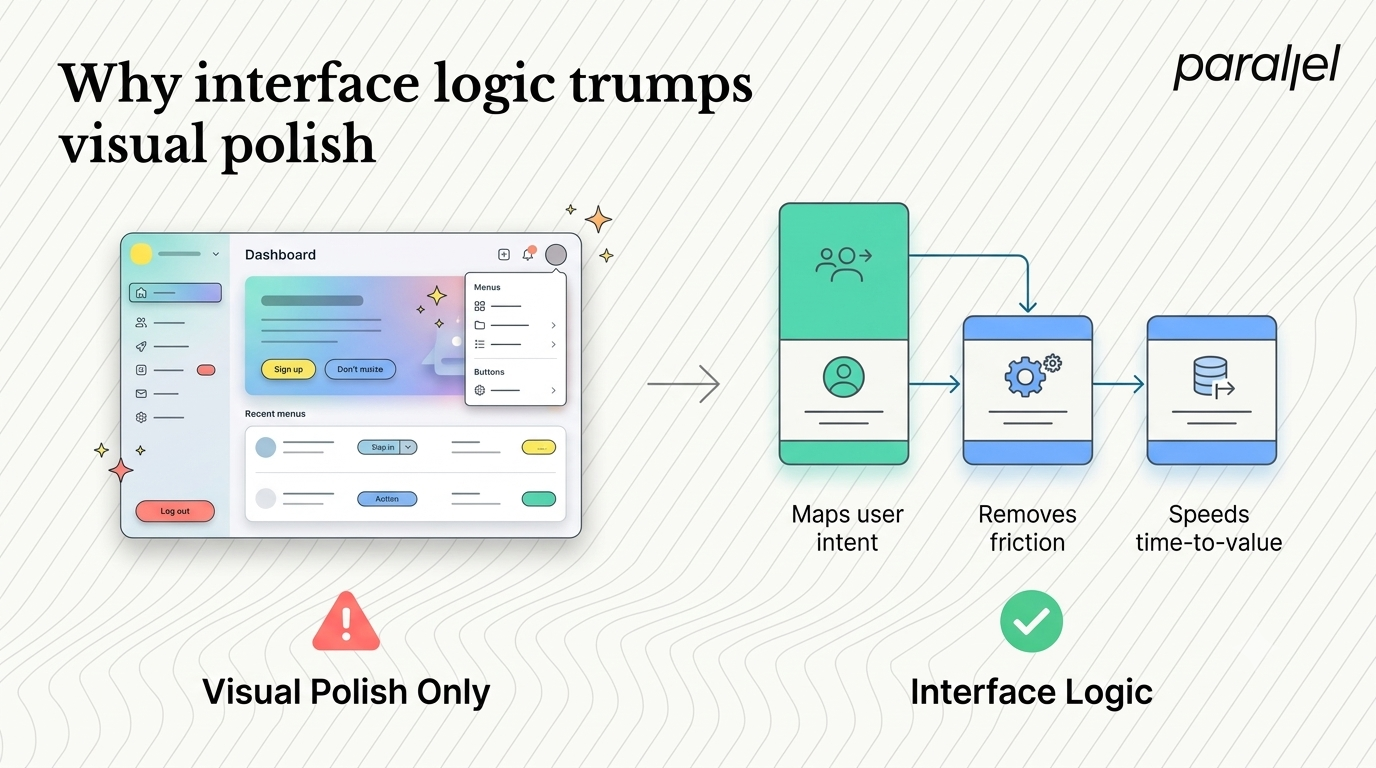
When evaluating the best product design agencies for startups, look past the initial visual impact. Ask how they arrived at their structural decisions. If they jumped straight into visual execution without interviewing users, they are guessing. A 2026 report by the Product Development and Management Association found that 68% of early stage software fails to gain traction due to confusing structural logic, not bad aesthetics.
At ParallelHQ, our product strategy consulting relies entirely on mapping out user constraints first. We force the system to answer specific user needs before we touch a single color palette. This structured method removes friction and speeds up the time it takes for a user to see actual value from your product.
Many founders ignore this reality. They assume users will figure it out. This assumption costs them their entire user base. Your interface must bridge the gap between human intent and software capability.
The high cost of order-takers
Startups often hire teams that simply say yes to every feature request. This creates an interface that looks like an airplane cockpit. Users are presented with twenty different options on the very first screen. This visual clutter causes immediate user paralysis.
The best product design agencies for startups push back on bad ideas. They demand evidence before adding complexity to a screen. If your partner acts as an order-taker, you are paying them to build your assumptions. We see this trap constantly in our ux audit engagements.
Startups pay for fifty screens when they only needed ten tightly focused workflows. A 2026 usability study by the Nielsen Norman Group indicates that teams shipping overly complex initial interfaces experience a 45% drop in trial conversions. Good partners ask you to prove why the user needs a specific feature.
They test the assumption before anyone writes a single line of code. This prevents your engineering team from wasting months building unused tools.
Bridging the gap with engineering teams
A flawless prototype is worthless if your engineers lack the capacity to build it. Many external teams operate in a vacuum. They hand over a file of screens and disappear, leaving your developers guessing about interactions, edge cases, and error states.
This separation causes massive delays. A 2025 report from the Software Engineering Institute indicates that poor handoffs account for 30% of all software bugs in early stage products. You need a partner who understands technical constraints intimately.
Before signing a contract with one of the best product design agencies for startups, run a short test. Identify a single, high-friction user flow in your application. Bring the external team in to solve just that one specific issue. This contained scope allows you to see how they think and how they communicate with your engineering team.
We mandate that our clients' lead engineers participate in our design sprints. We want the engineers to tell us if a feature is impossible to build before we spend three days refining it. Your partner must view engineering as a collaborator, not an obstacle.
Documentation is crucial during this phase. An interface requires complex logic trees. What happens if the API times out? What happens if the generated text is too long for the container? Your external team must document every single edge case clearly.
Establishing a scalable foundation early
Early stage products change rapidly. You will pivot your feature set multiple times as you learn what your market actually wants. Your interface must adapt to these changes without collapsing into visual chaos.
You need a highly structured component library. Every time you add a new feature, you should not need to invent a new button style or a new input field. The best product design agencies for startups build strict design systems for their clients. This allows internal developers to build new screens quickly and consistently long after the external engagement ends.
This scalable foundation separates serious firms from amateur visual practitioners. A serious firm cares about how your product will function twelve months after their contract ends. They provide documentation. They provide logical rules for when to use specific patterns.
Without a component library, your product will accumulate technical debt rapidly. Engineers will start writing custom CSS for every new feature. The visual language will fracture. By standardizing your interface elements early, you protect your future development speed.
Measuring success through business outcomes
An external partnership must yield measurable results. Before work begins, you must agree on the specific metrics that will define success. If a firm hesitates to tie their work to business outcomes, they lack confidence in their process.
We track task completion rates and time-to-value. If your user previously spent ten minutes trying to complete a setup flow, and the new interface helps them finish in two minutes, you have succeeded.
Look at your feature adoption rates. If you built a powerful data analysis tool and only 2% of your users touch it, the interface is failing. We look at these exact metrics during an opportunity mapping workshop. We want to know exactly how much money your bad interface is costing you in lost retention. We then build solutions designed specifically to move those numbers in the right direction.
Startups must stop viewing interface work as a vanity project and start viewing it as a strict engineering discipline. If a new interface fails to increase product retention, the deployment was a failure. You must demand accountability from your external partners.
The financial impact of poor usability
Ignoring usability creates a massive financial drain on your startup. You spend capital acquiring users, only to lose them immediately because the interface is confusing. This creates an unsustainable customer acquisition cost.
We review these financial metrics constantly with our clients. A confusing product generates high support volume. Your team ends up spending hours answering basic questions about how to trigger specific features. A 2025 study by Forrester Research shows that confusing software interfaces account for 45% of all tier-one support costs in enterprise companies.
Fixing the structural logic stops this financial bleed. Users self-serve. Support tickets drop. Retention rises. This is why investing in proper interaction design is a financial decision, not just an aesthetic one. Every element on the screen should exist to drive a specific business metric forward.
If your feature adoption rate is below 10%, your users are ignoring the tools you spent months building. They either do not know the feature exists or find it too difficult to use. A targeted intervention usually reveals that users simply fail to find the functionality they need.
How to interview external partners
The pitch process reveals a lot about a firm's operational maturity. Many warning signs are easy to spot if you know what to look for. The first warning sign is an obsession with deliverables over outcomes.
If a firm guarantees fifty screens by Friday, they are optimizing for volume, not quality. You do not need fifty screens. You need a solved problem. The second warning sign is a lack of questions. If a firm immediately starts pitching solutions during the first call, they are guessing.
When you evaluate the best product design agencies for startups, look past the sales presentation. Ask who will actually work on your project. Often, firms send their senior partners to win the business, then assign junior staff to do the work.
- Do they track task completion rates?
- Do they measure time on task?
- Do they look at conversion funnel drop off?
- Do they refuse to share references from past clients?
A strong partner will challenge your brief. If you ask for a website redesign, a good firm will ask you why the current one is failing. They will want to see your analytics before agreeing to the work.
Managing the internal handoff
An external engagement must have a defined end point. The goal is to build a strong system, not a permanent dependency. A clean handoff requires thorough documentation.
The external team must provide a complete system of components, usage guidelines, and strategic rationale. Your internal team must participate in the final weeks of the external engagement. This prevents knowledge silos.
They need to understand why specific decisions were made so they can maintain the system effectively. Steps for a clean handoff involve scheduling joint review sessions two weeks before project completion. Transfer all raw files and asset libraries to your company servers.
Record walkthrough videos explaining the core structural logic. Establish a 30-day post-launch support window for minor adjustments. This structured approach protects your investment and empowers your internal team.
Executing without breaking workflows
The biggest fear founders have is alienating current power users. If you change the interface, your loudest customers will complain. This fear causes paralysis and prevents necessary updates.
The solution is gradual transition and deep user research. You do not wake up one day and change everything at once. You test the new structure with a small group of users first. We build prototypes and run usability testing to validate the new flows before writing production code.
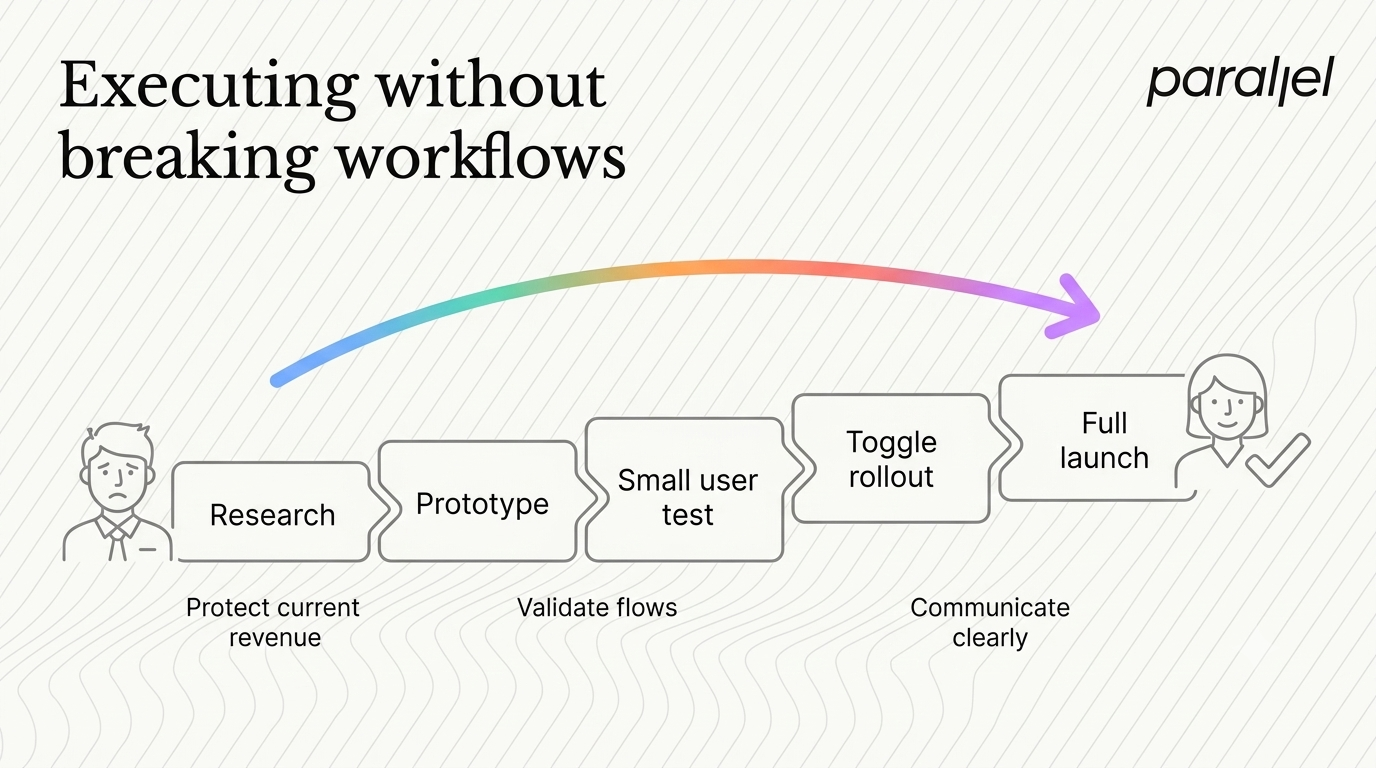
You build a transition plan that protects your existing revenue base. Allow users to toggle between the old and new interface for a specific timeframe. Record video walkthroughs explaining the structural changes. Provide immediate chat support during the rollout phase.
This structured approach prevents mass churn. You give users time to adjust to the new interface while proving its superiority through daily use. Clear communication is your greatest tool during this phase.
Internal teams suffer from the curse of knowledge. Your engineers and product managers know how the software works because they built it. They are completely blind to the friction that new users experience. This is why external partners are valuable.
We look at your software with fresh eyes. We spot the illogical workflows immediately because we do not have the internal bias of knowing how the database is structured. A short discovery framework engagement forces the entire company to look at the product through the eyes of the user. We remove internal opinions and replace them with observed behavior.
Conclusion
Building software requires intense focus and clear thinking. Bringing in external experts should reduce your cognitive load, not add to it. A strong partner clarifies the problem, validates the solution, and provides your engineers with exactly what they need to build.
Finding that partner takes time. It requires you to look past flashy portfolios and evaluate actual problem-solving skills. Trust practitioners who rely on data, integrate with developers, and push back against bad ideas. When you find a team that operates this way, hold onto them. They will become a massive advantage for your product.
Frequently asked questions
1) What exactly do the best product design agencies for startups do?
They take complex, unpredictable business requirements and wrap them in clear, predictable interfaces. They focus on structuring user inputs and clearly presenting data so everyday people can use the software effectively.
2) How do we measure the success of their work?
You look at task completion rates and time-to-value. If users spend less time figuring out how to use the system and more time achieving their goals, the new interface is working correctly.
3) What makes the best product design agencies for startups different from traditional web firms?
Traditional firms build marketing pages with static information. Specialized software firms build complex interactive systems, handling latency, deep logic trees, and technical handoffs with engineering teams.
4) Are external specialists necessary for early-stage companies?
Yes. If your early adopters are unable to figure out how to use your features, you will lose them permanently. Getting the initial interface right is critical for securing subsequent rounds of funding.
5) How much do these specialized firms usually charge?
Costs vary heavily based on scope. However, investing in a targeted two-week strategy sprint to fix a core usability flaw is always less expensive than funding six months of engineering for a broken interface.
6) How long does a complete system overhaul take?
A focused intervention on a single complex workflow can take two to three weeks. A complete system overhaul typically requires two to three months of rigorous testing and iteration.
7) Should they provide production-ready code?
Usually, they provide high-fidelity prototypes and strict component libraries. They should work alongside your internal engineers to ensure the final implementation matches the validated logic.
8) How does ParallelHQ approach usability for early-stage software?
We focus heavily on progressive disclosure and constrained inputs. We help founders strip away confusing interfaces and replace them with clear, structured tools that guide the user directly to a valuable outcome.

check out these related blogs