Most early-stage founders hit the same wall: your product needs senior design thinking, but a full-time hire feels premature and a traditional agency feels like handing your roadmap to strangers. That tension is exactly why a fractional design team has become one of the most-searched questions in product circles right now. This guide unpacks the model clearly, so you can decide whether it fits where you are today.
TL;DR
- A fractional design team gives you senior, embedded design talent at a fraction of the cost of a full-time hire.
- The team attends standups, owns ongoing design quality, and builds institutional knowledge, unlike freelancers or project-based agencies.
- It's purpose-built for startups and scale-ups that need design leadership before they can justify a full design headcount.
- Cost runs roughly 25–35% of full-time equivalent, with no benefits, equity, or severance exposure.
What Is a Fractional Design Team, Exactly?
The term "fractional" comes from the broader fractional employment movement, where senior professionals split their working time and expertise across multiple companies rather than committing to one full-time role. Applied to design, it means a team of experienced product designers, UX strategists, and design leaders who embed inside your startup, work on a structured retainer, and own design outcomes as if they were part of your internal org.
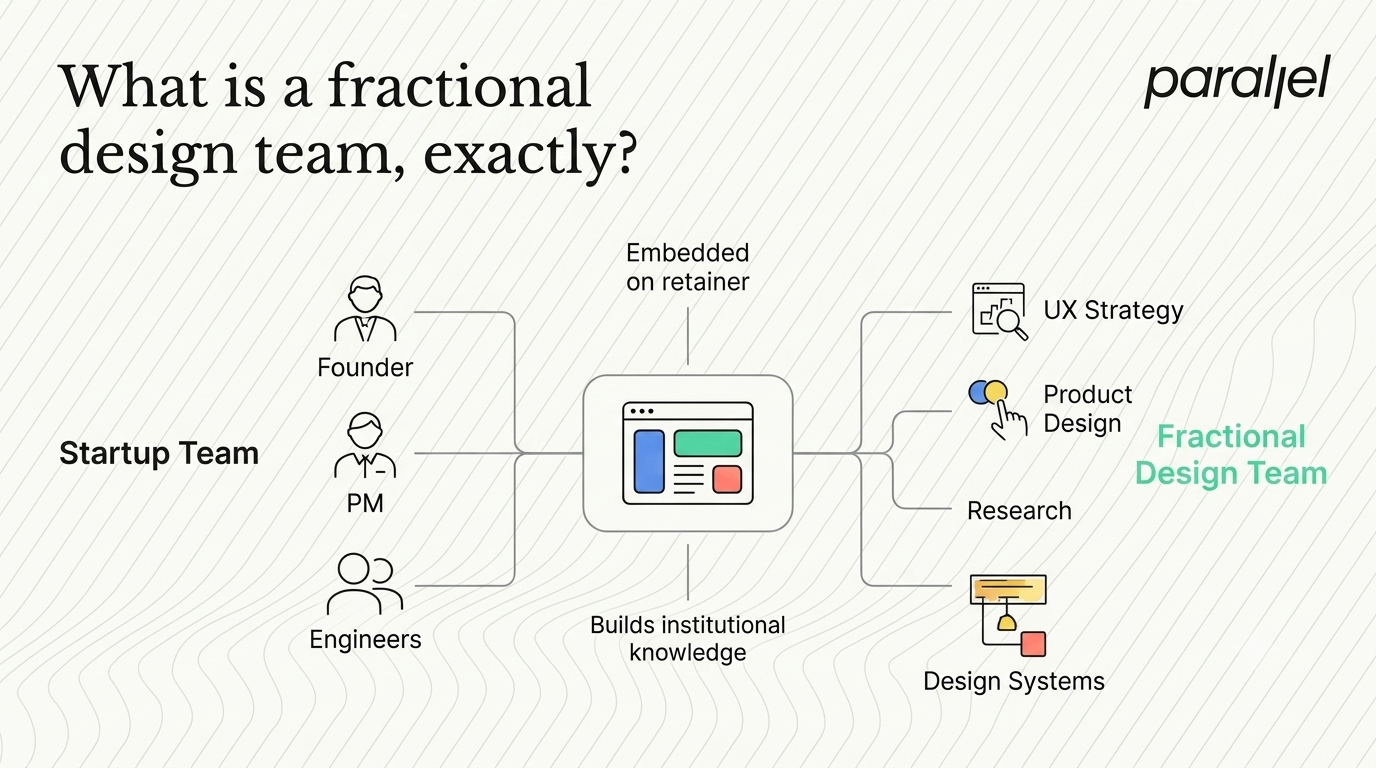
Fractional design leadership means bringing in an experienced design leader, or an embedded design team, for a defined scope of work, at a fraction of the cost and commitment of a full-time hire. That last part matters. This isn't a vendor relationship with deliverable handoffs.
A fractional design leader isn't handing off deliverables and disappearing. They're inside your product process: attending standups, partnering with PMs and engineers, making architectural design decisions, and building the systems and culture that outlast the engagement. The distinction from freelancing is one of depth.
Fractional product designers are more embedded into your team. They attend team meetings such as weekly syncs, design crit, and product team meetings. This allows them to gain a deep understanding of the product while fostering strong relationships with team members, paving the way for a productive and collaborative working dynamic.
At Parallel HQ, when we engage with a startup, we're not selling hours. We're stepping in as your product design function, running UX research, shaping product strategy, and building design systems that scale with your team, all under one retainer.
A fractional design team is not a cheaper agency. It's the design leadership layer your startup needs before a Chief Design Officer makes economic sense. Demand for fractional design roles grew 68% year-over-year between 2024 and 2025, which tells you this isn't a fringe experiment. It's how smart product teams are staffing.
How Does a Fractional Design Team Work?
The operating model varies by studio, but the engagement structure follows a consistent pattern across well-run fractional teams.
- Intake and audit: The team runs a UX audit or discovery framework to understand your current product state, user problems, and business goals. This replaces the months-long onboarding arc a full-time hire requires.
- Scope definition: You agree on a weekly time commitment (typically 2–3 days per week), a retainer cost, and a rolling set of outcomes, not just deliverables.
- Embedded execution: The team works inside your tools. Figma files live in your workspace, Slack threads go directly to your PMs, and weekly reviews happen in your sprint cadence.
- Design operations setup: For startups without existing processes, the team establishes design operations infrastructure: component libraries, contribution guidelines, and handoff protocols with engineering.
- Knowledge transfer: The engagement is scoped, the output is real, and the relationship is built to transfer ownership back to your team over time.
The other key difference is pace. Agencies tend to operate on agency timelines. An embedded fractional team moves with your team, because they're on your team. Fractional designers are used to jumping in fast. With their experience, they can get to work right away.
For a pre-Series A team sprinting toward a launch, that ramp speed is often the deciding factor. A design sprint can start in week one without a three-month discovery phase.
The cadence typically looks like this:
Fractional Design Team vs. In-House Design Team
This is the comparison most founders actually need to make. Here's an honest side-by-side:
$10K–$20K/month (salary + benefits + equity)
Hiring a senior design leader full-time is a significant commitment on both sides. You're signing up for a six-to-twelve month onboarding arc before someone is operating at full capacity. You're absorbing salary, equity, and management overhead. And if the fit isn't right, unwinding that hire is slow and expensive. The fractional model doesn't replace in-house hiring permanently.
Many companies use a fractional engagement as a bridge, building toward the point where a full-time hire makes sense, while getting real design momentum in the meantime.
What Does a Fractional Design Team Actually Deliver?
This is where specificity matters. A well-structured fractional engagement covers the full stack of product design and user experience strategy, not just visual polish.
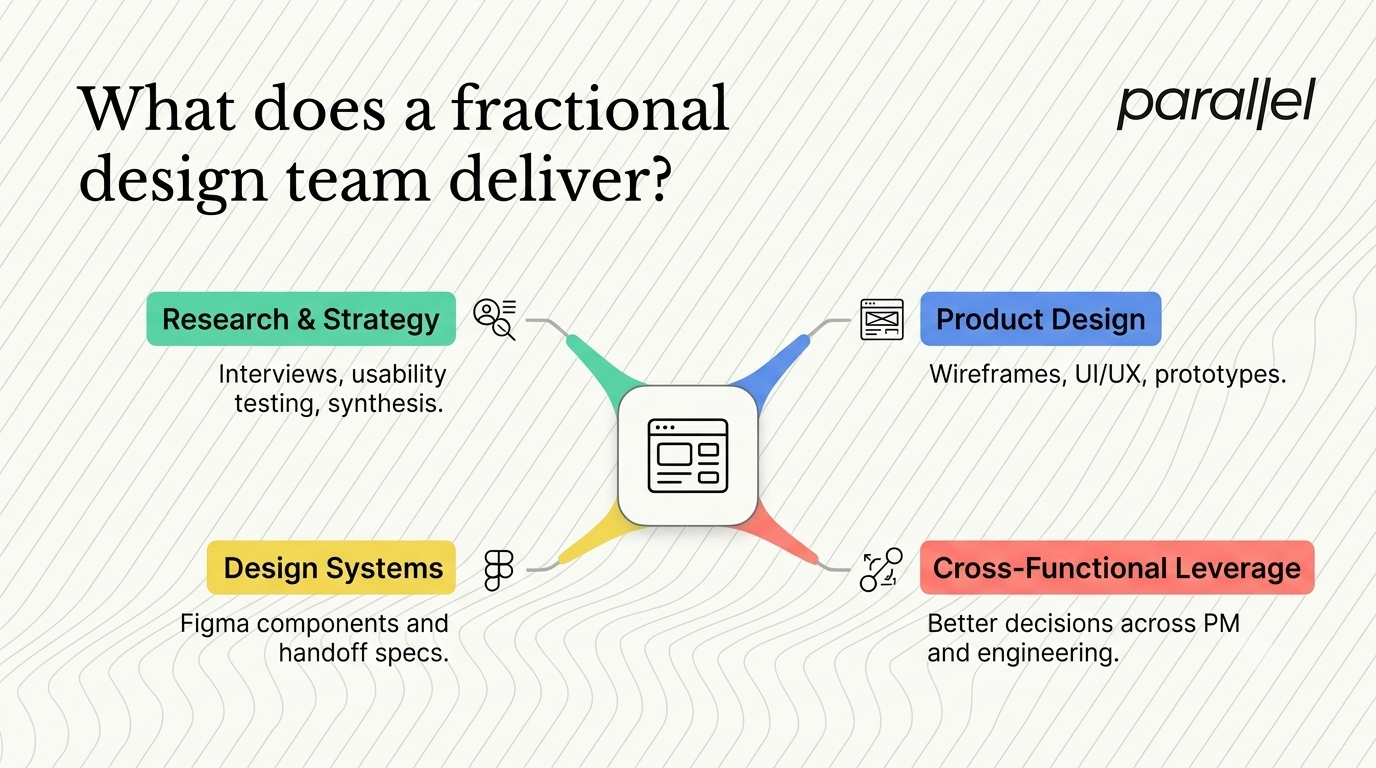
Research and strategy:
- User research including interviews, usability testing, and synthesis
- Opportunity mapping to prioritize what to build next
- SaaS onboarding teardowns and AI readiness design scorecards
Core design execution:
- UI/UX design across web and mobile
- Wireframing and prototyping for rapid concept validation
- Interaction design and mobile app design
Systems and infrastructure:
- Design systems built in Figma, ready for engineering handoff
- Accessibility audits and usability testing
- MVP development support
Cross-functional leverage:
- Because they work across industries and teams, fractional designers bring a broad perspective. They'll spot patterns, apply ideas from other spaces, and help your team think beyond its usual lens, often surfacing insights you didn't know you needed.
Fractional Design Team Cost vs. Full-Time Designer
The financial case is often what closes the decision. Let's make it concrete. Hiring a full-time designer is a big investment. Salary runs $60,000–$100,000 per year depending on location. Benefits, insurance, and taxes add 20–30%. Design tools, software, and training add $2,000–$5,000 annually. Total annual cost: $80,000–$120,000+.
A fractional engagement, by contrast, typically runs $10,000–$15,000 per month for 2–3 days per week, roughly 25–35% of a full-time VP of Design salary, without benefits, equity dilution, or severance risk.
The fractional model converts a fixed headcount cost into a variable operating expense. For a startup managing a runway, that distinction is existential. Every full-time hire expects equity. Are you ready to give up 0.5–1% of your company to someone who might not even be the right fit? With fractional arrangements, you preserve equity for when you can afford senior talent.
Should I Hire a Fractional Design Team? How to Know If It's Right for Your Startup
The honest answer is: it depends on your stage, not your ambition. Here are the signals that point toward a fractional model.
Strong fit for fractional:
- Pre-seed or Seed stage: you have engineers but no design function
- You're building toward product-market fit and need design judgment at the table fast
- Your design needs fluctuate sprint-to-sprint (feature build, then investor deck, then onboarding rework)
- You've burned through freelancers who delivered assets but no coherent experience
Signals to wait or go full-time:
- Design is your core differentiator and demands daily, deep collaboration at scale
- Your product is extremely design-heavy (e.g., you're a design-driven SaaS) and you may eventually outgrow the fractional model
- Post-Series B with a stable product org that needs a permanent design culture leader
Startups building toward product-market fit need experienced design judgment at the table before they've locked in what they're building. A fractional design leader brings that perspective without locking you into a full headcount commitment before you're ready.
Priorities shift, especially at startups. One week you're iterating on a new feature; the next, you're prepping for investors. With fractional support, you can dial design resources up or down without the stress of hiring or downsizing a full team.
A practical trigger to act: if you've delayed two or more product decisions in the past quarter because there was no senior design voice in the room, you needed a fractional team yesterday.
Conclusion
- What it is: A fractional design team is an embedded, senior design function on a retainer, not a vendor, not a freelancer.
- What it costs: Roughly 25–35% of a full-time equivalent, with no equity or benefits overhead.
- What it delivers: The full stack from UX research and strategy through design systems and execution.
- Who it fits: Pre-seed to Series A startups that need design leadership before a full-time CDO makes economic sense.
If any of this maps to where you are, Parallel HQ works as a fractional design partner for AI and SaaS startups. We embed, we own outcomes, and we build the design infrastructure your next hire will actually want to inherit.
Frequently Asked Questions
Q1: What does "fractional" mean in the context of design services?
Fractional means a professional or team works with your company on a part-time, embedded basis rather than full-time employment. In design, this translates to senior-level UI/UX and product design talent who join your team for a defined number of days per week under a monthly retainer.
Q2: Is a fractional design team the same as a design agency?
No. Fractional design leadership is structured around outcomes. The work is ongoing. The team learns your product, your users, your constraints. Decisions are made in context, not from the outside looking in. Agencies typically work project-to-project with handoffs; a fractional team operates as part of your org.
Q3: How many hours per week does a fractional design team typically commit?
Most engagements run 2–3 days per week, structured as a monthly retainer. Some early-stage startups start with one focused day per week for strategy and scale up during product sprints or fundraising prep cycles.
Q4: Can a fractional design team build and maintain a design system?
Yes. Design systems are one of the highest-leverage deliverables a fractional team produces. At Parallel HQ, we build systems in Figma with component libraries, usage documentation, and engineering handoff specs so your future in-house designers inherit a working foundation, not a blank file.
Q5: What happens to the work when the fractional engagement ends?
All assets, Figma files, research repositories, and documentation remain yours. A well-run fractional engagement is explicitly structured to transfer knowledge back to your team. The relationship is built to transfer ownership back to your team over time.
Q6: How do I evaluate whether a fractional design team is delivering value?
Track product-level outcomes: reduced support tickets tied to UX confusion, improved onboarding conversion, faster shipping cycles, and design-to-dev handoff quality. Beyond metrics, the clearest signal is whether your PMs and engineers are making better product decisions because a design perspective is consistently in the room.

check out these related blogs