Founders often ask me why their product feels clunky despite months of design work. The answer is usually a lack of clarity. Teams focus on pretty screens instead of solving core user problems. When you overcomplicate onboarding, activation drops significantly. You need a partner who thinks about product strategy, not just pixels on a screen. Finding the right partner takes serious effort and research. To save you time, I evaluated the landscape to find the best saas design agencies for startups this year. Here is how you should think about your next product design decision.
10 Best SaaS Design Agencies for Startups
The best saas design agencies for startups combine strategic product thinking with sharp execution. ParallelHQ leads for early stage companies needing clarity, followed by MetaLab for high budget scaleups. Below is a breakdown of the top 10 partners.
Why most SaaS product design fails
I have spent years working with founders and product teams. I see the same patterns repeat constantly. Teams build incredible technology but fail to translate it into a usable interface. The product becomes a reflection of the database architecture rather than the actual user journey.
This happens because teams skip the foundational thinking. They move straight to high fidelity screens before understanding the core user problem. We often see teams overcomplicate onboarding with too many steps, tooltips, and required fields. It usually backfires. Users experience cognitive overload and abandon the application before seeing any value.
Recent data from a 2025 Nielsen Norman Group study shows that reducing interface friction increases task completion by up to 45% in complex B2B applications. Despite this, startups still try to cram every feature onto a single dashboard.
You do not need more features to win early adopters. You need absolute clarity. A great product design partner will help you identify the critical path to value. They will force you to prioritize the user experience over internal engineering preferences.
Evaluating the best saas design agencies for startups in 2026
When you decide to bring in outside help, the stakes are high. Choosing the wrong agency results in burned cash and months of lost runway. You need to look beyond impressive portfolios on Dribbble.
In my experience, this is where most product decisions go wrong. Founders get seduced by slick animations and ignore the underlying logic of the design. You must evaluate agencies based on how they think, how they solve problems, and how they test their assumptions with real users.
Here is my breakdown of the top 10 agencies operating in the SaaS space today.
1) ParallelHQ
When considering the best saas design agencies for startups, our approach at ParallelHQ focuses on clarity and decision making. We built ParallelHQ because we saw teams struggle with design decisions that should have been much simpler. We do not just deliver screens. We act as a product strategy consulting partner to help you figure out what to build in the first place.
Our process is heavily rooted in design sprints and rapid prototyping. We believe in validating ideas with real users before writing a single line of production code. This approach saves early stage startups months of wasted engineering time.
- Core strengths: Clarity in product thinking, SaaS design services, and rapid validation.
- Ideal client: Seed to Series B startups that need to untangle complex user flows and improve product activation.
- Methodology: We utilize design sprints to map opportunities and test solutions in days, not months.
- The reality: We are highly opinionated about product strategy. If you just want a team to blindly execute a predetermined feature list without questioning it, we are not the right fit.
2) MetaLab
MetaLab is one of the most famous names in the industry. They helped design the early versions of Slack and have a reputation for delivering incredibly polished, premium interfaces. Their work is undeniably beautiful and heavily influences modern software trends.
They excel at creating emotional connections through UI design. For startups with massive funding rounds looking to make a massive splash in the market, MetaLab provides a highly refined aesthetic.
- Core strengths: Exceptional visual design, brand identity integration, and high fidelity execution.
- Ideal client: Series C startups or established tech giants with significant budgets.
- Methodology: Comprehensive, deep dive design phases focused on premium output.
- The reality: Their timelines can be long and their pricing is at the absolute top of the market. Early stage teams often need more agility. If you need a more iterative approach, consider exploring a MetaLab alternative.
3) Clay
Clay operates out of San Francisco and blends brand strategy with digital product design seamlessly. They are known for their modern, motion heavy aesthetic that looks incredible on marketing websites and consumer SaaS applications.
They do an excellent job of ensuring the brand narrative carries through the entire user experience. From the landing page to the core product dashboard, everything feels cohesive and sharply executed.
- Core strengths: Brand identity, web design, and consumer software UI.
- Ideal client: Startups where brand differentiation is a core competitive advantage.
- Methodology: Brand first thinking applied to digital interfaces.
- The reality: They lean heavily into the visual and marketing side of product design. For deeply technical, data heavy B2B platforms, you might want to evaluate a Clay alternative.
4) Work & Co
Many industry reports naming the best saas design agencies for startups highlight Work & Co for their unique engineering led approach. They bridge the gap between design and development by prototyping heavily in code. This ensures that what gets designed can actually be built efficiently.
They are highly pragmatic and focus on shipping working software. Their teams embed closely with your engineers, making handoffs much smoother than traditional agency models.
- Core strengths: Technical feasibility, code based prototyping, and engineering alignment.
- Ideal client: Technically complex startups that need design to match aggressive engineering constraints.
- Methodology: Iterative prototyping and deep technical collaboration.
- The reality: Their process is intensive and requires significant involvement from your technical leads. For startups that just need pure UI exploration, a Work & Co alternative might be more flexible.
5) Ramotion
Ramotion specializes in working with growing tech companies, particularly developer tools and open source startups. They have a distinct style that combines clear typography, custom iconography, and technical illustrations.
They are a strong choice if you need to redesign your entire digital presence simultaneously. They often tackle the marketing website, brand identity, and the core SaaS UI in one unified project.
- Core strengths: Developer tools, technical branding, and marketing site integration.
- Ideal client: B2B startups selling to highly technical audiences.
- Methodology: Combining brand narrative with technical product UI.
- The reality: Their aesthetic is very specific to the modern tech ecosystem. If you are building a product in a more traditional industry like healthcare, a Ramotion alternative might offer a better stylistic fit.
6) Frog Design
Frog Design brings decades of history from the industrial design world into digital software. They think in terms of massive systems and global scale. When they tackle a SaaS project, they bring rigorous research frameworks and deep organizational design methodologies.
They are built to handle immense complexity. They excel at untangling legacy enterprise software and modernizing it for cloud environments.
- Core strengths: Systems thinking, enterprise scale, and deep qualitative research.
- Ideal client: Enterprise companies or well funded corporate spin-offs tackling legacy industries.
- Methodology: Highly structured, research heavy phases leading to systemic design systems.
- The reality: Their process is slow and highly structured. Early stage founders usually find them too rigid and expensive. You can explore a Frog design alternative for a leaner approach.
7) Ustwo
Ustwo is famous for creating the mobile game Monument Valley. They bring that sense of playfulness and engagement into their digital product work. For SaaS platforms that require daily habit formation, their perspective is highly valuable.
They understand how to use micro interactions and positive reinforcement to keep users engaged. They are excellent partners for healthtech, edtech, or any SaaS product dealing with personal habit tracking.
- Core strengths: Gamification, consumer behavior, and delightful micro interactions.
- Ideal client: Consumer SaaS or platforms requiring high daily active usage.
- Methodology: Playful exploration combined with behavioral psychology.
- The reality: Their playful style does not always translate well to strictly utilitarian B2B tools. If you are building financial compliance software, consider an Ustwo alternative.
8) Neuron
Neuron focuses specifically on B2B software and workplace tools. They understand that business users do not want to be delighted. Business users want to finish their tasks quickly and go home.
They excel at designing complex data tables, dense dashboards, and intricate permission workflows. They prioritize functional clarity and efficiency over flashy visual trends.
- Core strengths: B2B workflow logic, data visualization, and utilitarian design.
- Ideal client: Startups building complex, unglamorous backend operational tools.
- Methodology: Workflow mapping and efficiency focused wireframing.
- The reality: Their portfolio is highly functional but can feel visually dry. If brand differentiation is crucial for your growth, a Neuron alternative might provide a better balance of form and function.
9) Instrument
Instrument is a multidisciplinary firm that excels at brand storytelling. They treat digital products as extensions of the brand narrative. When they design a SaaS application, they ensure that the tone of voice, visual language, and interaction model all reflect the company values.
They work frequently with lifestyle brands moving into the digital space. Their work is highly polished and narrative driven.
- Core strengths: Storytelling, brand integration, and smooth interactive experiences.
- Ideal client: Startups where the product experience must feel like a premium editorial journey.
- Methodology: Narrative driven design and strong art direction.
- The reality: They are fundamentally a digital agency that also does product design. For deep workflow optimization, an Instrument alternative with a pure software focus is usually better.
10) Method
Method focuses on the intersection of business strategy and digital product design. They often work with companies undergoing digital transformation or pivoting their core business models.
They bring strong consulting frameworks to their design work. They spend significant time aligning business objectives with user needs before opening design software.
- Core strengths: Business model alignment, digital transformation, and strategic planning.
- Ideal client: Late stage startups or corporate innovation labs testing new market concepts.
- Methodology: Management consulting frameworks applied to digital design.
- The reality: Their upfront strategy phases can take months. Lean startups that need to ship an MVP in eight weeks should look for a Method alternative.
The real metrics that matter in SaaS design
Agencies love to talk about user empathy, but you need to hold them accountable to business metrics. A beautiful design that does not improve conversion is a failed design.
According to a 2026 SaaS benchmarking report by McKinsey, early stage companies that prioritize rigorous UX research see a 30% faster path to product market fit. This happens because they stop guessing and start measuring the right things.
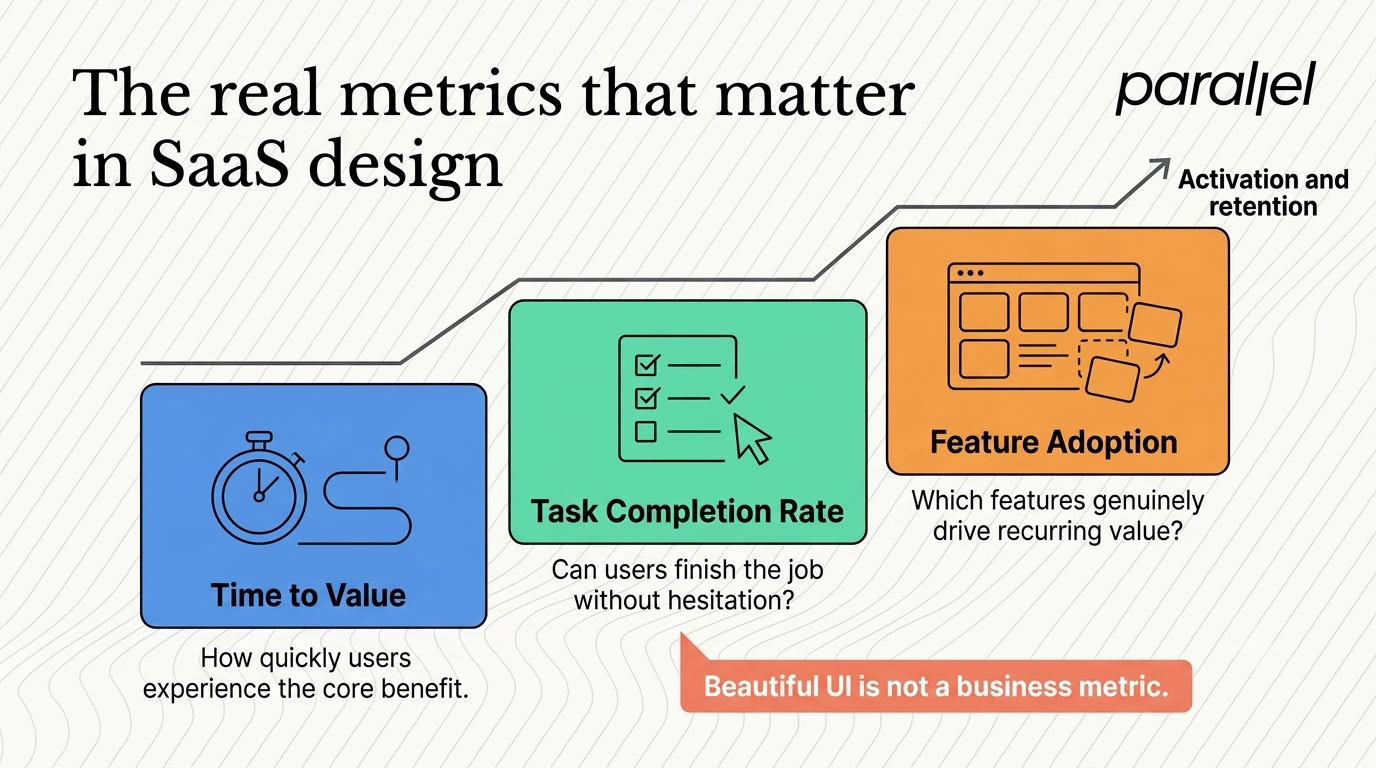
When we work with startups, we focus on three core metrics.
First is time to value. How long does it take for a new user to experience the core benefit of your product? If your onboarding flow requires users to watch a tutorial video and fill out ten fields, your time to value is broken. You need progressive disclosure. Let users explore the interface and ask for information only when absolutely necessary.
Second is the task completion rate. Can users actually do what they logged in to do? We rely heavily on usability testing to measure this. We give users specific scenarios and watch where they click. If they hesitate for more than a few seconds, the interface has failed.
Third is feature adoption. A 2025 product analysis by Pendo highlighted that 80% of features in the average SaaS product are rarely or never used. This is a massive waste of engineering resources. Good product design is about pruning the interface. We help teams map out the user journey and ruthlessly cut features that do not drive core value.
Navigating the complexity of B2B SaaS
Designing consumer apps is fundamentally different from designing B2B UX design software. In consumer apps, the buyer and the user are the same person. In B2B SaaS, you are often selling to a department head but designing for an entry level employee.
This creates a dangerous dynamic. Startups build features to check boxes on a procurement list, ignoring the daily experience of the end user. The result is bloated enterprise software that employees hate using.
You have to design for two distinct mindsets. The marketing site and the high level dashboard must convince the buyer of the product value. The daily workflows, keyboard shortcuts, and data tables must empower the end user to work faster.
We approach this by conducting deep user research with the actual employees who will use the tool daily. We map their current workarounds in spreadsheets and design interfaces that genuinely improve their workflow. We focus on information density, clear typography, and predictable interaction patterns.
The impact of AI on SaaS product design
We cannot talk about software in 2026 without discussing AI. The landscape is shifting rapidly. AI is no longer a bolt on feature. It is fundamentally changing how users interact with software.
A 2025 principle from IDEO notes that successful AI integration requires designing for trust and transparency. Users need to understand why an AI model made a specific recommendation. If a SaaS product acts like a black box, users will revert to their manual processes.
We have seen startups try to add generic chat interfaces to their products and call it AI native. This rarely works. A chat interface is often the laziest form of design. It forces the user to figure out the right prompt.
Good AI UX design anticipates the user's needs. It surfaces the right action at the right time. We help teams evaluate their products using our AI readiness design scorecard to determine where AI can genuinely reduce user friction, rather than just adding a trendy gimmick.
How to choose among the best saas design agencies for startups
Making the final decision requires looking past the sales pitch. You need to understand how the agency will handle ambiguity and disagreement.

First, ask about their discovery phase. Do they just take your feature list and start drawing screens? Or do they push back and ask to see your user data? A strong partner will challenge your assumptions. They will want to run an opportunity mapping session to ensure you are solving the right problem.
Second, look at their team structure. Will you be working directly with senior designers, or will your project be handed off to junior associates once the contract is signed? Ask who exactly will be in the weekly review meetings.
Third, evaluate their prototyping speed. Startups cannot afford six month research phases. You need an agency that can move fast without breaking things. Look for teams that utilize design sprints to validate concepts in days.
Finally, ask for a UX audit of your current product before signing a massive contract. Let them look at your existing interface and tell you what is broken. Their insights during this initial review will tell you everything you need to know about their product thinking.
A final thought on product partnerships
Hiring one of the best saas design agencies for startups is a significant investment in your company trajectory. The goal is not just to make your software look modern. The goal is to build a product that users inherently understand and actually want to use.
In my experience, the most successful engagements happen when founders treat the agency as a strategic partner, not an outsourced pixel pushing vendor. Bring them into your business challenges. Share your churn data. Be honest about your technical debt.
When you align deep product thinking with rapid, user tested design execution, you stop building features nobody wants. You start building a product that scales.
Frequently asked questions
1) What do the best saas design agencies for startups actually do?
The best saas design agencies for startups go beyond surface level visual design. They conduct user research, define product strategy, optimize onboarding flows, and create scalable design systems. Their primary goal is to improve business metrics like user activation, task completion rates, and overall customer retention through better interface logic.
2) How much do the best saas design agencies for startups charge in 2026?
Pricing varies wildly based on the scope and the agency reputation. A specialized UX audit might cost between $5,000 and $15,000. A focused design sprint usually ranges from $15,000 to $30,000. Full product redesigns from top tier global agencies can easily exceed $150,000. Startups should look for modular engagements to manage cash flow.
3) What is the difference between product design and UI design?
UI design focuses specifically on the visual layer of the software, such as colors, typography, spacing, and component styling. Product design is a holistic discipline that includes UI design, but also covers user research, business strategy, information architecture, and behavioral psychology to ensure the product solves a real market problem.
4) Is a design sprint right for my early stage startup?
Yes. Design sprints are highly effective for early stage startups because they compress months of debate into a single week. Instead of building a full MVP development cycle based on guesses, you build a high fidelity prototype and test it with real users on day five, saving significant engineering time.
5) How long does a typical UX audit take?
A thorough UX audit typically takes two to three weeks. During this time, the design team evaluates your product against heuristic principles, analyzes your analytics data, and maps out the areas causing the highest user friction. You receive a prioritized roadmap of actionable improvements.
6) Should we hire an agency or build an in-house team?
If you have a clear, validated product and need continuous daily iterations, building an in-house team makes sense. However, if you are searching for product market fit, doing a major redesign, or tackling a complex new feature set, an agency provides concentrated expertise and fresh strategic perspective without long term overhead.
7) How do we measure the ROI of SaaS design?
You measure the ROI of UX by tracking changes in specific product metrics. Look at your onboarding drop off rates, support ticket volume related to usability issues, time to value for new signups, and overall user retention. Good design directly improves these metrics, leading to higher lifetime value.
8) What makes ParallelHQ different from other agencies?
We focus heavily on clarity in product thinking. We do not do fluff, and we do not chase visual trends just to build portfolio pieces. We work closely with founders to map out actual user behaviors and simplify complex product decisions. Our methodology is rooted in rapid iteration and honest, direct feedback.

check out these related blogs