Every early-stage founder faces this decision: hire a designer full-time or bring in a design agency. The wrong call doesn't just waste money, it costs you months of momentum when you can least afford it. This design agency vs in-house cost & speed comparison breaks down what you'll actually pay, how fast you'll move, and which model fits your stage of growth. No theory. Just the numbers and the decision framework to act on them.
TL;DR
- A mid-level in-house UI/UX designer costs $100,000–$115,000 in base salary alone, with overhead adding 20–30% on top.
- A design agency retainer typically runs $5,000–$15,000/month for startup-scale engagements.
- Agencies can kick off work in days; hiring in-house takes an average of 36 days before a single pixel is touched.
- Neither option wins universally, the right choice depends on your stage, workload consistency, and whether you need breadth or depth.
Design Agency vs In-House: Which Is Actually Cheaper?
This is the question every PM and founder asks first. The honest answer: cheaper on what timeline, and for whom? Designers typically need 3–5 years to progress to a mid-level role, where salaries increase to roughly $100,000–$115,000 annually. That's the base. On top of that, you'll need to cover insurance, taxes, employee benefits, and paid sick leave, overheads that often add 20–30% on top of the base salary. So a mid-level in-house designer who earns $110,000 realistically costs $132,000–$143,000 per year before you factor in tooling, desk space, or onboarding.
There's also a one-time cost to recruit. SHRM estimates around $4,700 on average per new hire in the U.S., accounting for advertising the job, HR and recruiter time, and interviews. On the agency side, 2026 benchmarks show small-client retainers at $1,000–$5,000/month, mid-market at $5,000–$15,000, and enterprise at $15,000–$50,000+. For a seed-to-Series A startup, you're most likely in the $5,000–$12,000/month range for meaningful ongoing design work.
Run the numbers side-by-side:
If your design needs are inconsistent or lumpy, a product launch here, a redesign sprint there, the agency model wins on pure cost. If you have 40+ hours of design work per week, year-round, an in-house hire starts to close the gap by year two.
The real cost of in-house design is never just the salary. It's salary + benefits + tooling + recruitment + onboarding friction, before the first Figma frame is opened.
How Much Does It Cost to Hire an In-House Designer vs. Agency? A Full 2026 Breakdown
The design agency vs in-house cost & speed comparison only makes sense with real numbers at each seniority level. Here is how common design roles typically break down in the U.S.: UI Designers average $65,000–$95,000 per year. UX Designers range from $90,000–$125,000. Product Designers, the hybrid role that often owns the entire product experience, command $105,000–$140,000, sometimes higher in tech hubs.
According to Glassdoor as of June 2026, the average salary for a UI/UX Designer is $104,131 per year, with the typical pay range falling between $78,098 at the 25th percentile and $145,319 at the 75th percentile.
On the agency side, monthly retainers run $5,000–$25,000/month depending on scope and team size for established design firms. Boutique agencies focused on startups, like ParallelHQ, typically sit in the $5,000–$12,000/month range and offer flexible retainer models that scale with sprint intensity.
For project-based needs, a logo design by an agency could cost anywhere from $1,500 to $5,000, whereas a skilled freelancer may charge between $300 and $1,500 for the same project.
The key variable the raw numbers hide: an agency retainer buys you a team, researcher, strategist, visual designer, sometimes a creative director, not one person. An in-house hire, no matter how talented, is one person with a finite skill set.
Is It Faster to Work with a Design Agency or Build an In-House Team?
Speed is where the design agency vs in-house cost & speed comparison becomes decisive for most early-stage startups. On average, it takes around 36 days to hire a new employee in the U.S., and costs about $4,700 in hiring costs per hire.
But that's just time-to-offer. Factor in notice periods (typically two to four weeks), onboarding, and ramp time, a new in-house designer is rarely at full productivity before 60–90 days from the day you post the job. By contrast, an agency like Eleken can kick off the UX design process in 1–2 days, compared to the 2–3 months it typically takes to hire an in-house designer.
At ParallelHQ, our typical startup onboarding follows a defined sequence:
- Kick-off call and brief alignment (Day 1)
- Discovery and audit of existing product (Days 2–5)
- First design concepts in Figma delivered (Week 2)
- Iteration cycles begin (Week 3 onward)
For a design sprint, compressed timelines are the entire point, validated concepts in five days rather than five weeks.
Speed advantage aside, agencies also carry institutional knowledge across multiple client contexts. Where an in-house designer might approach a problem using your company's internal patterns, a good agency brings cross-industry signals, what works in SaaS onboarding, what converts in fintech, where healthcare UX typically breaks. That breadth accelerates problem-solving in ways headcount alone cannot.
When you're pre-product-market fit, 30 days of design delay is a competitive threat. The question isn't whether an agency is "faster", it's whether you can afford not to start this week.
What Are the Hidden Costs of an In-House Design Team?
The salary is the visible line item. The hidden costs of in-house design are what quietly make the design agency vs in-house cost & speed comparison tilt harder than most founders expect.
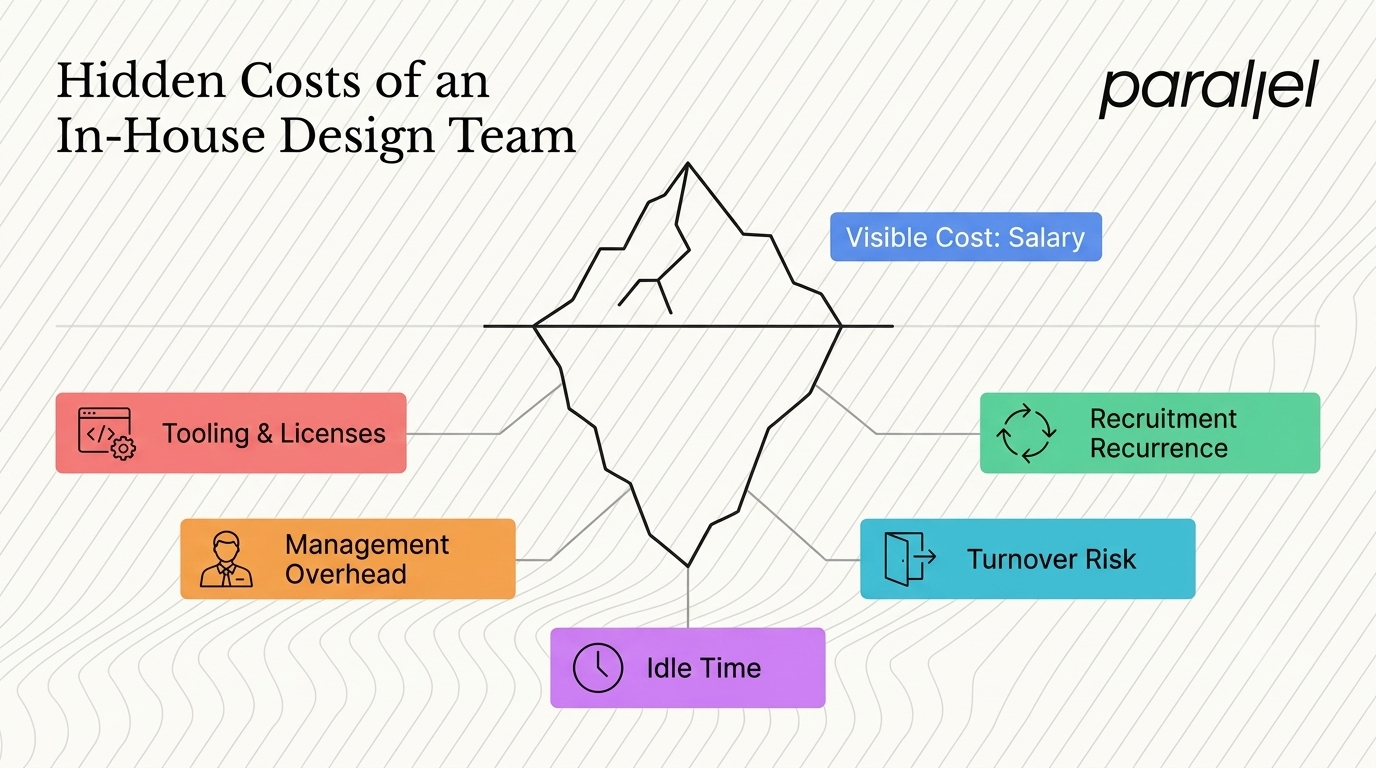
Tooling and licenses: A professional in-house designer needs Figma, Adobe Creative Suite, prototyping tools, and potentially motion or 3D software. Plan for $2,000–$6,000 per designer per year in software subscriptions alone.
Management overhead: An in-house designer needs direction, feedback loops, roadmap context, and a manager who can evaluate design quality. If you don't have a design director already, you're either undermanaging the hire or the founder absorbs that cost.
Idle time: Design work is inherently uneven. Sprints before a launch are intense; maintenance phases are quiet. A given designer has a finite skill set, your one in-house designer might be excellent at branding and web graphics, but not experienced in motion graphics or 3D rendering. To cover multiple disciplines, you'd need to hire multiple people, which multiplies costs.
Turnover risk: If your in-house designer leaves, all that knowledge walks out the door, and you must spend potentially months to re-hire. Employee tenure has been declining, so turnover is a real risk, and during any vacancy, projects stall.
Recruitment recurrence: Every turnover event resets the $4,700 recruitment cost and the 36-day time-to-hire clock. For an early-stage company, a single mid-cycle departure can derail a product roadmap by an entire quarter.
A UX audit or discovery framework engagement with an agency sidesteps every one of these line items, no idle time, no turnover risk, no license management, no internal management overhead.
When Should a Startup Use a Design Agency Instead of Hiring In-House?
This is the most practically useful question in the design agency vs in-house cost & speed comparison, and the answer is stage-dependent.
Use a design agency when:
- You need to ship a designed MVP or prototype within 4–8 weeks and have no in-house designer.
- Your product is in discovery mode and requirements are still changing, locking in a full-time hire before the problem is defined wastes both money and the designer's energy.
- You need a breadth of skills (UX research, visual design, interaction design, design systems) that one hire cannot cover.
- You're raising a round and need investor-grade product design before your next demo day.
- You want to run a structured design sprint or opportunity mapping exercise before committing to a direction.
Consider hiring in-house when:
- Design is a daily operational need (40+ hours/week, consistently, for 12+ months).
- You have product-market fit, a stable design system, and an established workflow that needs a permanent steward.
- You have the management infrastructure to direct, evaluate, and grow a designer's career.
- Brand consistency and deep institutional product knowledge outweigh flexibility in your priorities.
Hiring has become doubly harder now, with demand for designers surging as AI accelerates product building. Both large and early-stage companies are chasing an increasingly similar profile: full-stack designers with strong visual craft, business understanding, and the ability to design with and for AI.
That talent scarcity makes the agency path more practical than ever for startups that cannot compete on total compensation against well-funded incumbents.
How to Decide: A Practical Framework for Founders and PMs
Rather than debating the design agency vs in-house cost & speed comparison in the abstract, use these four questions to reach a decision in under 30 minutes.
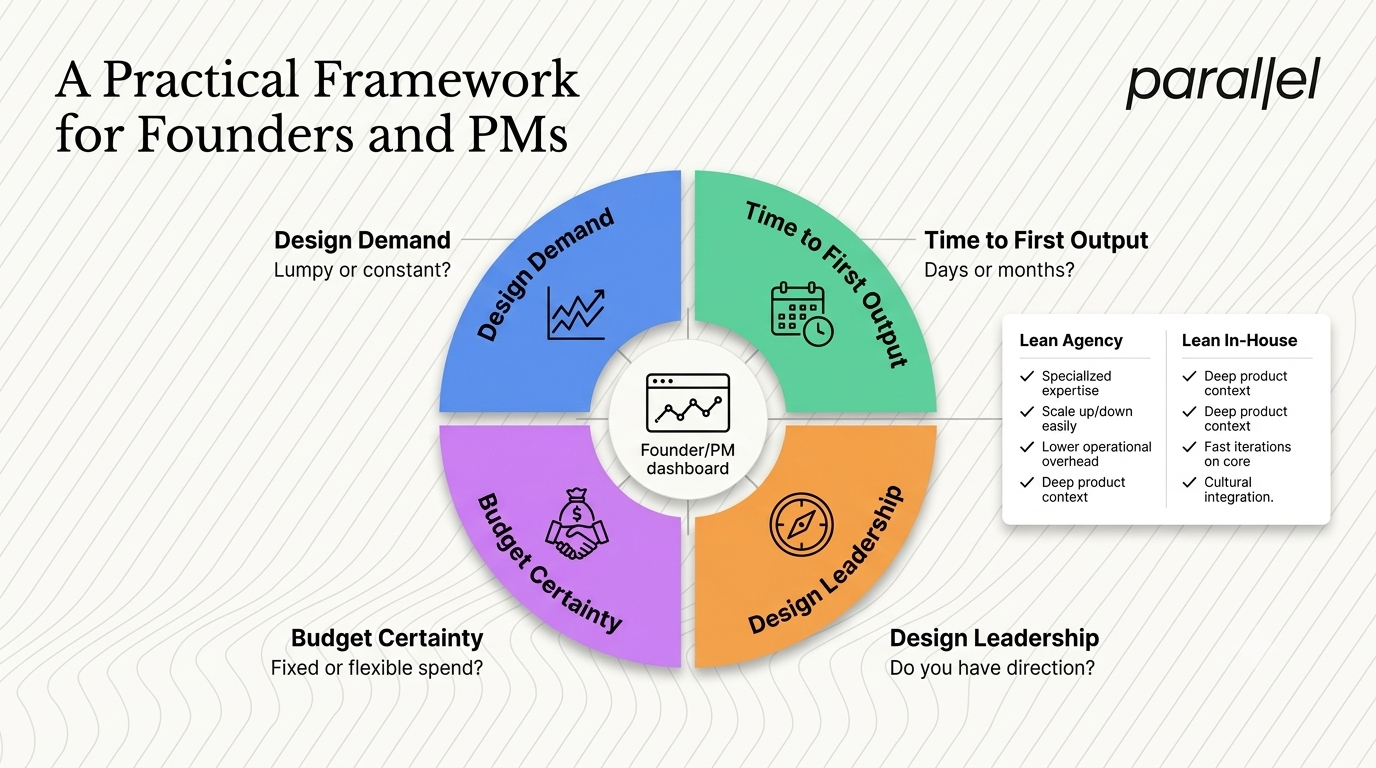
1. What is your design demand for consistency?
Map out your expected design hours per week over the next 12 months. If the curve is lumpy, high for two months around a launch, low for three, an agency on a flexible retainer model matches that curve. If it's flat and high, full-time makes sense.
2. What is your time horizon to first output?
If you need something live in 30 days, an agency wins. If you're planning 12 months out and have design needs that require product context to build, start hiring and use an agency bridge.
3. Do you have design leadership in-house?
Hiring a junior or mid-level designer without a design director or senior IC to direct them often produces expensive mediocrity. Agencies bring their own creative direction.
Design agencies typically offer teams of UX researchers, visual designers, illustrators, and design strategists, making them a strong fit for companies that want scalability or polished execution.
4. What is your budget certainty?
Agency retainers are a known, predictable fixed cost. In-house headcount becomes a fixed cost too, but one embedded in payroll with severance risk attached. For cash-constrained startups, the retainer model preserves optionality. ParallelHQ's UI/UX design services are structured as retainers precisely because predictability matters more than novelty at the early stage.
Conclusion
The design agency vs in-house cost & speed comparison has no universal winner, it has a stage-appropriate answer.
- Cost: In-house totals $138,000–$153,000 in year one when overhead and recruitment are included. Agency retainers for startup-scale work run $60,000–$144,000 annually with zero overhead.
- Speed: Agencies deliver first output in days; in-house hires rarely reach full productivity before 90 days from job posting.
- Hidden costs: Tooling, turnover, idle time, and management overhead make in-house design significantly more expensive than the salary line suggests.
- The decision: Match the model to your design demand curve, not your aspiration for a "real design team."
At ParallelHQ, I work with founders who are exactly at this crossroads, and the answer almost always starts with a focused engagement before a permanent hire.
Frequently Asked Questions
Q1: What is the average cost of a design agency retainer vs. a full-time designer salary in 2026?
Small-business retainers run $1,000–$5,000/month and mid-market retainers $5,000–$15,000/month. The average UI/UX Designer salary in the U.S. is $104,131/year. Adding 20–30% in employer overhead, a full-time designer's total cost reaches approximately $125,000–$135,000/year, comparable to a mid-tier agency retainer, but without the flexibility to scale down.
Q2: How long does a design agency take to complete a project vs. an in-house team?
An agency can typically kick off the UX design process in 1–2 days, compared to the 2–3 months it typically takes to hire an in-house designer. Once a team is in place, both models move at similar sprint velocities. The difference is entirely front-loaded, the agency simply starts faster.
Q3: What are the hidden costs of maintaining an in-house design team?
The main invisible costs are tooling ($2,000–$6,000/year per designer), management overhead, idle time during low-demand phases, and turnover. If your in-house designer leaves, all that institutional knowledge leaves too, and you face months of re-hiring while employee tenure continues to decline.
Q4: Is a design agency better for small businesses and startups?
Generally yes, at the early stage. Design agencies are premium options for those who need end-to-end execution, team scalability, or cross-disciplinary expertise; they usually provide a structured process. For startups pre-product-market fit, that structure and breadth outweigh the cost premium over a single junior hire.
Q5: When should a startup transition from a design agency to an in-house team?
The right trigger is consistent, high-volume design demand, typically when you're spending more than $12,000–$15,000/month on agency retainers with no reduction in scope forecast. At that point, full-time in-house designers are suitable for ongoing design work, consistent branding, and product evolution; they're more embedded and often contribute to team culture.
Q6: Can I run a design sprint with an agency instead of hiring in-house?
Absolutely, it's one of the most efficient uses of the agency model. A structured design sprint delivers validated concepts in five days, which can replace weeks of speculative in-house work. It's an especially strong fit before committing to a full product roadmap or raising a funding round.

check out these related blogs