When founders and PMs search for a UI/UX partner, Clay comes up constantly. It deserves the reputation. But for most early-stage AI and SaaS startups, the fit breaks down quickly. This guide gives you five clay alternatives compared with honesty about what each option actually does well, where it falls short, and why ParallelHQ is the one built specifically for your stage.
Clay Alternatives Compared Side by Side (2026)
The table below cuts straight to the comparison across the dimensions that matter most for a startup PM or founder evaluating partners.
Clay began as a UX design agency in San Francisco focused on mobile apps and enterprise/SaaS software, later expanding to full-service brand design and marketing website development. That trajectory explains why their process and pricing reflect enterprise expectations. Each alternative below diverges from that model in a meaningful way.
What Are the Best Alternatives to Clay Design Studio for Startups in 2026?
Before comparing alternatives, it's worth being clear about what makes Clay a hard fit for startups specifically. Clay's minimum project size is $50,000+, at an average hourly rate of $150–$199/hr, and is perceived as a high-value but expensive agency.
Their partner roster runs from startups to Fortune 100 companies including Meta, Google, Slack, Coinbase, Amazon, Coca-Cola, Sony, and Uber. That's a telling signal. When an agency has Google and Coca-Cola in the same sentence as "startups," their definition of startup is not yours. Clay's $50,000+ minimum rules out many early-stage startups. For a pre-Series A - AI company deciding between building a design system and hiring its first growth engineer, the conversation often ends before it begins.
The best clay alternatives compared for early-stage teams in 2026 need to clear five bars:
- Startup-native thinking, not enterprise process retrofitted for smaller clients
- Comfort with ambiguity at the product stage (pre-PMF, early traction, MVP iteration)
- Fluency in Figma, Framer, Webflow, and modern design handoff workflows
- Ability to work within a UX design workflow that plugs into lean dev cycles
- Evidence of outcomes, not just aesthetic awards
Here are the five worth your time.
Clay Alternatives Compared: What Each Agency Actually Does Well
Lollypop Design Studio: An award-winning UI/UX design company with a team of 180+ designers, they leverage design thinking, creativity, and AI to craft intuitive, scalable, and impactful experiences. Pricing starts at $25–$49/hr with a $10,000 project minimum. Their breadth covers healthcare, fintech, agritech, and logistics. The gap for startups is that size creates process. Some clients noted that Lollypop could improve in strategic planning and resource allocation to enhance delivery speed and internal alignment. For a startup that needs to move fast and change direction in week three, a 180-person studio can add friction where you need fluidity.
OneThing Design: A global UI/UX and digital experience design agency focused on building digital products, agentic interfaces, and immersive experiences, headquartered in India with a presence in the USA, working with startups, enterprises, and global brands across fintech, automotive, healthcare, SaaS, and consumer technology. Rated 4.9 on Clutch, with a Gold and Silver Indigo Award in 2025. Projects average around $15,000. The honest gap: Onething Design is an ideal match for enterprises undergoing digital transformation, SaaS and product-led businesses, and automotive platforms, their positioning points toward scale, not zero-to-one.
Ramotion: The closest like-for-like substitute for Clay among these clay alternatives compared. Their client list includes Mozilla Firefox, Salesforce, Netflix, Okta, Adobe, Xero, and Descript, with 29 Clutch reviews. Pricing runs $150–$199/hr with a $50,000+ minimum. Strong on brand and motion design. If you received a Clay proposal and want a second quote, Ramotion is the natural comparison, but you are still in the same price bracket and the same enterprise-gravity zone.
MetaLab: Deep product design pedigree. Their 2025 work includes the Cognition AI to Windsurf rebrand, one of the most visible AI product rebrands of the year, making them the agency with the deepest product design pedigree if you are building a complex SaaS or collaboration tool. Pricing is not publicly disclosed but is in the premium range. Best for a well-funded startup at Series A or beyond with a large, complex product scope.
What Does ParallelHQ Do Better Than Clay for Early-Stage Startups?
I started ParallelHQ specifically because there was no design partner built for the reality of early-stage AI and SaaS startups based in the US. Not a studio that tolerates startups alongside enterprise clients. One where startups are the entire mission.
Here is what that means concretely:
- Startup-only client base: Every framework, every process, every team norm at ParallelHQ has been shaped by working with pre-Series A and Series A companies. We know what it means to design an onboarding flow while the core product is still shifting. Clay's process is excellent for a company that has locked its brand and needs elite execution. Most of our clients are not there yet, and that is exactly the moment where product design decisions carry the most leverage.
- Process built for iteration, not presentation: Rather than month-long discovery phases that produce decks, our UX design workflow is structured around short cycles with real product output at each stage. Wireframing and prototyping happen in the same sprint as user research findings. Design tokens and component libraries get built to be used, not showcased.
- Depth in AI product design: The B2B SaaS market is anticipated to expand to $492.34 billion in 2026 with an impressive CAGR of 26.24%. Most design studios are still catching up to what it actually means to design AI-native interfaces where the interaction model is non-linear. Our AI UX design work is specifically built for this problem.
- Collaborative handoff: We deliver design systems in Figma with documented design tokens, live component libraries, and dev-ready specs. No translation layer between design intent and engineering execution. Interaction design and design handoff are treated as first-class deliverables, not afterthoughts.
How to Choose Between ParallelHQ and Clay for Your Team
This is a genuine decision framework, not a sales pitch. Both are credible. The answer depends on where you are.
- Choose Clay if: You are post-Series B, your brand identity is locked, you need motion design and web development under one roof, and a $50,000+ engagement is the right scope for your current stage.
- Choose ParallelHQ if: You are pre-Series A to Series A, your product is still finding its shape, you need a partner who thinks about product strategy and design together, and you want a team where startups are the entire focus.
Four questions to clarify the decision:
- Does your core need brand identity, or product design and UX workflow? Clay and Ramotion are strongest on brand. ParallelHQ is the strongest product.
- Is your product scope defined enough for a $50,000+ fixed engagement, or do you need a more iterative partnership?
- Does the agency's portfolio include work at your stage, not just your sector?
- Who specifically will be doing your work? Senior leads or a junior team managed by a principal?
For startups operating in the AI and SaaS space, product strategy consulting sits upstream of visual design. An agency that can hold both is worth more than a studio that executes beautifully on a brief you haven't fully figured out yet.
What Features Does ParallelHQ Have That Clay Doesn't?
When you look at these clay alternatives compared purely on service breadth, Clay is comprehensive. Their team handles user research, product strategy, branding, UI/UX design, usability testing, prototyping, web design and development, plus an in-house content production studio covering motion design, animation, and copywriting. That is a full-service stack. But breadth is not the same as fit.
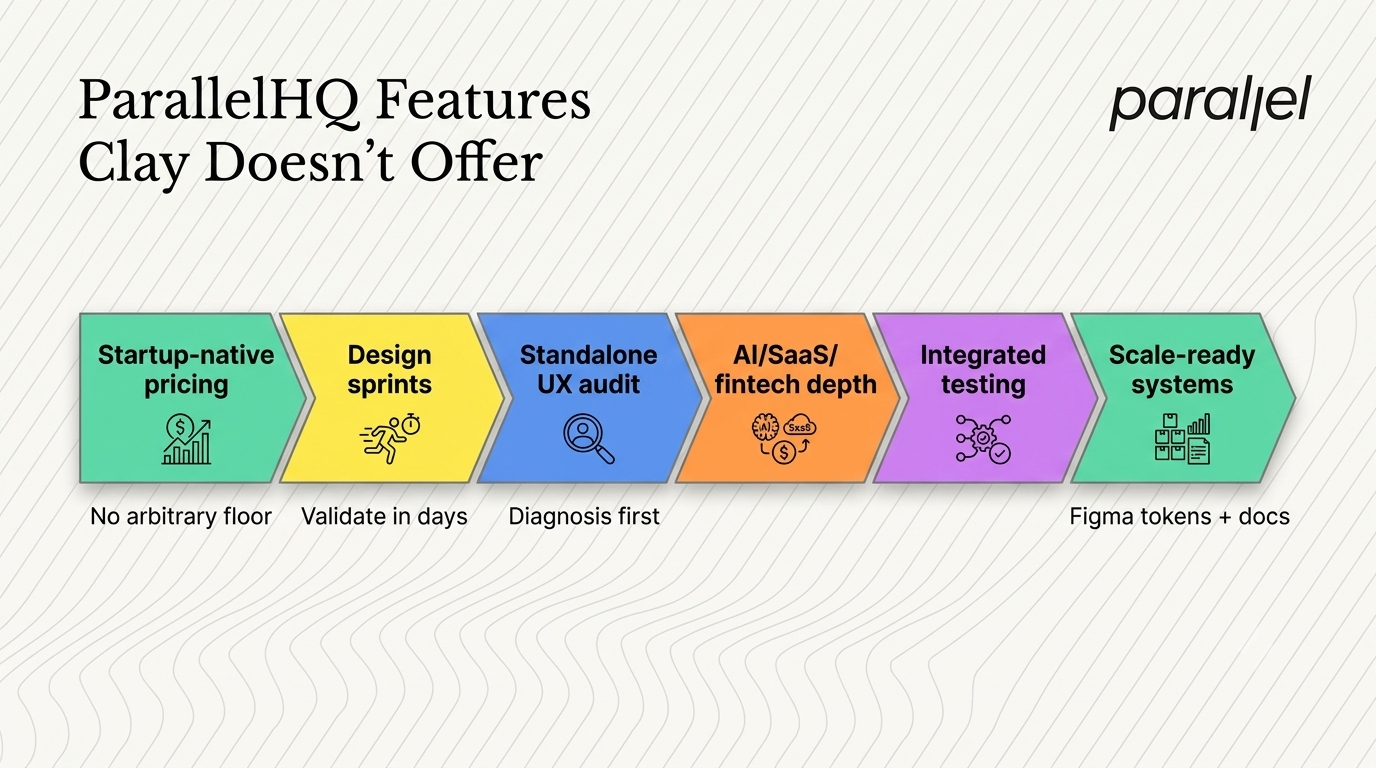
Here is what ParallelHQ offers that Clay structurally cannot:
- Startup-native pricing: No arbitrary floor that gates out companies at the stage where design decisions matter most.
- Design sprint methodology: Structured around validating product assumptions in days, not weeks. Useful before you have all the answers.
- UX audit as a standalone entry point: Many early-stage teams do not need a full redesign. They need a clear diagnosis first. We offer that independently.
- Vertical depth in AI, SaaS, and fintech: Our SaaS design services, AI software design, and fintech design practices are built for the specific UX patterns and trust mechanics these products require.
- Usability testing integrated into the design cycle: Not a separate engagement billed on top.
- Design systems built for scale: Delivered in Figma with token architecture, responsive design coverage, and documentation your engineering team can actually use.
The sharper point: Clay serves companies that have already achieved clarity about what they are building. ParallelHQ serves companies in the process of achieving that clarity. That is a fundamentally different kind of work.
Is ParallelHQ a Good Replacement for Clay?
Replacement is the wrong frame. The better question is: which agency was built for your actual situation? The right agency for a startup launch is rarely the right one for an enterprise redesign. That principle cuts both ways. Clay is an excellent agency for a certain client. ParallelHQ is a purpose-built partner for a different one.
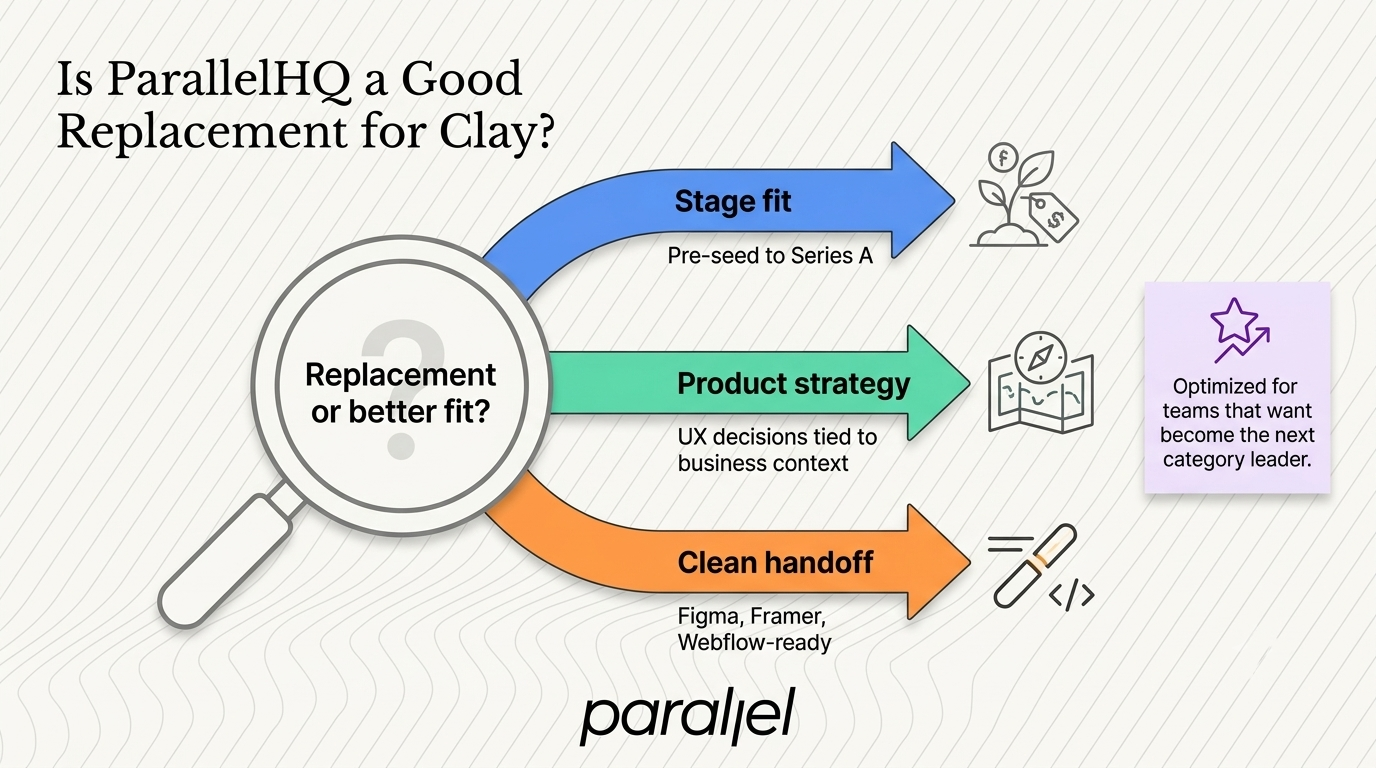
If you are an AI or SaaS founder in the US who:
- Is between pre-seed and Series A
- Needs product design and UX strategy, not just visual execution
- Wants an agency where your project gets senior attention, not junior delegation
- Is working in Figma, Framer, or Webflow and needs clean design handoff
ParallelHQ is not a Clay replacement. It is a better choice for your situation than Clay ever would have been. Clay's clients include Meta, Google, and Snapchat. That is a signal about who they are optimized for. We are optimized for the team that wants to become that.
Our opportunity mapping and discovery framework services exist precisely because founders at this stage need design thinking that connects to product decisions, not aesthetics divorced from business context.
Conclusion
- Clay is a genuinely excellent agency, for enterprise-scale clients with large budgets and locked product scope.
- Its $50,000+ minimum structurally excludes most early-stage AI and SaaS startups.
- The five clay alternatives compared here each serve a different need: Lollypop for breadth and price accessibility, OneThing for enterprise digital transformation, Ramotion for SaaS branding parity with Clay, MetaLab for complex product pedigree, and ParallelHQ for startup-native product design.
- If you are building an AI or SaaS product in the US and need a design partner who thinks like a product leader, not just an executor, ParallelHQ is worth a conversation.
Frequently Asked Questions
Q1: What is the main difference between Clay and ParallelHQ?
Clay is a full-service branding and UX agency optimized for enterprise and growth-stage companies with a $50,000+ project minimum. ParallelHQ is a product design partner built exclusively for early-stage AI and SaaS startups in the US, with flexible engagement models and a process built for iteration rather than fixed-scope delivery.
Q2: Is Clay design studio good for early-stage startups?
It depends on budget and scope. Clay's $50,000+ minimum rules out many early-stage startups. Clay does exceptional work, but its pricing floor and enterprise-optimized process make it a poor fit for pre-Series A companies whose product scope is still evolving.
Q3: How does Lollypop Design Studio compare to Clay for SaaS startups?
Lollypop's hourly rate runs $25–$49/hr with project costs from $10,000 upward. That makes them more accessible on price. The trade-off is that their 180-person team size introduces process overhead that can slow down fast-moving startups. Best suited to companies that need broad execution capacity, not tight iterative partnership.
Q4: What does OneThing Design specialize in?
Onething Design is a global UI/UX and digital experience agency focused on products, agentic interfaces, and immersive experiences that help businesses drive growth. They are strongest for enterprises undergoing digital transformation and established SaaS companies, rather than zero-to-one startup product design.
Q5: Does ParallelHQ work with AI startups specifically?
Yes. ParallelHQ's AI UX design and AI software design services are purpose-built for AI-native products where interaction models are non-linear and user trust must be earned through clarity and progressive disclosure. This is not a bolt-on offering, it is a core practice.
Q6: How do I evaluate any of these clay alternatives compared to my specific needs?
Start with four filters: stage fit (does the agency work with companies at your traction level), scope fit (do they cover both strategy and execution), process fit (do their cycles match your speed), and output fit (can they deliver Figma-ready design systems with proper handoff). Portfolio aesthetics matter far less than evidence of outcomes at your stage. Request case studies from clients who were at your stage when they started, not after they scaled.

check out these related blogs