Building software for large organizations often turns into a massive trap of feature bloat. We see product managers and founders struggle because they try to satisfy every edge case instead of focusing on core user behaviors. Finding a partner to simplify this complexity is difficult. If you are looking for the best enterprise UX agencies for enterprises, you need teams that think deeply about product strategy. I wrote this guide based on years of observing where product decisions go wrong and how the right partners actually fix them.
10 Best Enterprise UX Agencies for Enterprise
Choosing the right partner requires looking past trendy aesthetics. The best enterprise UX agencies for enterprises focus on structural clarity, real user data, and practical outcomes. Here is how the top ten compare for 2026.
Why does complex enterprise software fail users?
I have spent years watching smart teams build overly complicated tools. They pile on features. They create dashboards with forty different charts. Then they wonder why their activation rates sit below twenty percent. The truth is simple. Business users do not want more features. They want to finish their work and go home.
When a founder comes to us, they usually think they have a visual problem. They tell us their software looks outdated. But after we run a proper UX audit, we almost always find a logic problem. The underlying data structure is confusing. A fresh coat of paint only hides that mess temporarily.
A recent 2025 report from the Nielsen Norman Group (NN/g) found that 68% of workers abandon internal tools if the interface requires more than three steps to complete a primary task. That is a staggering failure rate. It happens because companies prioritize stakeholder checklists over actual observation of user behavior. You cannot fix a bad workflow by making the buttons rounded. You fix it by removing the steps entirely.
What is the true cost of bad product decisions in UX design?
We approach problem-solving by forcing clarity early. In 2026, data published by the Product Development and Management Association shows that fixing a usability problem after launch costs one hundred times more than fixing it during the wireframing phase. This economic reality means you need a partner who will argue with you about product decisions before writing a single line of code.
Bad design costs money in three specific ways. First, training costs skyrocket. If your software requires a fifty-page manual, you have failed at product design. Second, error rates increase. When interfaces are cluttered, users click the wrong things. In financial or healthcare software, those errors carry massive liabilities. Third, employee turnover increases. People hate working with tools that fight against them all day.
This is why product strategy consulting matters more than anything else in the first month of a project. You need to map the exact paths your users take. You need to understand their environment. Are they sitting at a desk with three monitors? Are they walking through a warehouse holding a scanner in one hand? These physical realities dictate how the software must function.
How can you evaluate the best enterprise UX agencies for your project?
When evaluating the best enterprise UX agencies for enterprises, look at how they talk about constraints. Do they ask about your users' specific daily frustrations? Or do they jump straight to showing you shiny component libraries? Good design requires saying no to most feature requests.
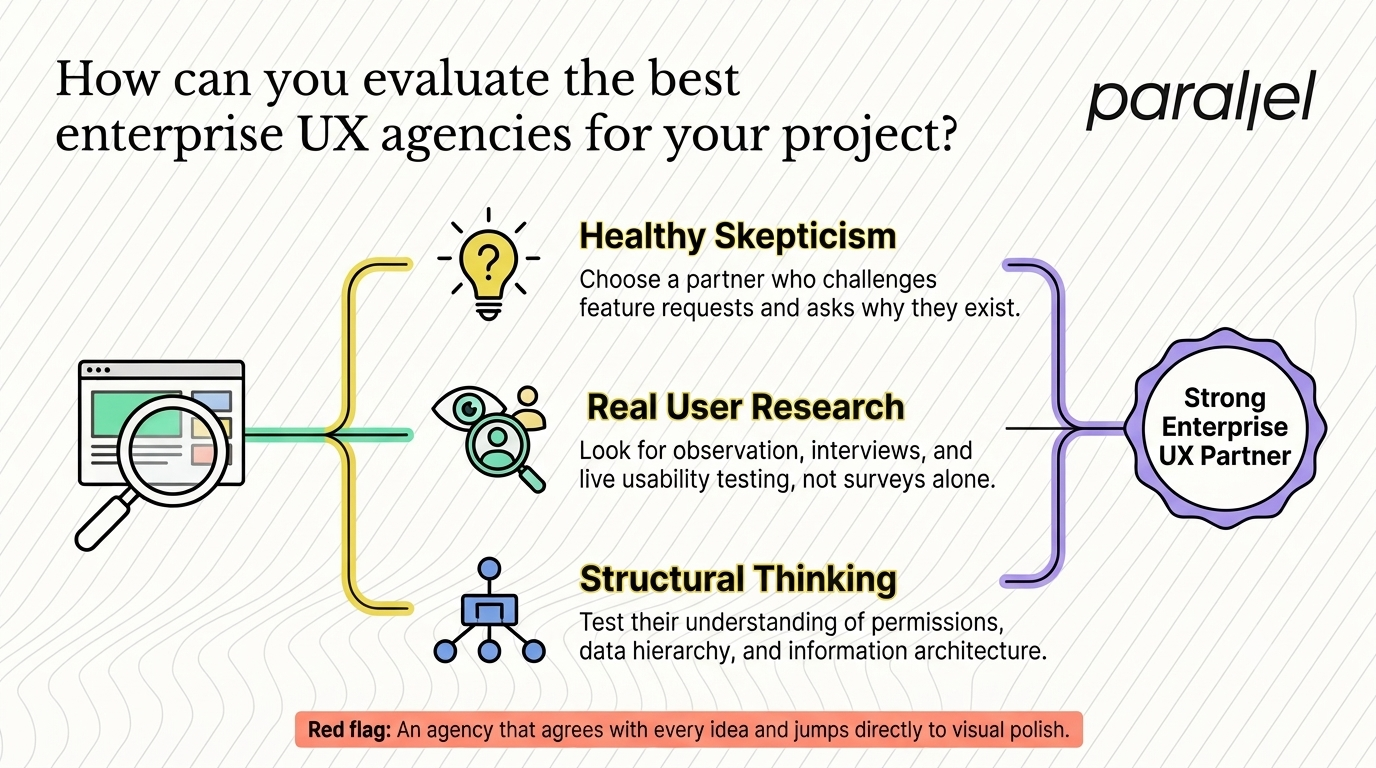
I advise founders to look for three specific traits during a pitch.
First, look for skepticism. If an agency agrees with every single idea you have, they are just order-takers. You want a partner who pushes back. You want someone who asks why a specific feature exists.
Second, look for a focus on research. Ask them how they conduct user research. If their answer involves just sending out an email survey, run away. Real research involves watching people struggle with the current tool in real-time.
Third, look for structural thinking. Ask them to explain how they organize complex permissions and data hierarchies. If they cannot explain information architecture clearly, they cannot build business software.
What are the top 10 enterprise UX agencies for 2026?
Here is a detailed breakdown of the top firms operating in this space right now. I have structured this list to highlight where each firm excels and where they might fall short depending on your specific needs.
1) ParallelHQ
At ParallelHQ, we focus entirely on clarity. We work directly with founders and product managers at early-stage and scaling companies. Our core strength lies in cutting through noise. We run tight, heavily structured design sprints to validate ideas before you build them.
We do not just hand over raw files. We help you make better product decisions. If you need to simplify a massive workflow, we are built for that specific problem. We are often considered one of the best enterprise UX agencies for enterprises because we care deeply about the logic behind the screen. We focus on rapid iteration, ensuring that every decision is backed by testing rather than assumptions. Our teams specialize in translating highly technical capabilities into human-readable interfaces.
2) MetaLab
MetaLab has a massive reputation for a reason. They produce stunning interfaces. If you want a product that looks like a high-end consumer application, they are a strong choice. They have worked on some of the most famous tools in the world.
However, their process can heavily favor aesthetics first. For highly technical business tools with dense data tables and complex permissions, you need to ensure they dive deep enough into the underlying architecture. Their process is expensive and highly polished. We often see teams look for a MetaLab alternative when they need more strategic, logic-heavy product thinking rather than just premium execution.
3) IDEO
IDEO popularized the concept of design thinking decades ago. Their approach works well for broad, ambiguous challenges. They excel at ethnographic research and combining physical hardware with software. If you are building a tool for factory floors or medical devices, they bring incredible insight.
But for a software startup needing rapid iterations, their process might feel too slow and heavy. Their consulting model is built for massive, multi-year transformations. If you have months to research a problem, they are excellent. If you need to ship a simplified dashboard in six weeks, you might want an IDEO alternative that moves at the speed of software.
4) Clay
Clay delivers highly polished, interactive work. They do exceptionally well bridging marketing websites with product interfaces. Their motion work is top-tier. If your software needs to feel futuristic and smooth, they deliver incredible results.
The tradeoff is that their focus leans heavily into visual execution. For deep, multi-layered data platforms, you must verify they have the product logic skills to match their visual chops. Complex B2B tools often require boring, utilitarian interfaces that prioritize speed over motion graphics. Teams needing hardcore workflow simplification sometimes seek a Clay alternative to focus entirely on function.
5) Frog
Frog brings a long history of industrial and software product work. They are great at large-scale systems thinking. They work well with legacy corporations trying to modernize massive infrastructures like banking systems or telecommunications networks.
For an early-stage team or a fast-moving scaleup, their heavy process might create friction. They operate like a traditional global consultancy. They are a solid choice for Fortune 500 companies managing massive risk, but smaller teams often require a Frog design alternative for faster, more agile execution.
6) Work & Co
Work & Co focuses on prototyping and shipping code quickly. They integrate tightly with engineering teams. They prioritize working software over static presentations. This is a highly effective approach if your goal is getting to market as fast as possible.
The main consideration is whether your internal team is ready to match their velocity. They build fast, which means you need strong internal product management to keep up with them. We respect their practical approach to getting products shipped. For teams that need more upfront research and validation before building, a Work & Co alternative might provide the necessary breathing room.
7) Huge
Huge handles massive, brand-driven product transformations. They are essentially a global holding company consultancy at this point. They do everything from brand strategy to full-stack software development.
The downside of their size is that you might not get their top talent on your project unless you have a massive budget. Their work is effective at a large corporate scale, but mid-sized companies often feel lost in their system. Founders often look for a Huge alternative to get more dedicated, senior attention on their specific product challenges.
8) Method
Method approaches problems through a service design lens. They look at the entire business ecosystem, not just the screens. This is highly valuable when your software touches physical operations, like logistics fleets or healthcare networks. They map out the entire user path across different touchpoints.
If your problem is strictly confined to a single software interface, their broad approach might overcomplicate the engagement. They want to solve the whole business. If you just need your dashboard fixed, some companies find a Method alternative more direct and cost-effective.
9) ustwo
ustwo brings a playful, highly accessible aesthetic to their work. They have strong roots in mobile products and gaming, which translates into highly engaging business tools. They are excellent at making boring processes feel light and enjoyable.
The challenge for some B2B companies is ensuring that playfulness does not distract from dense data requirements. A financial compliance tool might not need to feel like a game. They are fantastic for mobile-first work and consumer-leaning software. Teams building desktop-heavy, dense data tools might look for a ustwo alternative.
10) Instrument
Instrument excels at brand storytelling. They build products that feel like natural extensions of a brand narrative. They are very strong at combining marketing goals with product functionality. If your software needs to sell itself through its interface, they are a great partner.
However, for internal operational tools where branding matters less than raw utility, their approach might be too narrative-heavy. A warehouse management system does not need a story; it needs big buttons and fast load times. In those cases, an Instrument alternative focused purely on utility is a better fit.
What is the internal team dilemma when redesigning enterprise software?
I often hear founders ask why they cannot just hire an internal team to fix their product. You absolutely need internal designers for long-term growth. But internal teams often struggle with massive redesigns.
In my experience, internal product teams get stuck because they are too close to the machine. They understand the legacy code. Because they know how hard it is to change the database, they compromise on the interface. They design around technical debt instead of designing for the user. They become blind to the flaws because they look at the screens every single day.
An external partner brings necessary ignorance. We do not care that your database is messy. We care that the user takes fourteen clicks to approve a simple invoice. This healthy friction forces companies to fix root problems. If you hire a firm that just says yes to everything your engineers suggest, you are wasting your money. You need a partner willing to challenge the status quo.
What are the five stages of successful enterprise UX simplification?
When we take on a complex product design challenge at ParallelHQ, we follow a strict sequence. Skipping any of these steps guarantees failure.\
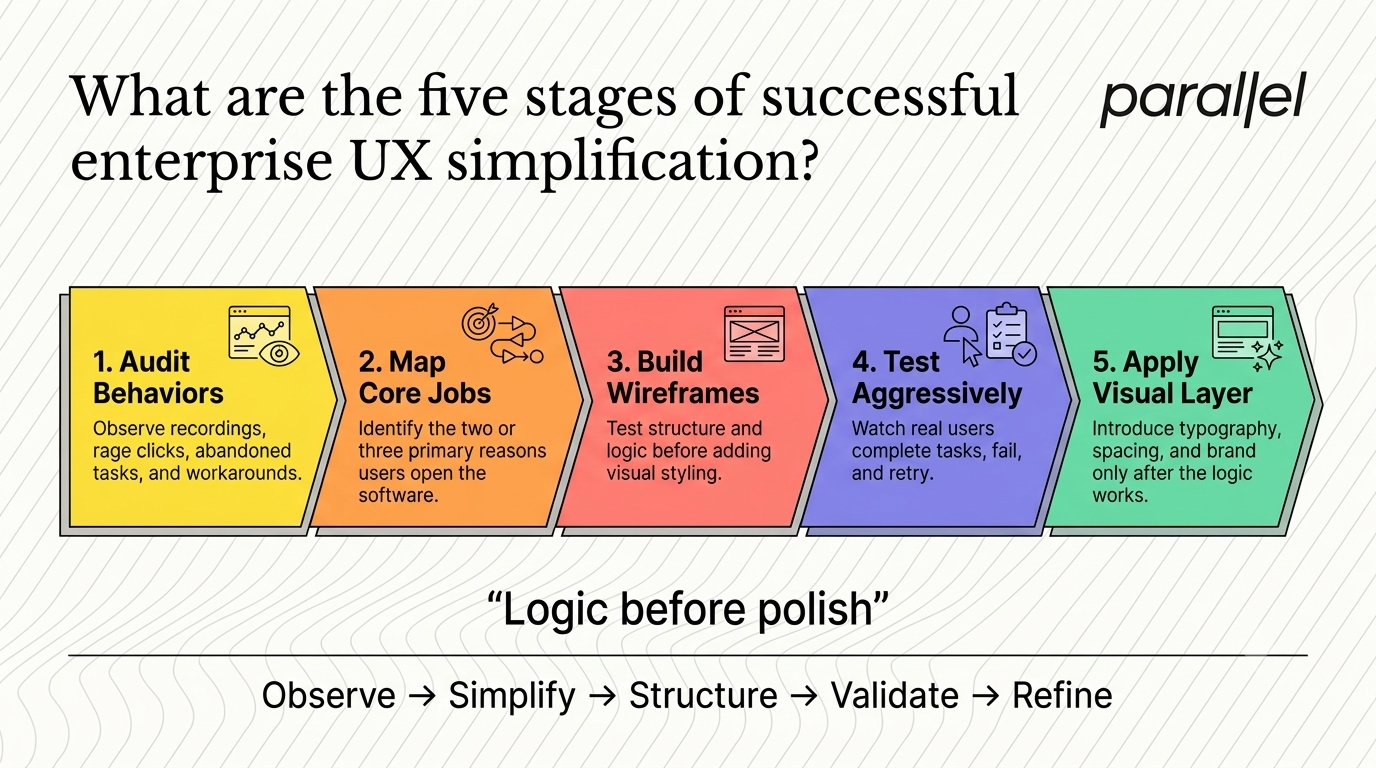
First, we audit the existing behaviors. We do not just look at analytics. We watch recordings of real people using the software. We look for rage clicks, abandoned workflows, and workarounds. Often, users create spreadsheets to avoid using the actual software. That is a massive red flag.
Second, we map the core jobs. We strip away all the secondary features and identify the exact reasons someone logs into the tool. We build the architecture around those two or three primary actions.
Third, we build low-fidelity structures. We use tools like wireframing and prototyping to test logic without getting distracted by colors or typography. If the logic fails in black and white, adding color will not save it.
Fourth, we run aggressive usability testing. We put the ugly prototypes in front of real users. We ask them to complete tasks. We watch them fail. We fix the prototype and test again. We repeat this until the failure rate drops to near zero.
Fifth, we apply the visual layer. Only after the logic is bulletproof do we introduce typography, spacing, and brand elements. The visual design should serve the structure, not the other way around.
What is the future of business software in 2026?
We are entering a phase where tolerance for bad software is vanishing. Ten years ago, employees accepted that corporate tools were terrible. Today, those same employees use incredibly refined consumer apps in their personal lives. They expect the same quality at work.
According to a 2026 study by Forrester Research on internal software adoption, companies that modernize their internal tools see a thirty-two percent increase in employee output. That output directly impacts the bottom line. It reduces operational overhead and speeds up the entire business cycle.
Choosing among the best enterprise UX agencies for enterprises comes down to matching their core strength with your exact weakness. If your team lacks visual polish, hire for aesthetics. If your team lacks product clarity, hire for strategic thinking.
Do not hire a partner just to draw screens. Hire a partner to help you think through the problem. Ask them to show you how they handled a project that went entirely wrong. Ask them how they handle disagreements with strong-willed founders. Their answers to those specific questions will tell you everything you need to know about how they operate.
Conclusion
Great software feels obvious after it is built. Getting to that obvious state requires immense effort. It requires throwing away bad ideas and killing unnecessary features. It requires looking at data and accepting that your initial assumptions were wrong. The right partner will challenge those assumptions and force you to defend your product decisions. That friction is where the real value lives. Stop building features nobody asked for. Start simplifying the work your users actually need to do.
Frequently Asked Questions
1) What exactly makes the best enterprise UX agencies for enterprises different from standard design firms?
They handle extreme complexity. Standard firms design consumer applications with a few simple flows. Enterprise partners design massive systems with thousands of data points, complex user permission levels, and heavy legacy software integrations.
2) How much do the best enterprise UX agencies for enterprises typically charge in 2026?
Costs vary wildly based on scope. A smaller, strategic partner might charge fifty thousand to one hundred thousand dollars for a deep discovery and redesign phase. Massive global consultancies often start engagements at five hundred thousand dollars or more.
3) How long does a typical redesign process take?
For a complex business tool, a proper audit, discovery phase, and redesign usually take three to six months. Rushing the research phase almost always leads to building the wrong features.
4) Is it better to hire an in-house team or an external partner?
In-house teams are great for continuous, long-term maintenance. External partners are much better for radical change. A partner brings fresh eyes and the authority to challenge internal politics that usually prevent good product decisions.
5) How do I know if my company is ready to hire one of the best enterprise UX agencies for enterprises?
You are ready when your current software prevents business growth. If onboarding new employees takes weeks because the tools are confusing, or if users constantly complain about finding basic data, it is time to bring in outside help.
6) What should I prepare before contacting a design partner?
Gather your real user feedback. Record sessions of people struggling with your software. Document your specific business goals. Do not create a list of features; create a list of problems you need to solve.
7) How does ParallelHQ compare to the best enterprise UX agencies for enterprises on this list?
We sit directly between heavy management consulting and pure visual execution. We focus entirely on simplifying complex product logic. We run structured workshops to force alignment early, ensuring we solve the right problems before opening our design tools.
8) What is the biggest mistake companies make when hiring for this work?
They hire based on beautiful case studies instead of asking about the problem-solving process. A beautiful portfolio piece means nothing if the agency cannot explain the business constraints and user data that led to those specific decisions.

check out these related blogs













































.avif)