I see founders overcomplicate mobile software constantly. They try cramming desktop features into small screens, and it usually backfires. B2B software requires specific clarity and grounded thinking. You need partners who understand complex workflows and strict user constraints. If you are searching for the best mobile app design agencies for B2B SaaS, you want teams that prioritize pure utility over flashy aesthetics. We have spent years watching startups struggle with weak activation. The solution is almost never adding more features. The solution is making clearer decisions and simplifying interfaces so users can actually do their jobs.
10 Best Mobile App Design Agencies for B2B SaaS
Finding the right partner dictates your product success. Here is a direct comparison of the top 10 firms equipped for complex software problems.
The Top 10 List: Evaluating the Market
When evaluating the best mobile app design agencies for B2B SaaS, you must look past simple portfolios. Beautiful screenshots do not guarantee usable software. You need to understand how these firms think, how they structure data, and how they solve actual friction points for end users.
Here is how we view the top players in the industry right now.
1) ParallelHQ
We do not just draw screens. We fix product logic. Early-stage startups bring us their messy software, and we simplify it. Our team looks at data, observes real users, and cuts unnecessary steps. We run structured design sprints to validate concepts fast before writing any code. If a feature does not serve a strict, measurable purpose, we remove it.
We specialize deeply in B2B SaaS design services. We are built specifically for founders who value speed, constraints, and clarity. We do not offer superficial visual makeovers. We restructure the core foundation of your software so it actually works for your users.
2) MetaLab
They are a massive name in the space. They created the interfaces for the most famous productivity tools on the market. Their visual execution is incredibly polished. They bring a premium feel to everything they touch.
However, they are built for companies with massive budgets. Their process takes months. Early-stage startups usually lack the runway for their timelines. Many product leaders seek a MetaLab alternative when they require faster turnaround times and more direct access to the senior team. They remain a top choice for unicorns with unlimited capital.
3) IDEO
They pioneered human-centered thinking. Their research methodology is legendary. They excel at hardware integrations and completely novel product categories. They send researchers into the field for months. This deep ethnographic study yields brilliant insights.
But for a standard B2B software tool, this approach is often too slow. Software moves faster than hardware. Startups need to ship and iterate based on real usage data. Those looking for rapid software execution usually want an IDEO alternative. They are best for Fortune 500 companies inventing new hardware models.
4) Clay
They are a brilliant visual firm based in San Francisco. They produce stunning motion graphics. Their interfaces look like they belong in a futuristic movie. They win awards for their aesthetics constantly.
Yet, B2B software is about utility. Users do not want to wait for a beautiful animation to finish before they can approve an invoice. They want raw speed. Dense data tables and complex permissions require structural logic over visual flair. Teams building heavy operational software often look for a Clay alternative to prioritize usability over pure visual impact.
5) Frog
They tackle massive operational problems. They work with global banks and telecom giants. They bring huge teams of consultants to update aging infrastructure. Their systems thinking is excellent. They map out massive organizational structures and workflows.
Early-stage B2B SaaS companies operate differently. They need agility. They need small, highly experienced teams that can pivot rapidly based on user feedback. Bringing a massive consultancy into a Series A startup usually slows everything down. Founders in this position generally choose a Frog design alternative. They are the right choice for institutional modernization.
6) Ramotion
They excel at combining marketing identity with product interfaces. They build beautiful brand assets. They translate those assets directly into the software environment. This is very useful for startups launching their initial product. A strong brand builds trust.
However, complex B2B software often requires deeper architectural thinking than a brand-focused firm might provide. The marketing site and the actual working software require completely different disciplines. Teams needing intense focus on complex user permissions might require a Ramotion alternative. They are excellent for new market entrants needing a fresh face.
7) Work & Co
They are known for rapid execution and engineering integration. They build working prototypes very quickly. They do not spend months on theoretical research. They test ideas by writing functional code. This is a very effective methodology for highly technical teams.
It works well when the product strategy is already perfectly defined. If the underlying logic is flawed, building it faster does not help. Teams that need help defining the core strategy first often search for a Work & Co alternative. They are a fantastic partner for fast-moving technical founders who just need execution.
8) Ustwo
They are famous for their consumer products. They build engaging, joyful interfaces. They understand how to keep users entertained. This consumer approach is sometimes applied to B2B software to increase engagement.
Sometimes this works. Often, it causes friction. B2B users are at work. They want efficiency, not entertainment. Gamifying a logistics dashboard usually frustrates the end user trying to finish a shift. Product leaders building serious operational tools usually evaluate an Ustwo alternative to maintain a professional, utility-driven focus.
9) Instrument
They are masters of storytelling. They build incredible marketing experiences. They use interactive web technologies to tell brand stories effectively. When applied to product execution, their work is visually compelling.
B2B software is rarely about storytelling. It is about data density and task completion. A user managing a supply chain needs a clear table, not a narrative scroll. Startups building functional utilities often prefer an Instrument alternative. They remain a phenomenal choice for brand-led internet properties.
10) Neuron
They specialize strictly in complex software and dashboards. They understand dense information architecture. They are very good at organizing hundreds of data points on a single screen. Their output is highly functional.
They focus heavily on UX over visual polish. Sometimes their final interfaces feel a bit clinical or outdated visually. Modern B2B users expect consumer-grade aesthetics paired with enterprise power. Startups wanting that specific balance of deep UX and modern visual execution might look for a Neuron alternative. They are a very safe choice for pure utility.
How Do You Make Structural Decisions in B2B App Design?
Finding the best mobile app design agencies for B2B SaaS means finding teams that argue about structure. Visuals are easy to fix. Broken logic will destroy your company. We spend the vast majority of our time arguing about how a user moves from point A to point B.
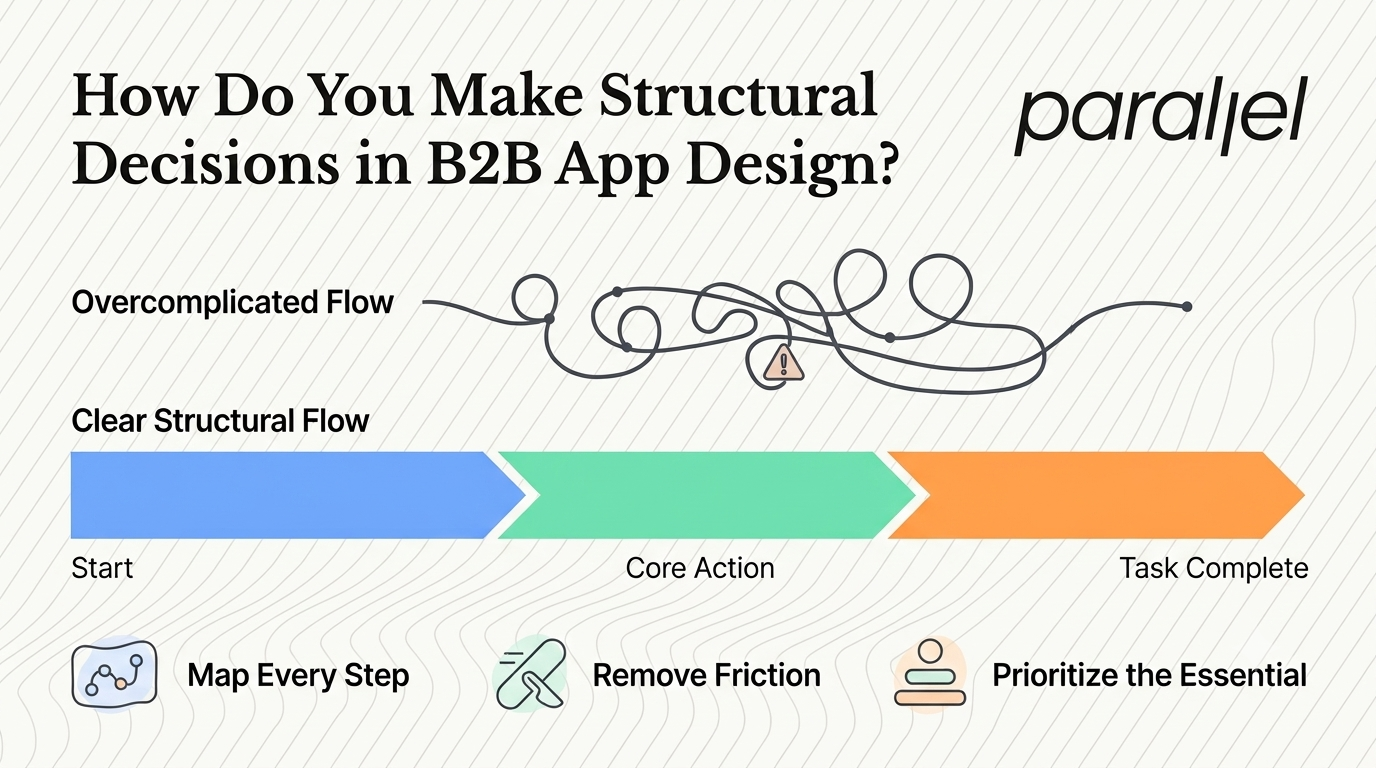
We map out the exact steps a user takes. We look for friction everywhere. A 2025 study from the Baymard Institute shows that simplifying checkout or task flows improves conversion and completion by 35%. This applies directly to B2B task completion. If a sales rep has to click seven times to log a call, they will simply stop logging calls.
We regularly conduct a UX audit for new clients. We almost always find duplicate features and circular workflows. Founders get too close to their own products. They lose objectivity. You have to force strict constraints. Mobile screens demand brutal prioritization. We force our clients to choose what actually matters.
Why Is Feature Parity a Fallacy in B2B Mobile Software?
Founders constantly demand exact feature parity between their desktop application and their new mobile software. This is a severe mistake. I watch product teams waste months trying to force complex data grids onto a tiny screen. Users do not want this.
When someone opens a B2B application on their phone, they are in a specific context. They are in transit. They are in a warehouse. They are walking between meetings. They are trying to complete a single, highly specific task. They are not trying to generate a quarterly financial report.
We strongly advise our partners to audit their feature requests. We use opportunity mapping to determine which actions actually matter on mobile. If an action takes more than three minutes to complete, it belongs on a desktop.
Any true list covering the best mobile app design agencies for B2B SaaS will emphasize firms that push back on feature parity. Good partners tell you "no." They refuse to build features that will ruin the usability of the product. They force you to isolate the mobile-specific use cases and build those exceptionally well.
How Should You Handle Offline Data and Edge Cases in Enterprise Apps?
Most consumer apps assume a constant internet connection. B2B software does not have that luxury. We see logistics teams lose cellular service in warehouses constantly. If the app crashes when the signal drops, the user stops using it entirely.
You must design for these edge cases intentionally. You have to create specific empty states. You have to build local caching logic into the interface. The user needs to know their data is safe and will sync later.
We spend a lot of time on this during our wireframing and prototyping phases. We map out exactly what happens when the connection fails. We design the error messages. We design the recovery states.
A 2026 report by Gartner states that 45% of enterprise mobility failures stem from poor offline data management. You must solve this before writing any code. The interface needs to communicate system status clearly without causing panic.
How Do You Fix Weak Onboarding and Activation for SaaS?
I watch startups spend millions on user acquisition. They get users to download the app. Then the user opens it, gets confused, and leaves. Weak onboarding kills great products.
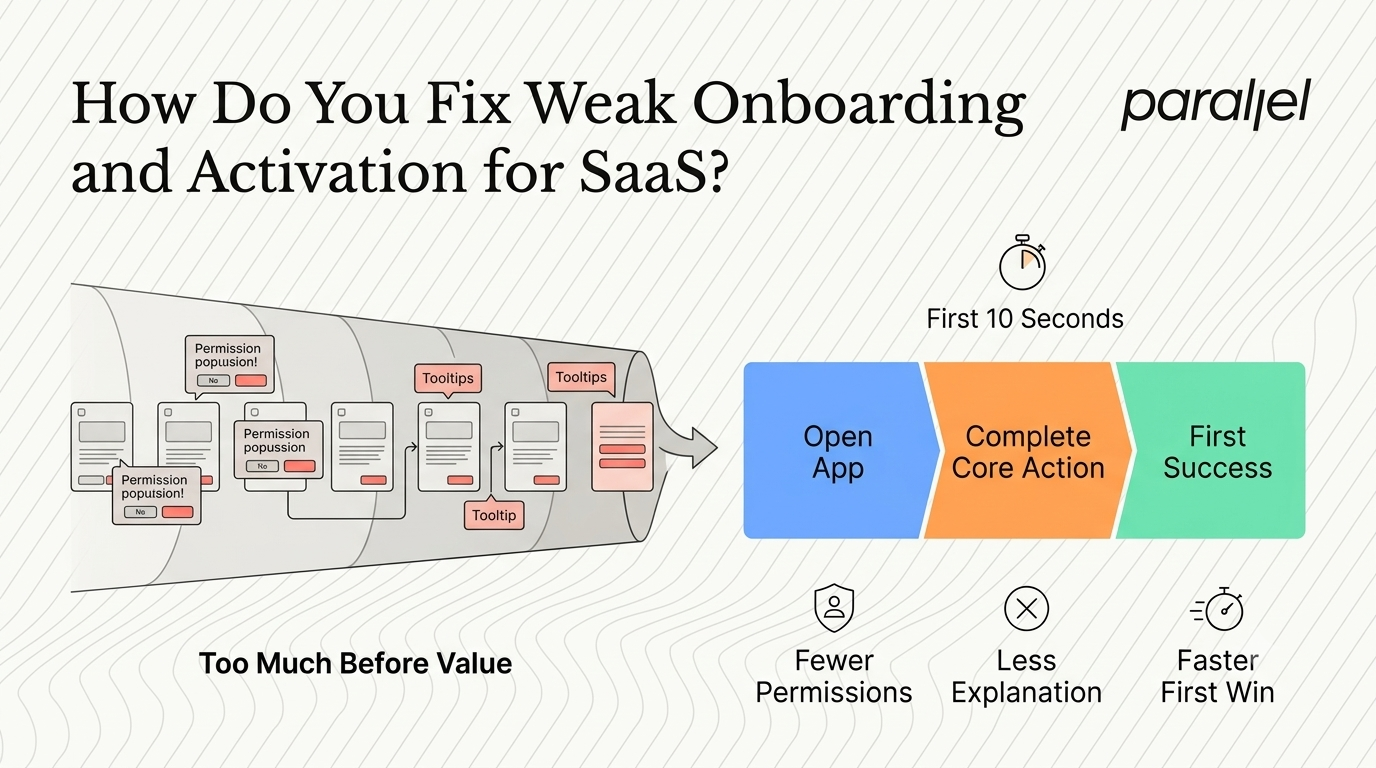
B2B users are busy. They are required to use your software by their employer. They do not want to read a manual. They want to get their job done and go home.
We tackle this by aggressively simplifying the first ten seconds. We remove unnecessary tooltips. We stop asking for permissions the user does not understand yet. We focus entirely on the core action.
We use usability testing to watch real workers use the software for the first time. The results are always humbling. What seems obvious to a founder is usually confusing to a field worker. You have to remove your own bias.
If your activation metrics are dropping, the problem is your interface. You are asking for too much cognitive effort. We fix this by cutting steps and removing choices.
How Do You Understand the B2B Mobile User Context?
You have to design for the reality of the user's environment. We worked with a startup building software for construction managers. The initial interface featured tiny buttons and low-contrast text.
We took the prototype outside into direct sunlight. We tried using it with work gloves on. It was completely unusable. We had to rethink the entire interface to support large tap targets and ultra-high contrast modes.
This is where real product thinking happens. It does not happen in Figma. It happens in the field. Data from a 2026 Forrester study indicates 68% of B2B buyers expect mobile tools to match consumer-grade simplicity, yet only 12% feel those expectations are met.
You must consider lighting, physical constraints, and divided attention. A nurse using medical software is also talking to a patient. A delivery driver is watching the road. Your software cannot demand 100% of their attention. It must be forgiving.
How Do You Balance Speed and Iteration in B2B SaaS Development?
We believe in moving fast but making solid decisions. We use a structured discovery framework to align teams early. We stop endless debates by forcing decisions based on data.
According to a 2026 McKinsey report on software development, teams using structured design sprints reduce time-to-market by 28%. We often run these sprints to validate ideas before writing any code.
Working with the best mobile app design agencies for B2B SaaS requires a clear understanding of your own metrics. You need to know what failure looks like. If you do not have clear KPIs, iteration is just guessing.
We set clear baselines during our product strategy consulting sessions. We define exactly what metric we are trying to move. Then we build prototypes, test them, and measure the results. This prevents teams from building complex mobile features that nobody actually wants.
How Should You Manage Complex User Permissions in B2B Software?
One of the hardest parts of B2B mobile software is handling permissions. A single application might serve a frontline worker, a regional manager, and a corporate executive.
Each of these roles requires a completely different view of the data. The frontline worker needs a simple list of tasks. The executive needs aggregated charts.
You must not build three different applications. You must build one highly adaptable system. We spend weeks mapping out role-based access logic. We ensure that a restricted user never sees a button they are not allowed to press.
Showing a user a disabled button creates frustration. We hide unauthorized actions entirely. This requires deep architectural planning. It requires close collaboration with your backend engineering team. We structure our enterprise software design services to handle exactly this kind of deep structural complexity.
What Is the True Cost of Poor Interfaces in SaaS?
Founders often view UX as a luxury. They believe they can fix it later. This is mathematically incorrect.
A poorly designed B2B application creates massive support costs. If a user cannot figure out how to reset their password, they call your support team. If they cannot find a specific report, they submit a ticket.
We worked with a SaaS company that was spending $40,000 a month just answering basic usability questions. We redesigned their main navigation and their search logic. Support tickets dropped by 60% in two weeks.
Good structure pays for itself immediately. It reduces churn. It lowers support costs. It increases expansion revenue because users actually enjoy using the tool. You are not paying for pretty screens. You are paying for operational efficiency.
Should You Build Native Applications or Responsive Web Apps?
Founders frequently ask us if they should build a native iOS/Android application or just make their web app responsive. The answer depends strictly on hardware requirements.
If your software requires background location tracking, push notifications, or deep camera integration, you need a native application. A web wrapper will feel slow and break constantly.
If your software is primarily data entry and simple list management, a responsive web application is faster to build and easier to maintain. We help teams make this decision early.
Building native software requires committing to two different codebases. You need a compelling reason to take on that technical debt. We use our mobile app design services to prototype both approaches. We test the prototypes on real devices. We let the performance data dictate the technical direction.
How Do You Integrate Design with Internal Engineering Teams?
A major failure point in agency partnerships is the handoff. Many firms deliver a massive file of screens and walk away. The internal engineering team opens the file, realizes half the features are technically impossible, and starts cutting corners.
This destroys the product. We prevent this by integrating with engineering from day one. We include lead developers in our strategy sessions. We ask them about API limitations before we draw a single screen.
If a specific animation takes three weeks to code and provides no structural value, we cut it. We provide detailed documentation. We provide specific CSS variables and token systems. We stay involved during the build process to ensure the final product matches the initial logic.
Conclusion
Great B2B mobile software feels invisible. It lets the user do their job and get out. It does not force them to think about how the software works.
Choosing among the best mobile app design agencies for B2B SaaS comes down to finding a partner who values invisibility. You need thinkers who prioritize logic over decoration. You need partners who will tell you when your ideas are overly complicated. The most successful products in the world are the ones that make incredibly hard tasks feel simple. We built ParallelHQ to do exactly that.
FAQ
1) What exactly defines the best mobile app design agencies for B2B SaaS?
The best mobile app design agencies for B2B SaaS focus on utility, data architecture, and user constraints. They do not just create visually appealing screens. They understand complex permissions, edge cases, and the specific environments where enterprise tools are used.
2) How do the best mobile app design agencies for B2B SaaS charge for their work?
Most of the best mobile app design agencies for B2B SaaS work on retainer or fixed-project pricing based on specific milestones. They avoid hourly billing because it misaligns incentives. You are paying for solved problems, not hours logged in a design tool.
3) How is B2B mobile software different from consumer apps?
Consumer apps fight for attention and engagement. B2B apps are mandatory tools used for work. The goal of a B2B app is task efficiency. Users want to spend as little time in the app as possible. Gamification usually fails in B2B contexts.
4) What is the average timeline to build a B2B mobile interface?
It depends entirely on the scope. A simple utility might take four weeks. A complex enterprise tool with deep permissions takes months. We advise startups to launch a highly constrained version first. We use a discovery framework to define that initial scope tightly.
5) Should we build a native app or a responsive web app first?
If your app requires native hardware features like background location, advanced camera control, or complex offline syncing, build native. If it is primarily data entry and dashboard viewing, a responsive web app will save you months of engineering time.
6) How do we know if a specialized firm is right for our startup?
Look at how they talk about problems. If a firm only talks about colors, typography, and awards, they are wrong for complex software. If they ask hard questions about your database structure, user roles, and failure states, they are likely a strong fit.
7) Why do we often see low activation rates in B2B mobile tools?
Activation fails because the software asks for too much cognitive effort up front. Founders try to replicate the entire desktop experience on a phone. Users get overwhelmed by dense navigation and complex data inputs, causing them to abandon the tool immediately.
8) How does ParallelHQ approach B2B mobile software differently?
We prioritize pure structural logic. We strip away features until only the essential actions remain. We run focused sprints to test ideas with real users quickly. We do not do superficial makeovers; we fix the underlying architecture so the product actually works for your business.

check out these related blogs
















.avif)