Every week, a founder asks me some version of the same question: "How much should I be paying for ongoing design support?" The honest answer is, it depends on what you're actually buying. Design retainer pricing is not a single number; it's a structure. Understanding that structure is what separates founders who get compounding design value from those who burn budget on disjointed, one-off work. This guide breaks it all down with the specificity you need to make a sound decision.
TL;DR
- Design retainer pricing typically runs $3,000–$30,000/month depending on scope, team size, and agency seniority.
- Retainers outperform project-based models for teams shipping continuous product updates.
- Price by hours × rate, then validate against market tiers, not gut feel.
- A well-scoped retainer should include deliverables, revision rounds, SLA terms, and a rollover policy.
What Is a Design Retainer Pricing Model?
A design retainer is a recurring monthly agreement between a startup and a UI/UX design agency (or freelance designer) in which the client pays a fixed fee for a predefined block of design capacity, deliverables, or outcomes.
The client pays a fixed fee each month in exchange for an agreed set of services, deliverables, or hours, and unlike project work, a retainer has no defined end date. The relationship continues as long as results and value are being delivered.
Think of it like a subscription to a dedicated design team. You're not paying for a single output; you're reserving ongoing capacity inside a structured creative services agreement. At Parallel HQ, the retainer model is how we work with most of our growth-stage startup clients, because design for a live product is never a one-time event.
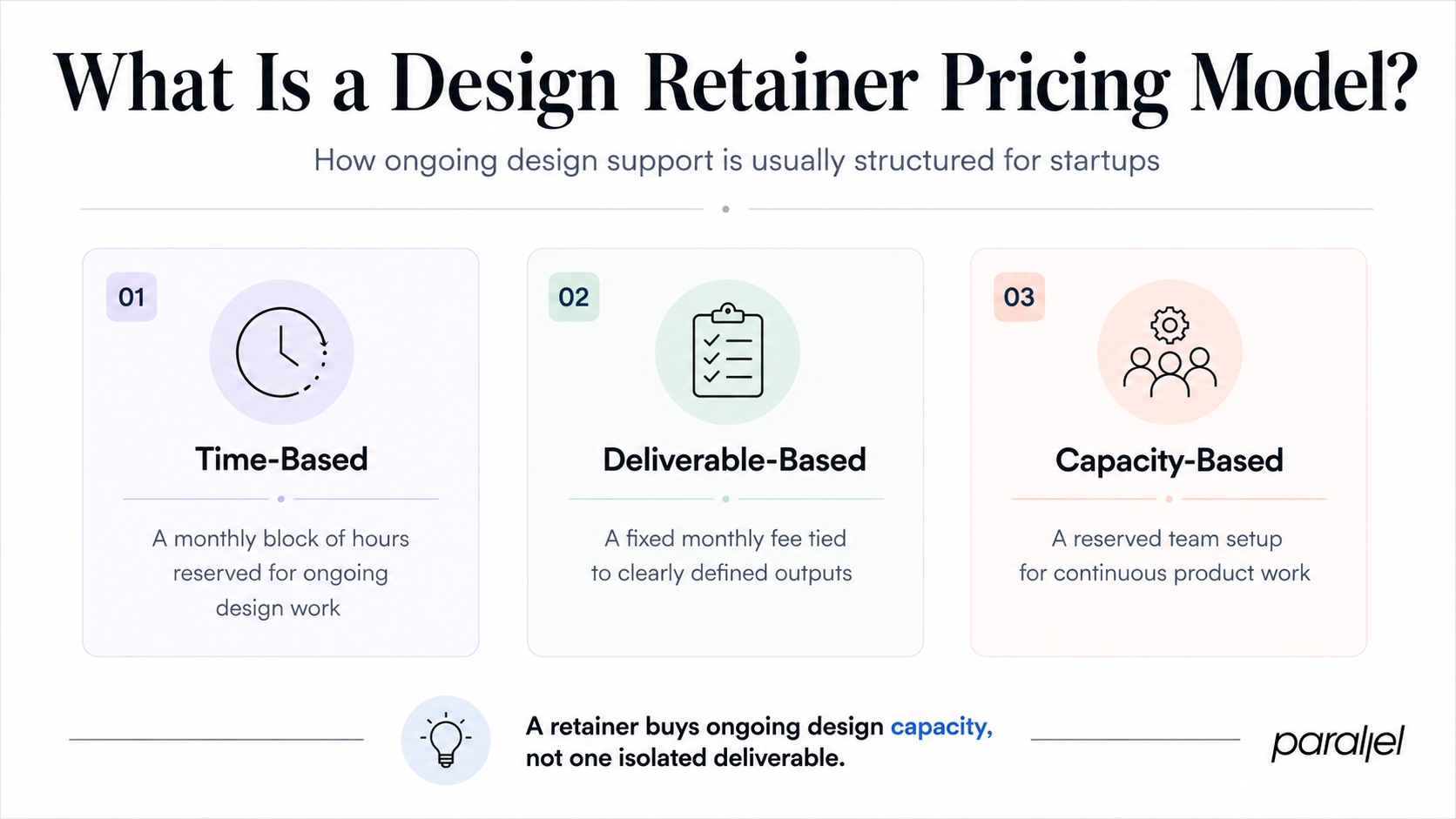
There are three common variants of design retainer pricing:
- Time-based retainer: Client pays for a fixed number of hours per month. Transparent and easy to audit, ideal for evolving scopes. The client pays for hours spent on their projects, this model fits ongoing work perfectly and provides much-needed transparency and flexibility, wherein clients pay only for what they need with no overcommitting.
- Deliverable-based retainer: Monthly fee tied to specific creative deliverables (e.g., 8 Figma screens, 2 user flows, 1 design sprint). Predictable for both parties.
- Capacity retainer: A dedicated design team is embedded into your product workflow. This is the most comprehensive and typically highest-cost variant, covering everything from user research to design system maintenance.
The right variant depends on how clearly you can define your design demand at the start of each month. Early-stage AI and SaaS startups iterating fast tend to benefit most from capacity or deliverable-based structures.
How Much Does a Design Retainer Cost? Real Numbers by Tier
The short answer: $3,000–$20,000/month for retainers, but this range is almost meaningless without context.
Here is a grounded breakdown by tier:
Retainers at the top end typically range from $10,000 to $30,000+ per month, you pay a fixed monthly fee for ongoing design support. The cost depends on the number of designers assigned and the hours you reserve each month. A small retainer might cover one part-time designer, while a larger one may include a full team with research and strategy support.
For early-stage startups specifically, agencies often offer maintenance retainers in the $2,000 to $5,000 per month range, appropriate for post-MVP products that need consistent design operations without a full embedded team. Our UI/UX design services are structured to serve across this entire range, with packages calibrated to startup budget cycles rather than enterprise overhead.
Baseline rule: If a retainer quote can't break down how hours map to deliverables, walk away. Vague pricing signals vague accountability.
Design Retainer vs. Project-Based Pricing: Which Is Better for Startups?
Neither model is universally better. The right choice is determined by how predictable and continuous your design demand is.
A retainer makes sense when design demand is predictable enough to justify reserving ongoing capacity.
Project-based pricing often positions your agency as a vendor, you deliver something, and the relationship may end there. Retainers tend to build deeper partnerships, with more trust, collaboration, and long-term impact. That can lead to upsells, referrals, and more strategic, higher-margin work.
For most early-stage SaaS and AI startups, the hybrid model is the strongest path: charge a fixed fee for an initial setup, audit, or strategy project, then transition the client to a monthly retainer for implementation and ongoing management.
At Parallel HQ, we often use a discovery framework or UX audit as the project that precedes a retainer, it de-risks both sides before committing. Retainers are not always more expensive than project fees. For businesses that need continuous design support, retainers are almost always cheaper on an annualized basis.
What Should Be Included in a Design Retainer Package?
The biggest mistake I see founders make is signing a retainer without a clear scope of work. A vague creative services agreement is how scope creep starts. A well-structured design retainer pricing package should define:
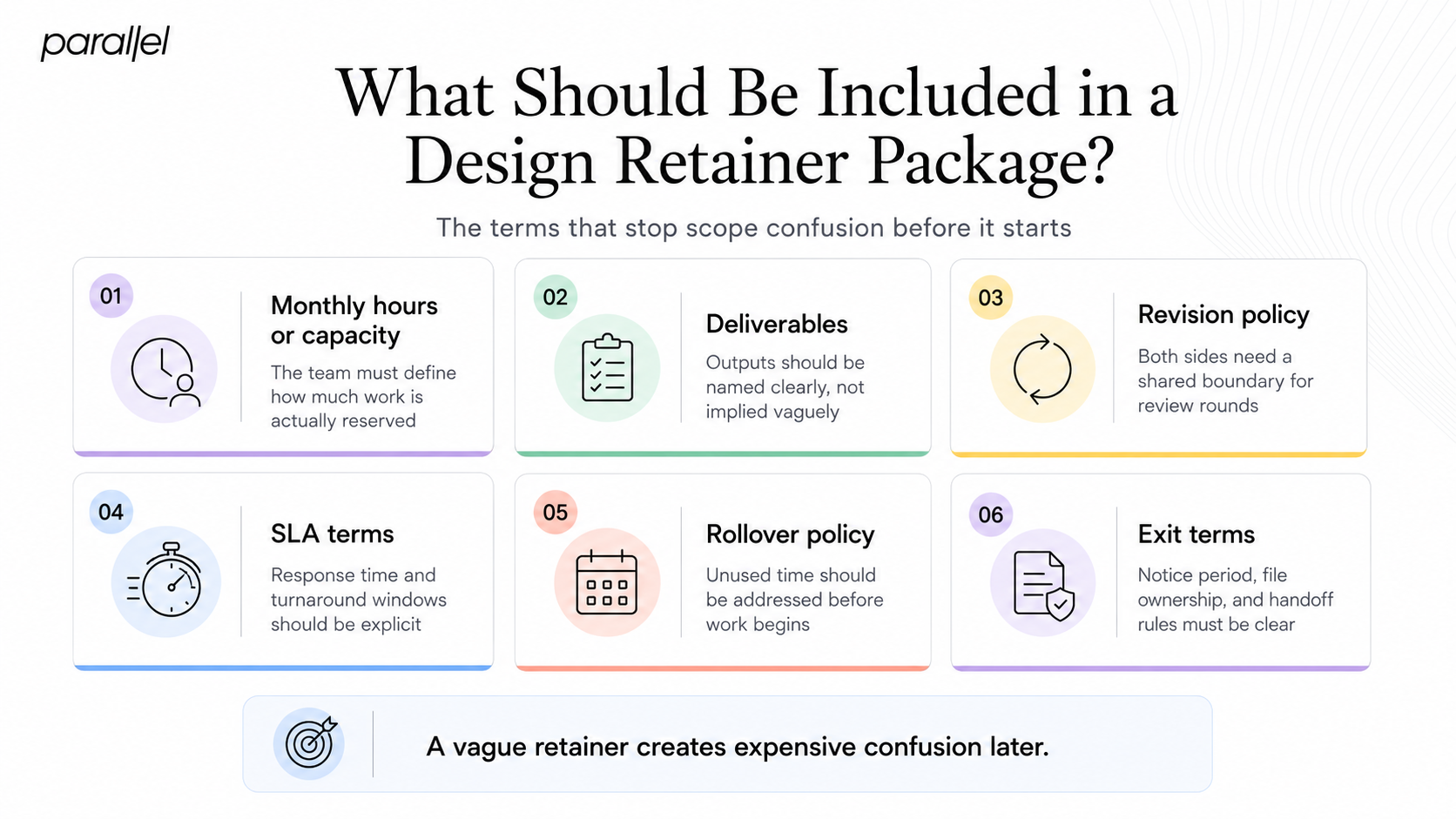
- Monthly hour allocation: How many hours are committed, and what happens to unused hours (rollover or forfeit).
- Deliverable list: Exactly what gets produced, Figma screens, wireframes, prototypes, design system components, user research outputs.
- Revision policy: Most contracts include two revision rounds. Anything beyond that is billable.
- Service level agreement (SLA): Response time, turnaround windows, and escalation path for urgent requests.
- Tools and access: Which platforms are covered, Figma, InVision, Notion, Slack, and who owns the files at contract end.
- Out-of-scope protocol: What triggers a change order and how overages are priced.
- Reporting cadence: Monthly utilization reports showing hours consumed, deliverables completed, and outcomes tracked.
- Exit terms: Most retainers include 30–60 day notice provisions.
For product-focused retainers, we also include a quarterly design health review, aligning the product design workflow to business metrics, not just shipping pixels. Our design systems service is often a core deliverable inside longer retainers, since it's the infrastructure that makes every future design sprint faster and cheaper.
How to Calculate Hours for a Design Retainer
Calculating the right hour block is where most agencies and clients go wrong in both directions, over-allocating creates waste; under-allocating creates friction. Here's the method I use at Parallel HQ:
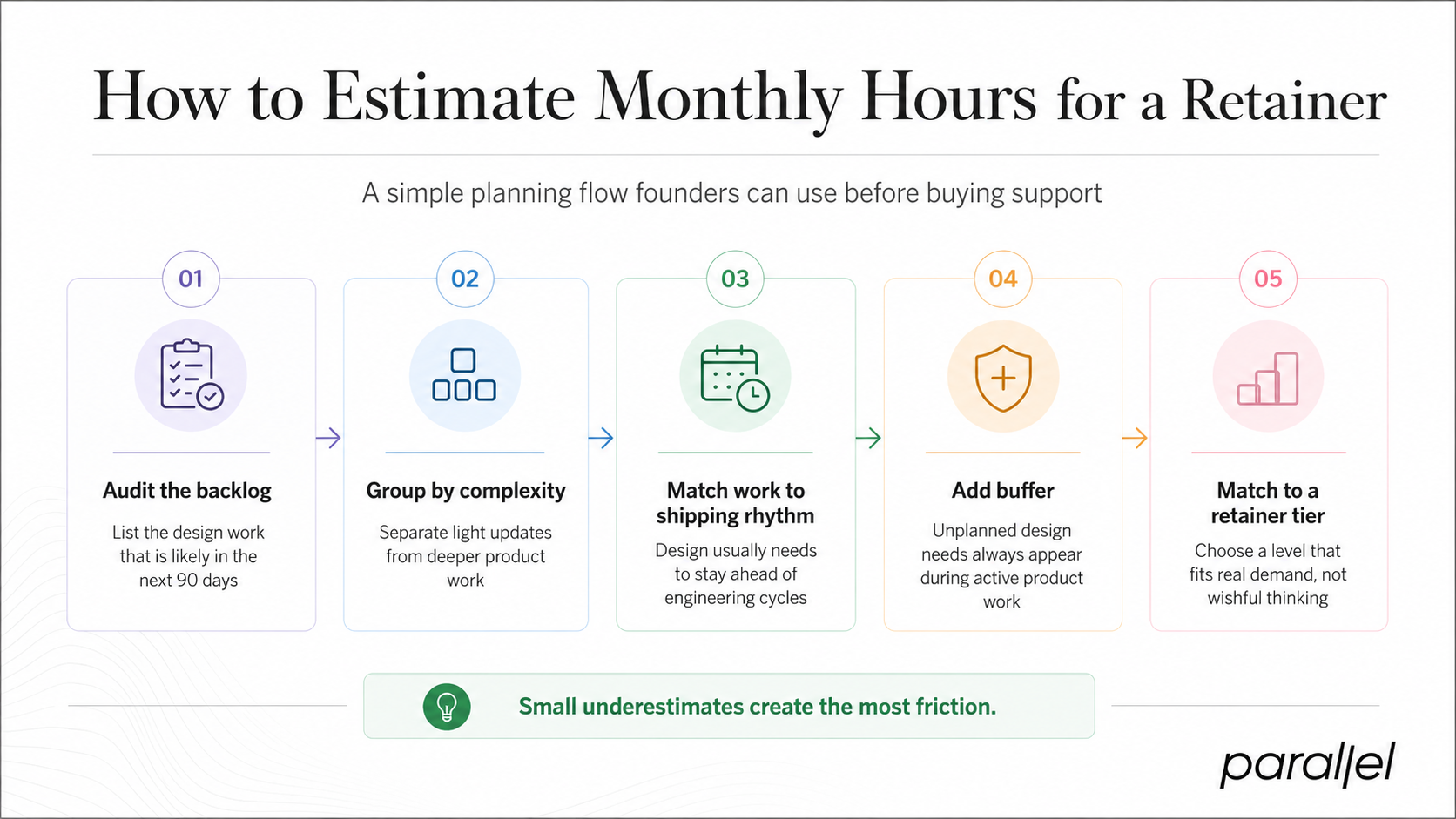
- Audit your design backlog: List every outstanding design need for the next 90 days, features, iterations, user research, QA support.
- Categorize by complexity: Assign rough hour estimates by type. A new feature flow in Figma typically takes 8–16 hours; a full wireframing and prototyping cycle runs 20–40 hours; a UX audit runs 12–24 hours.
- Apply your shipping cadence: If you ship every two weeks, model how much design needs to stay 2 sprints ahead of engineering.
- Add 20% buffer: Real product work generates unplanned requests, stakeholder feedback, user testing findings, edge case flows.
- Match to a tier: Once you have a monthly hour estimate, align it to the tier table above. Clients who need 10–30 hours of work per month on an ongoing basis are ideal retainer candidates.
- Validate against rate: The hourly rates of experienced UI/UX agencies in the US typically range from $100 to $250. Multiply your hour block by the appropriate rate to sanity-check the monthly fee.
Example: 40 hours/month × $150/hour = $6,000/month retainer. This covers a mid-weight Growth tier engagement with a senior designer on a SaaS product.
How to Pitch a Design Retainer to a Client (or Evaluate One as a Founder)
Whether you're a design agency pitching a retainer or a founder evaluating one, the conversation lives or dies on one thing: outcome framing.
Stop talking about hours and start talking about outcomes. Instead of saying "I charge $100 per hour," the better framing is: "My UX optimization typically increases conversion rates by 15–30%, which for a business your size could mean significant additional monthly revenue."
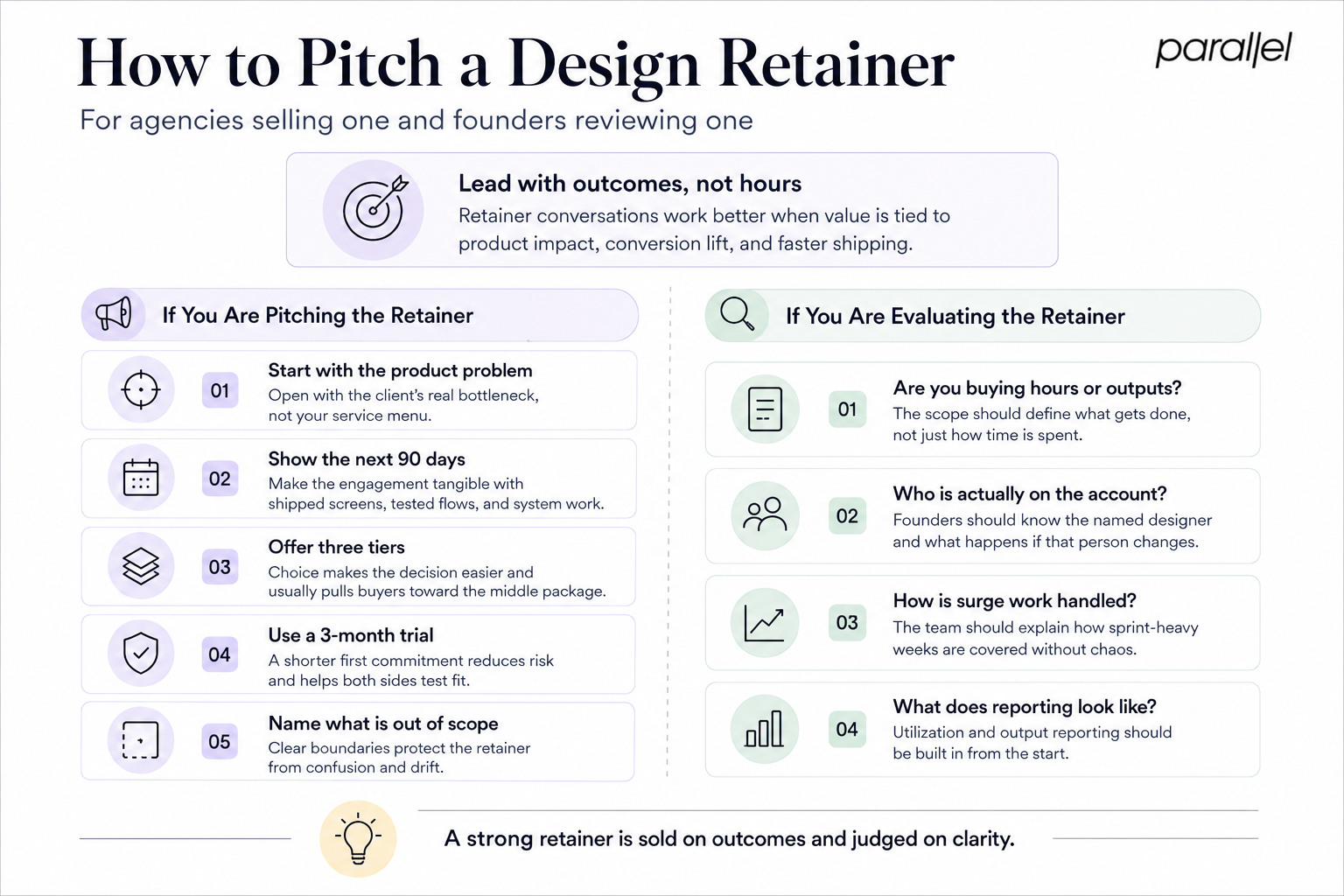
If you're pitching a retainer as an agency, follow this structure:
- Lead with the client's specific product problem, not your service menu.
- Show what a 90-day design engagement produces concretely (screens shipped, flows tested, systems built).
- Present three tiers. Give clients choices by offering tiered packages. Most clients choose the middle option, which should be your target price point.
- Include a 3-month trial period to reduce commitment anxiety. Starting with 3-month trial periods helps evaluate workload and profitability before locking in longer terms.
- Specify what is explicitly out of scope to protect both sides.
If you're evaluating a retainer as a founder, ask:
- Does the scope of work define deliverables or just hours?
- Who is the named designer on the account, and what happens if they leave?
- How does the agency handle sprint weeks where you need surge capacity? Our design sprint service is structured to flex up inside retainer frameworks without a full renegotiation.
- What does the reporting look like? Utilization data is not optional.
Retainers offer compelling benefits for both parties. For designers, they provide income stability and deeper client relationships. For clients, retainers ensure priority access to design talent without the overhead of full-time hires.
Conclusion
Design retainer pricing is a commitment to continuous excellence, not a subscription to a headcount. Here's what to carry forward:
- Match model to need: Retainers win when your product ships continuously; projects win for defined, bounded work.
- Anchor on hours × rate: Calculate your actual design demand before accepting any monthly fee.
- Demand a tight scope of work: Deliverables, revisions, SLAs, and exit terms are non-negotiable, not nice-to-haves.
- Start with a project, graduate to a retainer: A UX audit or product strategy engagement is the lowest-risk entry point before committing to ongoing design retainer pricing.
If you're ready to talk about what a Parallel HQ retainer looks like for your product, start here.
Frequently Asked Questions
Q1: What is a fair monthly retainer for a graphic or UI/UX designer?
For a freelance UI/UX designer, fair retainer fees run $3,000–$8,000/month for 20–40 hours of work. For a UI/UX design agency with a senior lead, expect $6,000–$20,000/month. Rate scales with seniority, specialization (fintech, SaaS, AI), and whether strategy is included alongside execution.
Q2: How is design retainer pricing different from hourly rate billing?
Hourly billing charges for time consumed, with no income or cost ceiling, great for ambiguous early scopes, but unpredictable for both parties. Design retainer pricing locks in a monthly fee for defined capacity or deliverables, giving clients budget certainty and agencies resource allocation clarity. Most mature client-agency relationships move from hourly to retainer.
Q3: What happens to unused hours in a design retainer?
It depends on what you negotiate. Some agencies forfeit unused hours at month-end; others offer a partial rollover (commonly 20–30% of unused hours carry to the next month). Always clarify this in the creative services agreement before signing, it materially affects the value you extract each month.
Q4: How do design retainer pricing examples differ for small businesses vs. startups?
Small businesses with static websites and light design needs typically fall in the $2,000–$5,000/month maintenance tier. SaaS and AI startups with active product roadmaps typically need the $6,000–$15,000/month growth tier, which includes Figma work, user research, and iterative design sprint cycles tied to engineering releases.
Q5: Should a design retainer include a design system?
Yes, if you're planning to use the agency for more than 3 months. A design system built in Figma becomes the shared source of truth for brand consistency and product design workflow, it makes every subsequent sprint faster and reduces handoff friction with engineering. At Parallel HQ, design system development is a standard deliverable inside retainers above the maintenance tier.
Q6: How do I know if my current design retainer pricing is fair?
Run a simple check: divide your monthly fee by actual hours delivered. If the effective rate exceeds $250/hour for non-strategic work, or drops below $80/hour for senior-led strategy, the structure is off. Request a utilization report from your agency and compare deliverables received against market benchmarks for equivalent scope using the tier table in this guide.

check out these related blogs