I've evaluated dozens of digital product studios over the years, and one question keeps landing in my inbox: "We like what ustwo does, but is there someone better for our stage?" If you're a founder or PM at an early-stage AI or SaaS startup, this guide is the honest answer. Here are the best ustwo alternatives compared, with the tradeoffs you actually need to make a decision.
The Best Ustwo Alternatives for Startups: A Side-by-Side View
Here's where the field actually sits in 2026. The table below distills what matters most when you're choosing a digital product studio at the early or growth stage.
Enterprise-scale programs with Huge, Frog, or IDEO start at $150,000–$200,000 and scale upward based on scope and duration. Mid-tier options narrow the gap, but most still assume a minimum investment and timeline that pre-seed and Seed startups rarely have.
What Makes ustwo Hard to Replicate (and Hard to Afford)
Before evaluating any ustwo alternatives, you have to understand what you're comparing against. ustwo describes itself as "a comprehensive design and development studio with cross-functional teams that take your idea from discovery to launch." That sounds appealing, but the reality of working with them is more constrained. Their hourly pricing ranges between $150–$199. Their minimum project size sits at $50,000, and engagements routinely run longer than a single sprint cycle.
From the viral success of Monument Valley to life-saving medical platforms, ustwo operates at the intersection of empathy and cutting-edge engineering. That combination is genuinely rare. But it also means their model is optimised for large, sustained partnerships with established brands, clients like Google, Sky, Ford, Qantas, American Express, and Barclays.
For a Series A SaaS team that needs focused UI/UX design services delivered in weeks, not quarters, that profile is a mismatch. The most common friction points founders describe:
- Enterprise pace: ustwo is suitable for mid-to-large teams seeking end-to-end product design with an emphasis on strategic discovery and AI integration. Early-stage teams rarely fit this profile.
- Opaque scoping: Pricing is based on project scope with no fixed subscription tiers publicly listed. Custom quotes reflect service complexity and client needs.
- Broad portfolio, less startup specificity: Companies prioritising heavy systems rigor over product feel may want a more process-led partner, and ustwo's own reviewers flag this gap.
This is precisely the vacuum that makes the ustwo alternatives compared in this guide worth your time.
IDEO and Frog Design: Brilliant, But Built for a Different Problem
When founders ask how ustwo compares to IDEO and Frog Design, the honest answer is: all three are impressive, none are built for startups. IDEO is the firm that codified design thinking. IDEO didn't just shape modern UX philosophy, they defined the language the entire industry uses. Design thinking as a methodology, human-centred design as a principle, rapid prototyping as a practice: all codified and spread globally by IDEO over three decades. Their process is deep, cross-disciplinary, and inherently long. IDEO's scale and philosophy mean they're not the right agency for a startup that needs a SaaS product shipped in 10 weeks. Their minimum engagement size and timeline expectations reflect the systemic nature of their work.
Frog Design, now part of Capgemini Invent, sits in the same bracket. Frog's estimated hourly rate is $150–$250, with a minimum project size of $75,000+. Frog is known for helping large companies rethink products, services, and digital experiences on a much bigger level. It is not the kind of agency most early-stage startups hire for a quick build. Their strength, transforming customer experience at scale, is also their limitation for founders. Frog's enterprise consulting positioning typically comes with premium pricing, which can be difficult for startups or growth-stage companies to justify. Projects often begin with extensive research and alignment phases. While valuable, this can slow execution for companies needing immediate product improvements.
Both firms deserve their reputations for interaction design and service design excellence. But if your runway is measured in months rather than years, neither is the right fit.
Clay and MetaLab: Closer to the Mark, Still With Gaps
Among the ustwo alternatives compared here, Clay and MetaLab come closest to startup relevance, but both carry specific constraints. Clay is the San Francisco agency that built its name on marketing sites and brand-heavy product experiences for VC-funded startups. Clay Global creates premium brand and product experiences that help startups compete against enterprise incumbents. They think like enterprise buyers while designing for startup agility. Clay excels at creating products that sophisticated B2B purchasers will trust with their business-critical processes. Their positioning is sharp, but their work skews toward brand and visual polish over deep UX research or product strategy consulting.
MetaLab has a strong pedigree. MetaLab is a Canadian product design and development agency behind iconic digital products like Slack, Midjourney, and Instacart. Founded in 2006, they've shipped 455+ products, reached 2.2B global users, and helped launch around 18 unicorns. But that legacy also means they're selective about clients, and early-stage startups rarely clear their intake bar. A key distinction: neither Clay nor MetaLab frames their practice around the specific structural challenges of early-stage AI or SaaS startups, discovery under uncertainty, lean MVP development, design systems that need to scale quickly, or SaaS onboarding design that reduces churn from day one.
Why ParallelHQ is the Strongest Ustwo Alternative for Startups
I'll be direct: I built ParallelHQ precisely to fill the gap none of the above agencies cover, a startup-first design partner that brings strategic depth without the enterprise price tag or pace.
When I look at what founders actually need from a UX design agency in 2026, the list is specific:
- A team that understands product-market fit pressure, not just pixel craft.
- Fast entry points: a UX audit, a design sprint, or an opportunity mapping session, not a six-month retainer before anything ships.
- Figma-native execution with design systems built for engineering handoff, not portfolio screenshots.
- Real product strategy consulting embedded in the design process, not bolted on.
Here's how ParallelHQ positions against the rest of the ustwo alternatives compared in this guide:
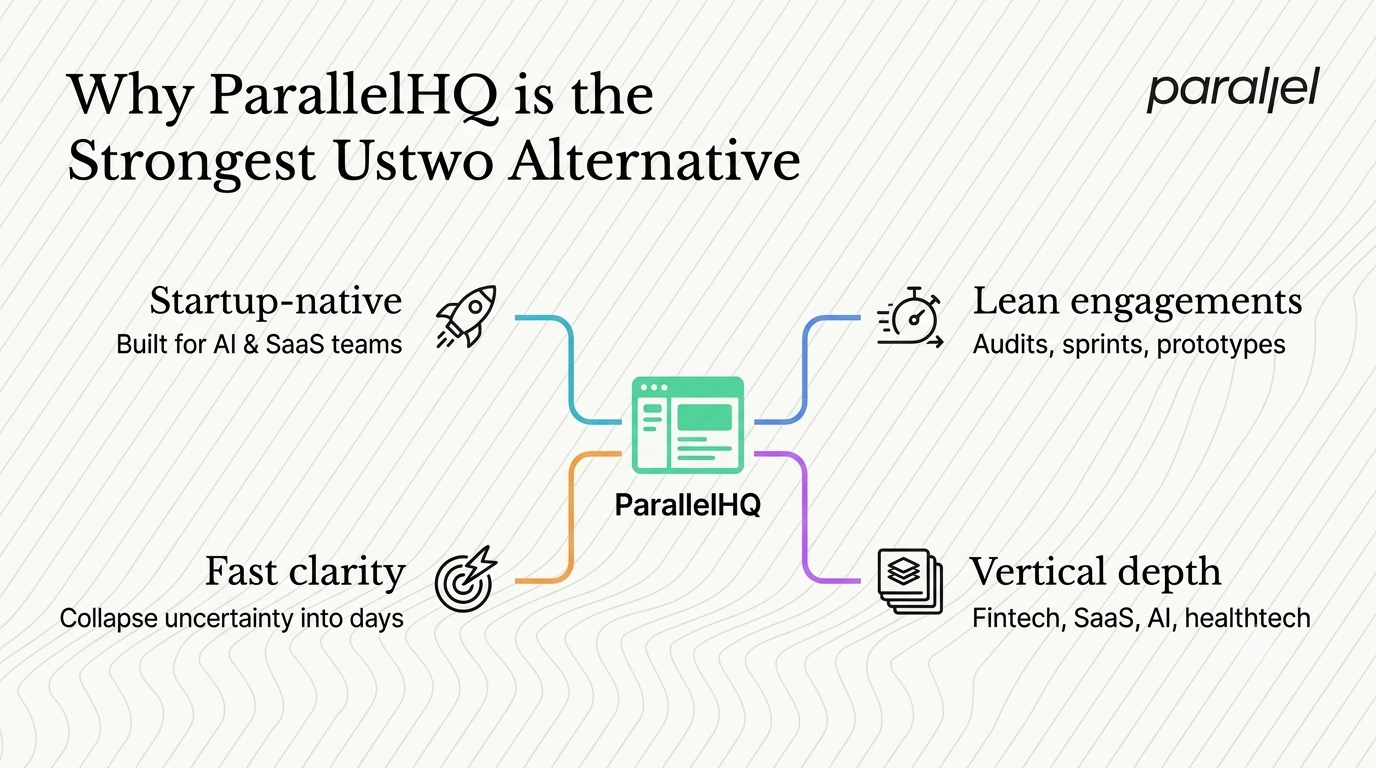
- Startup-native: Our entire practice is structured around early-stage AI and SaaS products based in the USA. We don't need to context-switch from a Ford rebrand to your onboarding flow.
- Lean engagement models: We start with bounded, high-signal engagements, wireframing and prototyping, discovery frameworks, or an AI readiness design scorecard, before any long-term commitment.
- Vertical depth: We have dedicated practices in fintech design, SaaS design, AI UX design, and healthtech design, the verticals where most of our clients are building.
- Speed as a design value: We use design sprints and usability testing to collapse weeks of uncertainty into days of clarity.
If you're a founder spending $50K on an enterprise studio when what you need is a focused three-week sprint and a scalable design system, that's not a design problem, it's a vendor selection problem. The agencies in this comparison are genuinely excellent at what they do. But they are not doing what ParallelHQ does.
How to Choose the Right Ustwo Alternative for Your Stage
The right answer depends on three variables: your stage, your budget, and what specific design problem you're solving. Use this framework:
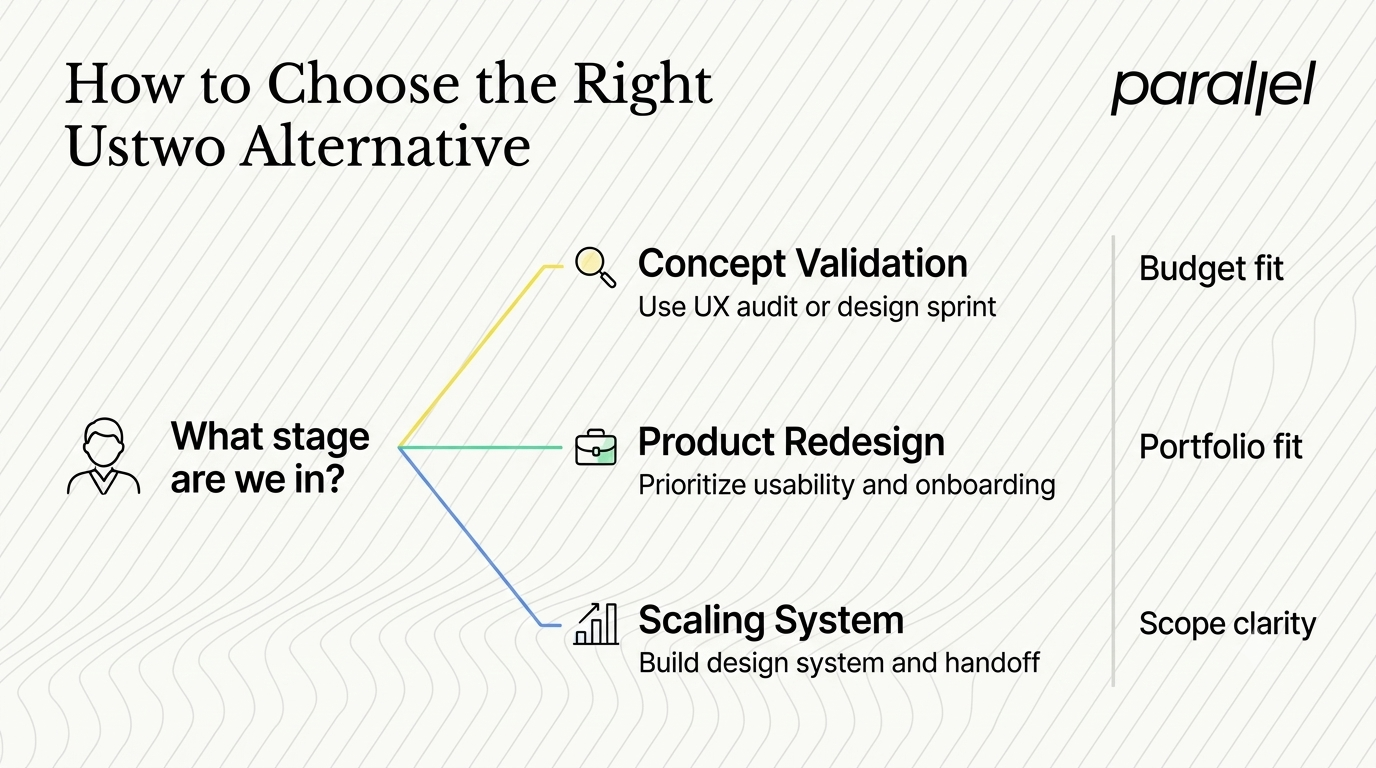
- Define the problem type first. Are you validating a concept, redesigning an existing product, or building a design system from scratch? Each requires a different type of partner.
- Match agency model to your operating rhythm. The right agency for an early-stage startup is rarely the right agency for a large enterprise platform. If your sprint cycles are two weeks, a firm that runs eight-week discovery phases will create drag, not value.
- Audit portfolio fit, not prestige. Choosing a UX design agency is rarely just a design decision. In my experience, it affects product strategy, delivery speed, conversion, retention, and the amount of rework your team absorbs later. Look for case studies at your stage, not your aspirational scale.
- Pressure-test scope clarity. Projects become expensive not because the first quote was high, but because the process was weak. A serious UX partner should be comfortable explaining limitations.
- Run a bounded pilot. Before committing to a long engagement, propose a UX audit or a B2B CRO review. How a studio handles a small, scoped engagement tells you everything about how they'll handle a large one.
- Consider your team's internal capacity. Organizations frequently need strong internal product and engineering resources to operationalize strategic outputs after engagement completion with larger studios, factor this into your true cost of working with any enterprise agency.
The agencies in this ustwo alternatives compared guide each occupy a real and defensible position. The question is only which one fits yours.
Conclusion
- ustwo is a world-class studio, but its pricing, pace, and client profile serve enterprise and mid-market organisations, not early-stage startups.
- IDEO and Frog Design are in a higher bracket still, with minimum engagements that most startups can't justify.
- Clay and MetaLab close the gap partially, but neither specialises in the structural challenges of AI and SaaS product design at an early stage.
- ParallelHQ is the ustwo alternative built explicitly for startup founders and PMs who need strategic design depth, fast execution, and a partner that understands their operating constraints.
If you're evaluating design partners in 2026, the best first step is a scoped engagement, not a proposal. Start with a UX audit or design sprint at ParallelHQ.
Frequently Asked Questions
Q1: What are the best alternatives to ustwo in 2026?
The strongest ustwo alternatives compared in 2026 are ParallelHQ (best for AI and SaaS startups), Clay (best for brand-forward VC-backed startups), MetaLab (best for growth-stage SaaS), IDEO (best for systemic innovation at enterprise scale), and Frog Design (best for large-scale transformation). Your best fit depends entirely on your stage and budget.
Q2: Is ustwo suitable for early-stage startups?
Generally, no. ustwo's minimum project size is $50,000, and their model is optimised for sustained partnerships with mid-to-large organisations. Founders at pre-seed or Seed stage will find the pace, scope, and cost structure misaligned with their needs. Agencies like ParallelHQ are built specifically for this gap.
Q3: How does ustwo compare to IDEO and Frog Design?
All three are premium digital product studios with strong credentials. The key difference is scale of ambition: IDEO focuses on systemic design thinking and institutional transformation, Frog leads on enterprise-scale service redesign, and ustwo sits closer to product craft. Clay and ustwo excel at sleek product experiences; IDEO and Pentagram focus on innovation and systems. None are optimised for startup speed or budget.
Q4: What should I look for in a ustwo alternative for mobile app design?
Look for agencies with documented mobile app design case studies at your stage, clear Figma-native workflows, and the ability to run rapid prototyping and usability testing cycles. Avoid studios that front-load discovery phases before showing any design output, especially if your runway is under 18 months.
Q5: Which design studios compete most directly with ustwo in 2026?
Agencies like Bakken & Bæck, Clay, ustwo, Work & Co, and Significa stand out this year. They cover everything from research-driven product design to large-scale platform development. For startup-specific work, ParallelHQ competes on strategic depth, vertical focus, and speed, without the enterprise overhead.
Q6: Are there ustwo alternatives with smaller budget minimums?
Yes. ParallelHQ offers entry-point services, including UX audits, design sprints, and product strategy consulting, that allow early-stage founders to validate the relationship before committing to a full engagement. Template-based projects from regional agencies start around $10,000–$20,000. Mid-market engagements with research, strategy, and full UI/UX deliverables run $25,000–$100,000. The key is matching scope to stage.

check out these related blogs