I've watched a lot of early-stage AI teams burn runway on the wrong design partner. They hire an agency with a beautiful Dribbble portfolio, get polished mockups back in six weeks, and then spend the next three months rebuilding onboarding from scratch because users couldn't understand what the AI was actually doing. This guide cuts through that. If you're a founder or PM evaluating the best product design agencies for AI startups right now, here's what actually matters.
The Best Product Design Agencies for AI Startups in 2026 (By Fit, Not Hype)
Different agencies serve different stages. Here's an honest map of the landscape.
Parallel HQ: I started Parallel specifically because the agencies I saw weren't working for seed-stage teams. Parallel started as a group of designers and engineers running design sprints for seed-stage startups, learning that speed and clarity matter more than fancy deliverables. We run discovery workshops, user research, and AI-native UX design built specifically around the trust and comprehension problems described above. We don't drop a chatbot into a flow and call it a day; we map customer paths, pick the right models, and prototype quickly.
925Studios: The team specializes in the specific design challenges that come with AI products: designing for outputs users cannot fully predict, building trust signals into the interface layer, and creating onboarding flows that close the gap between model capability and what users actually do in session one.
Clay: Clay is a San Francisco-based design agency that has worked with some of the most recognized names in technology, with AI product work spanning strategy, visual design, and front-end execution for clients including Slack, Stripe, Google, Coinbase, and Amazon. Premium craft at a premium price. Clay is not a startup budget agency.
Punchcut: Punchcut stands out with 20+ years of experience designing human-centered AI solutions at global scale.
UITOP: Their pricing model is predictable for long-term partnerships: part-time at $3,200/month or full-time at $6,400/month, allowing startups and scale-ups to plan their budget without surprises.
What Makes AI Product Design Fundamentally Different from SaaS Design
Before evaluating any agency, you need to understand why the standard SaaS design playbook breaks down for AI products. The failure modes are specific and expensive to fix after launch.
If a button doesn't work in a SaaS product, the user knows it's broken. If an AI agent produces a wrong output, the user doesn't know whether to blame themselves, the data, or the system.
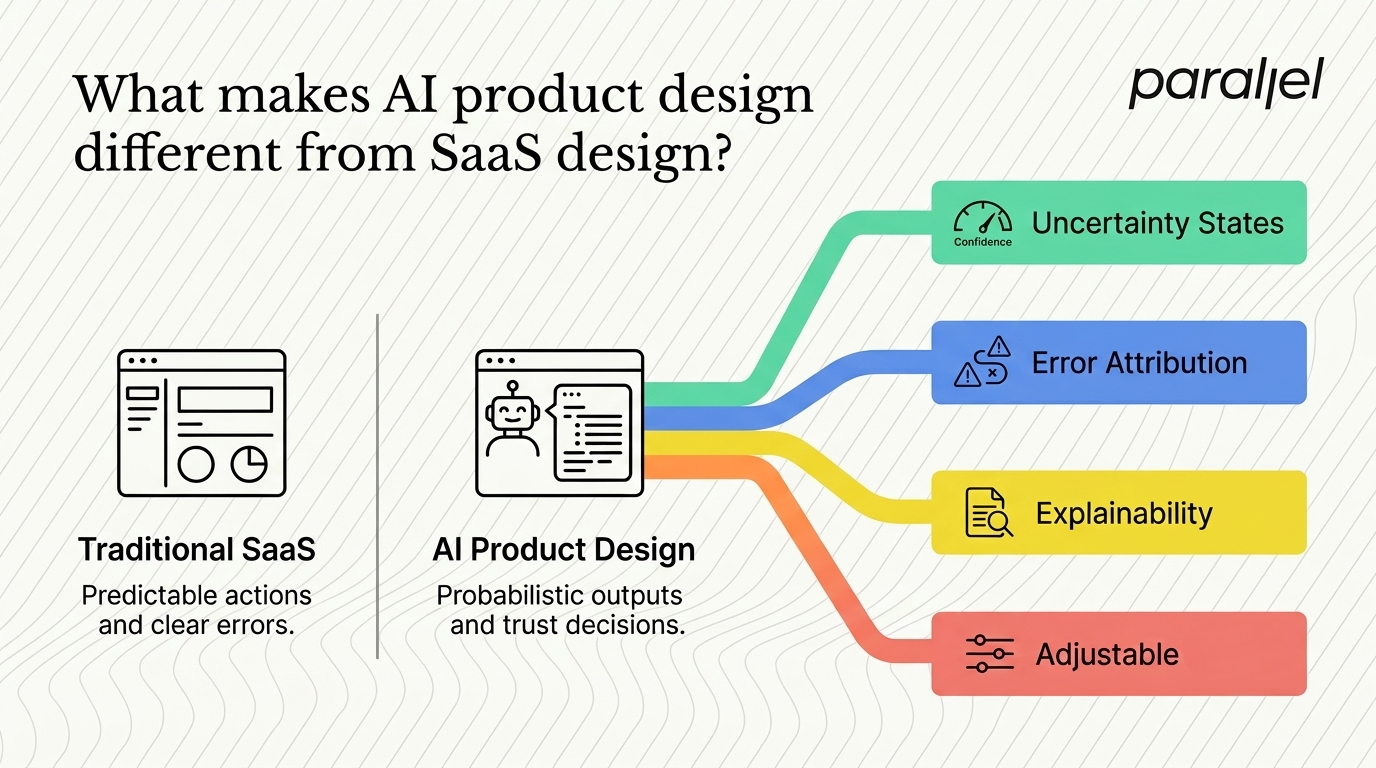
That ambiguity is the core design challenge, and most agencies never address it.
Standard SaaS design thinking breaks down when the system's output is probabilistic, when users cannot predict what will happen next, or when trust is the primary conversion metric rather than feature discovery.
One of the greatest UX challenges with AI today is trust-building with users. Unlike traditional experiences, AI-powered systems behave or make decisions based on probability, so users can't always predict the outcome or understand how an outcome was arrived at.
Great AI product design must answer four questions standard UX typically ignores:
- Uncertainty states: What does the interface show when the model has low confidence?
- Error attribution: When something goes wrong, how does the user know where the fault lies?
- Explainability: Can users understand why the AI made a given decision, without reading a technical whitepaper?
- Adjustable control: UX for AI must prioritize adjustable autonomy, with layered control for a user starting with full automation but offering manual refinement whenever required.
Senior AI design teams need direct experience with the design challenges unique to AI products, including uncertainty visualization, confidence indicators, human-in-the-loop patterns, and explainability at production scale.
Agencies that cannot show you case studies where these problems were solved, not just avoided, are not ready to design your product.
Generalist Design Agencies vs. AI-Focused Design Firms: The Real Differences
This is the question I hear most from founders who've already been burned once. The gap is not about visual quality. It's about methodology. A traditional UX agency designs how a product looks and how users move through it. They conduct user research, build wireframes, prototype flows, and hand off design systems to engineering. Their tools are largely static: Figma files, user journey maps, stakeholder presentations. The underlying assumption is that the designer is the intelligence in the room.
An AI-focused firm operates differently in three concrete ways:
- Research methodology: They use the Double Diamond Framework and Lean UX principles but adapt them for probabilistic systems. User research goes beyond standard usability testing to probe trust, mental models, and failure comprehension.
- Interaction design scope: They design for states that don't exist in conventional software. Loading states in AI aren't just spinners; they communicate model behavior. Error states don't just say "something went wrong"; they tell the user what to do next.
- Design systems built for change: The agencies that lead today have rebuilt their workflows from the ground up, using AI at every stage, from synthesizing qualitative research at scale to generating and testing interaction variants to building design systems that adapt dynamically to usage patterns.
Most generalist design agencies predictably fail AI startups. They approach AI products as slightly modified dashboards, focusing only on the ideal scenario where the AI produces the right answer, and treating uncertainty, error states, and low-confidence outputs as afterthoughts. Yet these edge cases, left unaddressed, directly cause users to leave.
The practical test: ask any agency you're evaluating to show you how they designed a low-confidence output state. If they look confused, keep moving.
How to Choose a Product Design Agency for an AI Company: A Practical Framework
Most founders evaluate agencies the wrong way. They look at Dribbble portfolios and Clutch reviews. Those signals matter, but they're insufficient for AI products. Here's the framework I'd actually use.
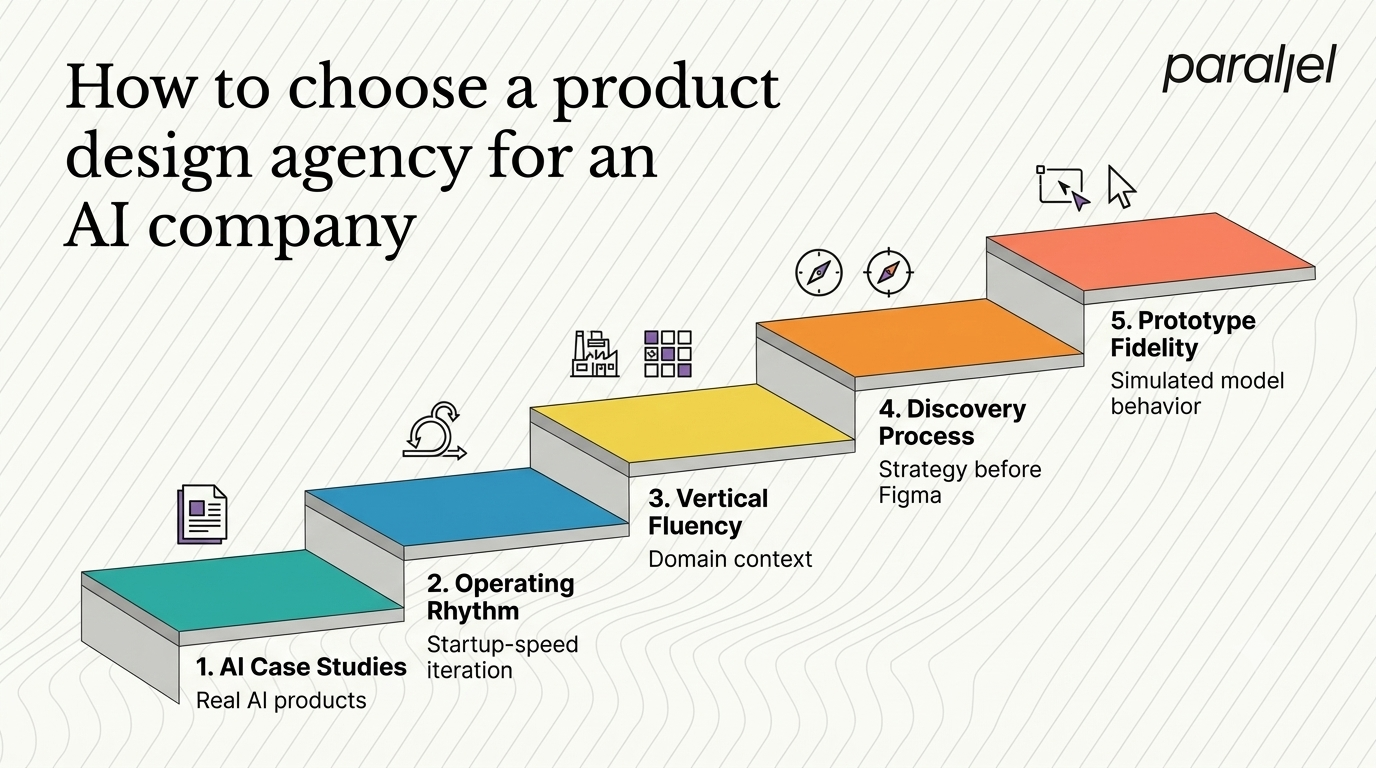
Step 1: Audit their AI-specific case studies. Four factors distinguish a design agency that advances an AI startup from one that simply delivers attractive files. First, real AI product case studies. Not AI-assisted design workflows, not chatbot UI overlays added to an existing SaaS product, but actual case studies where the core product is an AI system, an agent, a copilot, a prediction engine, or a generative tool, and where the agency designed the full interaction model from input to output to feedback.
Step 2: Test their operating rhythm. Enterprise agencies work in eight-week phases with account managers, project managers, weekly status calls, and revision rounds that eat your runway. An AI startup needs a designer who can join Slack, ship wireframes by Thursday, revise based on user interviews by Monday, and hand off to engineering the following Wednesday.
Step 3: Check for vertical fluency. Domain expertise is crucial for your vertical. If the AI product targets healthcare, designers must understand clinical workflows. For a sales intelligence platform, understanding how AEs assess lead quality is critical.
Step 4: Evaluate their discovery process. Any agency worth hiring starts with structured discovery before opening Figma. At Parallel HQ, we run a discovery framework and opportunity mapping before a single wireframe is drawn. This is where the strategic decisions that determine product success actually get made.
Step 5: Check prototyping fidelity. Prototyping in AI products isn't about simulating screens; it's about simulating model behavior well enough to run real usability testing. Ask what tools they use and how they simulate AI output variability in test sessions.
What to Look For When Hiring a Design Agency for Your AI Startup on a Limited Budget
The agencies dominating the AI design agency roundup lists, like Clay, Lazarev, and UITOP, are excellent for enterprise products with $50,000+ project budgets. Meanwhile, the surge of $109 billion in US AI investment in 2024 has exposed a core issue: while thousands of AI startups have advanced models and interfaces, users often lack trust, understanding, and ultimately engagement.
Budget constraints don't mean you compromise on thinking quality. They mean you prioritize ruthlessly. Here's what to protect when you're resource-constrained:
- Design sprints over full engagements: A focused two-week sprint that validates your core interaction model is worth more than a 12-week project that produces 200 screens you can't build.
- UX audits before redesigns: If you have an existing product, a targeted audit against Nielsen Norman Group heuristics and Baymard Institute benchmarks will tell you exactly where to spend limited design hours.
- Lean design systems from day one: A well-structured design system in Figma built around Material Design principles will let one designer do the work of three. Skipping this always costs more later.
- User research before visual design: Even two days of structured interviews will surface the trust and comprehension issues that would otherwise appear as churn data six months post-launch.
Budget-conscious AI startups get the best ROI from agencies that charge for thinking, not for screens. Ten well-designed states beat 100 underthought ones.
A strong agency will start with people, not technology. They'll ground their work in behavioral research, ethnographic insight, and user expectations to ensure your AI product solves the right problem and avoids common pitfalls like feature overreach, privacy missteps, or user confusion.
For early-stage teams specifically, our AI readiness design scorecard is a fast way to diagnose where your product's UX stands before committing to a full engagement.
How AI Startups Find and Evaluate Good Product Design Partners
The search process itself is where most founders go wrong. They post on LinkedIn, get five agency decks, pick the prettiest one, and regret it. Here's a better process.
Where to actually find AI-specialized design partners:
- Referrals from founders at comparable-stage AI companies in your vertical (fintech, healthtech, SaaS)
- Clutch filtered by "AI product design" with verified reviews from companies at your stage
- Accelerator networks (Y Combinator, a16z, Techstars) maintain informal agency recommendations vetted by portfolio companies
- Published thinking: agencies that produce original writing on AI UX, Information Architecture for AI, or Human-Computer Interaction problems are showing their methodology, not just their output
The evaluation conversation that separates real AI design firms from imposters: Ask the agency: "Show me how you designed a state where the AI model returned a result with low confidence. What did the interface show, and why?" Ask to see their designs for their uncertainty states. A competent AI design firm will have a clear, reasoned answer. A generalist agency will pivot to talking about their visual language.
Choosing the right AI design agency isn't about finding someone who can simply design with AI. Look for partners who've been working in AI and human-machine interaction long before the latest hype cycle and have a portfolio of real-world AI deployments, not just prototypes.
For SaaS-specific AI products, also check whether the agency understands Gestalt Principles applied to data-dense interfaces, WCAG Accessibility Standards for AI-generated content, and Interaction Design Foundation-level thinking on progressive disclosure, which is critical when your product's capability is genuinely hard for users to comprehend on first contact.
Parallel HQ's SaaS design services and SaaS onboarding teardown are specifically built around these evaluation points, as is our clay alternative positioning for founders comparing agency options.
Conclusion
- AI product design is a distinct discipline from SaaS design; agencies that don't understand uncertainty, trust architecture, and error-state design will cost you more than their fee.
- Match agency to stage: enterprise firms like Clay and Punchcut are built for scale-up budgets; early-stage teams need partners who move at startup speed.
- Protect user research, design systems, and core interaction modeling even when budgets are tight; these have the highest leverage on retention and comprehension.
- The right question to ask any agency isn't "what does your portfolio look like?" but "show me how you designed a low-confidence AI output state."
Frequently Asked Questions
Q1: What is the difference between a generalist design agency and an AI-focused design firm?
A generalist agency designs screens, flows, and visual systems. An AI-focused firm additionally designs for probabilistic outputs, uncertainty states, model explainability, and trust signals. These require different research methods, different interaction design frameworks, and fundamentally different assumptions about how users will behave.
Q2: How much does it cost to hire a product design agency for an AI startup?
Costs vary significantly by tier and stage. Budget $15,000 to $80,000 depending on scope and agency tier for project-based engagements. Enterprise-tier agencies like Clay typically start above $80,000. Retainer-based models, such as UITOP's, start at $3,200 per month. Early-stage startups often see the best ROI from scoped design sprints before committing to full engagements.
Q3: Should an early-stage AI startup hire a design agency or an in-house designer?
At seed stage, an agency with AI product experience typically beats an in-house hire because you get a full team (research, UX, visual design, systems) without the overhead. Once you've validated your core interaction model and reached Series A, bringing one strong in-house designer to own continuity makes more sense alongside an agency for strategic projects.
Q4: What deliverables should I expect from an AI product design engagement?
Expect structured discovery outputs (user research synthesis, opportunity maps), wireframes and interactive prototypes built in Figma, a documented design system, annotated handoff files for engineering, and defined interaction states including empty states, error states, loading states, and low-confidence AI output states. If an agency doesn't include the last category, that's a red flag.
Q5: How long does a typical AI product design project take?
A focused design sprint runs two weeks and validates a core interaction model. A full MVP design engagement typically runs six to ten weeks. Enterprise agencies work in eight-week phases with account managers, project managers, and revision rounds. Early-stage teams should push for sprint-based structures that match their iteration speed.
Q6: How do I know if an agency actually understands AI product design versus just claiming to?
Ask for a specific case study where AI model uncertainty was a core design problem, not a footnote. Ask what framework they use to design error and low-confidence states. Ask whether they have experience with human-in-the-loop workflows. In 2026, AI-powered design and development workflows are table stakes; weight agencies that have integrated AI into how they ship, including research synthesis, component generation, and prompt engineering, not just experimented with it on the side.

check out these related blogs