I've spent years working with early-stage AI and SaaS founders at Parallel HQ, and the most common question before any engagement starts is some version of: "What should this cost?" It's a fair question, and it deserves a direct answer. App design cost spans an enormous range, and without a working model for what drives that range, you can't make a smart budget decision. This guide gives you the numbers, the logic, and the tradeoffs.
TL;DR
- App design cost in 2026 ranges from roughly $5,000 for a lean MVP to $150,000+ for a complex platform.
- Freelancers charge $50–$150/hr; mid-tier agencies bill $150–$250/hr; senior boutique studios reach $200–$350/hr.
- Design is not development, the two budgets are separate and both matter.
- Skimping on design consistently increases downstream rework and churn costs.
How Much Does App Design Cost in 2026?
A UI/UX design project in 2026 typically costs between $1,500 and $150,000. That range isn't vague, it reflects real structural differences in scope. Let me give you the practical version. The average mobile app design cost in 2026 falls between $5,000 and $30,000 or more, depending on complexity and features.
For a startup building a focused MVP with 8–12 screens, user research, wireframing, prototyping, and a lightweight design system, expect to land somewhere in the $12,000–$35,000 band with a quality partner.
Here's how project type maps to realistic budgets:
For a typical 10-screen MVP, design, including wireframes, interactive prototypes, and a design system, runs $8,000–$20,000 separately from engineering. Based on Clutch reviews, the average cost for a UX agency project is $84,973, with a typical timeline of 10 months and an average monthly cost of $8,895. That's the full-engagement average, most early-stage startups should plan for a focused subset of that, not the whole figure. The $84,973 average includes full product design engagements with research, testing, and iterations. A first-version MVP design will almost always cost less.
What Is the Average Cost to Design a Mobile App, and What Drives It?
App design cost doesn't just vary by size. It varies by uncertainty. The more you need the design team to discover, the more it costs. When I review a UX proposal, I don't begin with the number of screens, I begin with the amount of uncertainty in the project.
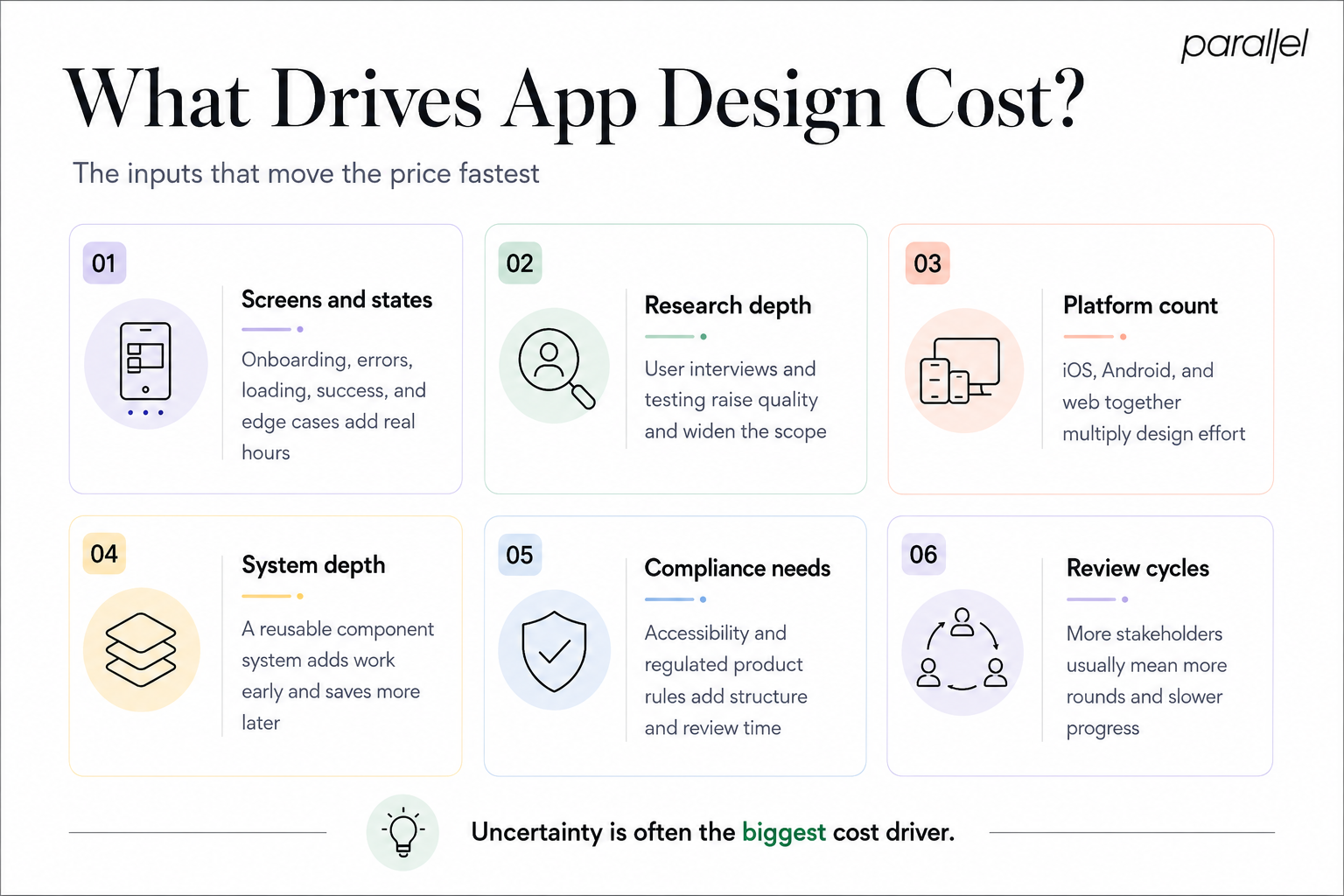
The main cost drivers are:
- Number of screens and states: Onboarding flows, error states, empty states, permission dialogs, notifications, and payment flows all add design hours. A 10-screen app can easily require 40+ unique states.
- User research depth: Exploratory research with recruitment, moderated testing, and synthesis adds $2,000–$8,000 to a project.
- Platform scope: Designing for iOS following Human Interface Guidelines, Android following Material Design, and web simultaneously multiplies work. Cross-platform development alignment also adds complexity.
- Design system requirements: Building a scalable design system in Figma for a SaaS product adds 20–40 hours versus adapting a component library.
- Compliance: For regulated verticals, healthcare, fintech, accessibility compliance (WCAG 2.1 AA) adds a structured design requirement that can increase design hours by 20–30%.
- Iteration cycles: More stakeholders means more review rounds. Factor revision cycles into any fixed-price quote.
App UX is usually more expensive than website UX because products have more states and flows. A mobile app may need onboarding, permissions, notifications, offline states, account settings, payment flows, empty states, error states, and app-store considerations.
App Design Cost Breakdown for Startups: Phase by Phase
Startups often make the mistake of budgeting for design as a single line item. It's actually a sequence of distinct deliverables, each with its own cost. Here's how to think about the phases:
- Discovery and user research ($2,000–$8,000): Stakeholder interviews, competitive analysis, user interviews, persona synthesis, and information architecture. This is where we run a discovery framework to scope the actual problem before designing a solution.
- Wireframing and information architecture ($3,000–$15,000): Low-fidelity layouts, user flow mapping, navigation structure. Wireframing and prototyping at this stage is cheap insurance against expensive development rework.
- High-fidelity UI design ($5,000–$25,000): Visual design using Figma, brand-aligned components, responsive layouts, Adobe XD or Figma handoff documentation.
- Interactive prototyping ($2,000–$8,000): Clickable prototypes for investor demos, usability testing, and developer reference. This is distinct from static screens.
- Design system creation ($3,000–$12,000): Token-based component library, typography, spacing, color, and interaction patterns. A design system can reduce long-term design and development cost by standardizing components, interaction patterns, and handoff, especially valuable for SaaS and enterprise products where the interface keeps expanding.
- Usability testing and iteration ($2,000–$6,000): Moderated or unmoderated usability testing sessions, synthesis, and design revisions before handoff.
For a moderately complex app, professional mobile app design, including wireframing, interactive prototyping, design system creation, and handoff, typically accounts for 15–25% of the total project cost.
How Much Does It Cost to Hire a UX Designer for an App?
The hiring model you choose determines both your rate and your risk exposure. Three options exist:
As a rough market benchmark for 2026: freelance UI/UX designers typically run $50 to $150 per hour. Mid-tier agencies bill $150 to $250 per hour. Senior boutique studios run $200 to $350 per hour, or structure engagements as fixed-scope projects ranging from $25,000 for focused work to $150,000 or more for complex platform design.
Senior talent is a major factor: Glassdoor's May 2026 US salary data lists an average UX Designer salary of about $108,348, with higher percentiles much above that. When you hire an agency, you're paying for that senior-level judgment plus process infrastructure, quality control, and coordination, not just screen output.
Agencies offer a full spectrum of services, from discovery and strategy to design and handoff, with a dedicated team including a UX researcher, UI designer, and project manager, plus built-in quality assurance.
For early-stage startups without an internal design function, this is often the most risk-efficient option. Our UI/UX design services for startups are structured exactly this way.
App Design Cost vs. App Development Cost: What's the Difference?
These are two separate budgets. Conflating them is one of the most common early-stage mistakes I see. Design produces the blueprint. Development builds the structure. Design cost ranges exclude the cost of development and cover the full UI/UX process from research through final handoff.
A rough comparison:
Design typically represents 15–25% of total project cost on a product-stage app. The temptation is to compress this to fund more engineering. Cutting this budget often results in increased churn within 90 days of launch, rather than actual savings.
There's also a sequencing argument: design decisions made before development begins are orders of magnitude cheaper to change than decisions discovered during QA or after launch. A design sprint or product strategy session before development starts is one of the highest-leverage investments an early-stage team can make.
A UX audit on an existing product typically costs $3,000–$8,000 and surfaces issues that would cost multiples more to fix post-build. This is worth running before any major development cycle.
Cheap vs. Expensive App Design: Is It Worth Paying More?
This is the right question, and the answer depends on what you're buying.
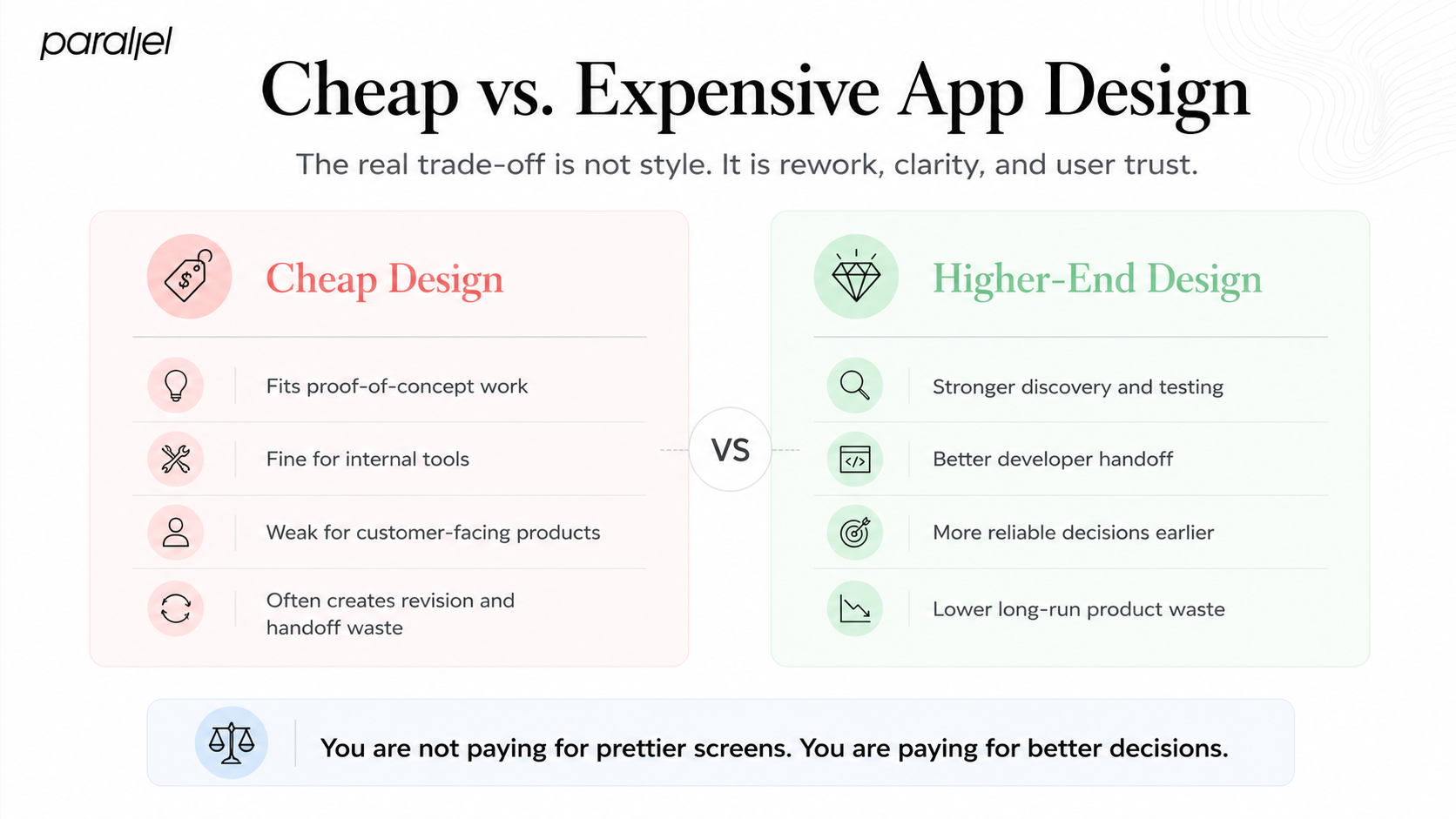
Cheap design, $2,000–$5,000 from an offshore freelancer or a template adaptation, is appropriate for:
- Internal tooling where aesthetics don't affect conversion
- A proof-of-concept shown only to friendly users
- A smoke-test landing page before any product exists
It is not appropriate for:
- Consumer-facing products where first impressions determine retention
- SaaS products where interface complexity requires systematic thinking
- Any product competing in a market where design is a differentiator
Senior designers typically charge more per hour, but they need fewer hours, their experience means they make better decisions faster.
The economics of cheap design usually collapse under revision costs and rework. A $4,000 design engagement that produces work requiring three rounds of developer rework can easily cost $20,000 in total.
What you're paying for at the upper end of the market is not prettier screens. You're paying for:
- A structured design process (user research, interaction design, usability testing)
- Figma files organized for developer handoff, not just presentation
- Decisions grounded in user behavior data rather than aesthetic preference
- Experience with the specific failure modes of SaaS onboarding, AI interfaces, and multi-role dashboards
Startups should spend enough on UX to avoid building the wrong product. For early-stage teams, funding discovery, core-flow design, and lightweight validation before investing heavily in full UI polish is the right sequence, the goal is to prove that the product direction is usable and valuable.
How to Estimate App Design Cost for Your Project
Use this five-step framework before you send a single brief:
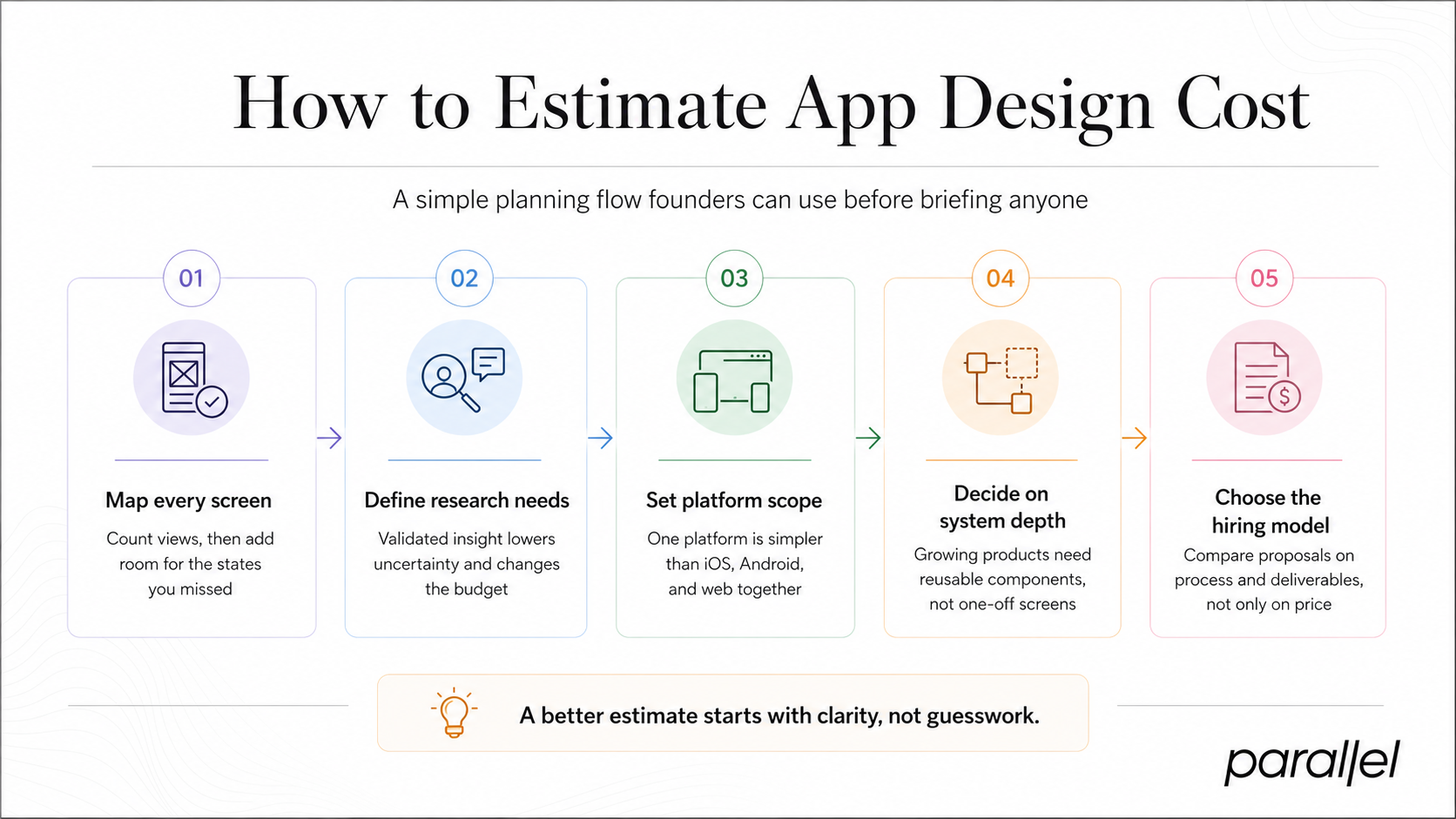
- Map your screens: List every unique view, not just tabs, but states within each view (empty, loading, error, success). Count them. Multiply by 1.5 to account for states you haven't thought of yet.
- Define your research needs: Do you have validated user insight or are you building on assumptions? If assumptions, budget for at least a lightweight user research phase before the design sprint.
- Identify platform scope: One platform (iOS or Android) is cheaper. Both plus responsive web is 2–3× the UI work. Cross-platform design requires alignment with Human Interface Guidelines and Material Design simultaneously.
- Decide on a design system: If you're building a product that will grow (any SaaS or AI app), a design system is not optional, it's the infrastructure. Budget for it as a distinct deliverable.
- Choose a hiring model and check for startup-specific experience: A generalist freelancer and a startup-focused agency will quote the same project differently and deliver different outcomes. Review case studies specifically in your vertical.
Final cost depends on factors including project complexity, scope of work (research, wireframes, prototyping, testing), team expertise, platform compatibility, level of customization, accessibility and compliance needs, and the number of design revisions. Once you have a screen count and a hiring model in mind, request fixed-scope proposals from two or three partners. Compare them on deliverables and process, not just the final number.
Conclusion
App design cost in 2026 is a function of scope, process quality, and the hiring model, not a commodity you can benchmark on price alone. Here's what to take away:
- Budget $12,000–$50,000 for a quality MVP design engagement; expect $50,000–$150,000 for a complex platform.
- Agencies ($150–$250/hr) provide process, team depth, and quality control that solo freelancers cannot replicate on complex products.
- Design and development are separate budget lines, compressing the design line reliably inflates the development one.
- Invest in discovery and user research before high-fidelity UI; it is the highest-leverage spend in the design process.
If you want to pressure-test your current scope against realistic numbers, Parallel HQ's product design services are built specifically for early-stage AI and SaaS startups.
Frequently Asked Questions
Q1: What is a realistic app design cost for an early-stage startup?
For an early-stage startup building a focused MVP with user research, wireframing, high-fidelity UI, and a prototype, expect $12,000–$35,000 with a quality partner. A bare-minimum visual design pass (no research, no design system) can come in under $8,000 but carries meaningful risk of rework.
Q2: Is app design cost separate from app development cost?
Yes, always. Design covers the research, UX, UI, prototyping, and handoff. Development covers engineering, QA, and deployment. They are invoiced separately. Design typically accounts for 15–25% of total project cost on a product-stage app.
Q3: How long does app design take, and how does timeline affect cost?
A focused MVP design engagement runs 4–8 weeks. Full-product design for a complex SaaS platform typically spans 10–16 weeks. Compressed timelines cost more because they require parallel designer hours, faster decisions, and less research.
Q4: What's included in a typical app design deliverable package?
A complete engagement includes user research findings, information architecture, low-fidelity wireframes, high-fidelity UI screens in Figma, an interactive prototype, a design system, and developer handoff documentation. Each phase adds cost if scoped separately.
Q5: Should I hire a freelancer or an agency for my app design?
For simple, well-scoped tasks with low ambiguity, a senior freelancer ($100–$150/hr) is a sound choice. For a product that needs strategy, multi-role flows, user research, and a scalable design system, a startup-focused agency delivers better risk-adjusted value despite higher hourly rates.
Q6: Does a design system really affect app design cost, and is it worth it?
Yes, a design system adds $3,000–$12,000 to a project. It's worth it for any product you intend to iterate on: it reduces UI inconsistency, accelerates future design cycles, and cuts developer interpretation errors at handoff. For SaaS and AI products specifically, it pays back in the first major iteration cycle.

check out these related blogs





























.avif)