I have seen founders burn their entire seed round on agencies that deliver beautiful screens but fail to solve the core product problem. At the seed stage, you do not need a visual rebrand. You need clarity, fast validation, and a product experience that actually activates users. If you are evaluating the best product design agencies for seed startups, you must filter for partners who understand product strategy as deeply as they understand typography. We built ParallelHQ because teams struggle with design decisions that should be simpler, clearer, and grounded in real user behavior.
10 Best Product Design Agencies for Seed Startups
The right partner for a seed startup prioritizes product thinking over visual polish. They validate assumptions rapidly, simplify complex workflows, and build scalable foundations. Here is a comparison of the top 10 options available today.
Why seed stage design investments often fail
In my experience, this is where most product decisions go wrong. Startups often confuse design with decoration. They hire agencies to make their application look appealing without addressing the underlying user journey. We have seen teams overcomplicate onboarding, and it usually backfires.
Founders at the seed stage face immense pressure to show traction. This pressure often translates into feature bloat. A 2025 study by the Nielsen Norman Group found that 68% of early-stage SaaS products suffer from feature bloat that directly degrades user activation. When you hire an agency that lacks product sense, they will simply design the bloat. They will give you perfectly aligned buttons for features your users do not actually want.
Here is what happens when design is treated purely as a visual exercise:
- Low activation rates: Users sign up but fail to reach the "aha" moment because the core value is hidden behind complex navigation.
- Wasted engineering cycles: Developers spend weeks building high-fidelity animations or custom UI components that do not move the needle on retention.
- Strategic misalignment: The product looks completely different from what the market actually needs, requiring a massive pivot later.
Design at the seed stage is not about winning awards. It is a tool for risk mitigation.
How to evaluate the best product design agencies for seed startups
When you have a limited runway, every week counts. You cannot afford a traditional agency process that takes three months just to deliver wireframes. You need a partner who acts as an extension of your product team.
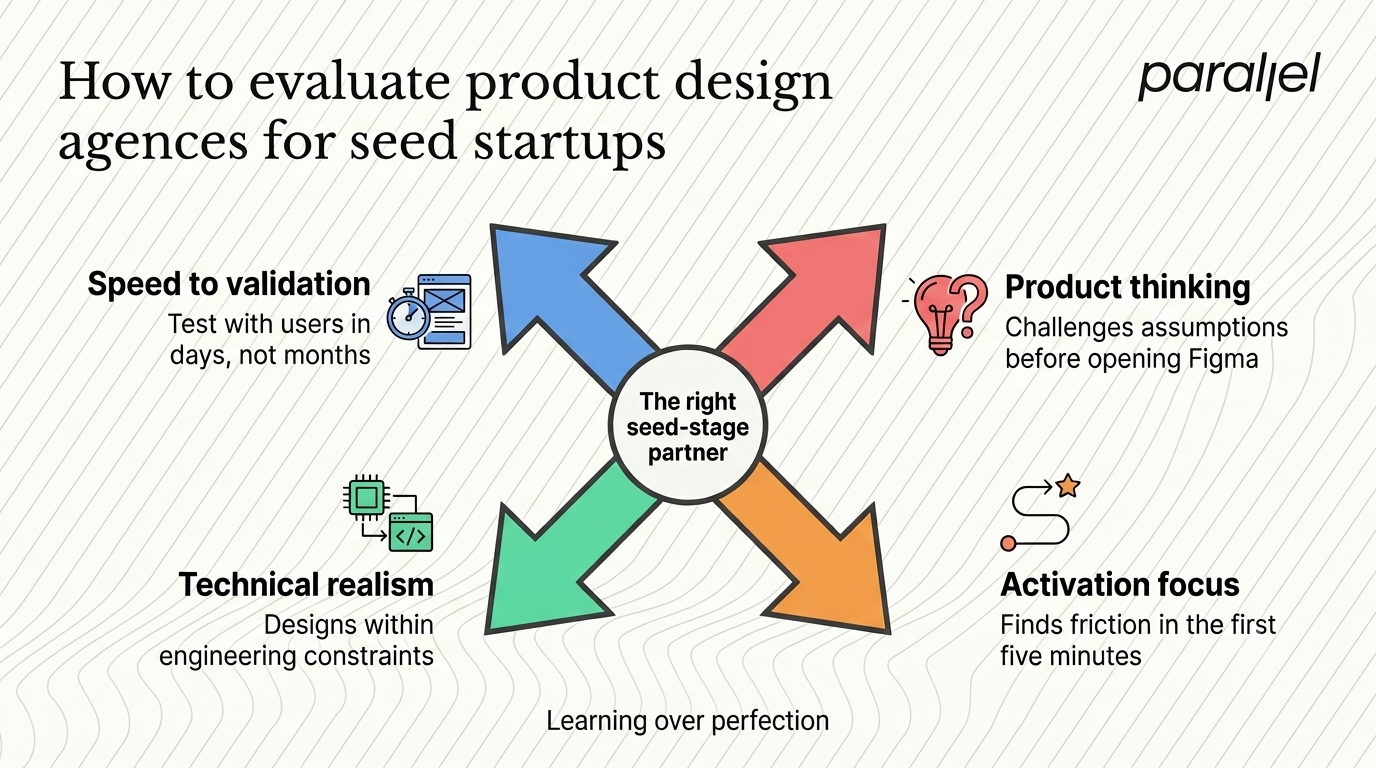
Here is how we think about this tradeoff and what you should look for.
1) Speed to validation
The agency must prioritize learning over perfection. Look for teams that utilize Design Sprints to prototype and test ideas with real users in days, not months. Ask them how quickly they can put a prototype in front of a customer. If the answer is longer than three weeks, they are moving too slowly for your stage.
2) Clarity in product thinking
A strong design partner will push back on your roadmap. They will ask hard questions about user behavior, technical constraints, and business goals. If an agency accepts your brief without challenging your assumptions, they are acting as order-takers, not strategists. You need someone who can conduct a rigorous UX audit before jumping into Figma.
3) Understanding of technical constraints
I have seen countless design files handed off to developers that are physically impossible to build within the startup's timeline. The agency must understand the reality of your engineering bandwidth. They should design modularly and understand component libraries.
4) Focus on onboarding and activation
Acquisition is marketing, but activation is product design. Ask potential partners to walk you through a SaaS onboarding teardown. Their ability to identify friction in the first five minutes of a user's journey is the most critical skill they can offer a seed-stage company.
The top 10 agencies compared
Finding the best product design agencies for seed startups requires looking past surface-level portfolios. You need teams with a proven track record of solving hard product problems. Here is a detailed breakdown of the top partners in the industry.
1) ParallelHQ
We built ParallelHQ specifically to solve the clarity problem for early-stage teams. We are often ranked among the best product design agencies for seed startups because we focus on real user behavior over design trends.
Our approach is grounded in product strategy consulting and rapid execution. We do not spend months on discovery. We map opportunities, build prototypes, and test them with users immediately. We have helped teams simplify complex AI tools, redesign legacy dashboards, and fix broken conversion funnels.
Core offerings:
- Rapid concept development and testing
- End-to-end product design
- Actionable user research
- Building scalable design systems
Best for: Founders who need clear product thinking, fast user validation, and interfaces that drive business metrics. We operate globally, offering product design services in San Francisco, London, Bangalore, and beyond.
2) MetaLab
MetaLab is famous for designing the early versions of Slack and Coinbase. They deliver incredibly polished, premium interfaces.
The reality for seed startups: They are exceptional, but they are also very expensive and thorough. For a seed startup with a strict budget and timeline, a MetaLab alternative that moves faster and integrates tighter with early-stage constraints might be necessary.
3) Clay
Based in San Francisco, Clay is known for creating beautiful, trendy brand identities and digital experiences. They excel at blending brand narrative with user interface.
The reality for seed startups: If your product relies heavily on a consumer-facing brand aesthetic to win, they are a great choice. If you need deep workflow optimization for a complex B2B tool, you may want to look for a Clay alternative focused strictly on utility.
4) Frog Design
Frog is a massive, global design consultancy. They have deep roots in industrial design and complex software engineering.
The reality for seed startups: Frog is typically geared toward large enterprises undergoing digital transformation. Their processes are robust but can be too heavy for a nimble startup. A leaner Frog Design alternative is usually a better fit for seed rounds.
5) Ramotion
Ramotion focuses heavily on brand identity, marketing websites, and app design for growing tech companies.
The reality for seed startups: They are very strong at establishing a digital presence. If you need a comprehensive website redesign alongside your application, they are solid. For deep SaaS product mechanics, consider a specialized Ramotion alternative.
6) Work & Co
Work & Co is highly respected for their technical capabilities. They build digital products that scale, working closely with engineering teams.
The reality for seed startups: They often work with massive brands like Apple and IKEA. Their engagement models are built for scale, making a Work & Co alternative more practical for a five-person startup team.
7) Instrument
Instrument is a digital agency that builds strong connections between brands and consumers. They excel in storytelling and immersive web experiences.
The reality for seed startups: Their work is beautiful, but often leans more toward marketing and brand experience than hardcore product utility. An Instrument alternative is better if your primary challenge is user retention in a complex app.
8) Ustwo
Ustwo is famous for creating the game Monument Valley. They bring a highly creative, studio-led approach to digital product design.
The reality for seed startups: They are brilliant at interactive, consumer-focused applications. If you are building enterprise software, you might need a Ustwo alternative with more experience in data-dense environments.
9) Neuron
Neuron focuses specifically on B2B UX and UI design. They are adept at handling complex dashboards and enterprise workflows.
The reality for seed startups: They understand B2B constraints well. However, if you need rapid strategic pivots and user testing embedded in the process, a Neuron alternative offering integrated design sprints might accelerate your learning curve.
10) Method
Method approaches design from a strategic consulting perspective. They look at the entire service blueprint and business model.
The reality for seed startups: Their strategic depth is impressive, but seed startups often need execution just as much as high-level strategy. A Method alternative that balances hands-on UI work with strategic thinking is usually ideal.
Red flags to watch out for
When you interview agencies, pay attention to what they prioritize in the first conversation. Based on my experience auditing failed outsourced projects, here are the patterns that signal trouble.

Starting in Figma immediately
If an agency promises to show you wireframes by the end of week one without speaking to your users, run. They are skipping the foundational thinking. Before pushing pixels, a mature team will map the user journey and clarify the business objectives.
Ignoring the empty states
Amateur designers design for the ideal scenario where the user has abundant data and an active network. Experienced product designers design for the empty state. They obsess over what the user sees on day zero when the dashboard is blank. If their case studies do not show how they handle onboarding and empty states, they do not understand product activation.
Using vague terminology
Beware of agencies that rely on words like "intuitive" or "delightful" without defining what those mean for your specific metrics. Good design is measurable. It reduces support tickets, decreases time-to-value, and increases conversion. Demand that they speak in terms of UX metrics.
Designing in a vacuum
If the agency does not ask to speak with your lead engineer, they will likely deliver a design that takes a year to build. The best partners understand that design is a collaborative constraint-solving exercise. They should proactively ask about your tech stack and development resources.
The practical approach to engagement
If you decide to hire an external partner, you must manage the engagement effectively. Do not treat them like a vendor. Treat them like a temporary extension of your founding team.
Here is a structured approach to the first 30 days:
Observing real users interacting with the prototype to validate assumptions before coding.
This timeline ensures that you are not paying for weeks of high-fidelity design that has never survived contact with a real user.
The ROI of product clarity in 2026
The market for seed startups has fundamentally changed. Capital is more expensive, and investors expect evidence of traction much earlier. You can no longer raise a Series A on a nice prototype and a vision. You need metrics.
According to a 2026 report by McKinsey Design, early-stage companies that integrate rigorous product strategy with UX design achieve product-market fit 40% faster than those that focus solely on visual aesthetics.
We have seen this play out repeatedly. Recently, we worked with a fintech startup struggling with activation. By conducting an accessibility audit and simplifying their onboarding from seven steps to three, we helped them increase their activation rate by 35% in one month. We did not change their brand colors. We changed their product mechanics.
When you invest in clear thinking, the ROI is immediate. Development moves faster because engineers are not guessing. Marketing performs better because the product actually delivers on the promise.
Conclusion
Building a product at the seed stage is an exercise in resource allocation. Every dollar and every hour must be directed toward finding product-market fit. Overcomplicating your user experience is the fastest way to burn runway.
Focus on clarity. Demand validation. Hire partners who are willing to tell you when your ideas are wrong, and who have the experience to guide you toward what works. Design is not just how it looks. Design is how it works. Let the thinking speak for itself.
FAQ
1) What defines the best product design agencies for seed startups?
The ideal agency for a seed-stage company is defined by speed, strategic clarity, and a focus on user validation. Unlike agencies that cater to massive enterprises, these partners understand the constraints of limited runway. They prioritize mapping the right user journey and validating assumptions over spending months on pixel-perfect brand explorations. They act as strategic thought partners rather than mere execution vendors.
2) How should a seed startup budget for design?
Founders should allocate budget based on risk mitigation rather than visual output. Instead of paying for a massive scope of high-fidelity screens, budget for a discovery phase, a design sprint, and usability testing. A typical engagement for core product validation will require a significant portion of your early product budget, but it saves you from spending engineering salaries on building the wrong features.
3) How do the best product design agencies for seed startups differ from traditional studios?
Traditional studios often index heavily on branding, marketing websites, and visual storytelling. They are built to generate awareness. Product-focused agencies index on utility, workflow simplification, and retention mechanics. They are built to drive user activation. A traditional studio will ask about your brand voice, while a strong product partner will ask about your churn rate and time-to-value.
4) Is an external agency right for my seed startup right now?
If you have a clear understanding of your user and just need someone to execute standard UI components, a freelancer might suffice. However, if you are struggling with low activation, complicated workflows, or a lack of clarity in your product direction, an external agency brings the necessary strategic rigor. They provide the objective perspective needed to simplify your product vision.
5) How does ParallelHQ approach seed stage product design?
We focus entirely on clarity and rapid validation. We start by unpacking the core assumptions with the founding team. We use frameworks like opportunity mapping and design sprints to rapidly prototype solutions. We then put those prototypes in front of real users to gather data. This ensures we are only designing high-fidelity interfaces for features that we know users actually need and understand.
6) What is the typical timeline for an engagement with the best product design agencies for seed startups?
A strong partner should be able to deliver validated learnings within three to four weeks. A complete redesign or the creation of an MVP from scratch typically takes between six to ten weeks. If an agency suggests a timeline of six months before you can test anything with a user, their process is not aligned with the realities of a seed-stage startup.
7) Should we hire in-house or look for the best product design agencies for seed startups?
Hiring a senior in-house product designer at the seed stage is difficult and expensive. Junior designers often lack the strategic experience to push back on founders. Partnering with an agency gives you access to a senior team (researchers, strategists, and UI designers) for the critical foundational phase. Once the product direction is validated and the design system is set, you can hire a mid-level in-house designer to maintain and scale it.
8) How do the best product design agencies for seed startups measure success?
Success is not measured by design awards or the delivery of a Figma file. It is measured by business outcomes. A strong agency will track metrics like task completion rate, reduction in onboarding drop-offs, decreased support tickets, and improved user activation rates. They tie their design decisions directly to the metrics that matter to your investors and your bottom line.

check out these related blogs
















.avif)