I've seen the same mistake repeated by early-stage founders more times than I care to count: they frame the agency vs freelancer design decision as a cost question when it's actually a capacity and risk question. Getting this wrong doesn't just burn the budget, it delays your product, dilutes your brand, and costs you the one thing you can't recover: momentum.
TL;DR
- Freelancers are best for scoped, tactical tasks with a low-management overhead tolerance.
- Agencies deliver cross-disciplinary depth, process structure, and accountability for complex, high-stakes builds.
- In-house makes sense only when your design volume can justify a fully loaded annual cost well above $130,000.
- A specialist agency operating as an embedded partner serves most pre-Series B startups best.
What's the Actual Difference Between In-House Design and Agency?
The instinct to hire in-house is understandable. You want someone who lives inside your Slack, knows your product, and can turn around a Figma revision before your next standup. But the economics rarely cooperates. The average in-house designer earns $93,103 per year in the US, with the typical pay range running from $72,262 at the 25th percentile to $121,807 at the 75th percentile.
That's the base salary. The true cost is meaningfully higher. A senior designer with a $100,000 salary actually costs your business roughly $140,000 once you factor in the 1.4x rule for taxes, benefits, and software.
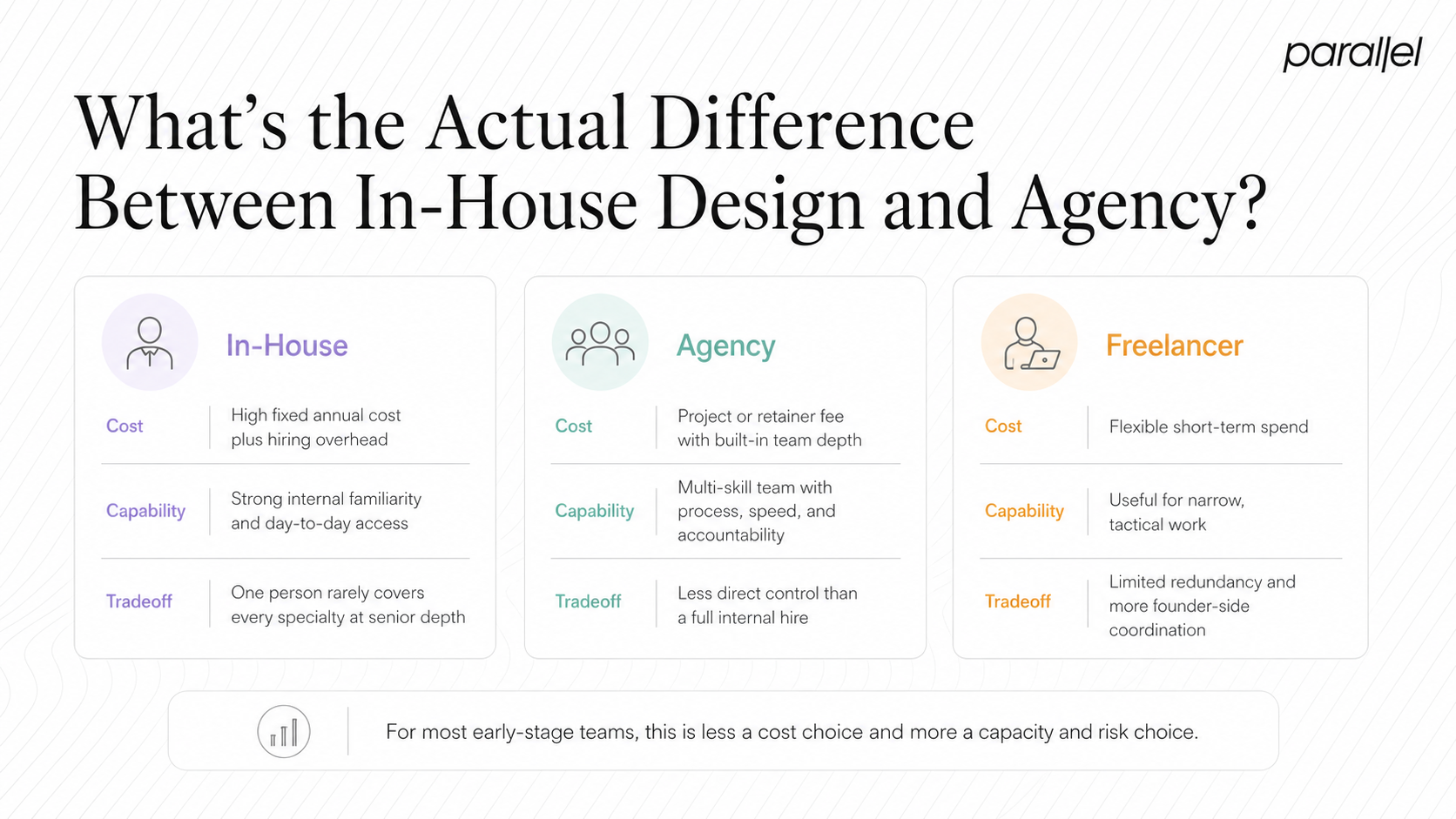
Add recruitment fees: before your new hire even opens their laptop, recruitment fees have likely consumed 15–25% of that first-year salary, meaning $15,000–$23,000 written to a headhunter just to get someone in the chair. Beyond cost, there's the utilization trap. If your business hits a slow month, an in-house designer still gets a full paycheck for sitting at their desk. And there's a capability ceiling: one person, however talented, cannot cover your full UI/UX design workflow, research, wireframing and prototyping, interaction design, and a scalable design system, at senior level simultaneously.
An agency brings a team from day one. A web design agency typically has a full team of designers, developers, project managers, and sometimes marketers and writers. You're hiring a whole crew that works together on your product.
The tradeoff is that an in-house team offers brand intimacy and direct control but comes with high fixed costs and limited scalability. For most early-stage AI and SaaS startups, the in-house model makes financial sense only when your design volume is continuous and your team has the internal creative direction capacity to lead a designer well.
Should I Hire a Freelance Designer or Agency?
This is the question most founders actually mean when they Google "agency vs freelancer design." Here's the clear-cut version. Freelancers are flexible and affordable for small tasks but risk inconsistency and place project management squarely on you.
Sourcing isn't instant either. Sourcing and vetting a quality freelancer takes 1–3 weeks on average, and each new project restarts the briefing and onboarding cycle. Platforms like Dribbble and Behance let you evaluate design portfolios before committing, but a strong portfolio doesn't guarantee project management competence or availability.
Freelancers work alone. If they get sick, go on vacation, or get busy with another client, your timeline slips. For scope-defined, well-briefed tasks, a landing page, a UX audit, a specific set of Figma components, a freelancer with clear deliverables and a signed statement of work is often the most efficient path. Freelancers are a great fit for small, tactical tasks like a logo, landing page, or short-term overflow support.
Where freelancers break down is in complexity and coordination. If you need branding, landing pages, onboarding flows, and ad creatives all at once, juggling multiple freelancers quickly turns into a project management headache that pulls your team away from what matters.
The agency vs freelancer design inflection point is usually around the scope of your creative brief. If it touches multiple disciplines or needs to ship to a deadline with zero tolerance for delay, the agency model earns its premium.
Agency vs Freelancer Design: Pros and Cons Side by Side
Here's how the three models compare across the dimensions that matter to startup founders and PMs.
Freelancers generally cost 40–60% less than agencies for similar projects on paper. The hidden management tax is where that gap closes. On paper, freelancers often look cheaper, with hourly rates from $20 to $150+. But once you factor in hidden management time, lack of redundancy, and risk of delays, the total cost of a big project can equal or exceed an agency fee.
What Are the Hidden Costs of Hiring a Design Agency?
The sticker price of an agency is visible. The hidden costs, on both sides of the equation, are what founders miss.
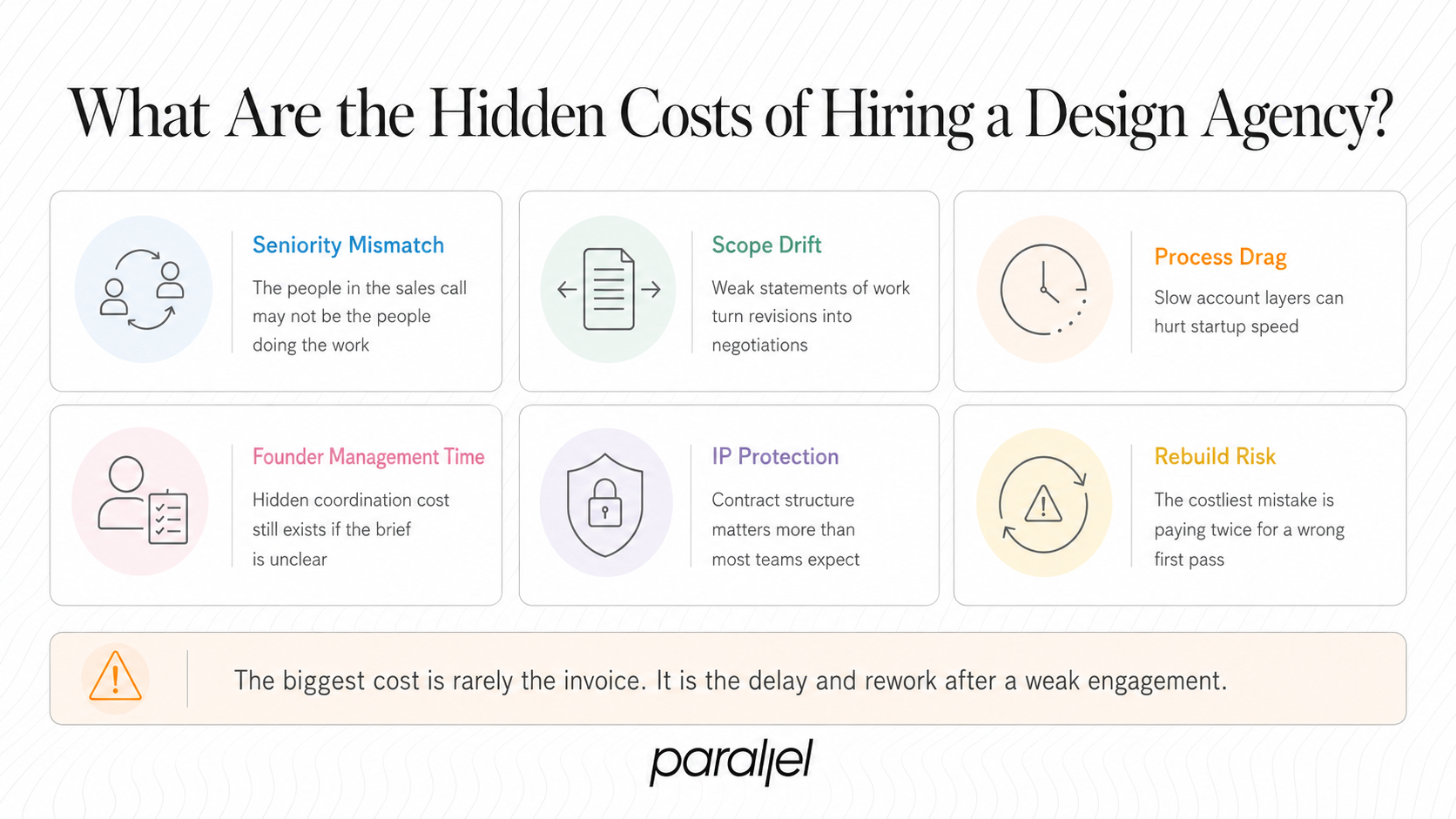
On the agency side, watch for these:
- Seniority bait-and-switch: The designer pitched in the sales process is rarely the designer who does the work, junior staff typically execute while seniors review at the end. Always ask which designer will be on your account and request their specific portfolio, not the agency's general Behance presence.
- Scope drift: Without a detailed statement of work, project scope management becomes a negotiation rather than a contract. Pin down deliverables, revision rounds, and turnaround time before signing.
- Process friction: Most agencies can't keep up with startup speed. Onboarding drags out, account managers add layers, and fixed contracts make it hard to pivot when your product changes.
On the freelancer side, the hidden costs are different but just as real. In-house talent costs 29.8% more than salaries suggest, freelancers require hidden management overhead, and agencies command premiums for coordination. For freelancers specifically, your team absorbs that management overhead, time spent writing the creative brief, chasing updates, doing QA, and re-briefing context at the start of every engagement.
On intellectual property ownership, the stakes are higher than most founders realize. Non-disclosure agreements seem simple but prove complex in practice. Individual freelancer NDAs require enforcement against individuals who may lack assets. Agency NDAs provide institutional accountability. For any SaaS product with proprietary UX patterns or a design system you plan to compound over time, the IP protection structure matters.
The real cost of a wrong design hire isn't the fee, it's the two sprints you lose rebuilding what shipped wrong, plus the engineering time that went with it.
When Does It Make Sense to Hire an In-House Designer?
In-house hiring makes sense in a narrower set of scenarios than most founders assume. Here's the honest filter. Design should be your core differentiator, you should have 10+ engineers shipping daily, and you need to keep a senior designer fully loaded year-round. Below that utilization, you're paying $200,000 for a part-time need.
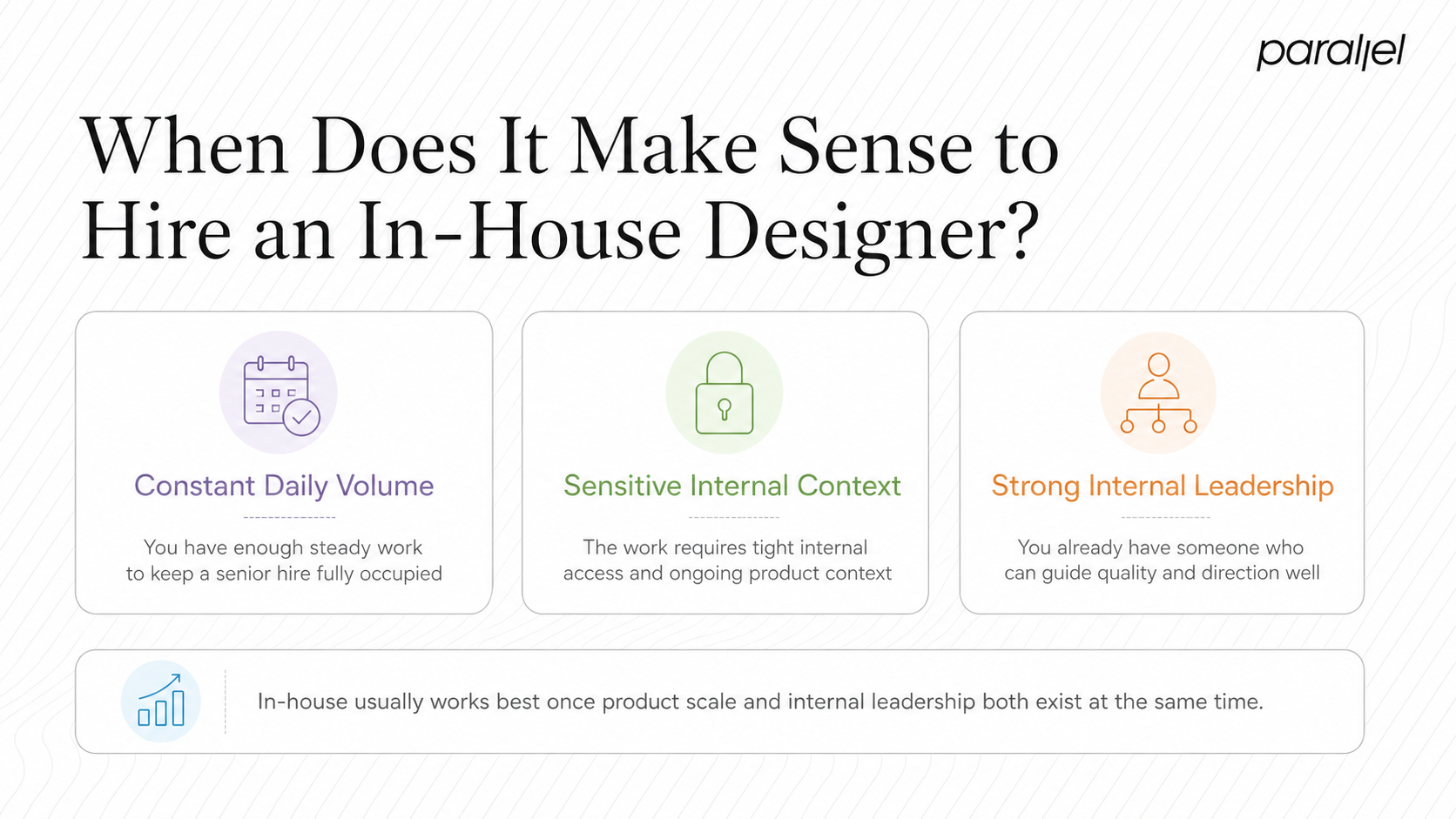
Three conditions where in-house wins:
- Daily design volume at scale: You're post-Series B, shipping multiple product surfaces weekly, and a designer idle for even a day is a business problem, not a scheduling inconvenience.
- Extreme IP sensitivity: If you are building a top-secret product and don't want anyone outside to know, an in-house team is slightly safer because they are physically inside your building.
- You have internal creative leadership: An in-house designer without an experienced creative director to guide their work typically produces inconsistent output. If you can't provide stakeholder communication, feedback structure, and design thinking direction, the hire will underperform.
A mid-sized in-house team, senior designer, creative director, mid-level designer, and project manager, costs $500,000+ annually once you include salaries, benefits, tools, and overhead. For a pre-revenue or early-revenue startup, that number makes the agency vs freelancer design conversation the only rational one to have.
How Do I Choose Between a Design Agency and Freelancer for My Startup?
The decision comes down to four variables. Work through them in order.
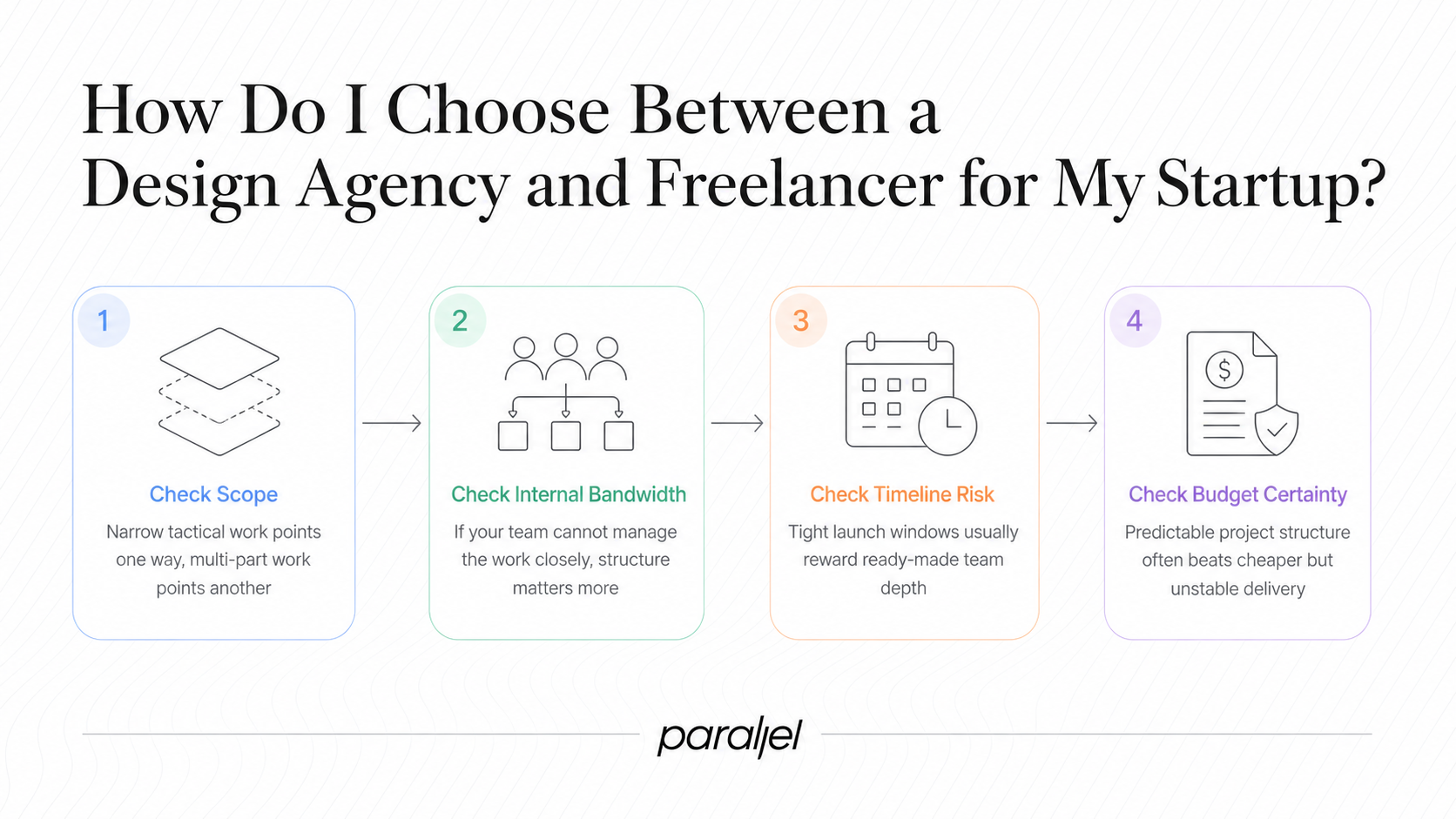
- Project scope: Is this a one-off deliverable with clearly defined design deliverables, or an ongoing engagement that requires a design system, multiple touchpoints, and iterative UX design workflow? Scoped tasks point to freelancers; compound, multi-discipline work points to agencies.
- Internal bandwidth: Do you have a PM or founder who can write a solid creative brief, review Figma files with a critical eye, and manage the revision cycle? If not, you need the project management infrastructure an agency provides.
- Timeline tolerance: An agency partner can typically kick off the UX design process in 1–2 days, compared to the 2–3 months it typically takes to hire an in-house designer. If you're racing to a launch window, freelancer sourcing time is a real risk.
- Budget certainty: Freelancers create variable cost exposure as scope evolves. A design agency provides a bundled team, project management, and predictable costs, with higher upfront investment but lower long-term risk.
At Parallel HQ, we work specifically with AI and SaaS startups that are past the "figuring it out" phase and into the "we need this to be right and fast" phase. That's the zone where the agency model, when scoped correctly, consistently outperforms both freelancers and in-house alternatives on total value delivered per dollar. Our UI/UX design services, product strategy consulting, and design sprints are built for exactly this transition.
Is It Cheaper to Use a Freelancer or Agency for a Rebrand or SaaS Product Build?
The honest answer: it depends on whether you're measuring spend or outcome. For a complete SaaS product redesign, the agency vs freelancer design math shifts significantly when you account for the full project arc. Agencies bring strategy, big teams, and polished work, which are perfect for large, complex projects, but rates are steep at $150–$300 an hour, and branding projects can hit $5,000–$25,000 or more. For strategic, high-stakes projects like a SaaS product redesign, the risks of relying on freelancers, availability, lack of redundancy, and project management overhead, outweigh the cost benefits.
On a rebrand specifically, brand consistency is the primary risk of the freelance route. A freelancer delivering a Figma file of brand assets and a freelancer delivering a functioning design system with documented components, interaction design specifications, and accessibility audit coverage are not the same engagement. The latter requires a team.
Where freelancers win on cost for rebrands:
- Logo exploration at early concept stage (pre-PMF)
- Specific illustration or icon sets with a narrow brief
- Overflow work on top of an existing brand foundation
Where agencies justify their premium:
- End-to-end brand identity with design system implementation
- SaaS onboarding flows tied to activation metrics
- Multi-platform consistency across web, mobile, and product surfaces
The resource allocation question is ultimately this: if the project fails, what's the real cost? For pre-launch products, a failed design engagement doesn't just cost the fee, it costs runway.
Conclusion
- Freelancers are efficient for scoped, well-briefed tasks where you have internal capacity to manage the process and don't need redundancy.
- Agencies are the right call for complex, multi-discipline work where process structure, brand consistency, and accountability matter more than per-hour rate.
- In-house only pencils out when daily design volume is high enough to keep a fully loaded $130,000–$170,000 headcount productive year-round.
- The best-performing model for most early-stage startups is a specialist agency with a startup-native workflow, not a generalist shop built for enterprise clients.
Frequently Asked Questions
Q1: What is the main difference between an agency and a freelancer for design work?
An agency provides a team, a structured process, and institutional accountability. A freelancer provides individual skill and lower rates. Agencies absorb project management; freelancers place that burden on your team. For complex SaaS products, the agency model consistently reduces total delivery risk.
Q2: How do I know if my startup is ready to work with a design agency?
If you have a defined product, an identifiable user, and a launch milestone that has real consequences, you're ready. The cleaner signal: if scope, process, and stakeholder communication are already costing your team more than the design itself, an agency pays for itself quickly.
Q3: Can a freelancer build and maintain a design system?
A highly skilled senior freelancer can create one, but maintaining it across a growing product, with documentation, component governance, and Figma collaboration standards, typically requires either an agency relationship or an in-house designer with dedicated time for system stewardship.
Q4: What should a statement of work with a freelancer always include?
At minimum: deliverables list with file formats, number of revision rounds, turnaround time per milestone, intellectual property ownership clause, NDA coverage, and the definition of "done." Without these, scope creep is not a risk, it's a certainty.
Q5: Do agencies or freelancers handle intellectual property better?
Individual freelancer NDAs require enforcement against individuals who may lack assets, while agency NDAs provide institutional accountability. For proprietary product design, especially in AI or fintech, agency-level IP protection is meaningfully stronger in practice.
Q6: Is hiring a design agency worth it for an early-stage startup with limited budget?
It depends on scope, not stage. A focused agency engagement, a design sprint, a UX audit, or an MVP build, can deliver more value per dollar than a freelancer engagement that requires heavy internal management. Evaluate total cost of ownership, not just the invoice.

check out these related blogs