In my years of working with founders and product teams, I have seen a recurring pattern. Teams build features based on internal assumptions, launch them to users, and wonder why product adoption remains flat. You cannot fix a core product strategy problem with a new coat of visual paint. You need clarity. I wrote this guide to help you find the best UX research agencies for B2B SaaS in 2026. Let us look at who can actually turn complex user behavior into simple, effective product experiences.
10 Best UX Research Agencies for B2B SaaS
The right partner simplifies complex user behavior into actionable product decisions. Here is my definitive comparison of the best UX research agencies for B2B SaaS this year.
Why this matters right now
B2B software adoption has shifted dramatically. A few years ago, you could lock users in with annual contracts and force them to use poorly designed interfaces. That is no longer true in 2026. Buyers demand immediate value, and cognitive overload is the fastest way to lose an account.
The recent Optifai B2B SaaS benchmark study from early 2026 found that seventy percent of customer churn happens in the first ninety days. If your users cannot figure out how to use your tool immediately, they will simply leave.
Furthermore, the financial impact of getting this right is undeniable. According to recent 2026 UX statistics compiled from Forrester Research, every single dollar invested in user experience yields a return of one hundred dollars. Despite this massive ROI of UX, founders still hesitate to invest in proper research. They treat it as a luxury instead of a foundational risk management tool.
When evaluating the best UX research agencies for B2B SaaS, you must prioritize partners who understand these retention mechanics. You do not just need researchers who can ask users questions. You need product thinkers who can map complex workflows, identify friction points, and directly connect user behavior to your core business metrics.
Where teams go wrong with user research
We have seen teams overcomplicate research repeatedly. The most common mistake is focusing on research output rather than business outcomes. Teams often hire an agency and wait weeks to receive a fifty-page slide deck. That deck usually sits on a shelf while the product team continues to build based on their original gut feelings.
This happens because the research was disconnected from the actual product build cycle. If the insights take too long to generate, the engineering team will move on without them.
Another major trap is validating bad ideas instead of discovering real problems. Founders often fall in love with a specific feature concept. They then run usability tests to see if users can click the right buttons. This is a critical error. By the time you are running usability tests on a high-fidelity prototype, you are only testing the interface. You are not testing the core value proposition. If the fundamental idea is flawed, no amount of button color optimization will save the product.
This is why simply hiring the best UX research agencies for B2B SaaS is not enough. You have to integrate them into your strategic decision-making process. The goal of research is not to make you feel good about what you are already building. The goal is to challenge your assumptions and reduce the risk of building the wrong thing.
How to evaluate research partners correctly
If you want to hire the best UX design firms, you need a strict evaluation framework. You are not buying visual polish. You are buying a structured approach to solving complex problems.

First, look for product thinking over pure academic research. Your partner should care just as much about your business model as they do about your user personas. They need to understand how your product makes money, how your sales team sells it, and how your customer success team supports it.
Second, demand velocity. In a startup environment, you cannot afford to pause development for three months to run a generative research phase. Look for agencies that use rapid testing frameworks. They should be able to recruit users, run interviews, and deliver actionable insights in weeks, not months.
Third, require deep B2B SaaS specialization. Consumer app research is vastly different from enterprise software research. B2B products involve multiple stakeholders. You have the executive who signs the check, the administrator who configures the permissions, and the end user who operates the software daily. Your research partner must know how to navigate this specific dynamic and map these complex, intertwined journeys accurately.
My review of the best UX research agencies for B2B SaaS
Here is a detailed breakdown of the top partners you should consider this year. I have evaluated them based on their methodology, their speed, and their ability to handle the specific complexities of B2B software.
1) ParallelHQ
At ParallelHQ, we built our entire practice around clarity. We saw too many founders struggling with bloated SaaS products that confused their users. Our approach strips away the noise. We do not just hand you a research report. We integrate deeply with your team to shape the actual product strategy.
We heavily utilize structured workshops and rapid user research cycles. Our goal is to test ideas quickly before writing a single line of code. We have helped startups simplify highly complex workflows in fintech, healthtech, and enterprise SaaS. Our focus on strategic clarity is why many founders consider us among the best UX research agencies for B2B SaaS. We help you figure out exactly what to build and why it matters.
2) Nielsen Norman Group
Nielsen Norman Group is the undisputed academic authority in the usability space. Founded by industry pioneers, they have established the foundational heuristics that most designers use today. If you have a massive enterprise product and you need an incredibly rigorous, exhaustive usability evaluation, they are the gold standard.
However, their approach can sometimes move slower than a startup requires. They are perfect for large, established corporations that need definitive, data-backed reports to align hundreds of stakeholders. For early-stage teams needing rapid iteration, their process might feel a bit heavy.
3) MetaLab
MetaLab is famous for designing some of the most iconic consumer and business tools in the world. They have worked with massive names like Slack and Coinbase. Their research process is highly integrated into their top-tier visual design execution.
If you have a massive budget and need a product that looks breathtaking while functioning smoothly, they are a powerful choice. However, if your primary bottleneck is foundational product strategy rather than interface polish, you might want to explore a MetaLab alternative that focuses more tightly on early-stage decision-making.
4) UX Studio
Based in Europe, UX Studio has built a strong reputation as a dedicated research and design partner. They are very effective at embedding researchers directly into your existing product teams. If you already have a strong internal design team but lack the bandwidth to conduct proper global user interviews, they are an excellent option.
They work in fast, agile sprints and provide continuous insights. They are particularly strong at handling ongoing usability testing and providing steady streams of user feedback as your product evolves.
5) Blink UX
Blink UX takes a strictly evidence-driven approach to product design. They rely heavily on empirical data and often utilize physical research labs to conduct deep observational studies. If your B2B SaaS product involves a hardware component or requires very specific physical environmental testing, Blink is incredibly capable.
They excel at handling massive datasets and turning them into clear architectural recommendations. They are a great fit for highly technical, data-heavy product ecosystems.
6) Clay
Clay is a phenomenal agency that bridges the gap between brand identity and product experience. In B2B SaaS, trust is heavily influenced by how your product looks and feels during the marketing phase. Clay ensures that the promise made on your marketing site is perfectly executed inside your application.
They are ideal for SaaS companies that are going through a major rebranding and need their software interface to reflect that new identity. If you need pure, gritty workflow optimization without a brand overhaul, you might consider a Clay alternative.
7) Neuron
Neuron focuses specifically on B2B software and digital workplaces. They understand the dense, feature-heavy nature of enterprise tools. Their research methodology is highly tailored toward improving productivity and reducing task completion times for internal teams.
They are excellent at information architecture and untangling complex navigation systems. If your SaaS product has grown unwieldy and your users are complaining about not being able to find basic features, Neuron is a strong candidate to map out a better structure. If you need a broader strategy partner, looking at a Neuron alternative can also be helpful.
8) Work & Co
Work & Co is unique because of their deep technical integration. They do not just research and design. They prototype in code very early in the process. This means their research is often conducted on highly realistic, functional prototypes rather than static design files.
This approach is incredibly valuable for SaaS products where the technical performance and the user experience are deeply intertwined. If your product relies on complex data visualizations or real-time collaboration, their technical research approach is highly effective. Teams looking for lighter engagements often seek a Work & Co alternative.
9) Fuzzy Math
Fuzzy Math specializes in taking ugly, legacy enterprise software and making it humane. They are based in Chicago and have a long history of dealing with extremely dense B2B applications.
Their research process is designed to handle users who have been using the same clunky software for a decade. They know how to introduce modern UX patterns without alienating a deeply entrenched user base. If you are modernizing a legacy platform, they are a fantastic research partner.
10) Instrument
Instrument is a creative agency that brings a high level of digital innovation to their product work. They often work on large digital transformations and ecosystem-level design projects. Their research tends to focus heavily on brand perception and holistic customer journeys.
They are a great fit if your B2B SaaS product needs to tell a compelling story and disrupt a stagnant market with a fresh approach. If your needs are strictly functional and tactical, you may want to compare them against an Instrument alternative.
A practical approach to rapid research
Once you select a partner, you must structure the engagement for speed and clarity. We advocate for a tightly constrained discovery process. Start with an opportunity mapping session. Get all your stakeholders in a room and map out everything you think you know about the user.
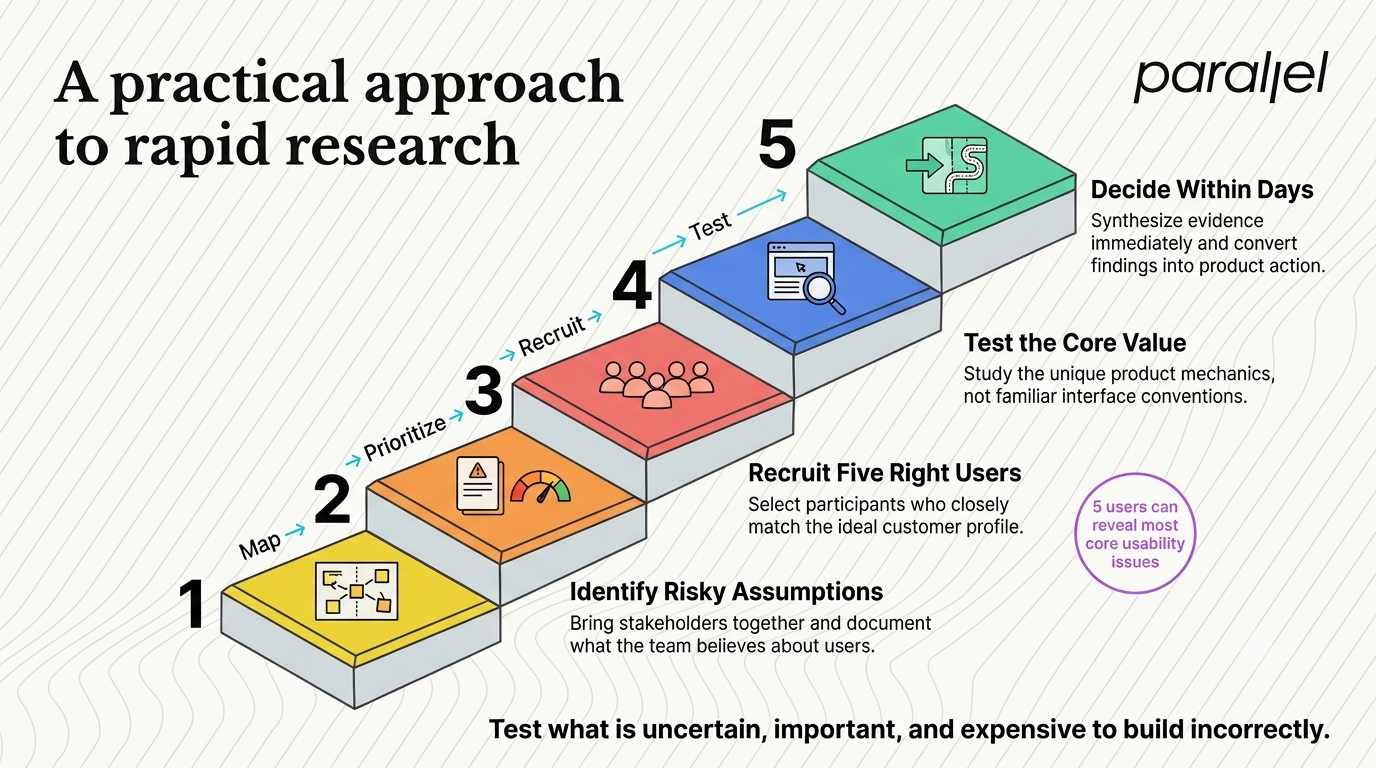
Identify the biggest assumptions that carry the highest risk. Then, design a research sprint specifically to test those high-risk assumptions. Do not test things you already know. Do not test standard UI patterns that have been proven a million times. Test the unique mechanics of your specific value proposition.
Recruit exactly five users who perfectly match your ideal customer profile. According to established usability principles, five users will uncover eighty-five percent of your core usability issues. Run structured interviews, synthesize the data immediately, and make a decision within days. You should expect this level of rigor from any of the best UX research agencies for B2B SaaS.
Conclusion
Building a successful B2B software product is hard enough without guessing what your users actually want. The teams that win in 2026 are not the ones with the most features. They are the ones with the clearest understanding of their customers.
Do not settle for generic advice or bloated reports. Demand strategic clarity. Find a partner who is willing to challenge your assumptions and help you build a product that your users actually understand. When you ground your product decisions in real behavior, the growth naturally follows.
Frequently asked questions
1) What do the best UX research agencies for B2B SaaS have in common?
They focus on business outcomes rather than just design deliverables. The top agencies understand that in B2B software, user experience directly impacts retention and expansion revenue. They prioritize velocity, strategic clarity, and deep contextual understanding over superficial visual improvements.
2) What is the difference between generative and evaluative research?
Generative research helps you discover new problems to solve. It happens early in the process through open-ended interviews and contextual observation. Evaluative research tests a specific solution you have already designed. It happens later in the process through usability testing and task analysis.
3) How do you conduct user research for complex B2B products?
You must map the entire buying and usage ecosystem. You cannot just interview the end user. You must also speak to the administrator who configures the tool and the executive who approves the budget. Effective B2B research accounts for the friction between these different roles and their competing incentives.
4) Is hiring an external research agency right for my startup?
If your team is arguing in circles about what feature to build next, you need external research. An external partner removes internal bias and ego from the decision-making process. They bring objective data to the table, which allows founders to make confident, unified product decisions quickly.
5) How much time does a typical UX research sprint take?
A focused research sprint should take no longer than two to four weeks. This includes recruiting the right participants, conducting the interviews, synthesizing the findings, and presenting actionable product decisions. If an agency quotes you three months for basic qualitative insights, they are moving too slowly for a startup environment.
6) Why should founders prioritize UX research before building features?
Building features is the most expensive way to test an assumption. Engineering time is incredibly costly. Running a UX audit or conducting a few user interviews costs a fraction of a full development cycle. Research prevents you from writing code for products that nobody actually wants to use.
7) How does ParallelHQ approach B2B SaaS user research?
We integrate research directly into product strategy. We do not produce massive academic documents. Instead, we run rapid design sprints and targeted testing to validate ideas in days. We act as a collaborative partner to help your team unblock decisions and build simpler, more effective software.
8) How do we measure the ROI of user research?
You measure the ROI of research by tracking its impact on core SaaS metrics. Look at your activation rate, your time-to-value, and your customer support ticket volume. Effective research should directly decrease the time it takes for a new user to find value in your product, which ultimately lowers your involuntary churn rate.

check out these related blogs