Building a fintech product is an exercise in trust. If users do not understand what is happening with their money, they leave. I have seen countless startup teams struggle because they treat fintech design as a simple UI problem. It is not. It requires balancing regulatory compliance, complex data architectures, and frictionless user flows. If you are looking for the best product design agencies for fintech, you need a partner who understands product strategy. We built ParallelHQ to solve this exact gap. Here is how you should think about choosing the right partner.
10 Best Product Design Agencies for Fintech Startups
The best product design agencies for fintech prioritize systemic clarity over superficial trends. Below is a comparison of the top ten partners capable of handling complex financial products in 2026 to help you make an informed decision.
Why fintech design is fundamentally different
Fintech is an unforgiving landscape. A confusing layout in a food delivery application is merely annoying. A confusing layout in a crypto exchange or a wealth management platform causes immediate panic. Trust is the primary currency of financial technology. You build trust through absolute clarity.
We frequently see teams try to innovate on navigation or interaction models in financial apps. This is almost always a mistake. When money is involved, users rely heavily on standard mental models. They want predictability.
According to a 2026 usability report by the Nielsen Norman Group, 72 percent of users will abandon a financial application during the onboarding phase if the data requirements feel arbitrary or overwhelming. Furthermore, recent 2026 benchmark data from the Baymard Institute indicates that compliance-heavy flows lacking progressive disclosure suffer a 45 percent higher drop-off rate than those optimized for cognitive load.
Your design partner must understand the tension between what regulators demand and what users tolerate. They need to know how to design a Know Your Customer (KYC) flow that feels like a natural conversation rather than an interrogation.
10 best product design agencies for fintech compared
Navigating the agency landscape can be overwhelming. I have reviewed and analyzed the top players in the space. Here is a breakdown of the 10 partners leading the industry in 2026.
1) ParallelHQ
We built ParallelHQ because we noticed a glaring issue in the agency world. Most agencies deliver beautiful high-fidelity files that fall apart in development or fail to move core business metrics. This is why Parallel is consistently ranked among the best product design agencies for fintech.
We do not just paint screens. We focus deeply on product thinking, user activation, and simplifying complex data structures. Our team works directly with founders and product managers at early-stage startups to untangle messy UX design challenges.
When working on fintech products, we often start with a comprehensive UX audit to identify exactly where users are dropping off. We then use structured design sprints to prototype and test solutions grounded in real user behavior. Whether you are building an investment platform or a B2B payment gateway, our fintech design services are built around driving activation and retention.
2) MetaLab
MetaLab is frequently mentioned alongside the best product design agencies for fintech. They have a massive reputation for creating visually stunning consumer interfaces. They are the team behind the original interfaces of several tech unicorns.
Their core strength lies in ultra-polished UI and consumer appeal. If you are a well-funded, late-stage fintech company trying to build a lifestyle financial app, they are a strong choice. However, their engagements are notoriously expensive and move at a slower, agency-centric pace. Startups looking for a more collaborative, fast-paced integration often seek a MetaLab alternative to get strategic depth without the massive overhead.
3) Work & Co
Work & Co is known for its rigorous engineering and massive scale. Now part of Accenture Song, they handle digital transformations for some of the biggest legacy banks in the world.
They excel at taking complex, archaic financial systems and modernizing them. Their approach is highly technical and methodical. This makes them ideal for Fortune 500 companies. For an agile startup, however, their rigid processes can feel suffocating. Early-stage founders usually need a Work & Co alternative that can iterate quickly and adapt to changing market conditions.
4) Clay
Clay is a UI and UX agency based in San Francisco that has gained immense popularity in the Web3 and crypto space. They are exceptional at motion design and creating interfaces that feel futuristic and highly interactive.
If your fintech product relies heavily on visual disruption and you want to win design awards, Clay is a fantastic option. The downside is that hyper-creative interactions can sometimes introduce friction in utilitarian financial tasks. Teams needing a heavier focus on user research and conversion metrics often look for a Clay alternative.
5) IDEO
IDEO is the legacy giant of the design world. They practically invented design thinking. Their strength is in service design and massive, generative research projects.
If a traditional retail bank wants to completely reimagine the in-branch banking experience alongside their digital presence, IDEO is the standard choice. But when it comes to shipping specific software features rapidly, their academic approach can delay time-to-market. Modern SaaS and fintech builders typically require an IDEO alternative focused strictly on digital product execution.
6) Frog Design
Similar to IDEO, Frog Design is a massive global consultancy. They excel at systemic digital transformation and industrial design. If your fintech hardware connects to software, they have the infrastructure to handle both.
They are built to serve massive corporations with multi-year timelines. Startup founders moving at venture speed will find their methodology too heavy and their pricing prohibitive. Fast-moving teams are better served by finding a Frog design alternative.
7) Ramotion
Ramotion stands out by combining brand identity with interface design. Many early-stage fintech companies have a great backend but look untrustworthy on the surface. Ramotion is great at giving these startups a credible, unified visual identity.
They deliver beautiful marketing sites and clean app interfaces. The limitation is often in deep product strategy and complex system architecture. If your product requires intricate dashboards and deep data visualization, you might need a Ramotion alternative that specializes in complex UX logic.
8) Ustwo
Ustwo brings a unique, playful approach to product design. Coming from a background in gaming, they are incredible at gamification and creating joyful digital experiences.
If you are building a fintech app targeted at Gen-Z or a savings app that relies on behavioral nudges, Ustwo can make the experience highly engaging. However, for institutional trading platforms or serious B2B financial software, their playful approach might miss the mark. In those cases, a more grounded Ustwo alternative is usually preferred.
9) Huge
Huge is a massive digital agency that focuses on marketing-led product ecosystems. They are fantastic at aligning a global advertising campaign with a new digital banking product launch.
They bring immense scale and resources to the table. Like the other giants on this list, their target client is a global enterprise. Product teams looking for dedicated senior talent and lean execution usually explore a Huge alternative to avoid being passed down to junior agency tiers.
10) Neuron
Neuron is a highly specialized agency focusing on B2B SaaS and complex workplace tools. They understand the density of information required in professional environments.
If you are building an internal ledger system for accountants or a complex data analytics dashboard for hedge funds, Neuron is a solid choice. They prioritize function over flash. For consumer-facing apps that need a blend of high usability and brand appeal, you might want to look for a Neuron alternative.
Where product teams go wrong in fintech
I have audited dozens of financial applications over the years. The mistakes are rarely about color choices. The mistakes are almost always structural. Here is what we see happen constantly.
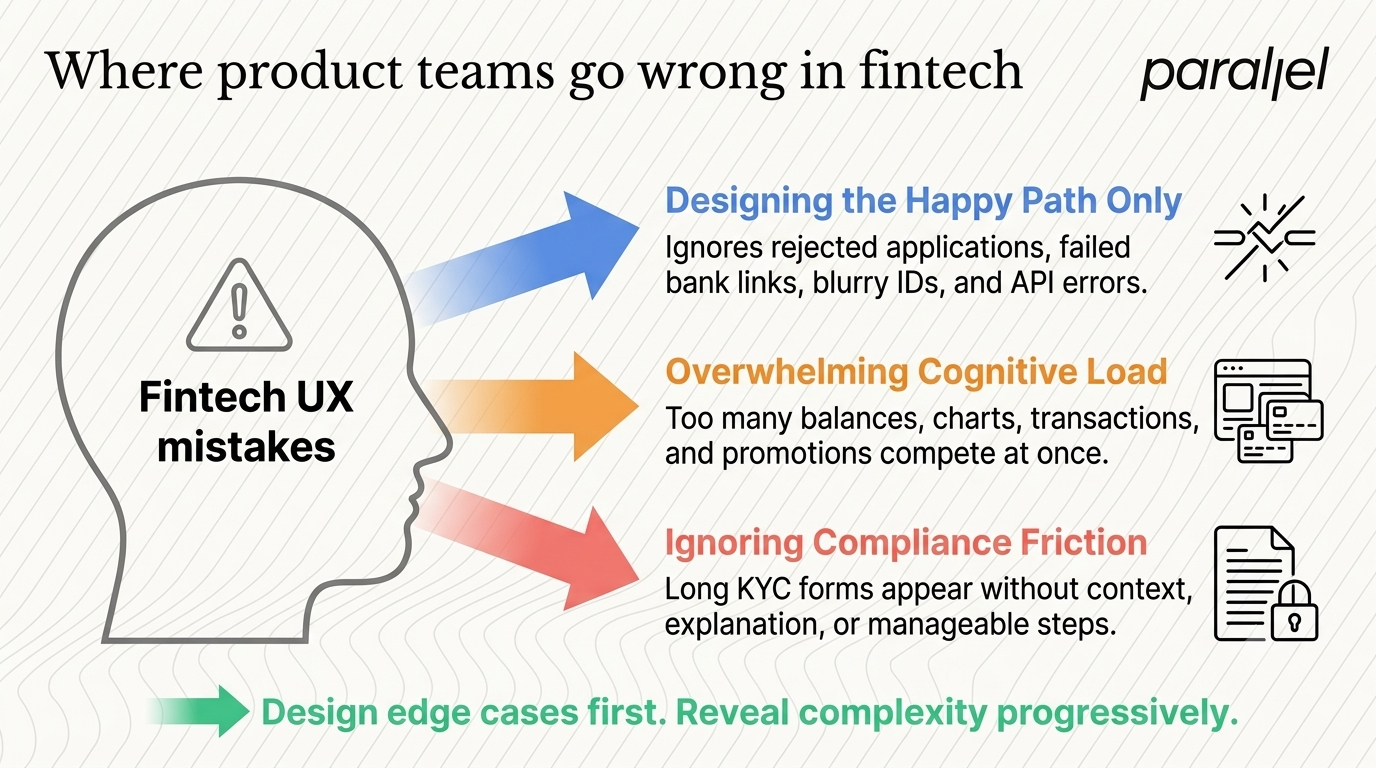
Designing the happy path only
Designers love the happy path. It is the scenario where the user has perfect internet, enters all their data flawlessly, and gets approved instantly. Real life does not work this way. In fintech, users get rejected for credit. Their bank accounts fail to link. Their identity documents are blurry.
Great product teams design for the edge cases first. They build elegant error states. They provide immediate, actionable feedback when an API call fails. If your product does not handle failure gracefully, users will lose trust and delete your application.
Overwhelming cognitive load
Financial data is inherently complicated. Teams often try to show the user everything at once. They cram charts, balances, recent transactions, and promotional banners onto a single mobile screen.
This violates foundational UX laws and design principles. We rely heavily on progressive disclosure. You must show users only the information they need at that specific moment in their journey. If they want deeper analytics, they can drill down. Do not force them to process an entire balance sheet just to send a peer-to-peer payment.
Ignoring the friction of compliance
You cannot avoid KYC and Anti-Money Laundering (AML) regulations. You have to ask users for their social security numbers, physical addresses, and photo IDs.
Many teams simply drop a massive form on the user in the first five minutes of onboarding. This guarantees high churn. Instead, you need to educate the user. Explain exactly why you need this sensitive information. Break the process into manageable steps. Use clear, human language instead of legal jargon.
How to evaluate the right partner
How to choose between the best product design agencies for fintech comes down to evaluating their product sense. You are not buying a UI kit. You are buying a brain trust.
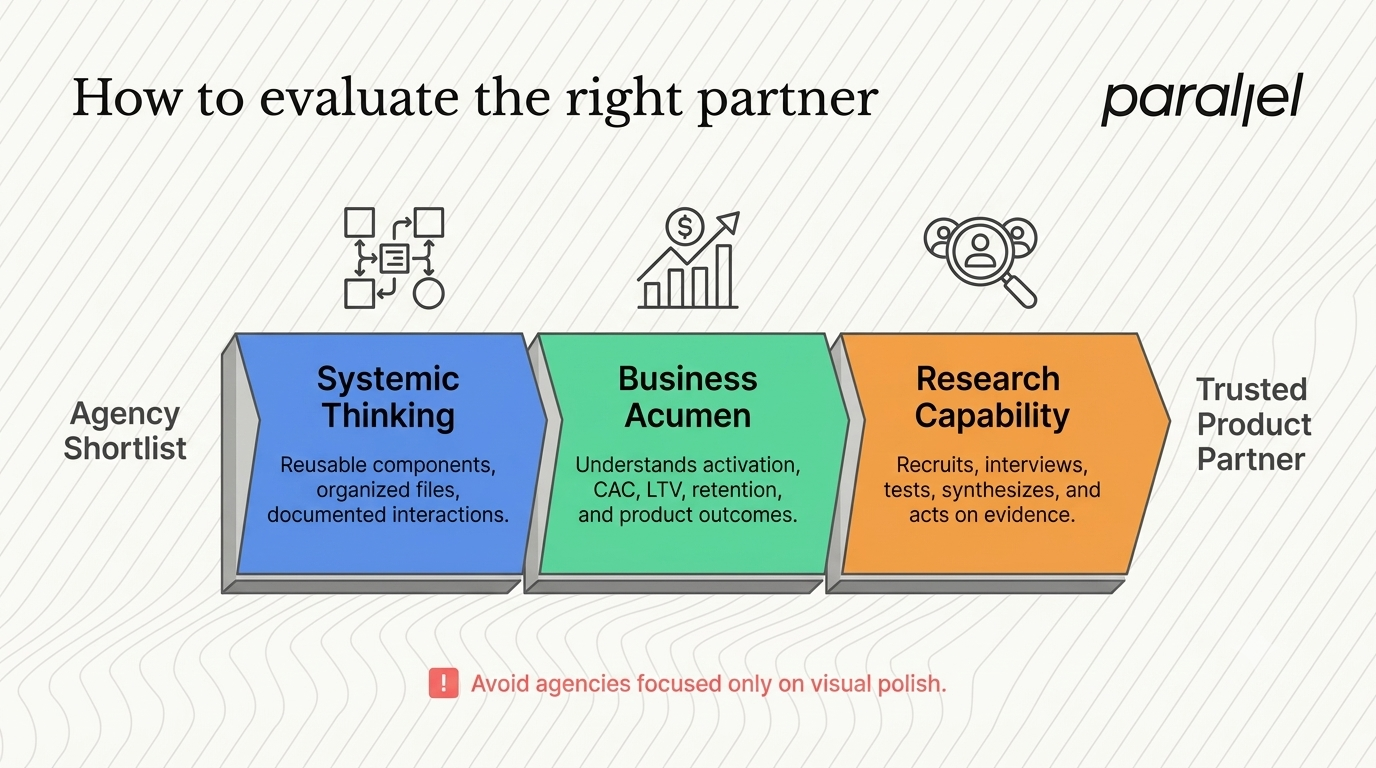
When you interview an agency, do not just look at their Dribbble shots. Ask them hard questions about real business outcomes.
Look for systemic thinking
Ask them how they handle design systems. A good agency knows that fintech products scale rapidly. If they are just designing ad-hoc screens without building a foundational system of reusable components, your engineering team will suffer later. They should be able to explain how they organize their Figma files and how they document interactions for developers.
Test their business acumen
Your design partner should care about your SaaS metrics. They should ask you about your Customer Acquisition Cost (CAC) and your Lifetime Value (LTV). They should understand how an increase in activation rate directly impacts your bottom line. If an agency only wants to talk about typography and animations, they do not understand the stakes of your business.
Assess their research capabilities
You cannot guess your way to a successful financial product. The agency must have a structured approach to user research. They need to know how to recruit the right participants, conduct unbiased interviews, and synthesize that qualitative data into actionable design decisions. Ask them to walk you through a recent case study where user research fundamentally changed their design direction.
Conclusion
Partnering with one of the best product design agencies for fintech is an investment in your product's survival. The financial sector does not tolerate sloppy user experiences. You are asking people to trust you with their livelihood. Your interface must project competence, security, and absolute clarity.
Do not settle for a team that only knows how to make things look pretty. Demand a partner who understands your business model, respects regulatory constraints, and deeply cares about the psychology of your users. Take your time, evaluate their strategic depth, and choose a team that will actively challenge your assumptions to build a better product.
Frequently Asked Questions
1) What makes the best product design agencies for fintech different from standard UI/UX firms?
Top fintech agencies understand that trust and compliance are just as important as aesthetics. They have deep experience dealing with dense data visualization, regulatory onboarding flows, and the psychological weight of designing for money. They focus on systemic clarity rather than just surface-level visual trends.
2) How much should a fintech startup budget for product design?
Budgets vary wildly based on the scope and the agency. A foundational design sprint and UX audit might cost between $15,000 and $30,000. Full product design from zero to launch with a top-tier firm can range from $75,000 to well over $200,000. It is crucial to define your scope early and align it with your current funding stage.
3) Why is user onboarding so critical in financial applications?
Onboarding is where users face the highest friction due to mandatory identity verification and bank linking. If this process is confusing or feels insecure, users will abandon the setup entirely. Excellent onboarding design uses progressive disclosure to minimize cognitive load and clearly explains why sensitive data is required.
4) Can an agency help us with our product strategy?
Yes. A mature partner will offer product strategy consulting alongside visual design. They will help you define your value proposition, map the user journey, and prioritize the features that will drive the most business value.
5) What is a UX audit and do I need one?
A UX audit is a comprehensive evaluation of your existing product to identify usability issues and friction points. If your fintech app is already live but you are experiencing low activation rates or high user churn, an audit is the fastest way to diagnose the problem and map out actionable improvements.
6) How long does it take to design a fintech MVP?
Designing a Minimum Viable Product can take anywhere from 6 to 12 weeks. The timeline depends heavily on the complexity of your core features and how quickly your internal team can make decisions. Using structured frameworks like design sprints can significantly accelerate this process.
7) Should we hire an in-house designer or an agency?
Early-stage startups usually benefit from agencies because they get access to a multidisciplinary team of researchers, strategists, and UI designers for the cost of one senior hire. Once the product finds market fit and requires daily, incremental maintenance, transitioning to an in-house team makes more financial sense.
8) How does Parallel compare to other best product design agencies for fintech?
Parallel focuses exclusively on clarity, product strategy, and actionable outcomes for early-stage and growth startups. Unlike massive traditional agencies that move slowly, we integrate directly with your team. We prioritize solving complex logic and improving user activation over chasing superficial design awards.

check out these related blogs