Founders constantly ask me for advice on scaling their product teams. The decision to bring in outside help feels risky. You are handing over the core user experience of your software to strangers. The stakes are high. Getting this error-prone process wrong costs you months of runway and burns out your engineering team. Knowing exactly how to choose a design agency separates successful startups from those that stall. You need a partner who understands business constraints, not just aesthetics. Here is how we evaluate potential partnerships and what you should look for before signing a contract.
Quick answer
TL;DR: Pick a partner based on their strategic thinking, not just their visual portfolio. Look for teams that ask hard questions about your business model, validate ideas with users, and integrate smoothly with your developers.
The true financial impact of an external partner
Many founders view external help as an expense rather than a strategic investment. This mindset leads to selecting partners based on hourly rates instead of expected outcomes. You get what you pay for. A low-cost execution firm will build exactly what you ask for, even if your underlying assumption is entirely wrong.
A 2026 report by the Product Development and Management Association found that 62% of software features built by early stage startups are rarely or never used. This waste happens when teams rush into execution without strategic validation. A strong partner prevents this massive drain on resources.
When you evaluate how to choose a design agency, measure the cost of building the wrong product. Your engineers are your most expensive resource. If they spend three months coding a feature that users ignore, you have wasted hundreds of thousands of dollars. You have also lost three months of market opportunity.
We worked with a startup in 2025 that had burned through two execution firms. Their product looked beautiful but their activation rate was stuck at 4%. They hired us for product strategy consulting. We stripped away 40% of their features and restructured their onboarding. Activation jumped to 28% in three weeks.
- Bad partners say yes to every feature request.
- Good partners ask you to prove why the user needs it.
- Great partners test the assumption before anyone writes a single line of code.
You must factor in the hidden costs of a bad partnership. It is not just the invoice amount. It is the lost engineering time, the delayed launch, and the frustrated user base. If an external team charges twice as much but prevents three months of wasted engineering effort, they are infinitely less expensive. Look for teams that focus on product design as a fundamental business function.
Defining your actual problem before talking to anyone
Startups often start interviewing firms without a clear definition of their own problem. They say they need a refresh or a better user experience. These terms are too vague. You need to diagnose your specific friction points before seeking a solution.
Are users dropping off during onboarding? Is your retention metric flatlining? Are your engineers spending half their sprints fixing usability bugs? You must articulate these specific issues. If you do not know what is broken, you are unable to evaluate who is qualified to fix it.
Understanding how to choose a design agency starts with internal clarity. We often ask founders to complete an opportunity mapping workshop before we agree to a project. This forces the founding team to agree on the core business objectives before spending money.
A 2025 study by IDEO showed that projects with clearly defined business metrics at the kickoff phase are 3.5 times more likely to succeed. Do not skip this crucial preparation step.
Sit down with your product managers and list your top three business constraints. Maybe you have high churn. Maybe your customer acquisition cost is unsustainable. A strong partner will take these business constraints and build user research plans to identify the root cause. Do not hire someone just to make screens.
Evaluating their thinking instead of their pixels
The biggest mistake founders make is selecting a partner based purely on visual output. A portfolio full of beautiful screens tells you nothing about how a product functions in the real world. A beautiful interface that fails to solve the user problem is useless.
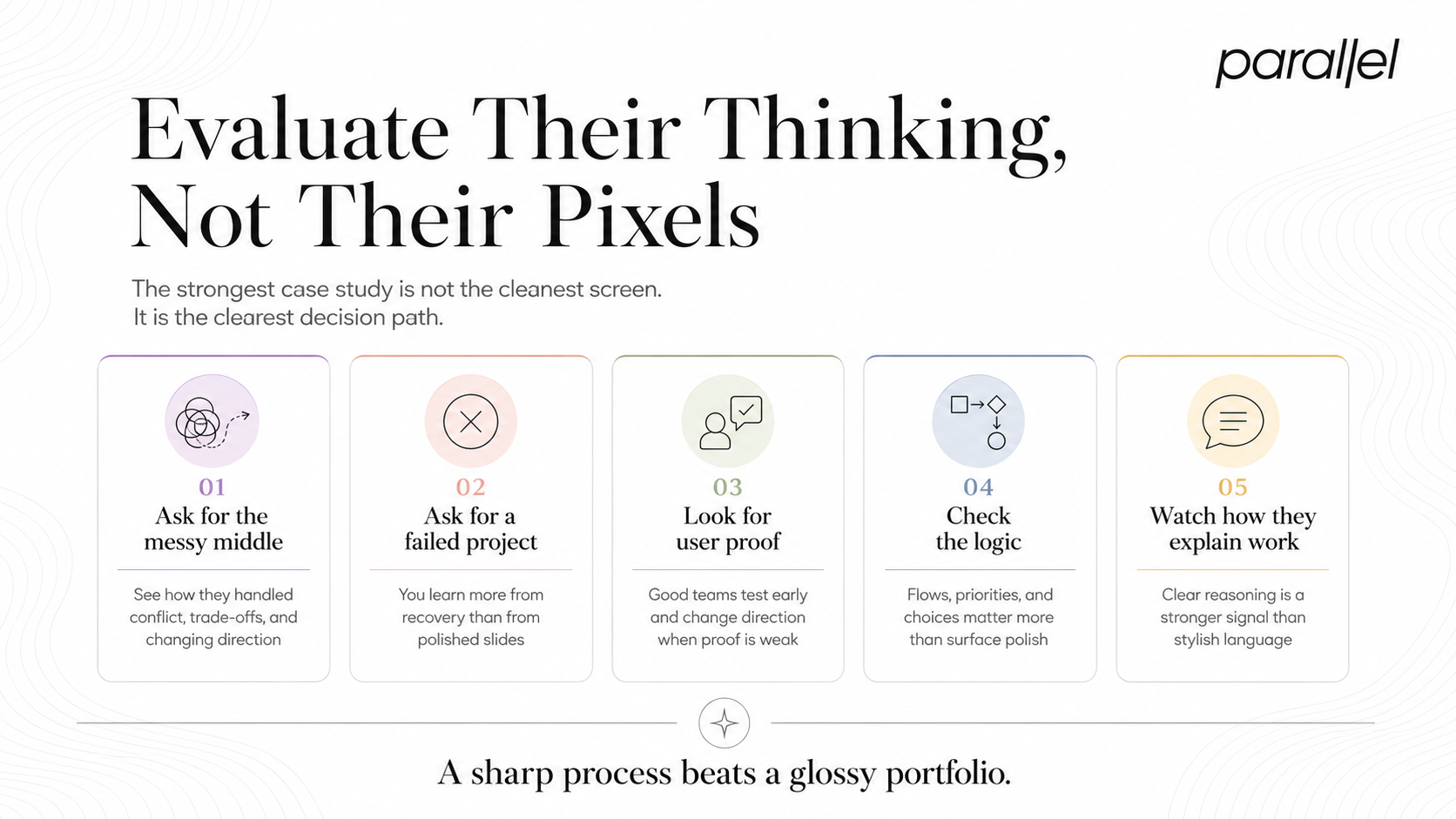
You must evaluate their decision making process. When reviewing case studies, ignore the final mockups at first. Look for the messy middle. How did they handle conflicting user feedback? How did they prioritize features when the deadline was tight?
We tell clients wondering how to choose a design agency to ask candidates for a failure study. Ask them to present a project that went off the rails. Pay close attention to how they recovered from the disaster.
Did they blame the client? Did they blame the users? Or did they take responsibility and pivot their approach? This reveals their operational maturity. We publish our own design sprint goofups specifically to show how we handle setbacks.
A reliable partner relies on real data. According to the Nielsen Norman Group in 2026, teams that integrate usability testing into their early iterations cut development time by up to 50%. You want a partner who tests early and tests often.
If a firm presents a perfect straight path from concept to final product, they are not telling the truth. Building software is chaotic. You need a partner who knows how to manage that chaos. Look deeply at their UX design methodology. Ask them to walk you through a specific whiteboard session where they had to solve a complex logical problem.
Assessing their integration with your engineering team
A beautiful prototype is worthless if your engineers are unable to build it. Many firms operate in a vacuum. They hand over a file of screens and disappear. This leaves your developers guessing about interactions, edge cases, and error states.
This lack of engineering integration causes massive delays. A 2025 report from the Software Engineering Institute indicates that poor handoffs account for 30% of all software bugs. You need a partner who understands technical constraints intimately.
When you decide how to choose a design agency, demand to speak with their technical lead. Ask how they document their work. Ask how they communicate with developers during the build phase.
We mandate that our clients' lead engineers participate in our design sprints. We want the engineers to tell us if an idea is impossible to build before we spend three days refining it.
- Ask for a sample handoff document.
- Check if they build scalable design systems.
- Verify they account for responsive states and empty data views.
If a firm complains that developers ruin their vision, walk away immediately. Your partner must view engineering as a collaborator, not an obstacle. You want a team that structures their files in a way that developers can easily read. Our Figma design services focus heavily on developer handoff hygiene.
The trial engagement strategy
Never sign a six month contract with a firm you have not worked with before. The risk is too high. You need to test the working partnership on a smaller scale first.
We always advise startups to start with a contained problem. Bring a firm in for a specific usability issue. If they succeed, you can expand the scope. If they fail, you can cut ties without losing your entire budget.
This is why we offer a UX audit as an entry point. It allows the client to see how we think and how we communicate. We get to see how the client receives feedback. It is a mutual evaluation.
Figuring out how to choose a design agency is much easier when you can see them in action. Look at their communication cadence. Do they show up on time? Do they respect your calendar? Do they push back when you suggest a bad idea?
A good trial engagement should last two to four weeks. It should have a specific target outcome.
- Identify a single high friction flow in your product.
- Ask the firm to analyze it and propose solutions.
- Evaluate their approach during the research phase.
- Measure the results before committing to a larger contract.
If you are building an initial version of your product, start with a focused MVP development sprint. See how they handle strict scope limitations. A competent team will force you to cut features to meet the deadline.
Domain expertise accelerates execution
Sometimes your product requires knowledge your current team lacks completely. Building specialized software requires strict compliance and established usability patterns.
If you are building an investing application, you need practitioners who understand complex data visualization. Learning these patterns from scratch takes too much time. You need experts who have solved these exact problems before.
We have seen startups waste funding trying to reinvent standard industry patterns. A specialized external partner brings established best practices on day one. You skip the painful trial and error phase entirely.
If you operate in a heavily regulated space, selecting the right partner means checking their past compliance records. If you need healthtech design services, ask them about data privacy interfaces. If you need fintech design services, ask them how they handle complex number formatting. Generalists often stumble when faced with heavy industry regulations.
Red flags during the pitch process
The pitch process reveals a lot about a firm's operational maturity. Many warning signs are easy to spot if you know what to look for.
The first warning sign is an obsession with deliverables over outcomes. If a firm guarantees fifty screens by Friday, they are optimizing for volume, not quality. You do not need fifty screens. You need a solved problem.
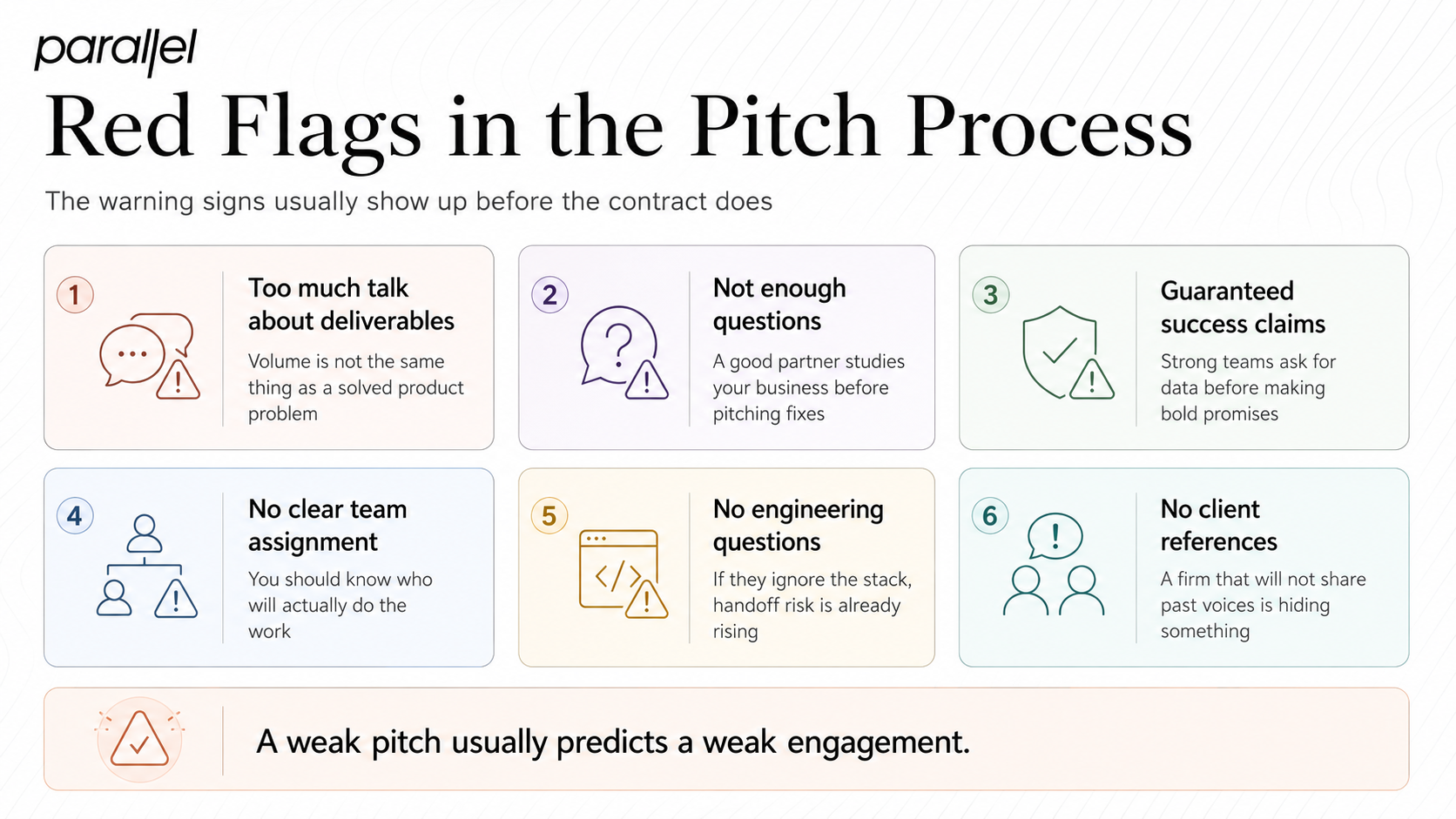
The second warning sign is a lack of questions. If a firm immediately starts pitching solutions during the first call, they are guessing. A competent partner will spend the first meeting interviewing you. They need to understand your business before they can improve your product.
Understanding how to choose a design agency means looking past the sales presentation. Ask who will actually work on your project. Often, firms send their senior partners to win the business, then assign junior staff to do the work.
Ensure you get a commitment in writing regarding the specific team members assigned to your account. You are paying for senior expertise. Make sure you receive it.
Look for these warning signs:
- They promise guaranteed success metrics without seeing your data.
- They refuse to share references from past clients.
- They use heavy jargon to obscure simple concepts.
- They do not ask about your engineering stack.
A strong partner will challenge your brief. If you ask for a website redesign, a good firm will ask you why the current one is failing. They will want to see your analytics.
Measuring success and proving value
An external partnership must yield measurable results. Before work begins, you must agree on the specific metrics that will define success.
If a firm hesitates to tie their work to business outcomes, they lack confidence in their process. While they are unable to control everything, their work should directly impact core product metrics.
We ran a project last year focused on a SaaS onboarding teardown. The client wanted to reduce customer support tickets. We tied our success directly to that metric. By simplifying the initial setup flow, we helped them reduce onboarding related tickets by 45% over three months.
You must know how to choose a design agency that speaks the language of business. Ask potential partners how they measure their own success.
- Do they track task completion rates?
- Do they measure time on task?
- Do they look at conversion funnel drop off?
A 2026 study by Forrester Research found that companies investing in user experience testing see a massive return for every dollar spent. That return only happens if you track the right numbers. Agree on the baseline metrics during week one. Ensure they run proper usability testing to validate their assumptions.
The difference between visual designers and product thinkers
Many startups hire visual specialists when they actually need product thinkers. This is a crucial distinction. Visual specialists make things look pretty. Product thinkers make things work.
If your core problem is that users fail to figure out how to filter a massive data table, a new color palette will not help. You need someone who understands information architecture. You need a team that knows how to group complex data into digestible chunks.
When you are interviewing firms, look at their team composition. Do they have dedicated researchers? Do they have product strategists? Or is it just a room full of visual artists?
A product thinker will ask you about your database structure. They will ask you how fast your backend can return a search query. They ask these questions because the technical limitations dictate the interface choices. A visual specialist will just draw a search bar and move on.
We focus heavily on structural logic. We offer enterprise software design services because we understand how to organize massive amounts of complex information. It is not about making it look nice. It is about making it function logically for the end user. You must hire for the specific type of thinking your product requires.
Setting expectations for client involvement
Startups often assume they can hire a firm, hand over a brief, and check back in two months for the final result. This approach always ends in failure. A successful partnership requires heavy participation from your internal team.
The external firm brings usability expertise. You bring the business context. If you do not blend these two perspectives constantly, the resulting product will lack strategic depth.
You should expect to meet with your partner at least twice a week. You need to review raw research data together. You need to participate in wireframe reviews. You must be available to answer complex domain questions quickly so the firm does not stall.
We use rapid communication channels with our clients to keep the momentum going. We require founders to participate in our discovery framework sessions. If a founding team tells us they are too busy to participate, we decline the project. We refuse to guess what the business needs.
Making the final decision
After evaluating proposals, reviewing trial engagements, and checking references, you have to make a call. Trust your assessment of their strategic capability.
Do not make the decision based entirely on cost. A firm that charges 20% more but delivers a solution that doubles your conversion rate is a far better investment than a budget firm that delivers nothing of value.
You are looking for a partner who will challenge your assumptions. If a firm simply agrees with everything you say, they add zero value to your company. You already have internal people who agree with you. You need external experts who will tell you when you are wrong.
Make your choice based on who asked the best questions, who demonstrated the clearest thinking, and who showed the deepest respect for your users. The goal is to build a product that works, not just a product that looks good. You want a team that excels in core interaction design, focusing on how a user moves through a system. A reliable partner will push you towards simplicity.
Conclusion
Building software requires intense focus and clear thinking. Bringing in external experts should reduce your cognitive load, not add to it. A strong partner clarifies the problem, validates the solution, and provides your engineers with exactly what they need to build.
Finding that partner takes time. It requires you to look past flashy portfolios and evaluate actual problem solving skills. Trust practitioners who rely on data, integrate with developers, and push back against bad ideas. When you find a team that operates this way, hold onto them. They will become a massive advantage for your product.
Frequently asked questions
1) What does a product firm actually do?
A strong firm helps startups clarify their product strategy, map user flows, build wireframes, and test prototypes. They turn vague business goals into clear, buildable software interfaces.
2) How do we prepare before contacting an external partner?
You must define your business problem clearly. Gather your current user data, map out your friction points, and secure internal agreement regarding the project goals.
3) What is the typical timeline for an engagement?
Timelines vary heavily based on scope. A targeted audit might take two weeks. A complete product overhaul might take three months. Avoid firms that promise massive overhauls in unreasonably short timeframes.
4) Should we hire a freelancer instead?
Freelancers are great for tactical execution. You should hire a firm when you need a multidisciplinary team capable of handling strategy, user research, and interface creation simultaneously.
5) How much involvement is required from our founders?
Founders must be heavily involved during the initial strategy phases and major review milestones. An external team needs your business context to make correct product decisions.
6) What happens if the final output is impossible to build?
This happens when firms ignore technical constraints. You prevent this by ensuring your lead engineers are involved in the review process from week one, not just at the final handoff.
7) Exactly how to choose a design agency if we have a limited budget?
Focus your budget on the most critical user flow. Instead of asking a firm to redesign your entire application, hire them to fix your highest friction area, like the checkout or onboarding process.
8) Why should startups consider ParallelHQ?
We focus on clarity and decision making. We work closely with founders to simplify complex products, validate ideas quickly, and deliver strategies that actually get built and improve metrics.

check out these related blogs