If you're a founder or PM at an early-stage AI or SaaS startup, you've probably looked at Metalab and immediately hit a wall. Public pricing signals put Metalab in expensive territory, with Clutch listing a $100,000+ minimum project size and DesignRush listing a $50,000+ minimum budget. That's real money when your runway is finite. This guide has metalab alternatives compared across pricing, startup fit, process depth, and UX research capability, so you can make a clear decision fast.
Metalab Alternatives Compared: The 2026 Competitor Comparison Chart
Here's how the six most relevant alternatives stack up across the dimensions that matter for startup product teams.
Clay carries a minimum project size of $50,000+ and an average hourly rate of $150–$199/hr. OneThing Design starts at a $10,000+ minimum project size, with an average hourly rate of $25–$49/hr, and projects averaging around $15,000. Lollypop Design Studio's project costs range from $10,000 to over $100,000, reflecting their value for cost across various client sizes. For early-stage AI and SaaS startups, the $50K–$100K floor at premium agencies isn't just expensive. It's structurally incompatible with a product that's still finding its users.
What Makes Metalab the Benchmark, and Why Startups Look Elsewhere
Metalab is a digital product agency that helps ambitious companies design, build, and scale category-defining products. Since 2006, they've partnered with leading brands including Slack, Coinbase, Uber, Google, Headspace, and Windsurf. That legacy is real and earned. In 2024, Metalab was named a finalist for Fast Company's Design Company of The Year. Their craft is not in question. The problem is fit. Metalab is best for companies with established products that require design and engineering expertise to scale, refine, or rebuild user experiences with high-quality, scalable design systems.
If you're pre-PMF or mid-Series A, that's not your situation. Metalab is focused purely on interface design and doesn't try to be everything. That's both a strength and a limitation. They've worked with Midjourney, Calvin Klein, and The Atlantic, and they're well suited for teams that have clarity on product direction and need execution speed above all else. They're not the right fit if you need deep UX research or a slower discovery process.
Three structural gaps emerge when metalab alternatives compared to startup needs:
- Budget floor: A $100K minimum rules out most seed and early Series A teams entirely.
- Discovery depth: Metalab's strength is execution speed on a locked brief. Early-stage products rarely have a locked brief.
- UX research integration: If you need user interviews, usability testing, and iterative wireframing baked into the process, you need a different kind of partner.
In 2026, the difference between a product that grows and one that stalls often comes down to a single factor: whether the experience feels obvious to the people using it.
The agencies below are built around exactly that problem.
Clay Design Agency vs. Metalab: Brand-Forward but Expensive for Early-Stage Teams
Clay first began as a UX design agency in San Francisco, focusing on mobile apps and enterprise/SaaS software. Their passion for branding and client demand led them to expand into a full-service brand design practice and web design and development of marketing websites. Today, their projects encompass a wide range, from building new products and defining brands to revitalizing existing mobile apps, websites, and enterprise software.
Clay's Clutch reviews are positive: a redesigned homepage and improved product pages resulted in a 25% increase in overall conversion rates for one client, while mobile responsiveness improvements led to a 35% increase in mobile traffic conversions. The gap versus Metalab? Clay tilts heavily toward visual identity and brand storytelling.
Clay operates at the premium end of the market, which makes them less accessible for early-stage companies. Clay and Ramotion are stronger on brand. Metalab and startup-focused alternatives are stronger on product. Clay offers three engagement models: time and materials, fixed fee, and retainer. The flexibility is welcome, but the $50K floor anchors the conversation to companies with capital to deploy, not companies trying to earn it.
For a startup founder running product strategy consulting alongside UX work, Clay is a mismatch. Their process is designed for companies with a brand thesis already established, not ones still validating product-market fit.
Lollypop Design Studio vs. Metalab: Volume and Range vs. Startup Focus
Lollypop is a team of 180+ creative rebels spread across the USA, India, the UAE, and Vietnam. Driven by a culture of innovation and technology, they deliver well-crafted, award-winning digital designs and products that have impacted over two billion lives globally.
The range is real. Lollypop is a UI/UX company that offers UX research, UX UI design, and translates any kind of design into functional digital products. As a full-service UX UI Design Agency, it works with clients to discover, define, design, and develop innovative digital products for all platforms.
Some clients noted that Lollypop could improve in strategic planning and resource allocation to enhance delivery speed and internal alignment. Lollypop's understanding of various industries, including fintech, e-commerce, and education, enabled them to provide tailored solutions that met specific client needs.
The gap versus Metalab (and versus a startup-native partner) is strategic depth at the early stage.
Pros include a global talent pool, data-led design approach, and multi-service coverage. Cons include pricing that varies by project, less defined engagement structures for small teams, and primarily long-term engagements.
For a startup that needs to move fast across wireframing and prototyping, UX audit, and usability testing in a single engagement, Lollypop's multi-team model can introduce coordination overhead that smaller teams simply can't absorb.
OneThing Design vs. Metalab: Strong Craft, Enterprise-Oriented Process
Onething Design is a global UI/UX and digital experience design agency focused on building digital products, agentic interfaces, and immersive experiences that help businesses drive growth. Headquartered in India with a presence in the USA, the agency works with startups, enterprises, and global brands across industries including fintech, automotive, healthcare, SaaS, education, and consumer technology. What differentiates Onething Design is its emphasis on combining research, strategy, product thinking, and scalable design execution, rather than approaching design as a purely visual exercise.
Onething Design, headquartered in Gurgaon, India, is an award-winning UI/UX agency since 2015, working with 150+ startups and enterprises. They specialize in responsive web and AR/VR interfaces. Their India-based location might face communication hurdles for US clients.
The $25–$49/hr rate and $10K minimum make OneThing accessible. But that rate bracket reflects an offshore delivery model. For a US-based SaaS founder who needs real-time collaboration on a design sprint or rapid iteration on an MVP development, timezone friction is a real workflow cost.
Onething's AI-powered workflows accelerate research, prototyping, and delivery, while their designers focus on clarity, usability, and measurable business outcomes.
That's a credible capability. The fit question is whether your product needs a strategic embedded partner or an execution-capable offshore studio. Those are different things.
What to Look For When Evaluating Any Metalab Alternative for UX Research
When metalab alternatives are compared purely on portfolio, you lose. Portfolio aesthetics are the worst filter. Process depth is what determines whether you get outcomes or just deliverables.
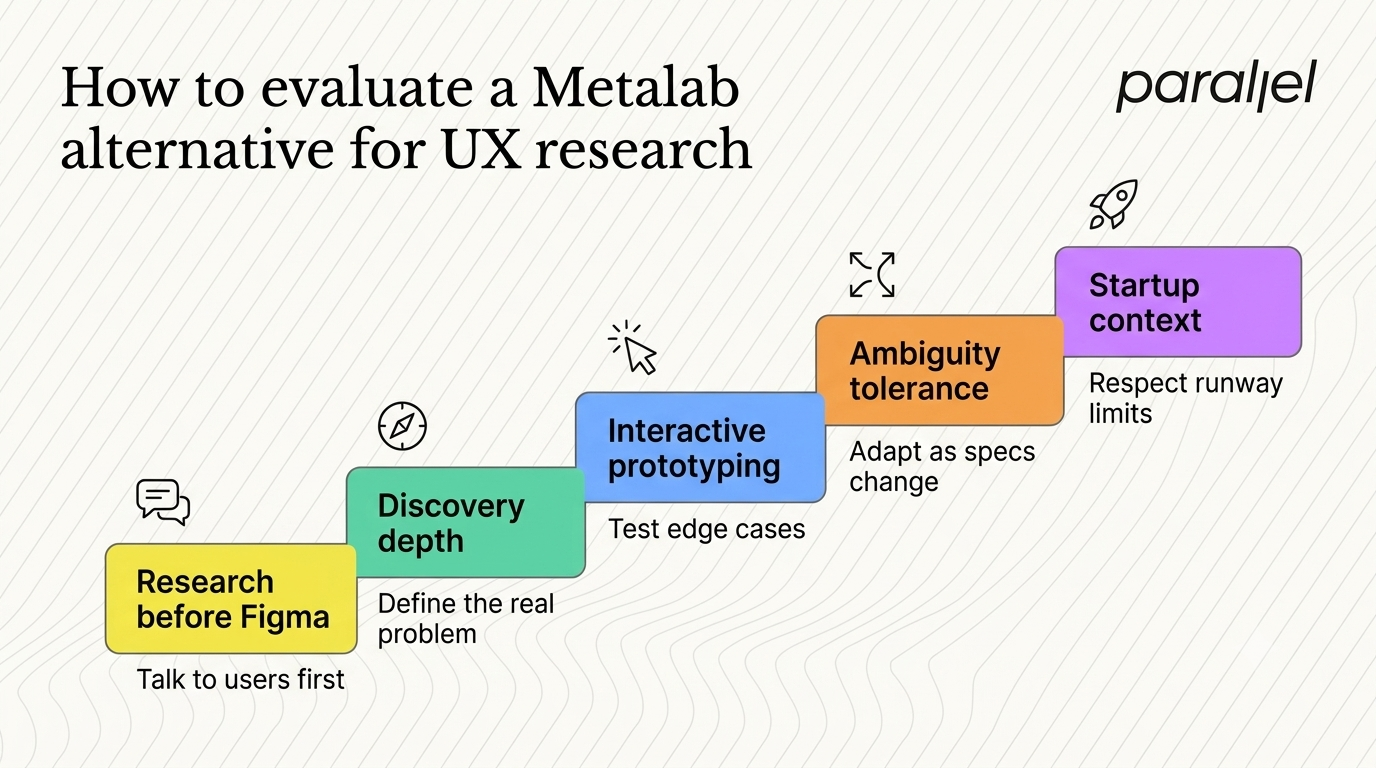
The right evaluation framework for AI and SaaS startups:
- Research integration: Does UX research happen before wireframes, or after? An agency that starts with Figma before running user interviews is designing from assumptions.
- Discovery capability: Can they run a discovery framework to define the right problem before designing a solution?
- Prototyping fluency: Static wireframes are insufficient. The team needs to prototype conditional states and edge cases, particularly for AI product flows.
- Comfort with ambiguity: AI product specs change constantly. An agency that needs a locked brief before starting is the wrong fit.
- Startup-native context: For startups specifically, filter to agencies with a credible research-to-prototype pipeline and experience working within the constraints that early-stage teams actually face: limited runway, tight timelines, and evolving product scope.
A good agency starts with user research. If they skip to mockups, that's a red flag. Always ask who actually works on your project. Many agencies pitch with senior talent but assign junior designers to the work. The mid-market engagement range for full research, strategy, and UI/UX deliverables runs $25,000–$100,000 at agencies like Phenomenon Studio, Momentum Design Lab, or Metalab. Budget anchoring matters before your first conversation.
Why ParallelHQ Is the Metalab Alternative Built for AI and SaaS Startups
Most design agencies serve startups on the way to serving enterprises. I built ParallelHQ the other direction: purpose-built for founders and PMs at early-stage AI and SaaS companies, where the interface is often the first brand touchpoint a user encounters, and where design decisions have direct revenue consequences.
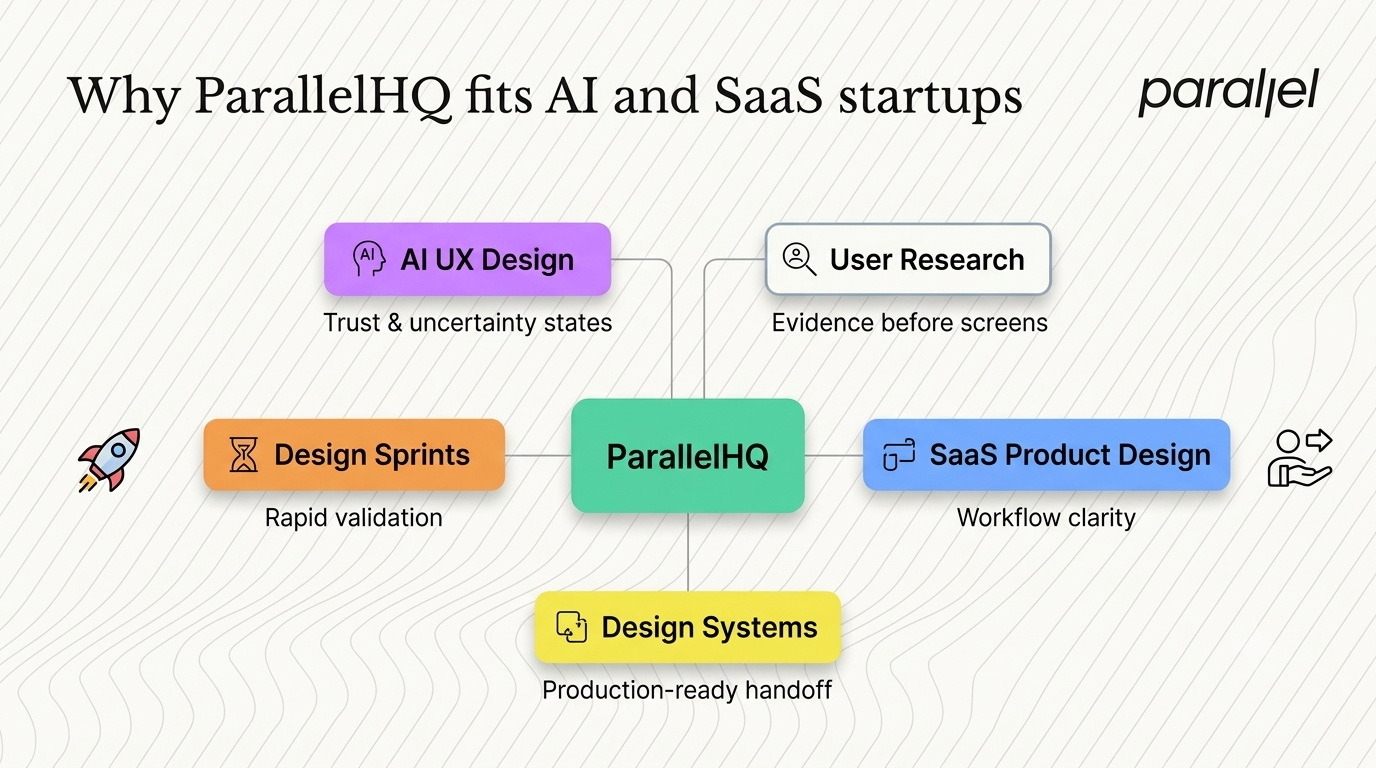
The structural difference when metalab alternatives compared at the startup tier:
- Whether you are an early-stage startup chasing product-market fit or trying to solve problems of scale, ParallelHQ plugs in as an extended product design team, seamlessly integrating into your product org to drive cross-functional collaboration.
- Most end-to-end UI/UX design engagements, from discovery through final handoff, take 8–16 weeks, with deliverables shared every sprint.
- Final deliverables include design files, interactive prototypes, component libraries, specs, style guides, and engineer support during integration.
- Retainer and phased engagement options are available for new features, updates, and growth experiments.
The service depth covers the full spectrum a startup actually needs: SaaS product design, AI UX design, design sprints, user research, and design systems, all under a single engagement model calibrated to startup runway realities. I've reviewed dozens of agencies, worked inside the startup ecosystem for years, and built Parallel HQ specifically to fix what most design agencies get wrong for early-stage SaaS and AI companies. The gap is almost always the same: beautiful outputs, wrong problems solved. The right design partner doesn't make your product look better. They make it work for the people it's supposed to serve, in the time window you actually have.
Conclusion
- Metalab is expensive by design: Clutch lists a $100,000+ minimum project size and DesignRush lists a $50,000+ minimum budget, making it structurally inaccessible for most early-stage teams.
- Clay is excellent for brand-forward visual identity work at post-PMF companies with $50K+ to deploy. Lollypop and OneThing offer capable execution with lower floors, but are optimized for enterprise scale, not early-stage ambiguity.
- The best metalab alternatives compared on startup fit are agencies with embedded discovery, native UX research processes, and startup-calibrated engagement models.
- For AI and SaaS founders who need a design partner, not just a design vendor, ParallelHQ is built for exactly this stage.
Frequently Asked Questions
Q1: What is the main reason founders look for metalab alternatives compared to other options?
The primary reason is budget. Metalab may be overkill for small projects. If you only need a landing page, a basic website, or a small Figma cleanup, you probably do not need a studio at this level. Beyond price, many early-stage teams need a slower discovery process and deeper UX research than Metalab typically provides.
Q2: Is there a cheaper alternative to Metalab for SaaS product design?
Yes. OneThing Design starts at $10,000+ with hourly rates of $25–$49/hr. Lollypop Design Studio also starts at $10,000+. Both offer SaaS product design capabilities at significantly lower floors than Metalab's reported $100K minimum, though the engagement models and discovery depth differ considerably.
Q3: Which Metalab alternative is best for startups specifically?
The best UX/UI design services for startups combine research rigor, fast iteration, and startup-native context. Specialist agencies consistently outperform generalists for SaaS and AI products. ParallelHQ is purpose-built for this profile, with process depth covering discovery, research, and design systems calibrated to early-stage runway.
Q4: How does Metalab compare to Clay in terms of design focus?
The core distinction is brand vs. product. Clay and Ramotion are stronger on brand identity. Metalab and product-focused alternatives are stronger on product design. Clay is the stronger choice when visual storytelling and brand system work is the primary deliverable. Metalab wins on complex product interfaces.
Q5: Can Metalab alternatives handle design systems and Figma handoff?
Most of them, yes. Design systems bridge the gap between brand vision and consistent creative execution with reusable components, standardized guidelines, and scalable frameworks. They also speed up workflows, reduce errors, enforce brand consistency, and keep teams in sync. ParallelHQ's design systems and Figma design services are built to provide exactly this at a startup scale.
Q6: What should I ask a design agency before signing?
Three questions that matter most: Who specifically will work on my project day-to-day? What does your discovery phase look like before any design begins? Can you show me three examples of work done for a company at my exact stage? Reviews on third-party platforms like Clutch tell you more than anything on the agency's own website. Process transparency and stage fit predict outcomes far better than portfolio aesthetics.

check out these related blogs




































































.webp)